
U.S. and Iran Open Historic Direct Talks in Switzerland Amid Ceasefire Tensions
U.S. Vice President JD Vance and Iranian officials launched a 60-day diplomatic sprint at the Lake Lucerne Summit to negotiate a permanent nuclear agreement and regional ceasefire. The high-stakes talks opened to immediate friction following threats of renewed military action from President Trump.
By Factlen Editorial Team
- U.S. Administration
- Seeks a diplomatic off-ramp to stabilize oil markets and permanently curb Iran's nuclear program, while maintaining the threat of military force.
- Iranian Leadership
- Demands an end to Israeli strikes in Lebanon and the unfreezing of assets, viewing the talks as a U.S. retreat while warning against American threats.
- Israeli Government
- Views the bilateral negotiations with deep skepticism, fearing the U.S. is prioritizing a swift diplomatic exit over dismantling Iran's proxy network.
- International Mediators
- Focus on preventing a full-scale regional war by facilitating technical agreements on maritime security and sanctions relief.
What's not represented
- · Lebanese civilians caught in the crossfire of the Hezbollah-Israel conflict
- · Global shipping companies navigating the Strait of Hormuz
Why this matters
The Lake Lucerne Summit represents the most significant diplomatic effort to stabilize the Middle East in years, opening a 60-day window to prevent a wider regional war. The outcome will directly dictate global oil prices, the security of international shipping lanes, and the trajectory of Iran's nuclear program.
Key points
- U.S. and Iranian delegations opened direct talks in Switzerland to negotiate a permanent nuclear agreement.
- The summit initiates a 60-day window established by a recent memorandum of understanding.
- President Trump threatened renewed military strikes against Iran if Hezbollah continues attacks in Lebanon.
- Iran's lead negotiator rebuked the U.S. threats, though the two sides still held an 80-minute session.
- Israel is not participating in the talks and views the bilateral negotiations with deep skepticism.
- The outcome will heavily impact global oil markets and the security of the Strait of Hormuz.
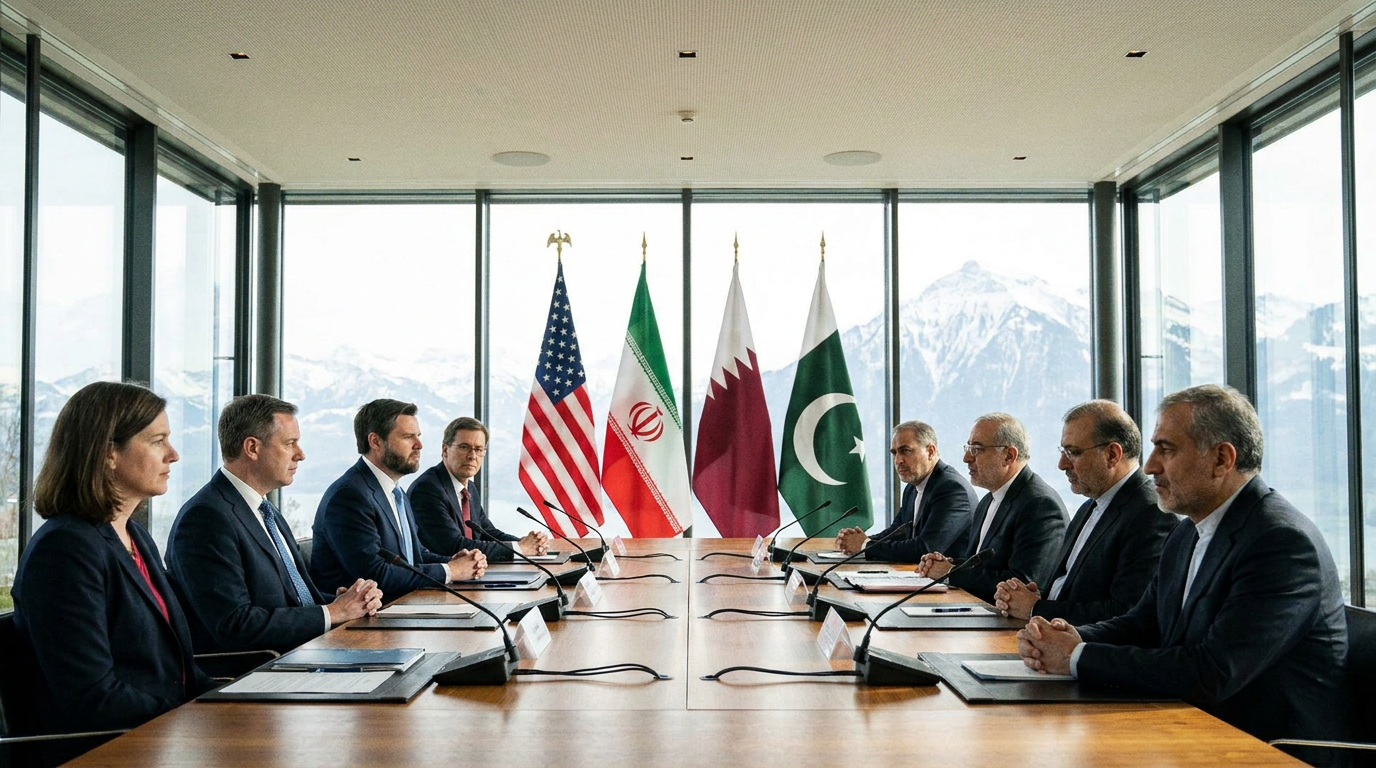
U.S. and Iranian delegations convened at the Bürgenstock resort in Switzerland on Sunday, launching a high-stakes 60-day diplomatic sprint aimed at securing a permanent nuclear agreement and ending the broader Middle East conflict. The gathering marks the most consequential effort to stabilize the region following weeks of intense warfare.[1][2]
The "Lake Lucerne Summit" represents the first direct negotiations between Washington and Tehran since the Islamabad summit in April. Vice President JD Vance, flanked by U.S. envoys Steve Witkoff and Jared Kushner, sat across from an Iranian delegation led by Parliament Speaker Mohammad Bagher Ghalibaf and Foreign Minister Abbas Araghchi.[1][6][8]
"The question before us now is how much more can we accomplish together? Can we turn over a new leaf?" Vance asked at the start of the historic session. The talks were formally mediated by Qatari Prime Minister Mohammed Abdulrahman Al Thani and Pakistani Prime Minister Shehbaz Sharif, whose nations brokered the preliminary ceasefire.[2][6]
However, the fragile diplomatic effort was immediately tested by threats from Washington. As the delegations gathered, President Donald Trump took to social media to demand that Iran stop its "highly paid proxies in Lebanon from causing trouble," warning that the U.S. would "hit Iran very hard again... only harder" if the violence continued.[2][4]

The remarks triggered a sharp rebuke from Tehran. Ghalibaf warned that the U.S. should "be careful with their statements," while Iranian state media reported that the talks had entered a "difficult phase" following the publication of the "insulting message." Despite the friction, the two sides managed to hold an initial 80-minute direct session.[2][4]
The negotiations stem from a recently signed memorandum of understanding that established a 60-day ceasefire window. The agenda is daunting: the U.S. seeks to permanently curb Iran's nuclear program and ensure the free flow of commercial shipping through the Strait of Hormuz, a vital waterway that handles a fifth of the world's traded oil.[1][7]
The negotiations stem from a recently signed memorandum of understanding that established a 60-day ceasefire window.
Iran's priorities are equally entrenched. Tehran is demanding the unfreezing of billions of dollars in assets, permanent sanctions waivers for oil exports, and an immediate halt to Israeli military operations against Hezbollah in Lebanon.[4][8]
The escalating violence in Lebanon has already cast a long shadow over the summit. The talks were originally scheduled to begin on Friday but were abruptly delayed after a heavy exchange of fire between Israel and Hezbollah left dozens dead, prompting Iranian officials to temporarily cancel their travel plans.[5][7]

While Washington and Tehran attempt to forge a new regional architecture, Israel has been notably excluded from the room. Israeli officials have expressed deep frustration over the U.S.-Iran memorandum, viewing the bilateral negotiations as a sign that Washington is eager to find a diplomatic off-ramp even if it leaves Iran's proxy network intact.[3]
U.S. intelligence agencies have reportedly warned the administration that Israeli Prime Minister Benjamin Netanyahu may continue military operations in Lebanon, a move that could easily derail the fragile Lucerne talks. In response, the Israeli government ordered its military to limit operations in Lebanon to defensive measures over the weekend.[2][3]
The economic stakes of the summit are immense. Following the recent escalation, Iran claimed to have closed the Strait of Hormuz, though U.S. Central Command disputed the assertion, stating that commercial vessels were still passing through. A sustained closure would send global energy markets into turmoil, a scenario the Trump administration is desperate to avoid.[2][7]

Over the next two months, technical working groups will attempt to hammer out the details of a comprehensive treaty. "This is just the beginning," a senior U.S. official noted. "Remember, we still have 58 days to go." Whether those days yield a historic peace or a return to full-scale war remains entirely uncertain.[7][8]
How we got here
April 2026
The U.S. and Iran hold initial direct talks at the Islamabad summit.
Mid-June 2026
Washington and Tehran sign a memorandum of understanding establishing a 60-day ceasefire.
June 19, 2026
Initial summit plans are delayed after a surge in violence between Israel and Hezbollah in Lebanon.
June 21, 2026
Delegations officially convene at the Lake Lucerne Summit in Switzerland.
Viewpoints in depth
The U.S. Strategy
Washington is balancing diplomatic engagement with the threat of overwhelming military force.
The Trump administration is pursuing a dual-track approach: offering Iran a path to sanctions relief and economic integration while maintaining maximum military pressure. Vice President JD Vance's presence in Switzerland signals the administration's serious commitment to a diplomatic off-ramp, driven in part by the need to stabilize global oil prices and avoid a protracted Middle Eastern war. However, President Trump's public threats serve as a reminder that the U.S. is prepared to return to military strikes if Tehran uses the 60-day window to stall or if its proxies continue to escalate.
Tehran's Calculus
Iran views the negotiations as a hard-won concession from the U.S. but remains deeply suspicious of American intentions.
Iranian leadership approaches the Lake Lucerne Summit from a position of perceived strength, believing that their military resilience and the threat of closing the Strait of Hormuz forced the U.S. to the negotiating table. Tehran's primary goals are securing permanent sanctions waivers to freely sell oil and unfreezing billions in assets. However, Iranian officials are adamant that any broader peace deal is contingent on the U.S. reining in Israeli military operations in Lebanon, viewing the protection of Hezbollah as a non-negotiable red line.
Israel's Frustration
Jerusalem feels sidelined by its closest ally and fears a premature diplomatic settlement.
The Israeli government has been relegated to the role of an 'armchair quarterback' as its primary adversary and its closest ally negotiate the region's future. Israeli officials are deeply concerned that the U.S. is prioritizing a swift end to the conflict over the complete dismantling of Iran's nuclear capabilities and proxy network. There is a palpable fear in Jerusalem that a U.S.-Iran deal will leave Israel to face a newly enriched and emboldened Tehran alone in the next phase of the conflict.
What we don't know
- Whether Israel will comply with the U.S. request to halt military operations in Lebanon during the 60-day window.
- If Iran will permanently commit to keeping the Strait of Hormuz open without imposing new transit fees.
- How the Trump administration plans to enforce the nuclear restrictions if a final agreement is reached.
Key terms
- Lake Lucerne Summit
- A high-level diplomatic gathering at the Bürgenstock resort in Switzerland aimed at negotiating a permanent U.S.-Iran peace agreement.
- Strait of Hormuz
- A narrow, strategically critical waterway between the Persian Gulf and the Gulf of Oman through which roughly 20% of the world's traded oil passes.
- Memorandum of Understanding (MoU)
- The preliminary agreement signed by the U.S. and Iran that established a 60-day window to negotiate a comprehensive treaty.
Frequently asked
Why is JD Vance leading the U.S. delegation?
Vice President JD Vance is spearheading the talks alongside special envoys Steve Witkoff and Jared Kushner, reflecting the Trump administration's high-level commitment to securing a diplomatic victory and stabilizing oil markets.
Is Israel participating in the summit?
No. Israel is not directly represented at the Lake Lucerne Summit and has expressed frustration over the U.S.-Iran bilateral negotiations.
What happens if the 60-day window expires without a deal?
If no comprehensive agreement is reached, the interim ceasefire could collapse, potentially leading to a resumption of direct U.S.-Iran military confrontation and severe disruptions to global shipping.
Sources
Source coverage
8 outlets
4 viewpoints surfaced








[1]AxiosU.S. Administration
Inside U.S.-Iran talks in Switzerland
Read on Axios →[2]The Washington PostU.S. Administration
JD Vance holds peace talks with Iran as Trump threatens strikes over Hormuz
Read on The Washington Post →[3]The Times of IsraelIsraeli Government
As talks open in Switzerland, Israel relegated to role of armchair quarterback
Read on The Times of Israel →[4]PBS NewsHourU.S. Administration
High-level U.S.-Iran talks on their interim deal to end the war had a tense start Sunday in Switzerland
Read on PBS NewsHour →[5]The GuardianInternational Mediators
JD Vance's staff were at an airbase ready to fly to summit in Obbürgen before trip was suddenly cancelled
Read on The Guardian →[6]Channel News AsiaInternational Mediators
Vance hopes US, Iran can turn the page at 'historic' talks
Read on Channel News Asia →[7]Radio Free Europe/Radio LibertyInternational Mediators
Delegations Gather For US-Iran Summit Amid Fragile Regional Truce
Read on Radio Free Europe/Radio Liberty →[8]Iran InternationalIranian Leadership
US-Iran high-level talks begin in Switzerland, Qatar says
Read on Iran International →


Every angle. Every day.
Get news politics stories with full source coverage and perspective breakdowns delivered to your inbox.