
2026 Rivian R2 vs. Tesla Model Y: The Complete Trade-Off Analysis
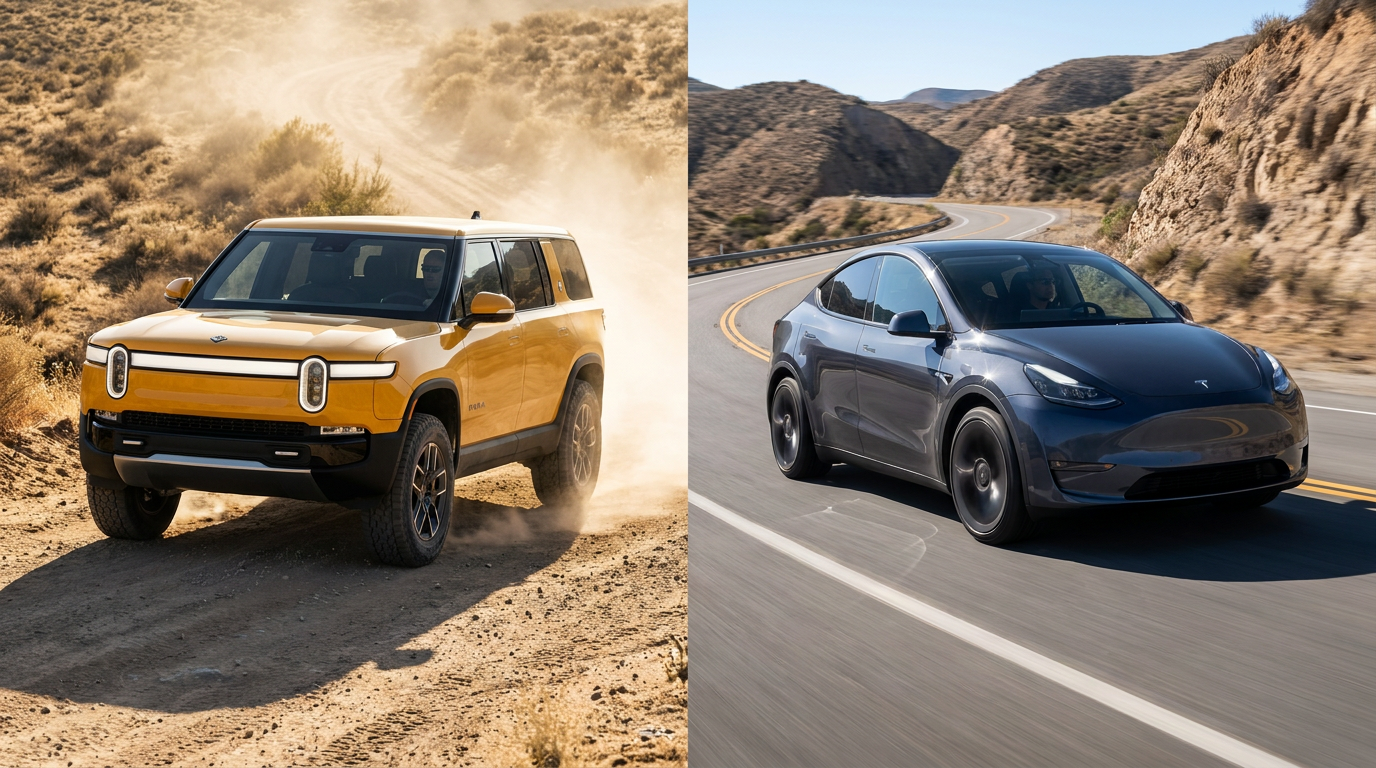
The midsize electric SUV segment has matured, offering buyers a stark choice between the aerodynamic efficiency of the refreshed Tesla Model Y and the rugged, boxy versatility of the all-new Rivian R2.
By Factlen Editorial Team
- Efficiency Pragmatists
- Prioritize aerodynamic design, charging speed, and proven software refinement.
- Outdoor Adventurers
- Value ground clearance, cargo volume, and rugged off-road utility.
- Value Shoppers
- Focus on immediate affordability and entry-level pricing for daily commuting.
What's not represented
- · Traditional auto mechanics transitioning to EV maintenance
- · Urban apartment dwellers reliant solely on public charging infrastructure
Why this matters
For the first time, buyers looking for a midsize electric SUV do not have to compromise between a rugged outdoor lifestyle and seamless charging infrastructure. This head-to-head comparison helps consumers navigate the $18,000 entry-price gap and choose the right vehicle for their specific daily needs.
Key points
- The 2026 Tesla Model Y "Juniper" refresh brings acoustic glass, ventilated seats, and a quieter cabin.
- The all-new Rivian R2 launches in 2026 with a boxier design, offering 90.1 cubic feet of cargo space.
- The Model Y holds a significant pricing advantage in 2026, starting around $40,000 for base models.
- Rivian's R2 matches the Model Y Performance in price but offers 9.6 inches of ground clearance for off-roading.
- Both vehicles feature native NACS ports, allowing seamless access to the Tesla Supercharger network.
The midsize electric vehicle segment has officially matured into a golden age for buyers. For years, the Tesla Model Y stood virtually unchallenged as the default recommendation for families seeking a practical, long-range electric SUV. In 2026, that landscape has fundamentally shifted. Tesla has rolled out its highly anticipated "Juniper" refresh, addressing long-standing criticisms regarding ride comfort and cabin noise. Simultaneously, Rivian has launched the R2, a smaller, more accessible sibling to its flagship R1S that brings the brand's signature rugged aesthetic to a mass-market footprint. Consumers are no longer forced to choose between early-adopter compromises; they now have two highly refined, distinct philosophies to choose from.[4][5]
The stakes for this comparison go beyond simple brand loyalty. Buyers are no longer just looking for "an EV" to save on gas; they are looking for specific utility that matches their lifestyle. This head-to-head matchup breaks down the inherent trade-offs between Tesla's pursuit of aerodynamic efficiency and Rivian's commitment to boxy, go-anywhere versatility. While both vehicles occupy roughly the same physical footprint in a garage, they are engineered to solve entirely different problems for the modern driver.[4][8]
The reality of pricing and availability heavily dictates the 2026 buying decision. For budget-conscious shoppers, the Tesla Model Y holds a massive and immediate advantage. Following its Juniper refresh, the rear-wheel-drive base Model Y continues to start at roughly $39,990. This aggressive pricing strategy ensures that Tesla remains the undisputed king of entry-level value, allowing buyers to step into a highly capable, long-range vehicle without crossing the $40,000 threshold.[2][4]
Rivian's rollout strategy for the R2 follows a different trajectory. To manage production scaling, Rivian is launching the R2 exclusively in its top-tier trims for the 2026 calendar year. The Performance Launch Edition arrives first with a starting price of $57,990, followed closely by the Premium trim at $53,990. Buyers waiting for the highly publicized $45,000 standard-battery R2 will have to wait until 2027. Consequently, early adopters of the R2 are paying a premium for immediate access.[1][2]

However, when comparing the top of the lineup, the vehicles reach striking price parity. The $57,990 Rivian R2 Performance lines up almost exactly against the Tesla Model Y Performance, which hovers around $57,490. At this $58,000 price point, the value proposition transforms from a question of budget into a fascinating study of contrasting engineering priorities. Buyers are asked to choose between blistering on-road acceleration and trail-ready off-road geometry.[4][6]
Parked side-by-side, the physical differences between the two SUVs are stark. The Rivian R2 measures 185.9 inches in length, making it nearly three inches shorter than the Model Y. Yet, the R2 stands a full three inches taller at 66.9 inches. The Tesla adopts a sloped, aerodynamic teardrop shape designed to slip through the wind, while the Rivian embraces a traditional, upright SUV silhouette with a flat roofline and a blunt front fascia.[3][8]
That boxy shape pays massive dividends when it comes to interior cargo volume. The Rivian R2 offers a cavernous 90.1 cubic feet of total storage with the second row folded flat. This dwarfs the Model Y's 76 cubic feet of maximum cargo space. For families who regularly haul camping gear, large dogs, or bulky furniture, the R2's upright greenhouse provides significantly more usable vertical space than the Tesla's sloping rear hatch.[3][8]
Rivian also introduces several clever packaging innovations that maximize utility. The R2 features a 5.2 cubic-foot front trunk, edging out the Model Y's 4.1 cubic-foot frunk. More impressively, the R2's rear window drops completely into the tailgate. Combined with fold-flat front seats, this allows owners to slide extra-long items—like surfboards or lumber—straight through the cabin while keeping the tailgate securely closed, a feat impossible in the Model Y.[2][6]

Inside the cabin, Tesla's "Juniper" update directly addresses past criticisms of the Model Y's stark minimalism. The 2026 model introduces acoustic glass on all windows, resulting in a cabin that is up to 25 percent quieter at highway speeds. Tesla has also added highly requested ventilated front seats, wrap-around customizable ambient lighting, and an eight-inch rear passenger touchscreen. These refinements elevate the Model Y from a tech-focused appliance to a genuinely premium environment.[7]
Inside the cabin, Tesla's "Juniper" update directly addresses past criticisms of the Model Y's stark minimalism.
The Rivian R2 counters with a multi-layered, tactile cabin that reviewers have compared to a modern designer loft. It utilizes premium materials like birchwood accents and features a distinctly rugged aesthetic. Crucially for many drivers, the R2 retains a dedicated digital driver's display behind the steering wheel, whereas the Model Y still requires the driver to look at the central screen for speed and range information.[5]
In terms of raw performance, both top-tier trims deliver staggering numbers. The Rivian R2 Performance utilizes a tri-motor setup to produce 656 horsepower and 609 pound-feet of torque. Despite this massive power advantage, the lighter, sleeker Tesla Model Y Performance is quicker in a straight line, hitting 60 mph in just 3.3 seconds compared to the R2's 3.6 seconds. Both vehicles offer acceleration that rivals traditional supercars, packaged in family-friendly bodies.[4][6]
Range and efficiency highlight the benefits of Tesla's aerodynamic focus. Both vehicles hover around the 330-mile mark for EPA-estimated range in their top trims. However, the Model Y achieves this range with a smaller battery pack, earning a 104 MPGe rating. The R2 Performance impressively achieves 109 MPGe, but its heavier curb weight and boxy shape mean it requires more raw energy to push through the air at highway speeds, slightly increasing long-term charging costs.[3][4]
Historically, charging infrastructure was Tesla's ultimate trump card, but that gap has officially closed in 2026. The Rivian R2 features a native NACS (North American Charging Standard) port built directly into the vehicle. This grants Rivian owners seamless, adapter-free access to Tesla's sprawling Supercharger network. While the Model Y charges slightly faster—completing a 10 to 80 percent charge in roughly 24 minutes compared to the R2's 29 minutes—both offer a frictionless road trip experience.[1][4]
The most profound difference between the two vehicles emerges when the pavement ends. Ground clearance is where the R2 pulls away entirely. The Rivian boasts 9.6 inches of clearance, a 25-degree approach angle, and a 26-degree departure angle. Paired with 32-inch tires and a sophisticated torque-vectoring all-wheel-drive system, the R2 is genuinely trail-capable, able to navigate deep ruts and rocky inclines with ease.[3][6]

Conversely, the Model Y's lower center of gravity and firmer suspension make it the superior vehicle for carving through canyon roads. With just 6.0 inches of ground clearance, the Tesla is strictly limited to pavement and well-graded dirt roads. However, on the tarmac, it drives much more like a sporty sedan than a high-riding utility vehicle, offering precise steering and minimal body roll during aggressive cornering.[3][5]
When analyzing the trade-offs, the case for the Tesla Model Y centers on aerodynamic efficiency, immediate affordability, and proven software refinement. The evidence is strictly quantitative: it achieves excellent energy efficiency, charges from 10 to 80 percent in just 24 minutes, and offers a starting price that undercuts the 2026 R2 lineup by nearly $18,000. It remains the most sensible choice for the average commuter.[3][4]
The case against the Model Y is rooted in its physical limitations and ubiquity. The evidence against it includes a sloping roofline that compromises the hauling of large, boxy items, and a low 6.0-inch ground clearance that prevents serious off-road exploration. Additionally, its minimalist, screen-centric interior lacks a dedicated driver's display, a design choice that continues to alienate some traditional car buyers.[3][5]
Conversely, the case for the Rivian R2 is built on sheer versatility, maximum cargo volume, and genuine off-road geometry. The evidence supporting the R2 includes its massive 90.1 cubic feet of total storage, a larger 5.2 cubic-foot frunk, and 9.6 inches of ground clearance. Its roll-down rear window and rugged interior materials make it a true adventure vehicle designed for active lifestyles.[3][6]

The case against the Rivian R2 focuses on its launch-year economics and physical bulk. The evidence against it includes a heavier 4,850-pound curb weight, a slightly slower 29-minute fast-charging curve, and a launch strategy that restricts 2026 buyers to the $57,990 Performance and $53,990 Premium trims. Budget-conscious buyers must wait until 2027 to access the brand's more affordable configurations.[1][4]
Ultimately, the Tesla Model Y fits well when your priority is daily commuting efficiency, sporty sedan-like handling, and immediate budget value. It does not fit when you regularly haul bulky outdoor gear or navigate rough, unpaved trails. The Rivian R2 fits well when you need a traditional SUV layout, maximum interior volume, and true off-road capability. It does not fit when you are shopping strictly under the $50,000 mark in 2026 or prioritize the absolute lowest cost per mile driven.[4][5]
How we got here
Early 2024
Rivian officially unveils the R2 platform and announces its target pricing.
Late 2025
Tesla rolls out the "Juniper" refresh for the Model Y, updating its exterior and interior.
Spring 2026
The Rivian R2 Performance Launch Edition begins reaching its first customers.
Late 2026
The Rivian R2 Premium trim enters production.
Early 2027
The sub-$50,000 Rivian R2 Standard trims are scheduled to launch.
Viewpoints in depth
Efficiency Pragmatists
Focus on the Model Y's superior aerodynamics, lighter weight, and faster charging curve.
For buyers who view vehicles primarily as transportation appliances, the Tesla Model Y remains the undisputed champion. This camp points to the Model Y's 104 MPGe rating and its ability to charge from 10 to 80 percent in just 24 minutes. They argue that the Rivian R2's boxy shape and heavier curb weight introduce unnecessary aerodynamic drag, which translates to higher long-term charging costs and slightly longer stops during cross-country road trips.
Outdoor Adventurers
Focus on the R2's 9.6 inches of clearance, 32-inch tires, and boxy cargo space.
This perspective argues that the Model Y is essentially a tall hatchback, entirely unsuited for true outdoor exploration. They highlight the Rivian R2's 9.6 inches of ground clearance, 25-degree approach angle, and massive 90.1 cubic feet of interior volume as evidence of its superiority. For this camp, the slight penalty in aerodynamic efficiency is a worthwhile trade-off for a vehicle that can genuinely navigate rocky trails and comfortably swallow bulky camping gear.
Value Shoppers
Focus on the $18,000 gap in entry pricing for the 2026 calendar year.
For budget-conscious consumers, the comparison ends at the sticker price. Because Rivian is restricting its 2026 R2 production to the $57,990 Performance and $53,990 Premium trims, the Tesla Model Y holds a massive $18,000 advantage at the entry level. This camp argues that while the R2 is an impressive machine, the ability to purchase a highly capable, long-range Model Y for roughly $40,000 makes Tesla the only logical choice for families shopping in the current calendar year.
What we don't know
- How the Rivian R2's real-world aerodynamic efficiency will hold up at sustained highway speeds in cold weather.
- Whether Rivian can scale production fast enough to meet demand for the sub-$50,000 R2 trims in 2027.
- Long-term reliability metrics for the R2's new platform compared to Tesla's highly mature Model Y architecture.
Key terms
- NACS (North American Charging Standard)
- The charging plug design originally developed by Tesla, now adopted by Rivian and other automakers for universal Supercharger access.
- MPGe (Miles Per Gallon Equivalent)
- A metric used by the EPA to compare the energy efficiency of electric vehicles against traditional gas-powered cars.
- Approach Angle
- The maximum angle of a ramp or obstacle a vehicle can climb from a flat surface without the front bumper hitting the ground.
- Frunk
- A storage compartment located under the front hood of an electric vehicle, occupying the space where a gas engine would traditionally sit.
Frequently asked
When can I buy the $45,000 Rivian R2?
The lower-priced Standard trims are scheduled to arrive in 2027. Only the $57,990 Performance and $53,990 Premium trims are available in 2026.
Do both vehicles use the same charging network?
Yes. The Rivian R2 features a native NACS port, allowing it to use Tesla Superchargers without an adapter, just like the Model Y.
Which vehicle is faster?
The Tesla Model Y Performance is slightly quicker, reaching 60 mph in 3.3 seconds compared to the Rivian R2 Performance's 3.6 seconds.
Did the Model Y update fix the bumpy ride?
Yes. The 2026 "Juniper" update includes retuned suspension and adaptive damping, which reviewers note significantly improves ride comfort over rough roads.
Sources
Source coverage
8 outlets
3 viewpoints surfaced








[1]EdmundsOutdoor Adventurers
Rivian R2 First Drive: This EV Is Even Better Than I Expected
Read on Edmunds →[2]Kelley Blue BookValue Shoppers
Rivian R2 Pricing, Range & Specs
Read on Kelley Blue Book →[3]ElectrekEfficiency Pragmatists
Rivian R2 vs Tesla Model Y: A full dimension comparison
Read on Electrek →[4]Road EthosValue Shoppers
Rivian R2 Vs. Tesla Model Y: An Honest Comparison For 2026 Buyers
Read on Road Ethos →[5]CarwowValue Shoppers
Rivian R2 vs Tesla Model Y: which should you buy?
Read on Carwow →[6]CarBuzzOutdoor Adventurers
Here's Every Way The Rivian R2 Beats The Tesla Model Y
Read on CarBuzz →[7]DIY Wrap ClubEfficiency Pragmatists
2026 Tesla Model Y Juniper: What's New?
Read on DIY Wrap Club →[8]CarsDirectValue Shoppers
2027 Rivian R2 vs 2026 Tesla Model Y
Read on CarsDirect →
Every angle. Every day.
Get automotive stories with full source coverage and perspective breakdowns delivered to your inbox.