
Bipartisan Backlash Mounts Against Trump's Iran Deal as Peace Talks Open in Switzerland
President Trump's provisional peace agreement with Iran is facing intense criticism from both Democrats and Republicans, even as Vice President JD Vance begins 60-day negotiations in Switzerland. The diplomatic push is already strained by Iranian threats to close the Strait of Hormuz and fresh warnings of military retaliation from the White House.
By Factlen Editorial Team
- Trump Administration
- Argues the provisional deal successfully halts a costly conflict and secures the Strait of Hormuz without U.S. taxpayer money.
- Congressional Republicans
- Warns that providing sanctions relief and reconstruction funds will allow Iran to rebuild its military and finance regional proxies.
- Congressional Democrats
- Condemns the agreement as a capitulation that bypasses congressional oversight and rewards Iranian aggression.
- Iranian Leadership
- Maintains that the ceasefire is conditional and insists on retaining the absolute right to enrich uranium.
What's not represented
- · European allies who were part of previous nuclear agreements
- · Regional Gulf states expected to finance the $300 billion reconstruction fund
- · Global shipping companies navigating the Strait of Hormuz
Why this matters
The provisional agreement aims to end one of the most significant U.S. military engagements of the decade and stabilize global energy markets by securing the Strait of Hormuz. However, the fierce domestic opposition and fragile ceasefire mean the 60-day negotiation window carries immense geopolitical and economic risk for American consumers and allies.
Key points
- President Trump's 14-point Memorandum of Understanding with Iran establishes a 60-day window for direct peace negotiations.
- Vice President JD Vance has arrived in Switzerland to lead the U.S. delegation in talks with Iranian officials.
- Lawmakers from both parties have fiercely criticized the deal, warning that a proposed $300 billion reconstruction fund will empower Tehran.
- Iran's Revolutionary Guard claims to have closed the Strait of Hormuz in response to Israeli strikes, though the U.S. insists the waterway remains open.
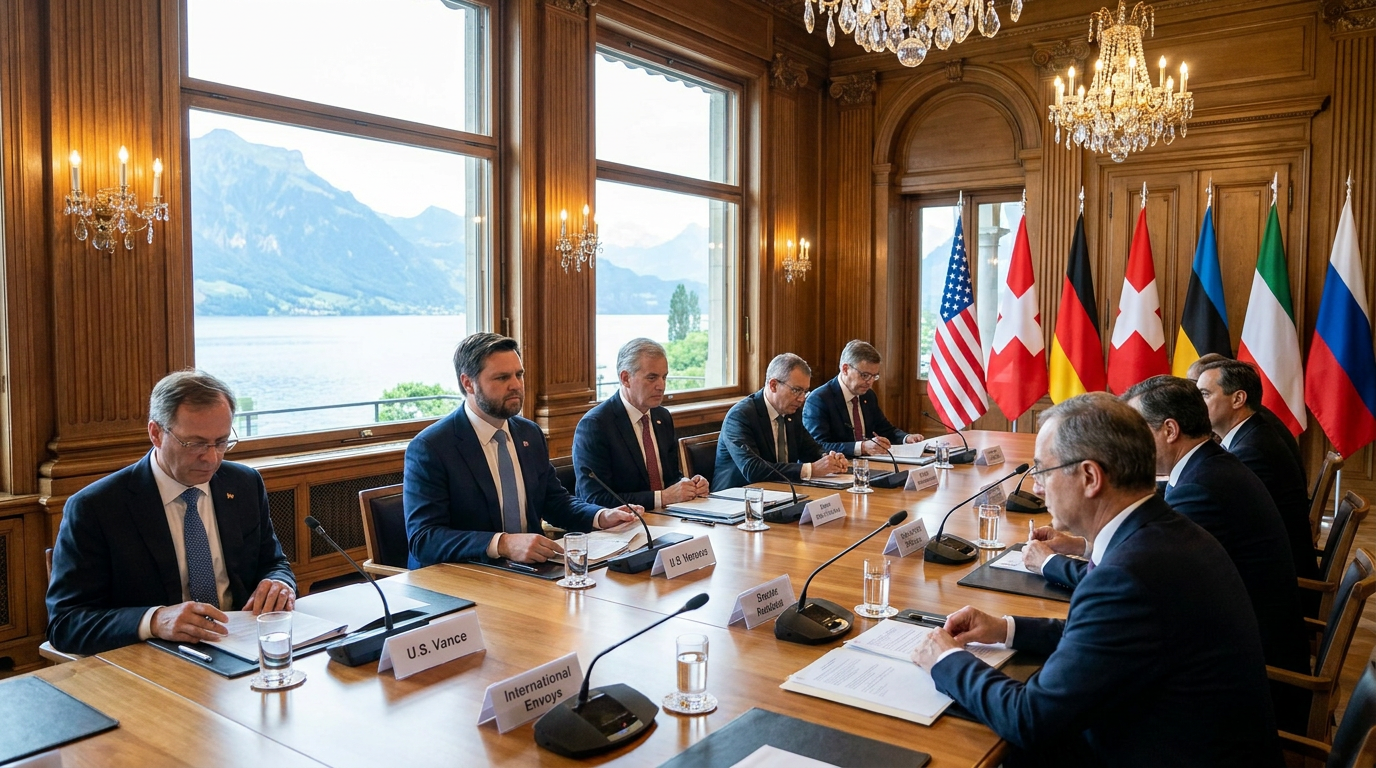
President Donald Trump’s 14-point Memorandum of Understanding with Iran is facing a gauntlet of bipartisan outrage in Washington, just as Vice President JD Vance arrives in Switzerland to open a 60-day window of direct peace negotiations.[1][3]
The provisional agreement aims to formally end the recent U.S.-Iran military conflict, reopen the critical Strait of Hormuz, and establish a framework for addressing Tehran’s nuclear program.[3][4]
But the ink on the deal is barely dry, and its terms are already under severe strain. Over the weekend, Iran’s Islamic Revolutionary Guard Corps (IRGC) Navy announced it had completely closed the Strait of Hormuz to maritime traffic.[8]
The IRGC cited ongoing Israeli military strikes against Hezbollah in southern Lebanon—which Iran considers a breach of the ceasefire’s spirit—as the catalyst for the blockade, warning all international vessels to stay away from the strategic chokepoint.[8]

The reality on the water remains heavily contested. While Iranian state media broadcast the closure, U.S. Central Command and Vice President Vance insisted the waterway remains open. Vance claimed that 12.5 million barrels of oil successfully passed through in a single night, pointing to the traffic as proof the ceasefire is holding.[4][6]
President Trump responded to the IRGC’s threats with characteristic bluntness, taking to Truth Social to warn that if Iran does not rein in its proxies in Lebanon, the U.S. will "hit Iran very hard again, just like we did last week, only harder."[1][3]
In a subsequent phone interview, Trump threatened to physically take over the Strait if Tehran interfered with shipping. He also floated the unprecedented idea of the U.S. imposing maritime tolls on the waterway if a final deal collapses, framing the fees as reimbursement for America acting as the Middle East's "Guardian Angel."[3]
In a subsequent phone interview, Trump threatened to physically take over the Strait if Tehran interfered with shipping.
Back in Washington, the White House is fighting a two-front political war as lawmakers from both parties revolt against the MOU's core concessions. The agreement reportedly involves regional partners establishing a $300 billion reconstruction fund for Iran and offers pathways to sweeping sanctions relief.[5]
Top Senate Republicans, who broadly supported the president’s initial military campaign, have blasted the diplomatic off-ramp. Texas Senator Ted Cruz told reporters that the president was receiving "very, very poor advice," warning that funneling billions to "theocratic lunatics" would inevitably endanger American lives.[5]

Fellow Texas Republican Senator John Cornyn echoed the alarm, arguing that any unfrozen assets or reconstruction funds will be diverted to rebuild Iran’s ballistic missile arsenal and finance regional proxies like Hamas, Hezbollah, and the Houthis.[1][5]
Democrats have been equally scathing, framing the agreement as a capitulation that bypasses congressional oversight. Senator Cory Booker labeled the MOU an "abject surrender," arguing that the administration ignited a disastrous conflict only to grant Iran massive economic benefits to stop it, leaving the U.S. looking like the "biggest loser" on the world stage.[2]
Former Obama-era National Security Adviser Susan Rice called the deal a "jaw-dropping, horrific surrender," criticizing the administration for granting significant upfront concessions before securing a comprehensive, verifiable mechanism to dismantle Iran's nuclear ambitions.[1]
Despite the domestic firestorm, Vance and a U.S. delegation that includes envoys Jared Kushner and Steve Witkoff are pressing ahead in Lake Lucerne, Switzerland. They are meeting with Iranian negotiators, alongside mediators from Qatar and Pakistan, and Rafael Grossi, the head of the International Atomic Energy Agency.[3]

Vance has forcefully defended the framework, emphasizing that not a single U.S. taxpayer penny is going to Iran. He argued that Tehran will only receive international reconstruction funds if it establishes verifiable pathways proving it is not rebuilding its nuclear program.[4][5]
Yet the gap between the two sides remains vast. Iranian President Masoud Pezeshkian declared over the weekend that Tehran will "never back down from the right to enrich uranium," setting the stage for a highly volatile 60-day diplomatic sprint where both the military ceasefire and the global energy markets hang in the balance.[3][7]
How we got here
Late Feb 2026
U.S. and Israeli forces launch a major military campaign against Iran following escalating regional tensions.
Mid-June 2026
President Trump signs a 14-point Memorandum of Understanding with Iran to halt hostilities.
June 20, 2026
Iran's IRGC claims to close the Strait of Hormuz, citing Israeli strikes in Lebanon as a ceasefire breach.
June 21, 2026
Vice President JD Vance opens 60 days of direct nuclear and peace negotiations in Switzerland.
Viewpoints in depth
Trump Administration's view
Argues the provisional deal successfully halts a costly conflict and secures the Strait of Hormuz without U.S. taxpayer money.
The White House maintains that the Memorandum of Understanding is a diplomatic victory that ends a dangerous military engagement while achieving core U.S. objectives. Vice President JD Vance emphasizes that the proposed $300 billion reconstruction fund will be financed by regional partners, not American taxpayers, and that Iran will only receive sanctions relief if it demonstrates verifiable compliance with nuclear restrictions. The administration views the 60-day window as a necessary cooling-off period to hammer out a final, enforceable treaty.
Congressional Critics' view
Warns that the agreement is a dangerous capitulation that bypasses the Senate and empowers a hostile regime.
Lawmakers from both sides of the aisle are united in their alarm over the deal's concessions. Republicans argue that providing Tehran with access to a $300 billion fund and lifting economic sanctions will inevitably allow the regime to rebuild its ballistic missile program and finance proxy groups like Hamas and Hezbollah. Democrats, meanwhile, condemn the administration for launching a costly military campaign without congressional approval, only to offer massive financial incentives to secure a fragile ceasefire, labeling the maneuver an 'abject surrender.'
Iranian Leadership's view
Maintains that the ceasefire is conditional and insists on retaining the absolute right to enrich uranium.
Tehran views the Memorandum of Understanding not as a surrender, but as a necessary pause that requires strict U.S. and Israeli compliance. Hardliners within the Islamic Revolutionary Guard Corps have already demonstrated their willingness to leverage the Strait of Hormuz, citing ongoing Israeli operations in Lebanon as a violation of the ceasefire's spirit. Furthermore, Iranian President Masoud Pezeshkian has drawn a hard line on the country's nuclear ambitions, declaring that Iran will never relinquish its right to enrich uranium, setting up a major clash for the upcoming negotiations.
What we don't know
- Whether the $300 billion regional reconstruction fund has secured actual financial commitments from Gulf states.
- How the U.S. plans to enforce the verifiable dismantling of Iran's nuclear program during the 60-day window.
- Whether Israel will agree to halt its military operations against Hezbollah in Lebanon to preserve the broader ceasefire.
Key terms
- Memorandum of Understanding (MOU)
- A formal, non-binding agreement outlining the broad terms of a negotiated settlement before a final treaty is drafted.
- Strait of Hormuz
- A narrow, strategically vital waterway between the Persian Gulf and the Gulf of Oman through which roughly 20% of the world's oil supply passes.
- Islamic Revolutionary Guard Corps (IRGC)
- A multi-service primary branch of the Iranian Armed Forces tasked with protecting the country's Islamic republic political system.
- Sanctions Relief
- The reduction or removal of economic penalties imposed on a country, allowing it to resume international trade and access frozen financial assets.
Frequently asked
What is in the new U.S.-Iran agreement?
The 14-point Memorandum of Understanding establishes a 60-day window for negotiations, aims to reopen the Strait of Hormuz, and proposes a $300 billion reconstruction fund financed by regional partners in exchange for Iran halting its nuclear weapons program.
Is the Strait of Hormuz currently closed?
The situation is contested. Iran's Revolutionary Guard claims it has completely closed the waterway, while U.S. Central Command and Vice President Vance state that millions of barrels of oil are still successfully passing through.
Why are both Democrats and Republicans angry about the deal?
Lawmakers fear the agreement bypasses congressional oversight and provides massive financial relief to Iran. Republicans argue the funds will be used to rebuild Iran's military and fund proxies, while Democrats call the deal an 'abject surrender' after a costly war.
Sources
Source coverage
8 outlets
4 viewpoints surfaced








[1]The GuardianCongressional Democrats
Trump faces fresh bipartisan criticism on Iran deal as Vance hails peace talks
Read on The Guardian →[2]Fox NewsCongressional Democrats
Booker slams Trump’s Iran deal as an 'abject surrender,' labels him the 'biggest loser' with 'egg on his face'
Read on Fox News →[3]The Washington PostTrump Administration
Trump threatens Iran over Hormuz as JD Vance holds peace talks
Read on The Washington Post →[4]CBS NewsTrump Administration
Vance heads to Switzerland for talks; Iran says it's closing Strait of Hormuz
Read on CBS News →[5]Courthouse NewsCongressional Republicans
In a break with the White House, top Senate Republicans blast the U.S. memorandum of understanding with Iran
Read on Courthouse News →[6]The New York TimesIranian Leadership
Uncertainty Remains Over the Strait of Hormuz
Read on The New York Times →[7]Al JazeeraIranian Leadership
Khamenei’s MoU stance stirs debate as Iran and US meet in Switzerland
Read on Al Jazeera →[8]Iran InternationalIranian Leadership
IRGC Navy says Hormuz 'completely closed,' warns vessels to stay away
Read on Iran International →

More in news politics
See all 5 stories →

Every angle. Every day.
Get news politics stories with full source coverage and perspective breakdowns delivered to your inbox.