
How the R21 Malaria Vaccine is Rewriting the Future of Global Health
The widespread rollout of the highly effective, low-cost R21/Matrix-M vaccine across Africa marks a historic turning point in the fight against malaria, promising to save hundreds of thousands of children's lives annually.
By Factlen Editorial Team
- Public Health Officials
- Focus on the logistical rollout and the necessity of combining the vaccine with existing tools like bednets.
- Vaccine Researchers
- Focus on the scientific milestone, the adjuvant technology, and the unprecedented efficacy data.
- Health Economists
- Focus on the low cost per dose, massive manufacturing scale, and the economic return on investment.
What's not represented
- · Rural clinic workers managing the cold chain
- · Parents of vaccinated children
Why this matters
Malaria kills nearly half a million African children every year, trapping communities in cycles of poverty. A cheap, highly effective, and easily scalable vaccine doesn't just prevent a disease—it unlocks generational economic and social potential across an entire continent.
Key points
- The R21/Matrix-M vaccine is the first malaria vaccine to consistently meet the WHO's 75% efficacy target.
- Developed by Oxford University, the vaccine intercepts the malaria parasite in the bloodstream before it reaches the liver.
- The Serum Institute of India is manufacturing the vaccine at a massive scale of 100 million doses annually.
- Priced at just $2 to $4 per dose, the vaccine is highly affordable for mass immunization campaigns in endemic regions.
- Public health experts stress that the vaccine must be used in tandem with existing tools like insecticide-treated bednets.
For millennia, malaria has been one of humanity's most relentless predators. Caused by the Plasmodium parasite and transmitted through the bite of infected Anopheles mosquitoes, the disease continues to claim over 600,000 lives annually. The vast majority of these victims are children under the age of five living in sub-Saharan Africa.[1]
Despite decades of intense global effort, creating a highly effective vaccine against malaria proved notoriously difficult. Unlike viruses, the malaria parasite is a complex, shape-shifting organism with a multi-stage life cycle that has evolved sophisticated strategies to evade the human immune system.[6]
That narrative is now fundamentally changing. The rollout of the R21/Matrix-M malaria vaccine across the African continent represents a watershed moment in global health. Developed by the Jenner Institute at the University of Oxford, this new shot is not just a scientific marvel; it is a scalable, affordable tool that public health experts believe could save hundreds of thousands of lives every year.[6][7]

The R21 vaccine works by intercepting the parasite at its most vulnerable point. When an infected mosquito bites a human, it injects the parasite in a form known as a sporozoite. The vaccine trains the immune system to recognize and attack these sporozoites in the bloodstream before they can reach the liver, where they would otherwise multiply and trigger the devastating symptoms of the disease.[3]
A crucial component of R21's success is the Matrix-M adjuvant, a technology provided by the biotechnology company Novavax. An adjuvant is an ingredient used in some vaccines that helps create a stronger immune response. In the case of R21, Matrix-M acts as a powerful amplifier, ensuring that the body produces a robust and durable defense against the parasite.[3][6]
The clinical data backing the vaccine is unprecedented in the history of malaria research. In massive Phase 3 trials involving nearly 5,000 children across Burkina Faso, Kenya, Mali, and Tanzania, the R21 vaccine demonstrated an efficacy rate of 75% in areas with highly seasonal malaria transmission.[1][3]

This 75% threshold is highly significant. For years, the World Health Organization (WHO) had set a target for a malaria vaccine to achieve at least 75% efficacy. R21 is the first candidate to reliably hit and sustain that benchmark when administered as a three-dose primary series followed by a booster a year later.[1][2]
R21 is actually the second malaria vaccine to be approved, following the RTS,S (Mosquirix) vaccine endorsed by the WHO in 2021. While RTS,S was a historic first step and paved the way for immunization programs, its complex manufacturing process meant that supply could never meet the overwhelming demand across endemic countries.[1][7]
R21 is actually the second malaria vaccine to be approved, following the RTS,S (Mosquirix) vaccine endorsed by the WHO in 2021.
This is where R21 fundamentally alters the equation: scale and cost. The University of Oxford partnered with the Serum Institute of India (SII), the world's largest vaccine manufacturer by volume. SII has already established a production capacity of 100 million doses of R21 annually, with plans to double that output over the coming years.[3]
Furthermore, the vaccine is remarkably cost-effective. Priced between $2 and $4 per dose, R21 is financially viable for mass deployment in low- and middle-income countries. This affordability allows international organizations like Gavi, the Vaccine Alliance, and UNICEF to procure and distribute the vaccine on a continental scale.[1][5]

The real-world rollout is now well underway. In mid-2024, countries like the Central African Republic, Côte d'Ivoire, and the Democratic Republic of the Congo began integrating R21 into their routine childhood immunization schedules. By 2025 and 2026, the campaign expanded to over a dozen nations, reaching millions of the world's most vulnerable children.[1][5]
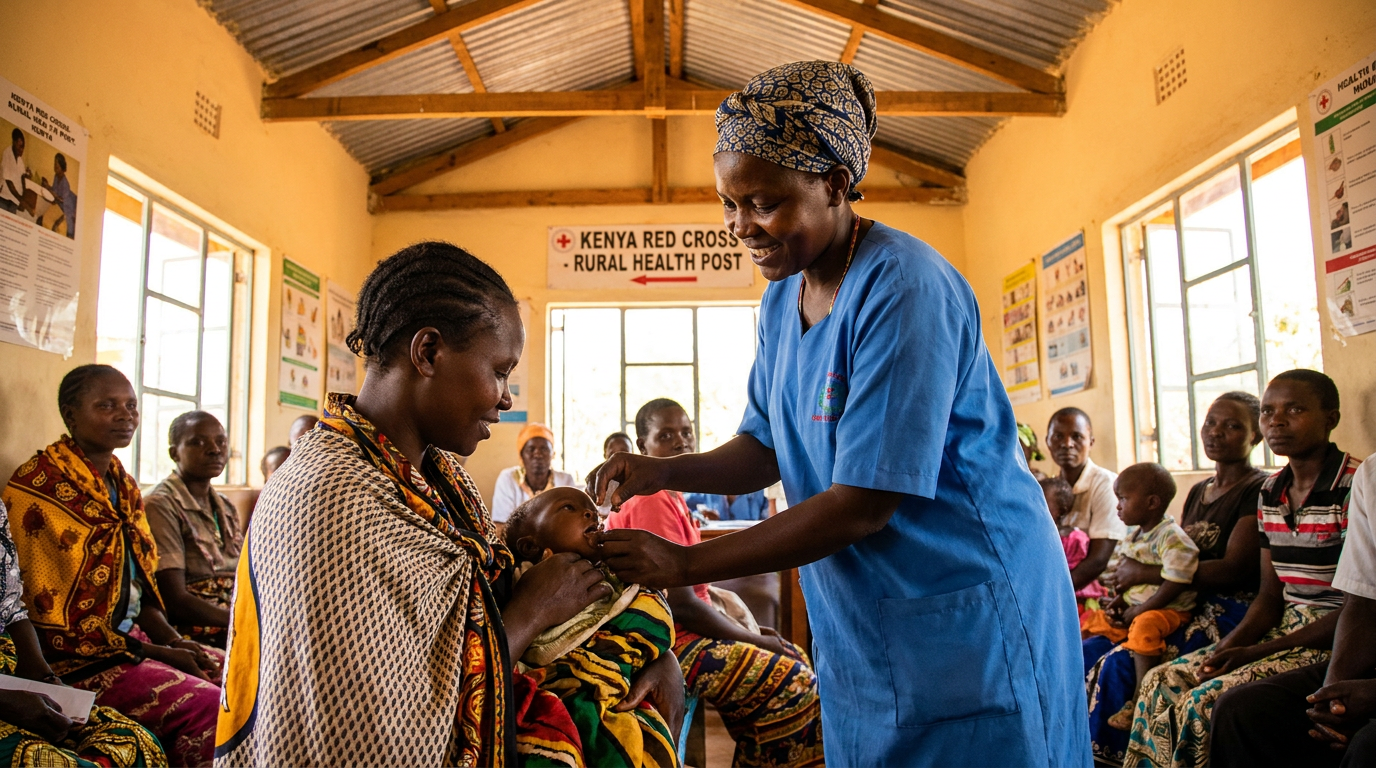
Delivering the vaccine is not without its hurdles. Many of the regions with the highest malaria burdens suffer from fragile healthcare infrastructure, making the maintenance of the cold chain—keeping the vaccines refrigerated from factory to rural clinic—a monumental logistical task.[4][7]
Additionally, health ministries in these nations are often battling multiple crises simultaneously. For instance, the Democratic Republic of the Congo launched its malaria vaccine rollout while simultaneously managing a severe mpox outbreak, highlighting the immense strain on local health workers and resources.[1]
Despite these challenges, early modeling suggests the population-level impact will be staggering. Mathematical models indicate that if vaccination coverage is high enough, it could generate a degree of herd immunity, providing indirect protection even to those who have not been immunized.[3][7]

However, public health officials are quick to emphasize that the vaccine is not a silver bullet. R21 must be deployed alongside existing, proven interventions. Insecticide-treated bednets, indoor residual spraying, and rapid access to antimalarial drugs remain absolutely essential to keeping transmission rates low.[1][4]
The combination of these tools is what gives experts hope. When a highly effective vaccine is layered on top of widespread bednet usage, the compounding effect drastically reduces both the incidence of the disease and the rate of severe, fatal complications.[4]
The arrival of the R21/Matrix-M vaccine is more than just a medical breakthrough; it is an economic catalyst. Malaria traps communities in cycles of poverty, keeping children out of school and adults out of work. By lifting this biological burden, the vaccine paves the way for greater educational attainment and economic growth across sub-Saharan Africa.[7]
After a century of false dawns and incremental progress, the global health community finally has the tools required to corner one of humanity's oldest foes. The widespread deployment of the R21 vaccine marks the beginning of a new era—one where a malaria-free future is no longer just a distant dream, but an achievable reality.[1][6][7]
How we got here
April 2021
Phase 2 trial results are published, showing the R21 vaccine achieved 77% efficacy, becoming the first to meet the WHO's target.
October 2023
The World Health Organization officially recommends the R21/Matrix-M vaccine for widespread use in children.
January 2024
The WHO launches the AMVIRA initiative to accelerate the logistical rollout of malaria vaccines across Africa.
May 2024
The Central African Republic becomes the first country to receive R21 doses for routine childhood immunization.
2025–2026
The rollout scales massively, with the Serum Institute of India producing tens of millions of doses for over a dozen African nations.
Viewpoints in depth
Public Health Officials
Focusing on comprehensive disease control and logistical realities.
While celebrating the vaccine, public health leaders stress that R21 is not a standalone cure. They argue that the vaccine must be integrated into existing infrastructure, layered alongside insecticide-treated bednets and rapid diagnostic testing, to truly collapse transmission rates in endemic regions. Their primary concern is ensuring the cold chain remains unbroken as the vaccine travels to the most remote rural clinics.
Vaccine Researchers
Focusing on the scientific milestone and adjuvant technology.
Immunologists and researchers view R21 as a triumph of modern vaccinology. They highlight the use of the Matrix-M adjuvant as the critical breakthrough that finally allowed a malaria vaccine to hit the WHO's 75% efficacy target, proving that targeting the complex, shape-shifting parasite during its brief sporozoite stage in the bloodstream is highly effective.
Health Economists
Focusing on scalability and return on investment.
Economists emphasize the manufacturing and pricing triumphs of the R21 rollout. By partnering with the Serum Institute of India to produce 100 million doses annually at just $2 to $4 each, they argue the vaccine avoids the supply-chain bottlenecks of previous iterations, offering an unprecedented return on investment for developing economies by keeping children healthy and in school.
What we don't know
- Exactly how long the vaccine's protection lasts beyond the first few years, and whether additional booster shots will be required later in childhood.
- How the widespread use of the vaccine might pressure the malaria parasite to mutate or evolve over the coming decades.
- Whether the fragile cold-chain logistics in the most remote rural areas can consistently support the massive scale of the rollout.
Key terms
- Plasmodium parasite
- The microscopic organism that causes malaria, transmitted to humans through the bites of infected mosquitoes.
- Sporozoite
- The specific, early stage of the malaria parasite's life cycle when it first enters the human bloodstream after a mosquito bite, before it reaches the liver.
- Adjuvant
- An ingredient added to a vaccine that helps create a stronger, more robust immune response in the patient's body.
- Efficacy
- A measure of how well a vaccine prevents disease in a controlled clinical trial setting.
- Endemic
- A disease that is consistently present within a specific geographic region or population, such as malaria in sub-Saharan Africa.
Frequently asked
How is the R21 vaccine different from the earlier RTS,S vaccine?
While both target the same stage of the malaria parasite, R21 uses a different structural design and the Matrix-M adjuvant. Crucially, R21 can be manufactured at a much larger scale and lower cost, solving the supply shortages that hindered RTS,S.
How much does the R21 malaria vaccine cost?
The vaccine is highly affordable, costing between $2 and $4 per dose, making it financially viable for mass immunization campaigns in low-income countries.
Does this vaccine mean bednets are no longer needed?
No. Public health experts strongly emphasize that the vaccine must be used alongside existing tools like insecticide-treated bednets and indoor spraying to achieve the highest possible reduction in malaria cases.
Who manufactures the R21 vaccine?
The vaccine was developed by the University of Oxford and is being manufactured at scale by the Serum Institute of India, the world's largest vaccine producer by volume.
Sources
Source coverage
7 outlets
3 viewpoints surfaced





[1]World Health OrganizationPublic Health Officials
WHO recommends R21/Matrix-M vaccine for malaria prevention in updated advice on immunization
Read on World Health Organization →[2]Gavi, the Vaccine AllianceHealth Economists
Malaria vaccine R21/Matrix-M shows 77% efficacy in phase 2 trials
Read on Gavi, the Vaccine Alliance →[3]National Institutes of HealthVaccine Researchers
Safety and efficacy profile of R21/Matrix-M malaria vaccine
Read on National Institutes of Health →[4]Malaria ConsortiumPublic Health Officials
R21 vaccine rollout in Africa paints an optimistic picture for malaria prevention
Read on Malaria Consortium →[5]UNICEFPublic Health Officials
UNICEF delivers first R21 malaria vaccine doses to Central African Republic
Read on UNICEF →[6]University of OxfordVaccine Researchers
Oxford R21/Matrix-M™ malaria vaccine recommended for use by the WHO
Read on University of Oxford →[7]Factlen Editorial TeamHealth Economists
Synthesis by Factlen editorial team
Read on Factlen Editorial Team →

Every angle. Every day.
Get world stories with full source coverage and perspective breakdowns delivered to your inbox.