
How Citizens' Assemblies Are Empowering the 'Exhausted Majority'
As political polarization dominates the headlines, a growing global movement is using random selection and structured deliberation to bypass partisan gridlock and forge consensus.
By Factlen Editorial Team
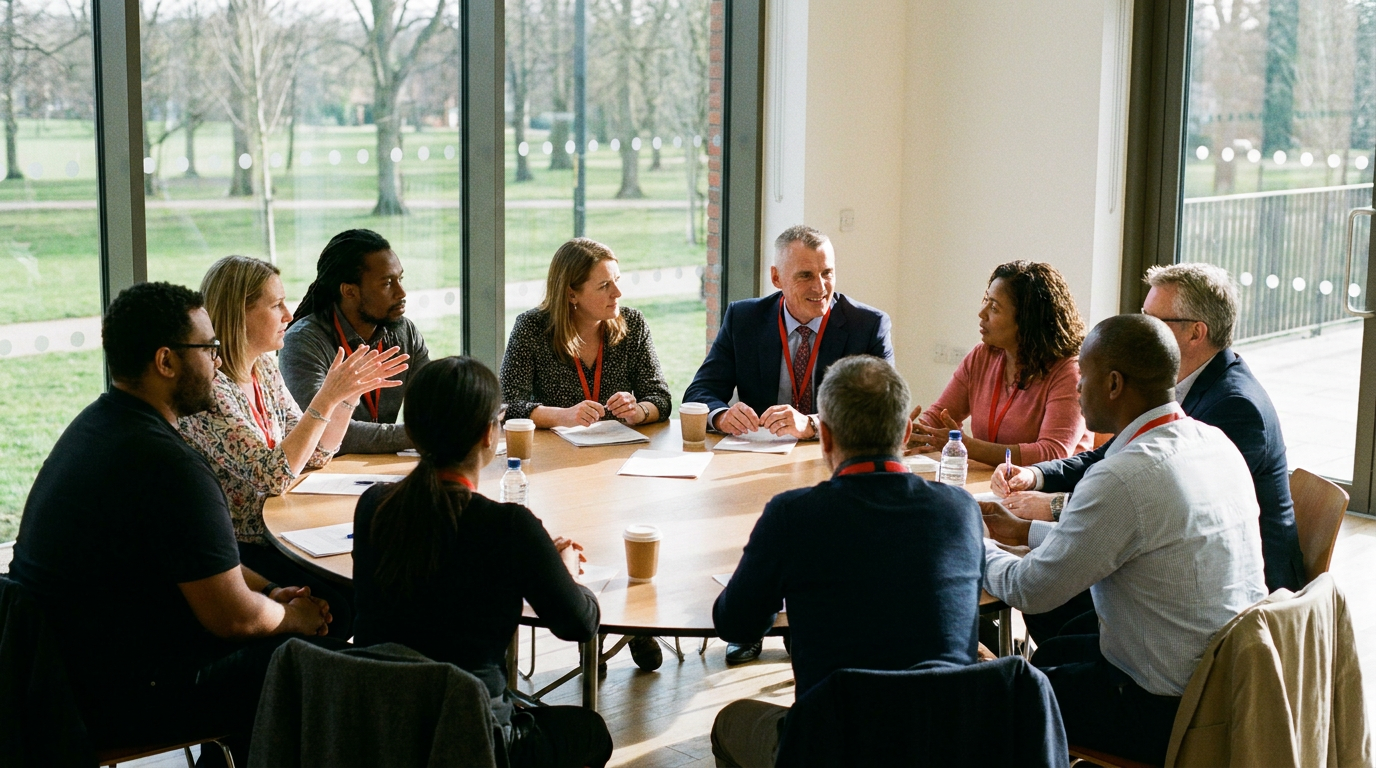
- Deliberative Democracy Advocates
- Argue that random selection and structured deliberation are necessary to bypass partisan gridlock.
- Bridge-Building Organizations
- Focus on grassroots dialogue and interpersonal connection to heal community divides.
- Institutional Skeptics
- Warn that assemblies risk becoming toothless advisory boards co-opted by existing power structures.
What's not represented
- · Elected officials hesitant to cede authority
- · Partisan media organizations that profit from polarization
Why this matters
Traditional political systems increasingly reward extreme partisanship, leaving most citizens feeling unrepresented. Deliberative democracy offers a proven, scalable mechanism to give everyday people a direct voice in solving complex, long-term challenges.
Key points
- Roughly 67% of the public belongs to the 'Exhausted Majority,' a group fatigued by polarization and eager for pragmatic compromise.
- Citizens' Assemblies use random selection (sortition) to create a representative microcosm of society, bypassing partisan gridlock.
- The OECD has tracked over 700 representative deliberative processes globally, marking a significant 'deliberative wave' in modern governance.
- Advocates are pushing to institutionalize these assemblies, ensuring their consensus-driven recommendations translate into binding policy.
If you consume a standard diet of modern political news, you could be forgiven for believing that democratic societies have fractured beyond repair. The loudest voices dominate the digital public square, algorithms reward outrage, and traditional electoral systems increasingly incentivize politicians to cater to their most extreme partisan bases. This dynamic creates an illusion of absolute, irreconcilable division, leaving everyday citizens feeling alienated from the very institutions designed to represent them. Yet, beneath the daily friction of culture wars and legislative gridlock, a different reality is quietly taking shape. A growing body of research suggests that the hyper-polarized narrative is largely a mirage, sustained by a vocal minority while the vast bulk of the population looks on in dismay.[1][3]
Researchers at the nonpartisan group More in Common have spent years mapping this landscape, coining a term that perfectly captures the current public mood: the "Exhausted Majority." According to their extensive polling and psychological profiling, roughly 67% of the American public falls into this category. These are individuals who, despite holding diverse views on specific policies, are fundamentally fatigued by the polarized state of society. They are more ideologically flexible, less prone to viewing political opponents as enemies, and deeply eager for pragmatic compromise. However, because they do not engage in the performative outrage that drives engagement metrics, their voices are systematically marginalized in traditional political discourse.[1][3]
The structural problem facing the Exhausted Majority is that conventional representative democracy—particularly in systems dominated by two major parties and closed primaries—struggles to translate their desire for consensus into actual policy. When elections become zero-sum battles focused on base mobilization, the political center is hollowed out. Lawmakers are punished for compromise and rewarded for ideological purity, making it nearly impossible to address complex, long-term challenges that require shared sacrifice and nuanced trade-offs. Recognizing this systemic failure, political scientists and civic organizers are increasingly turning toward a different model of governance, one designed specifically to bypass partisan gridlock and harness the collective intelligence of everyday people.[3][6]

This alternative approach is known as "deliberative democracy," and its flagship mechanism is the Citizens' Assembly. Unlike traditional town halls or public comment periods—which rely on self-selection and are routinely hijacked by the most highly motivated, polarized activists—a Citizens' Assembly is engineered to be a true microcosm of society. It treats citizens not as antagonists to be managed, but as capable problem-solvers who, when given the right conditions, can navigate complexity and find common ground. Over the past decade, this model has moved from the fringes of academic theory to the center of global democratic innovation.[2][4]
The foundation of any legitimate Citizens' Assembly is a process called "sortition," or random selection. Much like a legal jury, participants are chosen by lottery, but with demographic stratification applied to ensure the final group accurately reflects the broader population in terms of age, gender, ethnicity, income, and geographic location. This method effectively neutralizes the influence of special interest groups, lobbyists, and professional partisans. By bringing together people who would likely never interact in their daily lives, sortition creates a unique civic space where the Exhausted Majority is finally represented in proportion to its actual size.[2][5]
Once assembled, the citizens do not simply vote on preconceived proposals; they embark on a rigorous, structured learning phase. Over the course of several weeks or months, the assembly hears from a diverse array of subject-matter experts, stakeholders, and advocates representing multiple sides of the issue at hand. Participants are given the time and resources to cross-examine these experts, review data, and ask questions in a neutral environment. This emphasis on high-quality, verified information ensures that the subsequent discussions are grounded in shared facts rather than partisan talking points or social media disinformation.[4][5]
Following the learning phase, the assembly enters the deliberation stage. Guided by professional, neutral facilitators, the citizens work in small groups to discuss the evidence, weigh competing values, and negotiate trade-offs. The goal of this deliberation is not to force unanimous agreement, but to identify areas of rough consensus and develop practical policy recommendations. Because the participants do not have to worry about winning re-election or appeasing campaign donors, they are free to change their minds in response to new evidence and to prioritize the long-term common good over short-term political victories.[2][4]

Following the learning phase, the assembly enters the deliberation stage.
The success of this model is not merely theoretical; it is being documented on a massive scale. The Organization for Economic Co-operation and Development (OECD) has been tracking what it calls a global "deliberative wave." According to their database, public authorities have commissioned over 700 representative deliberative processes worldwide since the 1980s, with the pace accelerating dramatically since 2010. These assemblies have been deployed at all levels of government—from local city councils to national parliaments—proving that everyday citizens are more than capable of tackling highly technical and emotionally charged policy dilemmas.[2]
Citizens' Assemblies have proven particularly effective at resolving issues that traditional politicians consider too toxic to touch. The OECD data shows that assemblies are most frequently convened to address urban planning, environmental regulation, infrastructure investment, and public health. Because these issues involve complex trade-offs and long-term consequences that extend far beyond the next election cycle, they require the kind of patient, values-based deliberation that representative assemblies are uniquely designed to provide. When citizens are trusted with the full complexity of a problem, they consistently produce recommendations that are visionary, balanced, and broadly acceptable to the wider public.[2][4]
The momentum behind deliberative democracy is now reaching the supranational level. Recognizing that planetary challenges require global consensus, advocates are pioneering the concept of Global Citizens' Assemblies. A prominent example is the initiative surrounding the United Nations COP climate summits. Following a proof-of-concept assembly in 2021, organizers are preparing a massive Global Assembly for People and Planet to accompany the COP30 summit in Brazil in 2025 and 2026. By bridging the gap between everyday citizens and international decision-makers, these global assemblies aim to inject democratic legitimacy into multilateral institutions that often feel distant and opaque.[5]

In North America, the deliberative movement is rapidly maturing from a collection of isolated experiments into a cohesive institutional strategy. Organizations like FIDE North America have recently developed a comprehensive "Theory of Change" for Citizens' Assemblies, built collaboratively with practitioners, funders, and researchers. This framework standardizes best practices, clarifying exactly how assemblies can rebuild social cohesion, improve information integrity, and generate responsive democratic infrastructure. By establishing clear metrics for success, the field is positioning deliberative democracy not as a temporary novelty, but as a permanent, necessary upgrade to the civic operating system.[4]
Complementing these formal assemblies is a vibrant, grassroots ecosystem of bridge-building organizations working to reduce animosity at the community level. Groups across the United States are facilitating structured dialogues, interfaith programming, and civic education initiatives designed to pierce the "perception gap"—the documented phenomenon where partisans wildly overestimate the extremism of their political opponents. By creating safe forums for respectful interaction, these organizations are proving that the Exhausted Majority is eager to engage when the conditions for productive debate are met, treating polarization as a solvable civic challenge rather than an inevitable decline.[1][6]
Despite this profound optimism, the deliberative democracy movement faces significant hurdles. The most pressing challenge is ensuring that the recommendations produced by Citizens' Assemblies actually translate into binding policy. If public authorities convene assemblies merely as public relations exercises—ignoring their conclusions when they conflict with entrenched political interests—it risks deepening civic cynicism. Scholars warn against "democratic colonization," where the language of deliberation is co-opted by institutions without a genuine willingness to share power. For an assembly to be truly legitimate, it must be paired with a clear, pre-committed mandate from lawmakers to act on its findings.[4][5]

To overcome this limitation, the frontier of the movement is focused on institutionalization. Rather than relying on ad-hoc assemblies convened at the whim of politicians, advocates are pushing to embed deliberative processes permanently into the fabric of government. This includes establishing standing citizens' councils with rotating memberships, legally requiring assemblies for certain types of constitutional or environmental decisions, and integrating deliberative phases directly into municipal budgeting cycles. By making sortition and deliberation a routine part of how society governs itself, democracies can build a permanent bulwark against the polarizing forces of the modern era.[2][4]
Ultimately, the rise of Citizens' Assemblies represents a profound shift in how we view the capacity of the public. It rejects the cynical premise that citizens are hopelessly divided, irrational, or apathetic. Instead, it proves that when people are given the time, the information, and the respect to deliberate as equals, they reliably rise to the occasion. For the Exhausted Majority, who have long felt sidelined by the noise of partisan warfare, deliberative democracy offers a hopeful, practical mechanism to reclaim their voice and forge the consensus necessary to navigate the future.[1][3][4]
How we got here
1980s
The modern 'deliberative wave' begins with early experiments in citizens' juries and planning cells.
2010
The use of representative deliberative processes begins to accelerate dramatically worldwide.
2018
More in Common publishes its 'Hidden Tribes' report, identifying the Exhausted Majority.
2021
The world's first Global Assembly on the Climate and Ecological Crisis is held alongside the COP summit in Glasgow.
2025-2026
A massive Global Assembly for People and Planet is organized to accompany the COP30 summit in Brazil.
Viewpoints in depth
Deliberative Democracy Advocates
Argue that random selection and structured deliberation are necessary to bypass partisan gridlock.
This camp, which includes political scientists and civic innovators, believes that traditional electoral systems are fundamentally broken because they incentivize extreme polarization. They argue that by using sortition—randomly selecting a representative microcosm of the public—society can neutralize the influence of lobbyists and professional partisans. Their primary focus is on institutionalizing Citizens' Assemblies so that everyday people have direct, binding input on complex, long-term policy challenges.
Bridge-Building Organizations
Focus on grassroots dialogue and interpersonal connection to heal community divides.
Operating primarily at the local level, these organizations view polarization as a social and psychological crisis rather than purely a structural political one. They prioritize interfaith programming, community workshops, and civic education to pierce the 'perception gap'—the tendency for partisans to overestimate the extremism of their opponents. For this camp, the ultimate goal is reducing animosity and rebuilding basic civic trust, creating the cultural conditions necessary for any democratic reform to succeed.
Institutional Skeptics
Warn that assemblies risk becoming toothless advisory boards co-opted by existing power structures.
While not necessarily opposed to the concept of deliberation, this perspective highlights the practical risks of 'democratic colonization.' Skeptics point out that without binding legal authority, Citizens' Assemblies can easily be used by politicians as public relations exercises to feign engagement while ignoring the actual recommendations. They argue that unless governments pre-commit to enacting the policies generated by these assemblies, the process may ultimately increase civic cynicism rather than cure it.
What we don't know
- Whether traditional political parties and elected officials will willingly cede binding decision-making power to randomly selected citizen bodies.
- How effectively the consensus reached in a Citizens' Assembly can persuade the broader public that did not participate in the intensive learning phase.
Key terms
- Deliberative Democracy
- A form of governance where authentic, inclusive deliberation—rather than just voting or partisan debate—is central to legitimate decision-making.
- Sortition
- The use of random selection to populate a political assembly or council, ensuring demographic and cognitive diversity.
- Exhausted Majority
- A term describing the roughly two-thirds of the public who are tired of extreme polarization and favor practical compromise over ideological purity.
- Democratic Innovation
- The practice of designing and adapting new democratic institutions, such as citizens' juries or assemblies, to improve public participation.
- Perception Gap
- The documented psychological phenomenon where partisans wildly overestimate the extremism of their political opponents.
Frequently asked
What is sortition in politics?
Sortition is the practice of selecting political decision-makers by random draw, much like a legal jury. In Citizens' Assemblies, demographic stratification is applied to ensure the randomly selected group accurately reflects the broader population's age, gender, and background.
How is a Citizens' Assembly different from a town hall?
Traditional town halls rely on self-selection, which often attracts the most highly motivated and polarized voices. Citizens' Assemblies use random selection to ensure true representation and include a structured, expert-led learning phase before any deliberation occurs.
Do politicians actually implement the assembly recommendations?
Results vary widely. In some instances, such as Ireland's assemblies on constitutional reform, the recommendations directly shaped national law. In other cases, assemblies remain purely advisory, which advocates cite as a major hurdle to their effectiveness.
What is the 'Exhausted Majority'?
Coined by the research group More in Common, the Exhausted Majority refers to the roughly 67% of the public who are fatigued by extreme political polarization, ideologically flexible, and eager for pragmatic compromise.
Sources
Source coverage
7 outlets
3 viewpoints surfaced







[1]More in CommonBridge-Building Organizations
Hidden Tribes and the Exhausted Majority
Read on More in Common →[2]OECDDeliberative Democracy Advocates
Catching the Deliberative Wave: Innovative Citizen Participation
Read on OECD →[3]UC Berkeley Greater Good Science CenterInstitutional Skeptics
Are Americans Really as Polarized as We Think?
Read on UC Berkeley Greater Good Science Center →[4]FIDE North AmericaDeliberative Democracy Advocates
Theory of Change for Citizens' Assemblies
Read on FIDE North America →[5]Democracy InternationalDeliberative Democracy Advocates
Global Citizens' Assemblies: Pathways for Implementation
Read on Democracy International →[6]The FulcrumBridge-Building Organizations
Strategies for Bridge-Building Organizations
Read on The Fulcrum →[7]Factlen Editorial TeamInstitutional Skeptics
Synthesis by Factlen editorial team
Read on Factlen Editorial Team →
Every angle. Every day.
Get perspectives stories with full source coverage and perspective breakdowns delivered to your inbox.