
The Heat Pump Era: How the Cold-Climate Breakthrough is Rewiring the American Home
Advances in cold-weather performance and billions in federal rebates are making heat pumps the most consequential home remodel of the decade.
By Factlen Editorial Team
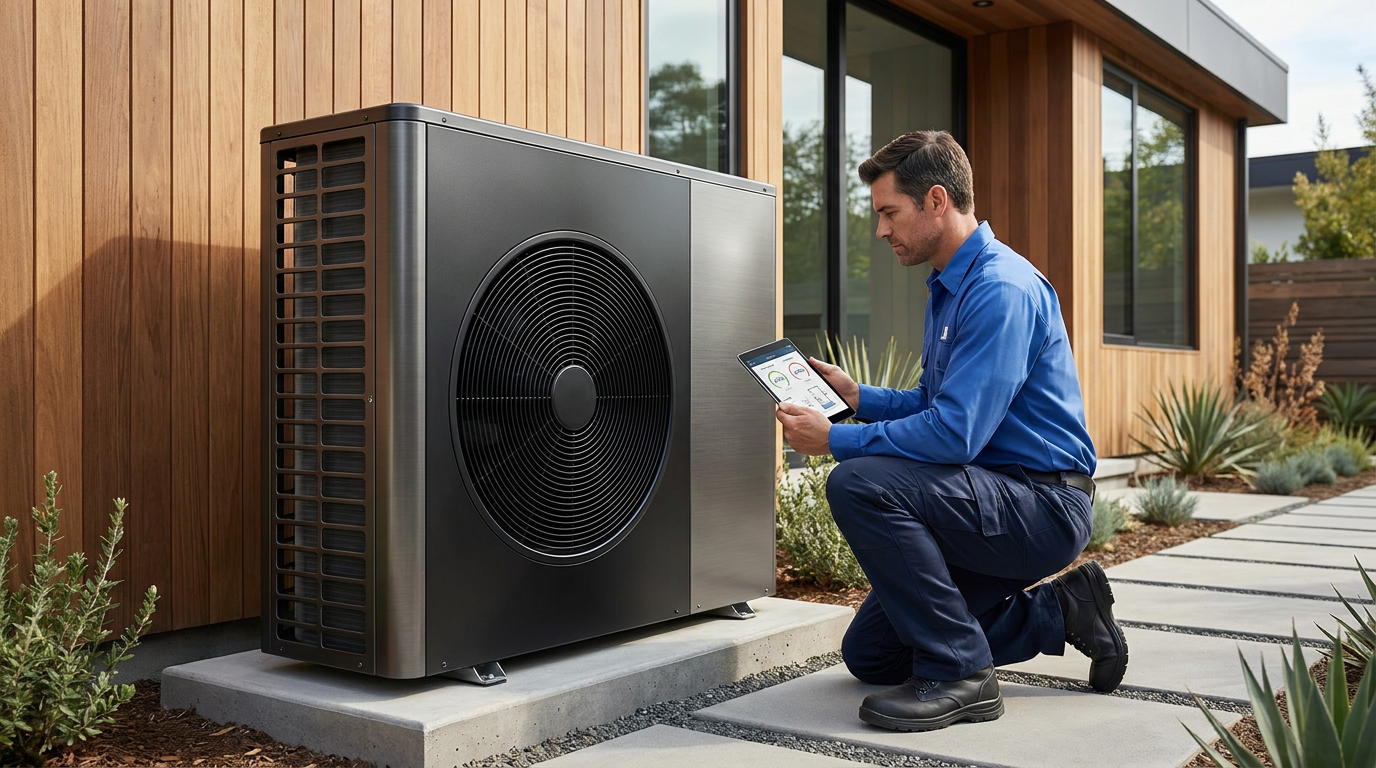
- Electrification Advocates
- Argue that rapid adoption of heat pumps is the most effective way to decarbonize residential buildings and lower utility bills.
- Energy Policymakers
- Focus on validating the technology's performance in extreme weather to ensure grid reliability and consumer confidence.
- HVAC Contractors
- Emphasize the practical hurdles of retrofitting, including the need for electrical panel upgrades, weatherization, and navigating complex rebate programs.
What's not represented
- · Natural gas utility operators facing declining residential demand.
- · Renters who cannot directly upgrade their building's mechanical systems.
Why this matters
Heating and cooling account for roughly half of a home's energy use. Upgrading to a modern heat pump can drastically lower utility bills, improve indoor air quality, and unlock up to $10,000 in federal tax credits and rebates for eligible households.
Key points
- Heat pumps outsold traditional gas furnaces in the U.S. for the fourth consecutive year in 2025.
- Unlike furnaces that burn fuel, heat pumps move existing thermal energy, achieving efficiencies of 300% or higher.
- Field tests prove modern cold-climate models maintain 100% heating capacity even at 5 degrees Fahrenheit.
- The Inflation Reduction Act provides up to $8,000 in upfront rebates for eligible low- and moderate-income households.
- Experts recommend an 'envelope first' approach, upgrading insulation and air sealing before installing a new system.
For decades, the defining features of a major home remodel were highly visible: quartz countertops, open-concept floor plans, and hardwood floors. But in 2026, the most consequential upgrade happening in American homes is largely hidden in basements and side yards. The residential energy transition has moved from a niche environmental pursuit to a core component of home valuation, driven by a piece of technology that fundamentally changes how a building manages temperature.[6]
The market data reflects a quiet but massive shift in consumer behavior. In 2025, for the fourth consecutive year, electric heat pumps outsold traditional fossil gas-fired furnaces in the United States. Shipments of the zero-emission appliances reached 3.6 million units, cementing their status as the dominant heating and cooling choice for new construction and major retrofits alike.[1]
To understand why this transition is accelerating, it is necessary to look at the underlying physics of the technology. Traditional heating systems, such as gas furnaces or oil boilers, rely on combustion. They burn a fossil fuel to create heat, which is then distributed through the home. Even traditional electric resistance heating works by forcing electricity through a resistor to generate warmth. A heat pump, however, does not create heat at all; it simply moves it.[6]

Using a closed loop of advanced chemical refrigerants and a compressor, a heat pump absorbs ambient thermal energy from one environment and releases it into another. During the summer, the system acts exactly like a standard air conditioner, absorbing heat from inside the house and pumping it outdoors. In the winter, a reversing valve flips the flow. The system extracts latent heat from the cold outside air—because even freezing air contains thermal energy—and compresses it to warm the interior of the home.[6]
Because moving heat requires significantly less energy than generating it from scratch, heat pumps achieve remarkable efficiency. This is measured by a Coefficient of Performance (COP). While a high-efficiency gas furnace might convert 95 percent of its fuel into usable heat (a COP of 0.95), and electric baseboards operate at exactly 100 percent efficiency (a COP of 1.0), a modern heat pump can easily achieve a COP of 3.0 or higher. It delivers three units of heat for every one unit of electricity it consumes.[6]
Despite this mathematical advantage, heat pumps historically suffered from a major geographic limitation. Early generations of the technology struggled to extract enough heat when outdoor temperatures dropped below freezing. As the mercury plummeted, the systems had to rely on inefficient electric resistance backup strips, causing winter utility bills to spike. This cemented a long-standing myth that heat pumps were only suitable for the mild winters of the Sun Belt, leaving the Northeast and Midwest reliant on gas and heating oil.[6]

That geographic barrier has been systematically dismantled by recent engineering breakthroughs. Inverter-driven compressors, which can vary their speed to precisely match the home's heating load, combined with next-generation refrigerants, have drastically improved cold-weather performance. To accelerate this shift, the U.S. Department of Energy launched the Cold Climate Heat Pump Technology Challenge, partnering with major manufacturers to engineer units specifically designed for the harshest North American winters.[2]
That geographic barrier has been systematically dismantled by recent engineering breakthroughs.
The results of this initiative have redefined the industry's capabilities. During extensive field validations conducted by the Pacific Northwest National Laboratory, prototype units from leading manufacturers were installed in homes across cold-weather states. The data revealed that these next-generation cold-climate heat pumps could maintain 100 percent of their rated heating capacity even when outdoor temperatures dropped to 5 degrees Fahrenheit.[3]
Furthermore, the efficiency of these units remained remarkably high in extreme conditions. The laboratory's field data showed that at temperatures between zero and 5 degrees Fahrenheit, the cold-climate models maintained a median COP of 1.9. This means that even in the bitter cold, the heat pumps were operating at nearly twice the efficiency of traditional electric resistance heating, effectively neutralizing the primary argument against their use in northern climates.[3]

While the operational physics and long-term savings are compelling, the upfront economics of retrofitting an existing home remain a significant hurdle. Installing a whole-home heat pump system can cost anywhere from $8,000 to over $20,000, depending on the size of the home, the condition of existing ductwork, and the complexity of the installation. For many households, this capital requirement has historically kept the technology out of reach.[6]
To bridge this financial gap, the federal government has deployed unprecedented capital through the Inflation Reduction Act. The centerpiece of this effort is the High-Efficiency Electric Home Rebate program, which is actively rolling out through state energy offices. This program provides up to $8,000 in point-of-sale discounts for heat pump installations, specifically targeting low- and moderate-income households earning below 150 percent of their Area Median Income.[5]
For households that do not meet the income thresholds for the upfront rebates, the legislation also expanded the 25C energy efficient home improvement tax credit. Any homeowner can now claim a tax credit covering 30 percent of the cost of a qualifying heat pump installation, capped at $2,000 annually. When combined with local utility incentives, these federal subsidies are fundamentally altering the return-on-investment calculation for home energy upgrades.[5]

However, executing a successful heat pump retrofit is rarely as simple as swapping one box for another. Many older homes lack the electrical infrastructure to support a new high-capacity appliance. Upgrading a home's electrical panel from 100 amps to 200 amps can add thousands of dollars to a project, a bottleneck that the industry is trying to solve with new 120-volt heat pump models and smart electrical panels that manage load dynamically.[1][6]
Building science experts also caution against treating the heat pump as a silver bullet for a poorly designed home. The most successful retrofits follow an 'envelope first' philosophy. If a home is leaking heat through uninsulated attics and drafty windows, installing a powerful new heating system is highly inefficient. By investing in air sealing and insulation first, homeowners can reduce their overall heating load, allowing them to install a smaller, less expensive heat pump.[6]
When executed correctly, the macroeconomic and environmental benefits of this transition are staggering. According to analysis by the energy think tank RMI, there are still over 25 million homes in the United States relying on outdated electric resistance heating. Upgrading these specific single-family homes to modern heat pumps would save households an average of $1,530 per year on their utility bills, while simultaneously slashing the winter peak demand that currently strains the electrical grid.[4]
As the 2026 remodeling season accelerates, the heat pump has evolved from a piece of specialized green technology into the standard bearer of modern home comfort. Supported by robust federal funding, validated by rigorous cold-weather testing, and embraced by a growing workforce of specialized contractors, the electrification of the American home is no longer a distant policy goal. It is a tangible, ongoing construction project happening in millions of basements and backyards.[6]
How we got here
2021
The Department of Energy launches the Cold Climate Heat Pump Challenge to spur sub-zero innovation.
2022
The Inflation Reduction Act passes, authorizing billions in home energy rebates and tax credits.
2024–2025
National laboratories conduct field validations proving next-generation heat pumps maintain capacity in extreme cold.
2025
Heat pumps outsell gas furnaces in the United States for the fourth consecutive year.
2026
State energy offices actively roll out point-of-sale HEEHR rebates to consumers.
Viewpoints in depth
Electrification Advocates
Argue that rapid adoption of heat pumps is the most effective way to decarbonize residential buildings and lower utility bills.
Organizations like Rewiring America and RMI view the heat pump as the linchpin of the residential energy transition. They point to data showing that replacing outdated electric resistance heating with modern heat pumps can save the average household over $1,500 annually. For these advocates, the transition is a race against time to eliminate the roughly 10 percent of U.S. carbon emissions that come from burning fossil fuels in homes, making aggressive state and federal subsidies essential.
Energy Policymakers
Focus on validating the technology's performance in extreme weather to ensure grid reliability and consumer confidence.
For the Department of Energy and national laboratories, the primary concern has been proving that electrification won't compromise comfort or grid stability during winter storms. By launching the Cold Climate Heat Pump Challenge and publishing rigorous field validation data, policymakers aim to dismantle the myth that heat pumps fail in freezing temperatures. Their focus is on ensuring that the mass deployment of these systems actually reduces winter peak demand rather than exacerbating it.
HVAC Contractors
Emphasize the practical hurdles of retrofitting, including the need for electrical panel upgrades, weatherization, and navigating complex rebate programs.
While supportive of the technology, the professionals installing these systems caution that retrofits are rarely plug-and-play. Contractors frequently encounter older homes with insufficient 100-amp electrical panels or poor insulation that must be addressed before a heat pump can function efficiently. They advocate for an 'envelope first' approach—sealing drafts and upgrading insulation—to ensure that homeowners don't overpay for oversized equipment that fails to deliver the promised savings.
What we don't know
- How quickly the electrical grid can upgrade local distribution transformers to handle the increased load of whole-home electrification.
- Whether the shortage of trained HVAC technicians will create installation bottlenecks as consumer demand accelerates.
Key terms
- Coefficient of Performance (COP)
- A measure of efficiency calculated by dividing the heat output by the electrical energy input; a COP of 3.0 means the system is 300% efficient.
- Inverter-driven compressor
- A variable-speed motor that allows a heat pump to adjust its output precisely to the home's heating or cooling needs, rather than just turning fully on or off.
- Electric resistance heating
- Traditional electric heating, like baseboards or space heaters, that generates heat by passing current through a resistor, operating at exactly 100% efficiency.
- Cold-climate heat pump (CCHP)
- A heat pump specifically engineered with advanced refrigerants and compressors to extract heat from outdoor air even at sub-zero temperatures.
Frequently asked
Do I need a backup gas furnace if I live in a cold climate?
Not necessarily. Modern cold-climate heat pumps can provide 100% of a home's heating needs down to 5°F and continue operating efficiently below zero, though some homes keep a backup for extreme weather or grid outages.
Can I get a heat pump if my house doesn't have air ducts?
Yes. Ductless mini-split heat pumps are designed specifically for homes without existing ductwork, allowing you to heat and cool individual rooms efficiently.
How do I claim the $8,000 IRA rebate?
The High-Efficiency Electric Home Rebate (HEEHR) is a point-of-sale discount administered by individual state energy offices. You must meet income requirements (below 150% of the Area Median Income) and use an approved contractor.
Sources
Source coverage
6 outlets
3 viewpoints surfaced






[1]Canary MediaElectrification Advocates
Heat pumps outsold fossil gas–fired furnaces in the U.S. yet again last year
Read on Canary Media →[2]U.S. Department of EnergyEnergy Policymakers
Residential Cold Climate Heat Pump Technology Challenge
Read on U.S. Department of Energy →[3]Pacific Northwest National LaboratoryEnergy Policymakers
Performance Results from DOE Cold Climate Heat Pump Challenge Field Validation
Read on Pacific Northwest National Laboratory →[4]RMIElectrification Advocates
The Case for Upgrading Electric Resistance Heating to Heat Pumps
Read on RMI →[5]Rewiring AmericaElectrification Advocates
IRA Savings Calculator and Rebate Guide
Read on Rewiring America →[6]Factlen Editorial TeamHVAC Contractors
Synthesis by Factlen editorial team
Read on Factlen Editorial Team →
Every angle. Every day.
Get home stories with full source coverage and perspective breakdowns delivered to your inbox.