
The Evidence on At-Home Red Light Therapy: What Actually Works
At-home LED masks and panels have surged in popularity, promising clinical-grade skin and hair benefits. A review of the latest dermatological evidence reveals where the science is solid—and where marketing outpaces reality.
By Factlen Editorial Team
- Clinical Dermatologists
- Medical professionals focused on evidence-based efficacy, proper dosing, and safety.
- Beauty & Wellness Reviewers
- Users prioritizing non-invasive, accessible anti-aging and skin health treatments.
- Factlen Editorial Synthesis
- Independent analysis bridging clinical data with consumer market realities.
What's not represented
- · Regulatory bodies evaluating long-term consumer device safety
- · Aestheticians offering professional-grade laser treatments
Why this matters
Consumers are spending hundreds of dollars on FDA-cleared light therapy devices to avoid invasive cosmetic procedures. Knowing which wavelengths and power specifications actually stimulate cellular repair prevents wasting money on underpowered gadgets.
Key points
- At-home red light therapy uses specific wavelengths to stimulate cellular energy and collagen production.
- Clinical evidence strongly supports its use for reducing acne, fine lines, and pattern hair loss.
- Red light (630–660 nm) targets surface skin, while near-infrared (810–850 nm) penetrates deeper tissue.
- Efficacy depends heavily on a device's irradiance, or power output, which many consumer brands under-deliver.
- The treatment is highly safe, utilizing no UV light, though eye protection is required for blue light modes.
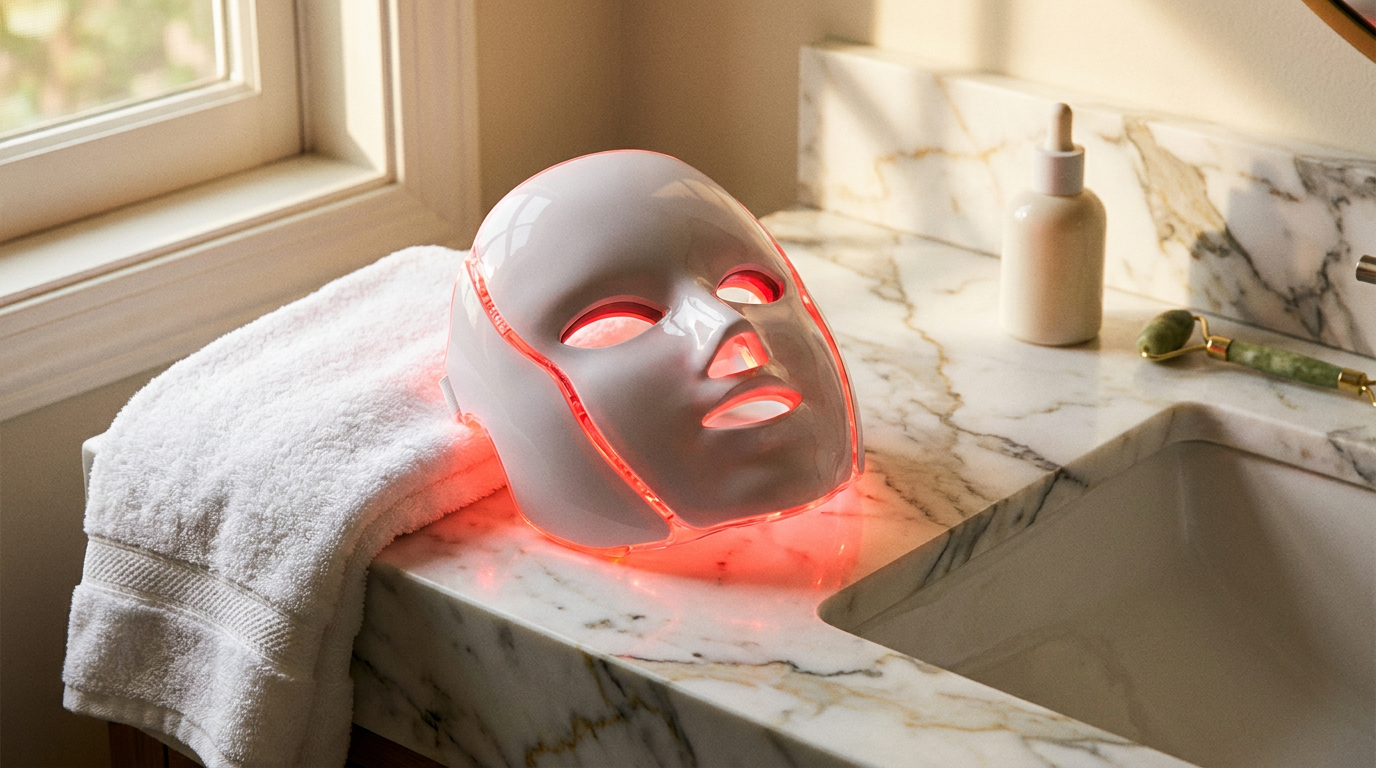
Once confined to the sterile rooms of dermatology clinics, red light therapy has rapidly become a cornerstone of the consumer wellness and beauty market. Devices ranging from flexible silicone face masks to full-body panels now promise to reverse wrinkles, clear stubborn acne, and stimulate hair growth from the comfort of a living room couch.[3][4]
But as the market floods with increasingly expensive devices, the gap between clinical science and consumer marketing has widened. The underlying technology, known clinically as photobiomodulation (PBM), is not a modern wellness fad; it is grounded in decades of peer-reviewed research and biological science.[5]
The challenge for today's consumer is separating the devices that deliver a genuine, therapeutic dose of light from those that merely emit a pleasant red glow. Understanding the mechanics of light therapy is essential before investing hundreds of dollars in an at-home gadget.[7]

At the cellular level, red light therapy works by interacting directly with the mitochondria—the microscopic powerhouses responsible for producing energy inside human cells.[6]
When specific, targeted wavelengths of light penetrate the skin, they are absorbed by a mitochondrial enzyme called cytochrome c oxidase. This absorption acts as a biological catalyst, stimulating the production of adenosine triphosphate (ATP), which is the primary fuel that cells use to function, repair damage, and regenerate tissue.[5][6]
The efficacy of any light therapy device depends entirely on the specific wavelengths it emits. Red light, typically calibrated between 630 and 660 nanometers (nm), penetrates the upper layers of the skin, known as the papillary dermis. This makes it highly effective for targeting fine lines, rough texture, and surface-level inflammation.[2][6]
Near-infrared (NIR) light operates at a longer wavelength, ranging from 810 to 850 nm. Because it is invisible to the naked eye, users cannot see it working, but it penetrates much deeper into the reticular dermis and underlying tissue. This deeper reach makes NIR essential for improving collagen density, skin firmness, and even localized muscle and joint recovery.[5]

Near-infrared (NIR) light operates at a longer wavelength, ranging from 810 to 850 nm.
Blue light, which operates around 415 nm, works through an entirely different mechanism. It does not penetrate deeply into the skin but instead targets the surface layer, where it actively destroys the Cutibacterium acnes bacteria responsible for inflammatory acne breakouts.[3][4]
The strongest dermatological evidence for at-home consumer devices centers on photoaging and overall skin rejuvenation. Consistent use of adequately powered red and near-infrared light has been definitively shown to stimulate fibroblasts, the specialized cells responsible for producing collagen and elastin.[2][5]
Clinical trials demonstrate that these structural changes to the skin are highly measurable, though they require patience. Studies tracking users over a standard 12-week period have recorded a remarkable 48 percent increase in collagen density and a 38 percent decrease in the appearance of periorbital wrinkles, commonly known as crow's feet.[7]
For acne sufferers, the clinical evidence is similarly robust when red and blue light are utilized together. A comprehensive 2025 meta-analysis published in JAMA Dermatology reviewed multiple patient studies and concluded that at-home LED devices reduced inflammatory acne lesions by approximately 45 percent over a four- to eight-week period.[1]

Hair loss, specifically androgenetic alopecia or pattern baldness, is another area with exceptionally strong clinical backing. A 2025 consensus review endorsed photobiomodulation as an effective treatment, with users typically seeing meaningful, measurable improvements in hair density and thickness after 16 to 24 weeks of consistent helmet or comb use.[5][6]
Despite these proven, peer-reviewed benefits, dermatologists routinely caution that many consumer-grade devices lack the raw power required to replicate clinical results. The critical, often-overlooked metric is irradiance—the actual power density of the light delivered to the skin, measured in milliwatts per square centimeter.[5][7]
If a device's irradiance is too low, the total energy delivered during a standard 10-minute session—known as the fluence—will fall below the therapeutic threshold. The established evidence range for facial anti-aging requires 5 to 20 joules per square centimeter per session to trigger meaningful cellular changes.[7]

Safety is one area where the medical consensus is nearly universal and highly reassuring. Red and near-infrared light therapy does not utilize ultraviolet (UV) rays, meaning it is biologically impossible for these devices to burn the skin, damage cellular DNA, or increase the risk of melanoma and other skin cancers.[2][5]
The primary safety concern flagged by medical professionals involves eye protection. While red and near-infrared light are generally considered safe for the eyes at standard consumer power levels, direct retinal exposure to blue light carries documented risks. Experts mandate the strict use of opaque goggles when operating masks equipped with blue LED acne modes.[5][6]
How we got here
1960s
Endre Mester discovers low-level laser therapy (LLLT) while experimenting with lasers on mice.
1990s
NASA begins experimenting with red LED lights to promote plant growth and wound healing in space.
Early 2000s
Photobiomodulation crosses into clinical dermatology for the treatment of skin conditions and wound healing.
2010s
The first generation of at-home, consumer-grade LED face masks enters the beauty market.
2025
Major medical journals publish consensus reviews confirming the efficacy of at-home LED devices for acne and photoaging.
Viewpoints in depth
Clinical Dermatologists
Medical professionals focused on evidence-based efficacy and safety.
Dermatologists emphasize that while photobiomodulation is a proven biological mechanism, the consumer market is flooded with underpowered devices. They advise patients to look past marketing claims and focus on specific metrics: a wavelength between 630 and 850 nm, and an irradiance high enough to deliver a therapeutic dose. They also stress that at-home devices require months of consistent, daily use to achieve results that a single in-office laser treatment might accomplish.
Beauty & Wellness Consumers
Users prioritizing non-invasive, accessible anti-aging and skin health treatments.
For many consumers, the appeal of at-home LED therapy lies in its convenience and safety profile. Unlike chemical peels, microneedling, or injectables, red light masks offer a pain-free, zero-downtime addition to a nightly routine. Even if the results are more subtle than clinical interventions, the ability to treat fine lines, acne, and inflammation from the couch makes the initial hardware investment worthwhile for this demographic.
Device Manufacturers
Brands developing and marketing at-home photobiomodulation technology.
Manufacturers argue that they are democratizing access to dermatological technology. By securing FDA clearance for their devices, they aim to legitimize the at-home market. Leading brands increasingly focus on multi-wavelength technology, combining red, near-infrared, and blue light into single flexible silicone masks to treat multiple skin concerns simultaneously, justifying premium price points with clinical trial data.
What we don't know
- Whether the lower irradiance of budget-friendly consumer devices can ever match the long-term efficacy of clinical-grade panels.
- The exact optimal dosing schedule (minutes per session and sessions per week) for maximizing collagen production without diminishing returns.
- How effectively at-home red light therapy treats complex pigmentation issues like melasma, where clinical evidence remains mixed.
Key terms
- Photobiomodulation (PBM)
- The use of specific wavelengths of light to stimulate cellular function, energy production, and healing.
- Irradiance
- The power density of light delivered to the skin, typically measured in milliwatts per square centimeter.
- Fluence
- The total amount of light energy delivered to the tissue over the course of a session.
- Near-Infrared (NIR) Light
- Invisible light wavelengths (typically 810–850 nm) that penetrate deeply into the skin to target collagen and joint tissue.
Frequently asked
Does red light therapy cause skin cancer?
No. Red and near-infrared light therapy does not use ultraviolet (UV) rays, meaning it cannot damage DNA, burn the skin, or increase the risk of skin cancer.
How long does it take to see results?
Results require consistency. Clinical trials show acne reduction in 4 to 8 weeks, wrinkle reduction in 12 weeks, and hair density improvements in 16 to 24 weeks.
Do I need to wear eye protection?
While red and near-infrared light are generally safe for the eyes, direct exposure to blue light carries risks. Opaque goggles are mandatory when using blue LED modes.
What is the difference between FDA-cleared and FDA-approved?
Most at-home devices are 'FDA-cleared,' meaning they are proven substantially equivalent to an existing safe device. 'FDA-approved' requires a much more rigorous clinical trial process.
Sources
Source coverage
7 outlets
3 viewpoints surfaced







[1]JAMA DermatologyClinical Dermatologists
Meta-analysis of at-home LED devices for acne
Read on JAMA Dermatology →[2]American Academy of DermatologyClinical Dermatologists
Light therapy for skin conditions
Read on American Academy of Dermatology →[3]ForbesBeauty & Wellness Reviewers
Best LED Face Masks With Red Light Therapy
Read on Forbes →[4]Women's HealthBeauty & Wellness Reviewers
The Best LED Face Masks For Wrinkles And Acne
Read on Women's Health →[5]Dermatology TimesClinical Dermatologists
Evidence-based consensus on the clinical application of photobiomodulation
Read on Dermatology Times →[6]Superpower Clinical ReviewClinical Dermatologists
Red Light Therapy Panels: Which Wavelengths Actually Do Something
Read on Superpower Clinical Review →[7]Factlen Editorial TeamFactlen Editorial Synthesis
Synthesis by Factlen editorial team
Read on Factlen Editorial Team →

Every angle. Every day.
Get shopping stories with full source coverage and perspective breakdowns delivered to your inbox.