
The Evidence is In: Building More Housing Reliably Lowers Rent
Years of data from cities like Austin and Minneapolis prove that eliminating restrictive zoning and building more homes significantly reduces housing costs, especially for lower-income renters.
By Factlen Editorial Team
- Empirical Consensus
- Focuses on the aggregate data showing that increased housing supply reliably moderates rent growth across all income tiers.
- Nuance & Equity Researchers
- Highlight that while supply matters, upzoning's effects vary by neighborhood and must be paired with subsidies to protect the most vulnerable.
- Local Policy Implementers
- City officials and urban planners working to dismantle restrictive zoning and parking minimums to spur development.
What's not represented
- · Low-income renters currently facing eviction
- · Construction industry labor unions
- · Environmental advocates focused on urban sprawl
Why this matters
For years, the debate over how to solve the housing crisis relied on competing economic theories. Now, hard data from cities that actually changed their laws proves that building more homes—even market-rate ones—reliably lowers rent and provides immediate financial relief to lower-income tenants.
Key points
- Cities that aggressively reformed zoning laws, like Austin and Minneapolis, are seeing significant drops in median rent.
- A 30% increase in Austin's housing stock led to a nearly 10% drop in overall rents, with the steepest declines in older, more affordable buildings.
- Economists point to 'filtering,' where new luxury units absorb high-income renters, freeing up older apartments for middle- and lower-income residents.
- While supply-side reforms are highly effective, researchers caution they must be paired with subsidies to fully protect vulnerable neighborhoods from short-term displacement.
For decades, the American housing market has operated under a simple, painful math: population growth vastly outpaced construction, creating a nationwide shortage of four to seven million homes.[7]
As prices spiraled and homeownership slipped out of reach for millions, a fierce debate emerged over the solution. Supply-side advocates argued that stripping away restrictive zoning laws to allow more construction would naturally cool prices.[7]
Skeptics, however, countered that developers would only build luxury units, enriching investors while doing nothing for lower-income renters—or worse, accelerating gentrification.[7]
Now, in 2026, the theoretical debate is giving way to hard empirical data. Several major U.S. cities have spent the last five to eight years aggressively deregulating their housing markets, providing a real-time laboratory for economists to measure what actually happens when a city builds its way out of a shortage.[7]
The most compelling evidence comes from cities that enacted sweeping land-use reforms before the pandemic. Minneapolis made headlines in 2018 by eliminating single-family-only zoning citywide and abolishing minimum parking requirements for new developments.[2]
The results of the Minneapolis 2040 plan have been stark. While national rents surged by 22% between 2019 and 2024, rents in Minneapolis actually declined by 4% during the same period, proving that comprehensive zoning reform can decouple a local market from national inflationary trends.[2]

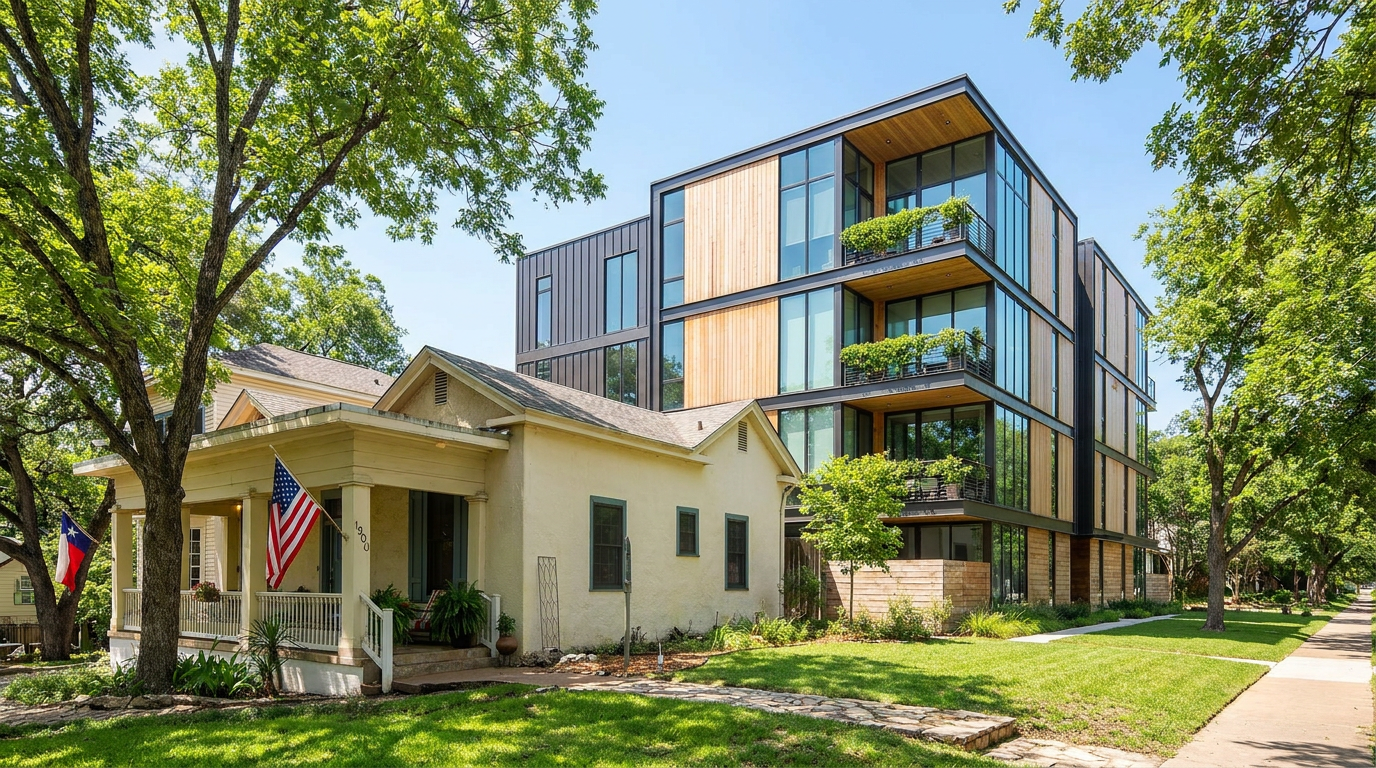
Austin, Texas, executed a similar playbook, streamlining permitting, reducing parking mandates, and allowing denser housing along commercial and transit corridors.[2]
Between 2015 and 2024, Austin added roughly 120,000 new housing units—a massive 30% increase in its housing stock that vastly outpaced the national average.[1]
As a direct result of this construction boom, Austin's median asking rent dropped by nearly 10% year-over-year in recent measurements, representing the steepest decline of any major U.S. metropolitan area.[1][2]

The central fear of upzoning critics has always been that new construction only benefits the wealthy. However, recent comprehensive data from the Pew Charitable Trusts challenges this assumption directly.[1]
The central fear of upzoning critics has always been that new construction only benefits the wealthy.
Analyzing 1,654 ZIP codes across the country, Pew researchers found that in metropolitan areas that increased their housing stock by at least 10% from 2017 to 2023, rent growth slowed significantly compared to stagnant markets.[1]
Crucially, the steepest rent declines occurred in "Class C" apartments—older, non-luxury buildings that typically house lower-income residents. In Austin, rents in these older buildings fell by roughly 11% from 2023 to 2024.[1]
This phenomenon occurs because of a mechanism economists call "filtering," which describes the chain reaction of moves triggered by new construction.[6]
When a developer builds a high-end apartment building, it is rarely occupied by people moving out of subsidized affordable housing. Instead, it attracts higher-income renters who vacate middle-tier apartments.[6]

Those middle-tier units then become available to moderate-income renters, who in turn vacate older, lower-tier units. A landmark study by economist Evan Mast tracked 52,000 urban residents to map these migration chains.[6]
Mast found that for every 100 new market-rate homes built in a high-income neighborhood, between 45 and 70 homes are eventually freed up in below-median-income neighborhoods, preventing wealthy renters from bidding up the prices of older stock.[6]
Despite the strong data from high-growth cities, the evidence that upzoning is a universal panacea remains mixed in certain contexts. Urban planner Yonah Freemark's research highlights that upzoning's success is highly dependent on local market conditions; in "weak-market" neighborhoods, simply changing the zoning code does not automatically spur developers to build.[4]
Furthermore, studies of neighborhood-level rezonings in cities like New York found that upzoning lower-income areas without accompanying tenant protections can temporarily increase land values and displacement pressures before new supply comes online.[3]

A 2025 study from the National Bureau of Economic Research also cautioned that easing supply constraints might not yield anticipated affordability if local income growth continues to skyrocket, as high incomes inherently drive up housing costs regardless of zoning.[5]
Ultimately, the emerging academic consensus suggests that while upzoning is not a standalone cure, it is a necessary precondition for housing affordability. When paired with targeted subsidies for the lowest-income renters, removing barriers to construction remains the most proven method for stabilizing the housing market and providing relief to renters across all income brackets.[3][7]
How we got here
2018
Minneapolis passes the 2040 Plan, becoming the first major U.S. city to eliminate single-family-only zoning.
2019
Austin launches the 'Affordability Unlocked' program to ease height restrictions and stimulate lower-cost housing production.
2023
Austin repeals minimum parking requirements citywide to lower the cost of multifamily development.
2024–2025
Data reveals significant rent drops in Austin and Minneapolis, contrasting sharply with rising national averages.
2026
A growing body of academic research confirms that increased housing supply reliably slows rent growth, particularly for older units.
Viewpoints in depth
The Supply-Side Argument
Building more market-rate housing relieves pressure across the entire market.
Proponents of aggressive upzoning point to the fundamental laws of supply and demand. For decades, artificial caps on housing density—such as single-family-only zoning and mandatory parking minimums—prevented cities from adapting to population growth. By legalizing denser construction, cities allow developers to absorb the demand of high-income renters. Crucially, evidence from economists like Evan Mast demonstrates the 'filtering' effect: when wealthy residents move into new luxury buildings, they vacate older units, which then become available and affordable to middle- and lower-income residents. In this view, every new unit built, regardless of its price tag, helps ease the overall shortage.
The Equity and Displacement Concern
Upzoning without targeted protections can accelerate gentrification in vulnerable areas.
While acknowledging the need for more housing, equity-focused researchers and anti-displacement advocates caution against treating upzoning as a universal cure. Studies of neighborhood-level rezonings in cities like New York have shown that upzoning low-income, transit-rich areas can sometimes trigger speculative land buying. This drives up property taxes and incentivizes landlords to evict existing tenants before new supply can actually be built to cool the market. These advocates argue that broad upzoning must be paired with robust tenant protections, mandatory inclusionary zoning, and direct government subsidies to ensure that the lowest-income residents are not displaced during the transition period.
The Income-Driven Skepticism
Housing costs are primarily driven by rising local incomes, not just zoning constraints.
A more skeptical economic perspective, highlighted by recent NBER research, suggests that the focus on zoning might be slightly misplaced. These researchers argue that the primary driver of skyrocketing housing costs in superstar cities is the rapid growth of high-income jobs. In this view, even if a city completely deregulates its housing market, prices will continue to rise as long as the local economy keeps minting high earners willing to pay a premium for location. Therefore, while building more housing is necessary, it may not result in the dramatic price drops that some reformers promise, simply because the underlying demand generated by localized wealth creation remains so strong.
What we don't know
- Whether the dramatic rent drops in Austin and Minneapolis will stabilize or continue to fall as more supply comes online.
- The exact threshold of new construction required to trigger the 'filtering' effect in chronically underbuilt coastal cities like New York and San Francisco.
- How upcoming changes to federal interest rates will impact the pace of new multifamily construction in deregulated markets.
Key terms
- Upzoning
- Changing local zoning codes to allow for denser housing development, such as permitting apartment buildings in areas previously restricted to single-family homes.
- Filtering
- The economic process where building new, expensive housing causes higher-income people to move, freeing up their older homes for middle- and lower-income residents.
- Class C Apartments
- Older, non-luxury apartment buildings that typically offer the most affordable market-rate rents in a city.
- Parking Minimums
- Local laws requiring developers to build a certain number of off-street parking spaces for every new housing unit, which significantly increases construction costs.
- Inclusionary Zoning
- Policies that require developers to designate a certain percentage of new housing units as affordable for lower-income residents.
Frequently asked
Does building luxury apartments actually help lower-income renters?
Yes. Through a process called 'filtering,' new luxury units absorb high-income renters, preventing them from bidding up the prices of older, more affordable apartments.
Did eliminating parking minimums lower rent?
Yes. Parking garages are incredibly expensive to build. Removing the mandate to build them significantly lowers construction costs, allowing developers to charge lower rents and build more units.
What is 'missing middle' housing?
It refers to multi-unit housing types like duplexes, triplexes, and townhomes that sit between single-family homes and large apartment complexes. Many cities banned these for decades.
Does upzoning cause gentrification?
The evidence is mixed. While citywide upzoning generally lowers rents, upzoning only specific low-income neighborhoods can sometimes increase land values and displacement pressures in the short term.
Sources
Source coverage
7 outlets
3 viewpoints surfaced







[1]Pew Charitable TrustsEmpirical Consensus
New housing slows rent growth most for older, more affordable units
Read on Pew Charitable Trusts →[2]The Texas TribuneLocal Policy Implementers
Austin officials look to smaller zoning reforms to stimulate housing supply
Read on The Texas Tribune →[3]Urban InstituteNuance & Equity Researchers
What the Latest Research Tells Us about the Effects of Upzoning
Read on Urban Institute →[4]Journal of Planning LiteratureNuance & Equity Researchers
Upzoning and Housing Affordability: A Review of the Literature
Read on Journal of Planning Literature →[5]National Bureau of Economic ResearchNuance & Equity Researchers
Housing Supply Constraints and Income Growth
Read on National Bureau of Economic Research →[6]W.E. Upjohn InstituteEmpirical Consensus
The Effect of New Market-Rate Housing Construction on the Low-Income Housing Market
Read on W.E. Upjohn Institute →[7]Factlen Editorial TeamEmpirical Consensus
Synthesis by Factlen editorial team
Read on Factlen Editorial Team →
Every angle. Every day.
Get real estate stories with full source coverage and perspective breakdowns delivered to your inbox.