
Apple Overhauls iPhone Experience with Siri AI and Practical New Features in iOS 27
Apple's upcoming iOS 27 update introduces 'Siri AI,' a deeply integrated assistant capable of understanding personal context, onscreen content, and complex multi-step requests. The update also brings a standalone Siri app and expanded landscape mode, though the most advanced features will require the newest hardware.
By Factlen Editorial Team
- Apple Ecosystem Enthusiasts
- Value the deep integration, privacy-first on-device processing, and the seamless ability of Siri to interact with personal data across apps.
- Tech Industry Analysts
- View the update as a necessary catch-up to industry leaders that will drive a massive hardware upgrade supercycle.
- Hardware Critics
- Frustrated by the aggressive hardware gating that locks even recent flagship buyers out of the most advanced features.
What's not represented
- · European Union Regulators
- · Android Ecosystem Competitors
Why this matters
For hundreds of millions of iPhone users, iOS 27 represents the most significant shift in how they interact with their devices in years. By transforming Siri from a basic voice command tool into an aware, context-sensitive AI assistant, Apple is fundamentally changing daily digital workflows—from splitting bills to drafting emails.
Key points
- Apple's iOS 27 introduces Siri AI, a rebuilt assistant with deep system integration and onscreen awareness.
- A new standalone Siri app allows users to type queries, upload files, and sync conversation history across devices.
- The Camera app gains a 'Siri Mode' that can analyze real-world objects, such as calculating tips from a restaurant receipt.
- Siri AI requires an iPhone 15 Pro or newer, with the most advanced voice and dictation features reserved for upcoming hardware.
- The update also expands landscape orientation to many built-in apps, hinting at future foldable device support.
Apple has officially unveiled iOS 27, bringing a sweeping set of artificial intelligence features to the iPhone and fundamentally transforming its long-standing virtual assistant into 'Siri AI.' Announced at the 2026 Worldwide Developers Conference, the update promises to make the iPhone profoundly more capable by integrating generative AI deeply into the operating system.[1][2]
The overhaul serves as a tacit acknowledgment from Apple that the original iteration of Siri had fallen behind modern chatbots like OpenAI's ChatGPT and Anthropic's Claude. In response, Apple has rebuilt the assistant from the ground up, equipping it with broad world knowledge, conversational reasoning, and the ability to execute complex, multi-step requests.[4][6]
The most significant leap forward is Siri AI's new 'personal context understanding' and 'onscreen awareness.' Unlike third-party web chatbots, Siri AI can securely access a user's on-device data—including messages, emails, and photos—to answer highly specific questions. It can also 'see' what is currently displayed on the screen and take contextual action.[2][4]
This onscreen awareness extends to the physical world via a new 'Siri Mode' built directly into the iPhone's Camera app. Users can point their camera at a restaurant receipt, and Siri will automatically identify the items, calculate the appropriate tax and tip, and offer to split the bill with friends using Apple Cash.[1][4]

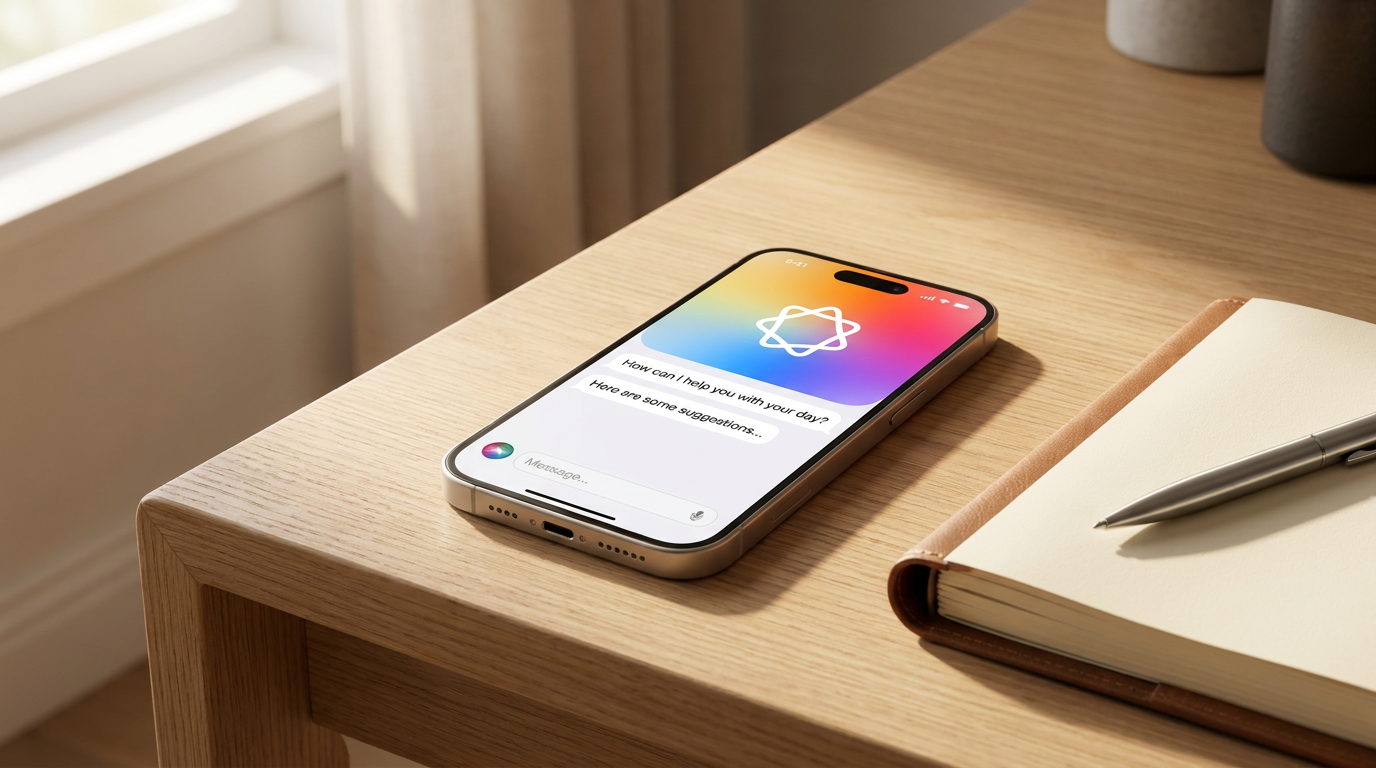
In a major structural change for the operating system, iOS 27 introduces a standalone Siri app to the iPhone Home Screen for the first time. Rather than existing solely as a transient voice overlay, Siri now has a dedicated hub where users can interact with it via text or voice.[3]
Within the new Siri app, users can revisit past conversations, upload documents or photos for analysis, and maintain a continuous chat history. Because the app syncs via iCloud, a user can start a complex research query on their iPhone and seamlessly pick up the conversation on their Mac or iPad.[3][4]
Apple is also introducing systemwide writing tools powered by the new intelligence models. A feature dubbed 'Write with Siri' allows users to draft emails or documents from scratch, proofread their work for grammar, or dynamically adjust the tone of their writing to be more professional or casual—all without leaving the app they are currently typing in.[4]

Apple is also introducing systemwide writing tools powered by the new intelligence models.
The integration extends deeply into media management. Users can ask Siri to locate highly specific images—such as 'photos of my dog at the beach from last summer'—and immediately command the assistant to edit the lighting or share the album with a specific contact, executing multiple app actions in a single breath.[2][4]
However, the computational demands of these new features mean they will not be available to all users. While the baseline iOS 27 update will install on older hardware, the Apple Intelligence suite and Siri AI require an iPhone 15 Pro, iPhone 15 Pro Max, or newer models in the iPhone 16 and upcoming iPhone 17 lineups.[2][4]
Furthermore, Apple has bifurcated the AI experience even among supported devices. The company's most advanced on-device models—which power highly expressive, customizable Siri voices and a vastly more accurate systemwide dictation engine—are reserved exclusively for the most capable upcoming hardware, including the iPhone 17 Pro, the rumored iPhone Air, and iPads or Macs equipped with at least 12GB of unified memory.[5]

The rollout will also be geographically restricted at launch. Due to ongoing regulatory complexities, Siri AI and Apple Intelligence features will not be available on iPhones or iPads in the European Union or China when iOS 27 debuts this fall, though Mac users in the EU will have access.[2][4]
Beyond artificial intelligence, iOS 27 brings several practical quality-of-life improvements. Apple is significantly expanding landscape mode support across its built-in applications. Apps like Apple Music, Podcasts, Weather, and Home will now feature optimized, left-aligned sidebars when the phone is turned sideways.[4]
This widespread adoption of landscape orientation has fueled industry speculation that Apple is laying the software groundwork for a future foldable iPhone, ensuring its core applications are already optimized for a wider, tablet-like aspect ratio.[4]

For newer devices, iOS 27 also introduces 'Dual Capture' for FaceTime. This feature allows users on the iPhone 17 lineup to broadcast video from both their front-facing and rear-facing cameras simultaneously during a video call, letting them show their face while also sharing what they are looking at.[4]
Early developer testing also points to significant under-the-hood performance optimizations. Beta testers have reported that basic system functions, such as loading recent photos or transferring files via AirDrop, operate noticeably faster on the new software architecture.[1]
How we got here
June 2024
Apple announces its initial 'Apple Intelligence' roadmap at WWDC.
September 2025
iOS 26 launches with foundational AI tools, but Siri remains largely unchanged.
June 8, 2026
Apple unveils iOS 27 and the complete 'Siri AI' overhaul at WWDC26.
July 2026
Scheduled release for the iOS 27 public beta.
September 2026
Anticipated global public launch of iOS 27 alongside new iPhone hardware.
Viewpoints in depth
Tech Industry Analysts
Viewing the update as a necessary catch-up that will drive massive hardware sales.
Industry watchers note that Apple had allowed Siri to languish while competitors like OpenAI and Google pushed the boundaries of generative AI. By integrating these capabilities directly into the operating system, Apple is not just catching up—it is leveraging its massive install base to normalize AI for everyday consumers. Analysts predict that the strict hardware requirements for Apple Intelligence will trigger a historic 'supercycle' of iPhone upgrades, as millions of users realize their current devices cannot run the new features.
Hardware Critics
Frustrated by the aggressive hardware gating of the most advanced features.
While acknowledging the computational demands of local AI models, some critics argue that Apple is aggressively segmenting its user base. The revelation that even the iPhone 16 Pro will not support the most advanced on-device dictation and expressive voices—reserving them for the upcoming iPhone 17 Pro and 'iPhone Air'—has sparked frustration. This tiered approach means that users who recently purchased flagship devices will still be locked out of the ultimate iOS 27 experience.
What we don't know
- When Apple will resolve regulatory issues to launch Siri AI in the European Union and China.
- Exactly how much the advanced on-device AI features will impact battery life on older supported models like the iPhone 15 Pro.
Key terms
- Apple Intelligence
- Apple's suite of generative AI features that run primarily on-device to protect user privacy.
- Onscreen Awareness
- The ability of an AI assistant to 'see' and understand the text, images, and context currently displayed on a device's screen.
- Unified Memory
- A memory architecture used in Apple Silicon where the CPU and GPU share the same pool of high-speed RAM.
- Generative AI
- Artificial intelligence capable of creating new text, images, or code based on user prompts and contextual data.
Frequently asked
Will my current iPhone get Siri AI?
Siri AI requires an iPhone 15 Pro, iPhone 15 Pro Max, or a newer model. Older iPhones will receive the iOS 27 update but will not have access to the advanced AI features.
Is the new Siri app replacing the voice assistant?
No. You can still invoke Siri with your voice or the side button, but the new dedicated app provides a place to type requests, upload files, and review your conversation history.
Why isn't Siri AI launching in the EU or China?
Apple has paused the rollout in these regions to ensure the new AI features comply with local privacy and digital markets regulations.
What is Siri Mode in the Camera app?
It is a new feature that lets you point your camera at real-world objects—like a receipt or a book—and ask Siri questions about them or take actions like splitting a bill.
Sources
Source coverage
6 outlets
3 viewpoints surfaced






[1]TechCrunchTech Industry Analysts
Beyond Siri: Here are the practical AI features coming to your iPhone in iOS 27
Read on TechCrunch →[2]Apple NewsroomApple Ecosystem Enthusiasts
Apple introduces Siri AI, a profoundly more capable and personal assistant
Read on Apple Newsroom →[3]9to5MacApple Ecosystem Enthusiasts
iOS 27 adds an all-new app to your iPhone's Home Screen
Read on 9to5Mac →[4]MacRumorsApple Ecosystem Enthusiasts
Siri AI in iOS 27: Features, Requirements, and How It Works
Read on MacRumors →[5]MashableHardware Critics
Apple's most advanced AI features are reserved for a much shorter list of hardware
Read on Mashable →[6]Daily Code SolutionsTech Industry Analysts
Apple acknowledges Siri has fallen behind with broad AI overhaul
Read on Daily Code Solutions →

Every angle. Every day.
Get technology stories with full source coverage and perspective breakdowns delivered to your inbox.