
The 'Dual-Track' Era: How College and Elite Gymnastics Merged to Extend Athletes' Careers
Fueled by NIL rules and a cultural shift toward athlete longevity, top gymnasts are now competing simultaneously in the NCAA and on the world stage, shattering the myth that the sport belongs only to teenagers.
By Factlen Editorial Team
- The Athletes
- Gymnasts enjoy the financial independence of NIL and the supportive team culture of college.
- NCAA Programs
- College coaches value the elite experience and leadership these athletes bring to their rosters.
- Elite National Coordinators
- National team staff benefit from athletes staying in competitive shape year-round with less high-impact pounding.
- Sports Medicine Experts
- Medical professionals praise the built-in physical recovery periods of the hybrid calendar.
What's not represented
- · International Gymnastics Federation (FIG) Officials
- · Developmental Club Coaches
Why this matters
For decades, women's gymnastics was criticized for breaking down young athletes by age 18. The new dual-track system proves that athletes can peak in their mid-20s, earn college degrees, and achieve financial independence, creating a healthier blueprint for youth sports worldwide.
Key points
- NIL legislation in 2021 allowed gymnasts to monetize their brands without forfeiting NCAA eligibility.
- Athletes now split their year, competing in the NCAA from January to April and elite from May to August.
- The NCAA's focus on execution over extreme difficulty acts as a physical recovery period, extending careers.
- The average age of elite gymnasts has risen significantly, with athletes now peaking in their early-to-mid 20s.
For decades, the blueprint for a female elite gymnast was as rigid as it was punishing. Athletes were expected to peak at 16, endure grueling training regimens that maximized difficulty at the expense of joint health, and retire by 18. The sport was widely criticized for a culture that treated teenagers as disposable, with athletes considered 'past their prime' or 'geriatric' by the time they reached college age. The prevailing wisdom dictated that a woman's body could only withstand the extreme forces of elite tumbling for a fleeting window during adolescence.[6]
Under the old amateurism rules, gymnasts faced an impossible ultimatum that forced them to abandon either their education or their athletic potential. If they accepted prize money or sponsorships to fund their expensive elite Olympic dreams, they forfeited their eligibility to compete in the NCAA. Conversely, choosing the collegiate route meant stepping away from the international stage, as the rigorous NCAA schedule and strict amateur rules made maintaining a world-class elite career nearly impossible. Most athletes simply retired after one Olympic cycle, leaving the sport before they even enrolled in university.[5]
That paradigm shattered in the summer of 2021 with the introduction of Name, Image, and Likeness (NIL) legislation across collegiate sports. By allowing student-athletes to monetize their personal brands, NIL removed the financial penalty of competing in college. Almost overnight, the sport's biggest stars realized they no longer had to choose between a university education, a lucrative sponsorship portfolio, and a run at the World Championships. They could finally have it all, transforming college gymnastics from a retirement destination into a lucrative, high-profile platform for active elite competitors.[5][6]
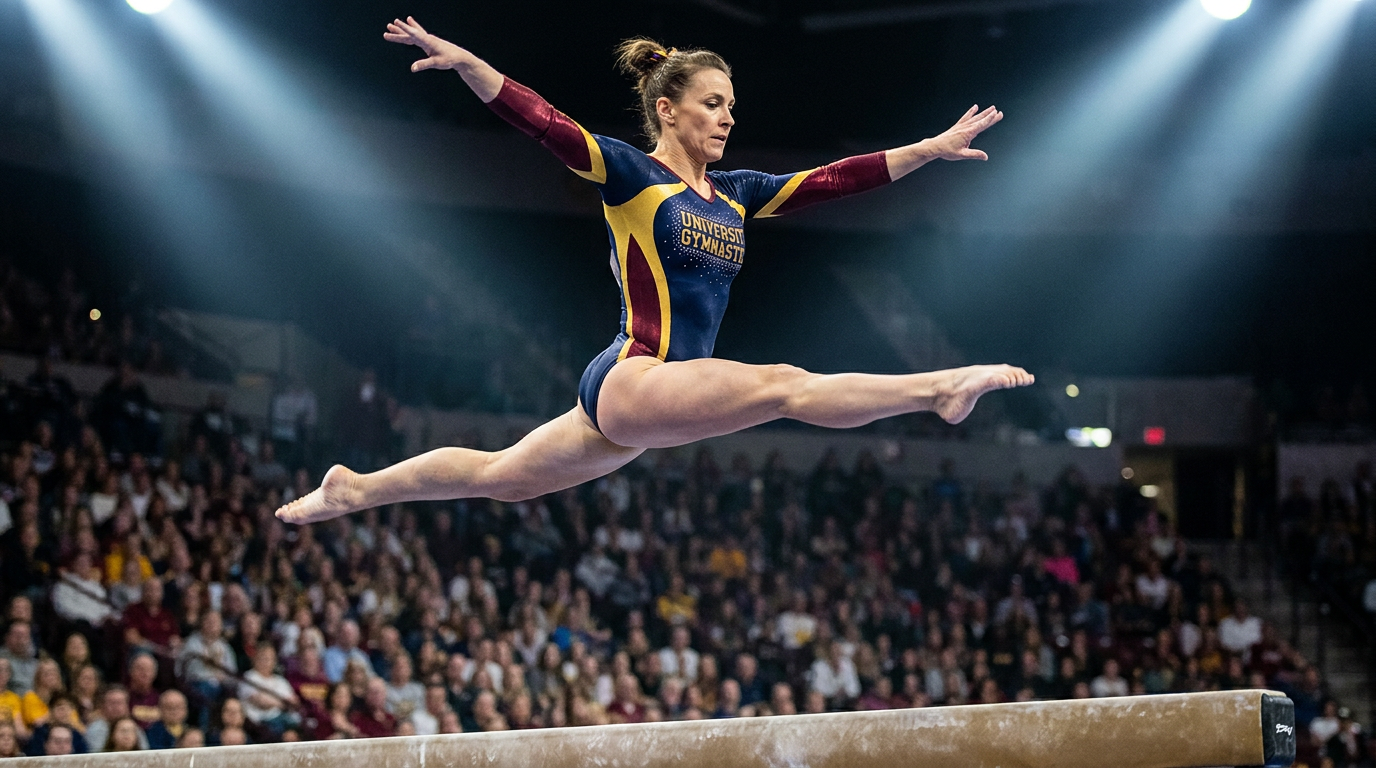
The result is the 'dual-track' era of women's gymnastics—a landscape where athletes seamlessly transition between the NCAA season and the international elite circuit. Today, a top-tier gymnast will compete for her university from January through April, traveling across the country for weekly dual meets. Once the collegiate championships conclude, she pivots immediately to elite training for the summer championship season, upgrading her routines to meet international standards. This year-round engagement keeps athletes in peak competitive shape without the monotonous grind of endless elite practice.[3]

The physical benefits of this hybrid approach have revolutionized training science and extended careers by years. Elite gymnastics is governed by the International Gymnastics Federation's open-ended Code of Points, which heavily rewards jaw-dropping difficulty and high-risk skills. NCAA gymnastics, however, uses a modified system capped at a perfect 10.0. This collegiate format prioritizes flawless execution, stuck landings, and consistency over sheer danger, fundamentally changing how athletes train during the winter months.[6]
By spending half the year competing in the NCAA, athletes are forced to pace themselves. They perform slightly downgraded routines that reduce the repetitive impact on their ankles, knees, and Achilles tendons. This built-in physical deloading period prevents the burnout and catastrophic injuries that historically ended careers before athletes turned 20. Instead of pounding their joints with double-twisting double backflips every day in practice, they focus on perfecting the basics, allowing their bodies to recover while still competing at a high level.[6]
By spending half the year competing in the NCAA, athletes are forced to pace themselves.
The mental and emotional benefits are equally profound. Elite gymnastics is notoriously isolating, with athletes spending upwards of 30 hours a week in private gyms, often separated from their peers and subjected to intense individual pressure. The NCAA environment introduces a raucous, supportive team culture where athletes compete for a collective goal. Gymnasts frequently cite the joy of competing for a university—complete with face paint, choreographed sideline dances, and sold-out arenas—as the exact psychological reset they need to maintain their passion for the sport.[6]
The 2026 landscape is entirely defined by these crossover stars. The NCAA season preview highlighted veterans like Jordan Chiles at UCLA, Skye Blakely at Florida, and Joscelyn Roberson at Arkansas—all of whom have successfully balanced collegiate campaigns with rigorous international elite assignments. Their success has proven that the dual-track method is not just possible, but optimal, demonstrating that the joy found in college competition translates directly into more confident, mature performances on the world stage.[3]
The pipeline is now fully integrated, with the next generation adopting this model from day one. The incoming recruiting classes are packed with athletes who view the dual-track as the standard career path rather than an exception. Standouts like Simone Rose, an incoming freshman at Florida, and Hezly Rivera, committed to LSU for 2028, are actively competing in elite Pan American and World events while securing their collegiate futures. The stigma of 'stepping down' to college has vanished entirely.[1][4]
This convergence will be on full display at the upcoming 2026 Xfinity U.S. Gymnastics Championships. Scheduled for August 6–9 at the Mortgage Matchup Center in Phoenix, Arizona, the premier domestic event will feature a roster heavily populated by current and future NCAA athletes. The national team that emerges from Phoenix to compete at the World Championships in Rotterdam will likely be the most college-experienced squad in U.S. history, a testament to the strength of the collegiate pipeline.[2][6]

The demographic shift resulting from this era is undeniable. The average age of the U.S. women's national team has steadily climbed, with the 2024 Olympic squad averaging 22.2 years old—the oldest since 1952. In 2026, a 22-year-old gymnast is no longer viewed as a veteran hanging on by a thread; she is considered an athlete in her absolute physical and mental prime, armed with the competitive maturity that only years of NCAA pressure can forge.[6]
This evolution has forced a reckoning among coaches and federations. In the past, elite and collegiate coaches operated in silos, sometimes viewing each other with suspicion over how an athlete should be trained. Today, the most successful programs require deep, ongoing collaboration. NCAA coaches must carefully manage their stars' workloads during the spring to ensure they peak for the elite summer season, while elite national staff rely on college programs to keep athletes healthy, engaged, and competitively sharp.[6]

Financial independence has also fundamentally changed the power dynamic within the sport. Because dual-track athletes can earn substantial incomes through NIL deals—often rivaling or exceeding traditional professional sports salaries—they are no longer beholden to abusive coaching tactics or toxic gym environments. They have the autonomy to choose where they train, who they train with, and when they compete, shifting the control from the federation back to the athletes themselves. This financial safety net allows them to prioritize their physical and mental health without fear of losing their livelihood.[5][6]
Ultimately, the dual-track era has saved women's gymnastics from its own worst tendencies. By merging the joy and pacing of the NCAA with the high-stakes ambition of the elite stage, the sport has finally created a sustainable blueprint. Gymnasts are no longer racing against a 16-year-old biological clock; they are building lifelong careers on their own terms, proving that peak performance and personal well-being are not mutually exclusive. As the 2026 season unfolds, the message is clear: the modern gymnast is stronger, older, and more empowered than ever before.[6]
How we got here
Pre-2021
Gymnasts are forced to choose between turning professional to fund their elite careers or maintaining amateur status to compete in the NCAA.
July 2021
The NCAA adopts interim NIL policies, allowing student-athletes to monetize their brands for the first time.
2022-2024
A wave of Olympic medalists choose to compete in the NCAA while maintaining their elite training, proving the dual-track model is viable.
August 2026
The Xfinity U.S. Gymnastics Championships in Phoenix features a roster heavily populated by current and future NCAA athletes.
Viewpoints in depth
NCAA Programs
College coaches value the elite experience these athletes bring to their rosters.
For university programs, having active elite gymnasts on the roster elevates the entire team's standard. While coaches must carefully manage their stars' physical workloads to prevent injury, the trade-off is acquiring athletes who are unfazed by high-pressure environments. These veterans mentor younger teammates and draw massive crowds, turning college meets into sold-out spectacles.
Elite National Coordinators
National team staff benefit from athletes staying in competitive shape year-round.
Historically, national team coordinators worried that college gymnastics would degrade an athlete's elite skills. Today, they recognize that the NCAA season acts as a crucial pacing mechanism. By competing weekly routines that focus on execution rather than extreme difficulty, athletes maintain their competitive edge and cardiovascular fitness without subjecting their joints to the relentless pounding of elite-level tumbling, resulting in healthier World Championship rosters.
The Athletes
Gymnasts enjoy the financial independence and supportive culture of the dual-track system.
For the athletes themselves, the dual-track era represents unprecedented autonomy. NIL deals provide a financial safety net that previous generations never had, allowing them to fund their training without relying solely on federation stipends. Furthermore, the raucous, team-oriented environment of college gymnastics provides a vital psychological break from the intense isolation of elite training, rekindling their love for the sport.
Sports Medicine Experts
Medical professionals praise the built-in physical recovery periods of the hybrid calendar.
Sports scientists and physical therapists have long warned about the dangers of early specialization and year-round peak-difficulty training in gymnastics. They view the dual-track system as a massive structural improvement. Because NCAA routines require fewer high-impact landings and less extreme spinal extension, the college season effectively serves as an active recovery period, drastically reducing the rate of catastrophic injuries like Achilles tears and stress fractures.
What we don't know
- Whether the International Gymnastics Federation will adjust its age minimums further in response to the aging up of the sport.
- How long the current generation of dual-track athletes will continue to compete before formally retiring.
Key terms
- NIL (Name, Image, and Likeness)
- NCAA rules that allow student-athletes to earn money from their personal brands, endorsements, and sponsorships without losing their collegiate eligibility.
- Elite Gymnastics
- The highest level of international competition, governed by the International Gymnastics Federation (FIG), which includes the World Championships and the Olympics.
- Code of Points
- The open-ended scoring system used in elite gymnastics that calculates a routine's total score by adding its difficulty value to its execution score.
- NCAA Gymnastics
- Collegiate-level gymnastics in the United States, which uses a modified scoring system capped at a perfect 10.0 to emphasize execution and team performance.
Frequently asked
What is a dual-track gymnast?
A gymnast who competes for a university in the NCAA during the winter and spring, and then competes at the elite international level during the summer.
How did NIL rules change gymnastics?
Name, Image, and Likeness (NIL) rules allowed college athletes to earn money from sponsorships. Previously, gymnasts had to forfeit college eligibility if they turned professional to fund their elite careers.
Why is NCAA gymnastics scored differently than elite?
NCAA gymnastics uses a system capped at a perfect 10.0, prioritizing flawless execution and consistency. Elite gymnastics uses an open-ended Code of Points that heavily rewards extreme difficulty and high-risk skills.
When are the 2026 U.S. Gymnastics Championships?
The 2026 Xfinity U.S. Gymnastics Championships will be held August 6–9 at the Mortgage Matchup Center in Phoenix, Arizona.
Sources
Source coverage
6 outlets
4 viewpoints surfaced






[1]College Gym NewsNCAA Programs
Recruiting Roundup: Elite and NCAA Crossover
Read on College Gym News →[2]USA GymnasticsElite National Coordinators
Phoenix to host 2026 Xfinity U.S. Gymnastics Championships
Read on USA Gymnastics →[3]Olympics.comElite National Coordinators
2026 women's NCAA college season preview: Elite stars return
Read on Olympics.com →[4]Inside GymnasticsThe Athletes
Class of 2026 Super 16: Elite and NCAA Crossover
Read on Inside Gymnastics →[5]NCAASports Medicine Experts
NCAA Women's Gymnastics: The New Era of College Sports
Read on NCAA →[6]Factlen Editorial TeamSports Medicine Experts
Synthesis by Factlen editorial team
Read on Factlen Editorial Team →
More in sports
See all 12 stories →Women's Soccer
NWSL Shatters Attendance Records as 2026 Expansion Teams Redefine Women's Soccer
9 sources

Standings
Edmonton Elks Surge to Undefeated Start as 2026 CFL Standings Take Early Shape
6 sources

Sports Science
How AI and Biomechanics Are Revolutionizing Elite Badminton Training
6 sources
Zone 2 Training
The Science of Zone 2 Training: What the Evidence Actually Says About the Low-Intensity Cardio Trend
6 sources
Every angle. Every day.
Get sports stories with full source coverage and perspective breakdowns delivered to your inbox.