
SpaceX's Historic IPO Triggers Massive Index Buying and a $60 Billion AI Acquisition
Following the largest initial public offering in history, SpaceX is set to join the Russell 1000 index, forcing billions in passive buying while simultaneously acquiring AI coding startup Cursor.
By Factlen Editorial Team
- Growth Bulls
- Believe SpaceX's ownership of the AI stack and space infrastructure justifies its massive premium and aggressive valuation.
- Index Rule Adapters
- Argue that benchmark rules must evolve to capture mega-cap companies immediately, ensuring passive funds reflect the true modern economy.
- Traditional Benchmarks
- Maintain that strict seasoning and profitability requirements protect passive investors from post-IPO volatility and speculative hype.
- Valuation Skeptics
- Warn that the company's multi-billion-dollar net losses and low public float make the stock dangerously overvalued.
What's not represented
- · Retail investors who purchased shares at the intraday peak
- · Executives at rival AI firms OpenAI and Anthropic
Why this matters
SpaceX’s historic IPO and immediate inclusion in major stock indexes means that anyone with a standard retirement account or passive ETF is about to become an investor in Elon Musk’s space and AI empire, whether they actively chose to or not.
Key points
- SpaceX raised $85.7 billion in the largest IPO in history, debuting at a $1.75 trillion valuation.
- FTSE Russell and Nasdaq enacted fast-entry rules, forcing passive funds to buy billions in SpaceX stock.
- S&P Global refused to waive its rules, blocking SpaceX from the S&P 500 until at least June 2027.
- SpaceX announced a $60 billion acquisition of AI coding startup Cursor just days after its IPO.
- The company is also preparing a $20 billion bond offering to refinance existing debt.
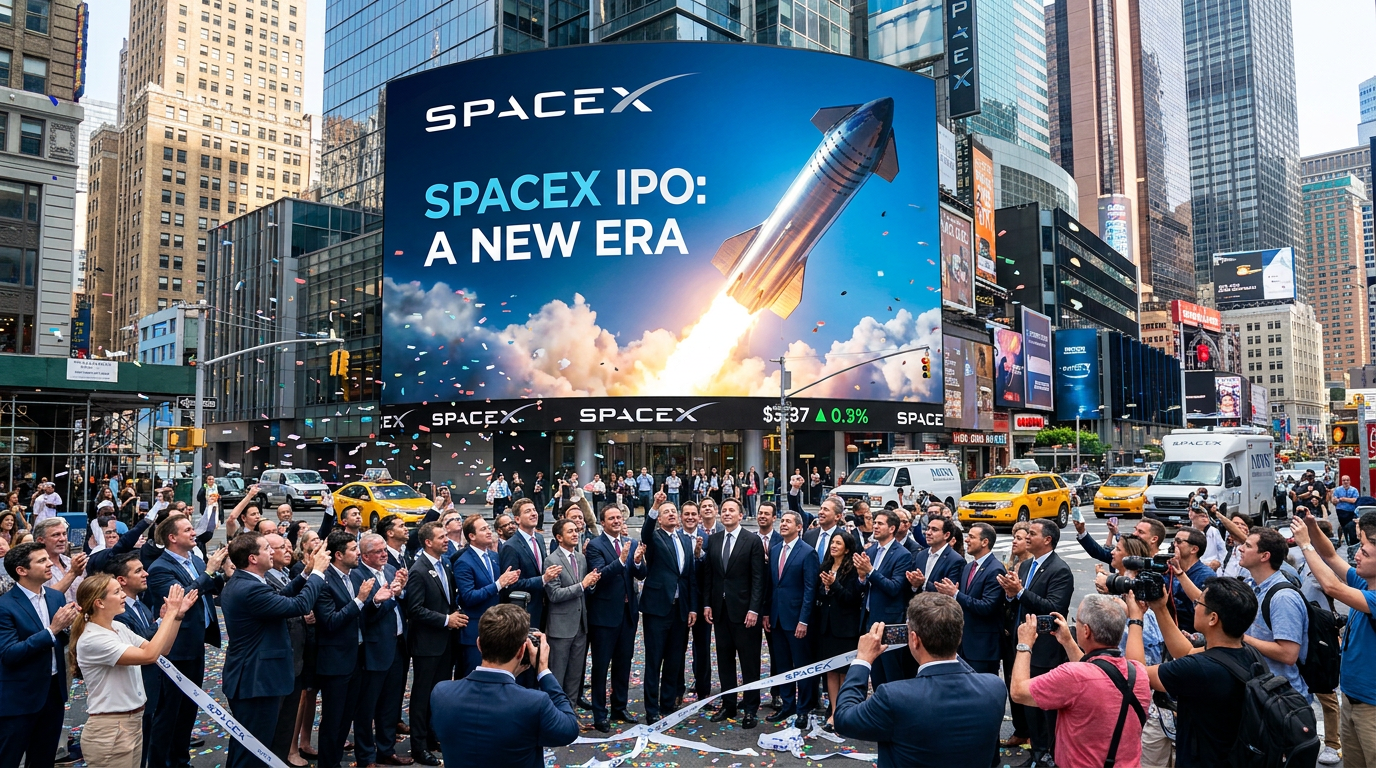
SpaceX’s long-awaited debut on the public markets has fundamentally rewired the mechanics of Wall Street. On June 12, 2026, Elon Musk’s aerospace and technology conglomerate executed the largest initial public offering in history, raising $85.7 billion and debuting at a staggering $1.75 trillion valuation. The sheer scale of the offering immediately vaulted SpaceX into the upper echelon of the world's most valuable companies, trailing only a handful of established tech giants. But the IPO was merely the opening act of a much larger financial shockwave that is now rippling through global equity markets.[1][4][5]
The stock’s first week of trading was defined by intense retail fervor and extreme volatility. Priced initially at $135 per share, the stock—trading under the ticker SPCX—surged to an intraday high of over $225 before cooling off to settle around the $185 mark. This rapid price action was exacerbated by a low public float; because only a small fraction of the company's total equity was made available for public trading, even moderate shifts in demand triggered outsized price swings.[4]
Now, the initial retail frenzy is giving way to a far more powerful and mechanical force: mandatory institutional buying. Because of SpaceX’s unprecedented size, several major index providers have invoked "fast entry" rules to bring the company into their benchmarks almost immediately. This administrative decision turns passive investment strategies into forced buyers, compelling exchange-traded funds and mutual funds to purchase billions of dollars of SpaceX stock regardless of its current valuation or fundamental metrics.[1][2]
FTSE Russell, which manages the widely tracked Russell 1000 index, confirmed that SpaceX will be added during its June reconstitution, set to take effect after the market closes on June 26. The Center for Research in Securities Prices (CRSP) and Nasdaq have enacted similar fast-track policies. For funds tracking these indexes, buying SpaceX is not an active choice—it is a strict requirement to maintain accurate benchmark weighting.[2][5][6]

The scale of this impending capital rotation is massive. Analysts estimate that index inclusion will trigger between $22 billion and $27 billion in near-term mechanical buying. To fund these mandatory purchases, portfolio managers will be forced to sell off fractional stakes in established index heavyweights like Apple, Microsoft, and Nvidia. This dynamic creates a powerful short-term technical setup, effectively guaranteeing a massive wave of price-agnostic demand for SpaceX shares.[5]
However, not all index providers are bending their rules for the mega-cap newcomer. S&P Dow Jones Indices stood firm, announcing that it would not grant SpaceX an exception to its strict entry requirements. To join the benchmark S&P 500, a company must demonstrate a 12-month public trading history and post four consecutive quarters of GAAP profitability.[5][7]
However, not all index providers are bending their rules for the mega-cap newcomer.
S&P Global's refusal to fast-track the stock serves as a protective buffer for the trillions of dollars parked in S&P 500 index funds. SpaceX remains a heavily loss-making enterprise, reporting a $4.94 billion GAAP net loss in 2025 as it aggressively scales its Starship program and satellite internet infrastructure. By enforcing its seasoning rules, S&P ensures that its flagship index remains insulated from the immediate post-IPO volatility and the supply overhang risks associated with SpaceX's eventual insider lock-up expirations.[7]
As a result, SpaceX will not be eligible for S&P 500 inclusion until at least June 2027. This creates a stark divergence in the passive investing landscape: funds tracking the Russell 1000 and Nasdaq are actively absorbing the stock's early turbulence, while S&P 500 investors will sit on the sidelines for another year, missing out on potential early gains but avoiding the immediate downside risks.[5][7]

While the market mechanics of index inclusion dominate trading desks, SpaceX is simultaneously making aggressive moves to justify its multi-trillion-dollar valuation. Just days after the IPO, the company announced a blockbuster $60 billion all-stock acquisition of Anysphere, the startup behind the popular artificial intelligence coding platform Cursor.[3][4]
The Cursor acquisition signals a massive expansion of SpaceX’s ambitions, moving the company aggressively into the enterprise AI sector. Cursor, which automates complex programming tasks and boasts widespread adoption among Fortune 1000 companies, gives SpaceX a vital asset to compete directly with industry leaders like OpenAI and Anthropic.[3]
The strategic rationale extends beyond simple software sales. Elon Musk has openly criticized the performance of existing coding tools, and integrating Cursor’s capabilities with SpaceX’s internal engineering workflows and its xAI division’s Grok models could yield massive efficiency gains. Analysts note that owning a top-tier AI coding agent provides SpaceX with a crucial wedge to attract lucrative enterprise clients who have thus far been hesitant to adopt Grok.[3]

Wall Street’s reaction to the dual catalysts of index inclusion and the Cursor acquisition has been sharply divided. Bullish analysts argue that SpaceX is assembling an unprecedented, vertically integrated technology stack. Investment bank Oppenheimer recently raised its price target on the stock to $250, citing the Cursor deal as evidence that SpaceX is positioning itself to dominate every layer of the AI and space infrastructure markets.[2][4]
Conversely, valuation skeptics warn that the current share price is dangerously disconnected from financial reality. Research firm Morningstar issued a stark warning, assigning SpaceX a fair value estimate of just $62 per share. Skeptics point to the company's massive cash burn, the steep premium paid for Cursor, and the underlying reality that the stock's current momentum is being driven more by forced passive buying than by sustainable free cash flow.[4]
Adding another layer of complexity to its capital structure, SpaceX is reportedly preparing to launch a $20 billion bond offering. The debt sale, aimed at refinancing a bridge loan maturing in 2027, highlights the immense capital requirements needed to sustain the company's dual dominance in aerospace engineering and artificial intelligence. As the June 26 index inclusion date approaches, SpaceX stands at the center of a historic financial experiment, testing the limits of market mechanics, passive investing, and the sheer gravitational pull of mega-cap tech.[2]
How we got here
June 4, 2026
S&P Global announces it will not alter its rules to allow SpaceX fast entry into the S&P 500.
June 12, 2026
SpaceX goes public in the largest IPO in history, raising $85.7 billion.
June 16, 2026
SpaceX announces the $60 billion acquisition of AI coding startup Cursor.
June 26, 2026
SpaceX is scheduled to be added to the Russell 1000 index, triggering massive passive buying.
Viewpoints in depth
The Passive Buying Mandate
Why ETFs and index funds are forced to buy SpaceX regardless of its fundamentals.
For funds tracking the Russell 1000 or the CRSP US Total Market Index, buying SpaceX is not an active investment choice—it is a mechanical requirement. Because index providers like FTSE Russell altered their 'fast entry' rules to accommodate the historic IPO, portfolio managers must purchase billions of dollars of SpaceX stock within days of its listing. This creates a powerful short-term technical setup where price is driven entirely by mandated demand rather than traditional valuation metrics, forcing funds to sell off established tech giants just to make room for the newcomer.
S&P's Protective Stance
The rationale behind S&P Global's refusal to fast-track SpaceX into the S&P 500.
S&P Dow Jones Indices stood alone among major benchmark providers by refusing to waive its entry requirements. The S&P 500 mandates a 12-month seasoning period and four consecutive quarters of GAAP profitability—a hurdle SpaceX currently misses due to its reported $4.94 billion net loss in 2025. Proponents of S&P's decision argue that these rules are essential guardrails that protect everyday retirement accounts from the extreme volatility and supply-demand imbalances that plague low-float IPOs, ensuring the index tracks proven financial stability rather than market hype.
The AI Stack Bull Case
Why analysts believe the $60 billion Cursor acquisition justifies the soaring stock price.
Bullish analysts view SpaceX as far more than a rocket manufacturer; they see an emerging monopoly over the entire artificial intelligence infrastructure. By acquiring the AI coding platform Cursor for $60 billion, SpaceX is directly challenging OpenAI and Anthropic for lucrative enterprise contracts. Firms like Oppenheimer argue that integrating Cursor with SpaceX's existing satellite networks and xAI's Grok models gives the company unparalleled cost and quality advantages, creating a vertically integrated tech behemoth that warrants a multi-trillion-dollar valuation.
What we don't know
- How the market will absorb the eventual expiration of insider lock-up periods, which will significantly increase the public float.
- Whether the integration of Cursor into SpaceX's operations will successfully attract the enterprise clients that have so far eluded Grok.
Key terms
- Initial Public Offering (IPO)
- The process by which a private company offers shares to the public for the first time, allowing general investors to buy ownership stakes.
- Passive Index Fund
- An investment fund designed to mechanically track the performance of a specific market benchmark, like the Russell 1000, rather than having managers pick individual stocks.
- Public Float
- The portion of a company's total shares that are freely available for trading by the general public, excluding closely held insider shares.
- GAAP Profitability
- A measure of a company's net income calculated according to Generally Accepted Accounting Principles, a strict standardized set of accounting rules.
- Fast Entry Rule
- A policy exception made by index providers that allows exceptionally large newly public companies to join a market index within days, rather than waiting months.
Frequently asked
When did SpaceX go public?
SpaceX held its initial public offering on June 12, 2026, raising $85.7 billion at a $1.75 trillion valuation.
Why are index funds forced to buy the stock?
Major index providers like FTSE Russell and Nasdaq changed their rules to allow 'fast entry' for the mega-cap company. Passive ETFs tracking these indexes must mechanically buy the stock to match the new index weightings.
Is SpaceX in the S&P 500?
No. S&P Global refused to waive its entry requirements, meaning SpaceX will not be eligible for the S&P 500 until at least June 2027, provided it achieves GAAP profitability.
What is Cursor and why did SpaceX buy it?
Cursor is a popular AI-powered coding platform. SpaceX acquired it for $60 billion to compete with OpenAI and Anthropic in the enterprise AI market and integrate it with its Grok chatbot.
Sources
Source coverage
7 outlets
4 viewpoints surfaced







[1]MarketWatchGrowth Bulls
The initial SpaceX frenzy is cooling off — but a new wave of cash is waiting to strike
Read on MarketWatch →[2]MorningstarValuation Skeptics
SpaceX is expected to secure index entry in the coming days and weeks
Read on Morningstar →[3]The VergeGrowth Bulls
SpaceX is officially buying Cursor for $60 billion
Read on The Verge →[4]MashableValuation Skeptics
How low could it go? The stock fell for days in a row
Read on Mashable →[5]SpotGammaIndex Rule Adapters
Index rule changes for SpaceX inclusion turn passive strategies into actively managed exposure
Read on SpotGamma →[6]The Motley FoolIndex Rule Adapters
SpaceX Can Be Added to the Russell 1000 and Russell 3000 After Today
Read on The Motley Fool →[7]WorldAdvisorsTraditional Benchmarks
SpaceX, Other Mega IPOs Face Index Entry Hurdles as S&P Rules Prioritize Stability
Read on WorldAdvisors →



Every angle. Every day.
Get finance stories with full source coverage and perspective breakdowns delivered to your inbox.