
The End of the Untraceable Deepfake: How Mandatory AI Watermarking is Securing the Web
New global regulations and technical standards are converging in 2026 to make AI-generated content permanently identifiable, fundamentally reshaping digital trust.
By Factlen Editorial Team

- Regulators & Policymakers
- Argue that mandatory, machine-readable transparency is essential to protect digital trust and combat misinformation.
- Commercial AI Providers
- Support standardized watermarking as a way to build enterprise trust and avoid fragmented global compliance requirements.
- Open-Source Advocates
- Warn that overly rigid watermarking mandates could stifle decentralized innovation and are technically difficult to enforce on open weights.
- Digital Publishers & Creators
- Embrace cryptographic provenance to protect the value of human-made content and avoid algorithmic shadowbanning.
What's not represented
- · Independent AI Developers
- · Privacy Advocates
Why this matters
By August 2026, the internet will fundamentally change how it handles truth. The shift to mandatory, machine-readable AI watermarking means users will no longer have to guess if an image or video is real, establishing a new baseline of digital trust that protects everything from democratic elections to personal reputations.
Key points
- The EU AI Act mandates machine-readable watermarking for all AI-generated content by August 2026.
- Regulators are requiring a multi-layered approach, combining C2PA metadata with imperceptible pixel-level watermarks.
- The US is driving compliance through federal procurement standards outlined by the AI Safety Institute.
- While image and audio watermarking are robust, text watermarking remains technically fragile.
- Major platforms are beginning to algorithmically demote content that lacks verifiable provenance metadata.
The era of the untraceable deepfake is facing its most formidable coordinated challenge to date. By August 2026, the internet will undergo a fundamental architectural shift as the European Union’s AI Act Article 50 transparency obligations become legally enforceable. This mandate requires that all AI-generated or significantly manipulated media—whether image, video, audio, or text—be technically detectable and machine-readable. For the first time since the generative AI boom began, the burden of proof is shifting from the consumer, who previously had to guess if a piece of media was real, to the creators and platforms distributing the content. This transition from voluntary industry guidelines to binding legal frameworks marks a massive victory for digital trust, establishing a baseline where authenticity is cryptographically guaranteed rather than blindly assumed.[3][7]
The primary claim anchoring this new regulatory regime is that digital provenance requires a standardized, interoperable ecosystem rather than siloed corporate solutions. The evidence supporting this approach is robust, codified in the European Commission’s draft Code of Practice on Marking and Labelling of AI-Generated Content. The framework explicitly rejects the notion that a simple visual 'Made with AI' label is sufficient. Instead, it mandates a machine-readable infrastructure that can be automatically detected by web browsers, social media algorithms, and search engines. This ensures that the context of a digital file travels with it, regardless of where it is posted or how many times it is downloaded.[3][6]
To achieve this, regulators and technologists have coalesced around a 'multi-layered' technical stack, operating on the premise that no single watermarking technique can survive the chaotic environment of the modern web. The first layer of this defense is 'Hard Binding,' primarily driven by the Coalition for Content Provenance and Authenticity (C2PA). C2PA functions as a digital manifest—a cryptographically signed metadata file embedded directly into the header of an image or video. This manifest records the content's origin, the specific AI tools used in its creation, and any subsequent human edits. Because it is cryptographically signed, any tampering with the metadata breaks the signature, immediately flagging the file as potentially compromised or unauthenticated.[1][3]

However, the evidence regarding metadata resilience acknowledges a critical vulnerability: C2PA manifests can be intentionally stripped by malicious actors or accidentally removed by legacy social media compression algorithms. To counter this, the regulatory consensus requires a second layer known as 'Soft Binding' or imperceptible watermarking. Technologies like Google DeepMind’s SynthID embed a statistical signature directly into the pixels of an image or the waveforms of an audio file. This signal is invisible to the human eye but easily detectable by algorithmic scanners. Crucially, imperceptible watermarks are designed to survive heavy compression, color grading, cropping, and even screenshots, providing a persistent 'ghost signal' when the C2PA metadata is lost.[1][7]
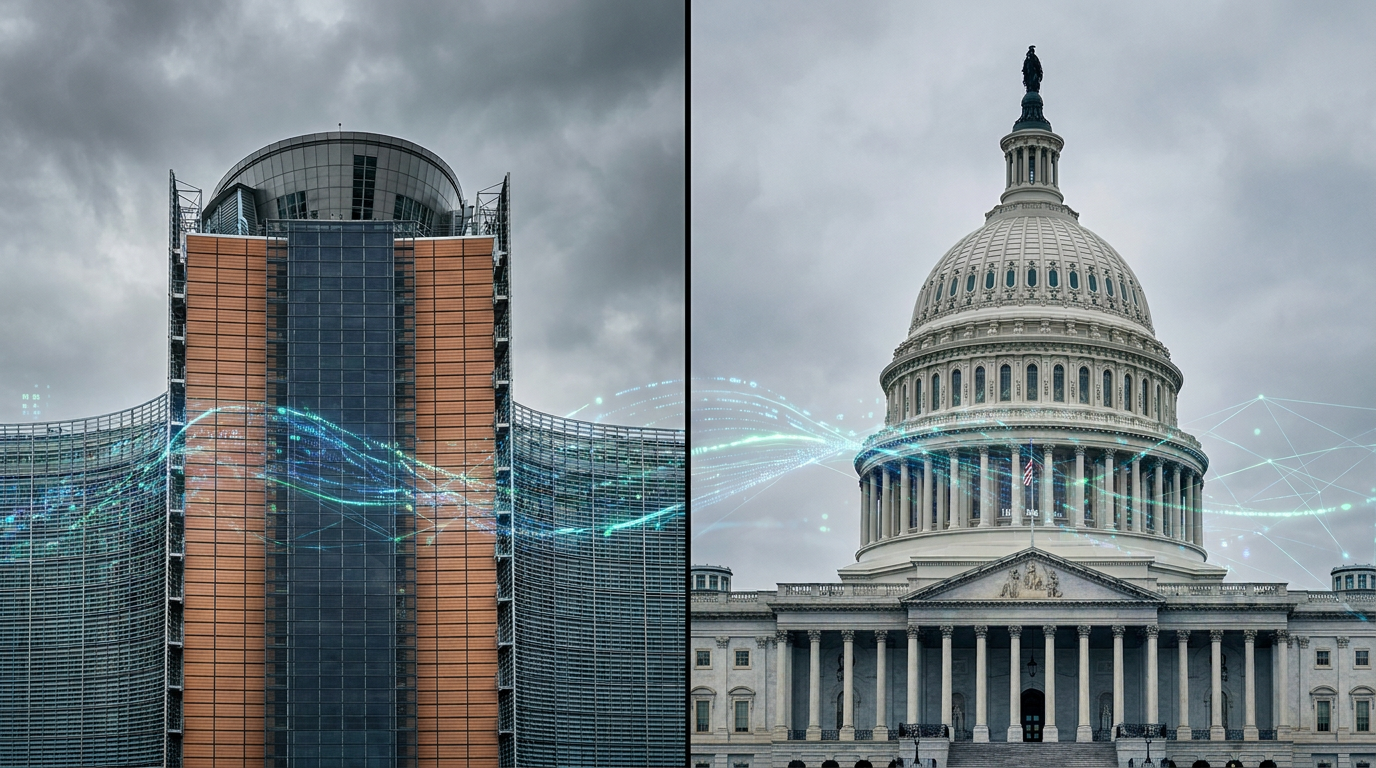
While the European Union is driving the hardest regulatory deadlines with its August 2026 enforcement date, the United States has constructed a parallel framework built on federal procurement power and standard-setting. The foundation of the US approach stems from Executive Order 14110, which directed federal agencies to establish rigorous standards for identifying synthetic content. Rather than threatening immediate fines, the US strategy forces compliance by requiring that any AI vendor wishing to do business with the federal government must implement robust watermarking and provenance tracking. This effectively sets a de facto national standard, as major AI labs cannot afford to be locked out of federal contracts.[2][4]
The foundation of the US approach stems from Executive Order 14110, which directed federal agencies to establish rigorous standards for identifying synthetic content.
The evidence for the US strategy's effectiveness is detailed in the National Institute of Standards and Technology (NIST) AI 100-4 guidelines, finalized by the US AI Safety Institute. The NIST framework provides a science-backed taxonomy for managing synthetic content risks, explicitly endorsing the combination of digital watermarks and metadata recording. By standardizing how provenance data is tracked, NIST has given enterprise software vendors and cloud providers a clear blueprint for compliance. Industry analysts note that while the US guidelines are technically voluntary for the private sector, they have rapidly become the benchmark for corporate liability and vendor contracts, mirroring the market-shaping effect of earlier cybersecurity frameworks.[4][6]

Despite the strong consensus around visual and auditory media, the evidence pack reveals significant technical uncertainty regarding the watermarking of AI-generated text. Academic audits and technical reviews demonstrate that while pixel-level and waveform watermarks are highly robust, text watermarking remains fragile. Current text watermarking techniques typically involve subtly biasing the AI model's vocabulary choices during generation. However, researchers have consistently shown that these statistical patterns can be easily erased by running the text through a secondary paraphrasing model or by manually editing a few key sentences. The fragility of text watermarking represents the most significant gap between regulatory expectations and current technical capabilities.[5][7]
Regulators have acknowledged this limitation and adapted their frameworks accordingly. Rather than demanding impossible technical feats, the 2026 standards for text rely heavily on 'Provenance Certificates.' These are digitally signed manifests issued by the AI provider at the point of generation, formally guaranteeing the origin of the text. While this does not prevent a user from copy-pasting the text into an unauthenticated document, it provides a verifiable paper trail for high-stakes environments like automated journalism, legal filings, and corporate communications. The consensus is that while text provenance cannot be perfectly secured at the character level, securing the institutional workflow is a highly effective mitigation strategy.[3][5]
The enforcement of these new standards is fundamentally reshaping the economics of digital platforms. Under the EU AI Act, companies that fail to implement required transparency mechanisms face fines of up to €15 million or 3% of their global annual turnover. Consequently, major social media networks and search engines have transitioned from passive hosts to active enforcers. Platforms are aggressively deploying automated scanners to detect C2PA credentials and SynthID markers upon upload. Content that carries verified human-origin metadata is increasingly prioritized in recommendation algorithms, while unauthenticated synthetic media faces algorithmic demotion or mandatory visible labeling.[1][3]

This algorithmic shift has profound implications for digital creators, publishers, and e-commerce vendors. In the 2026 digital economy, AI watermarking is no longer merely a copyright issue; it is a matter of algorithmic survival. Commercial creators are rapidly adopting C2PA-compliant cameras and editing software to ensure their human-made content retains its premium status. E-commerce marketplaces now routinely require verifiable proof that product visuals are either original or carry proper AI disclosures, rejecting assets that break the provenance chain. This creates a powerful financial incentive for the entire digital supply chain to adopt transparency standards voluntarily, accelerating the regulatory timeline.[6][7]
The transition is not without friction, particularly within the open-source AI community. Open-source advocates argue that strict watermarking mandates disproportionately burden decentralized developers who lack the infrastructure to maintain cryptographic signing servers. There is ongoing debate about how to enforce imperceptible watermarking in model weights that can be freely downloaded and modified by end-users. However, policy compromises are emerging, such as holding the platforms that host and distribute open-source models jointly responsible for ensuring baseline transparency features are enabled by default.[5][7]

Ultimately, the standardization of AI watermarking represents a maturation of the generative AI industry. Just as the introduction of SSL certificates (HTTPS) secured web traffic and enabled e-commerce in the 1990s, C2PA and imperceptible watermarking are establishing the foundational trust layer for the AI era. By making the origin of digital content transparent and verifiable, these technologies protect the public from malicious deepfakes while simultaneously allowing legitimate AI-assisted creativity to flourish in a regulated, safe environment. The August 2026 milestone is not the end of synthetic media, but rather the beginning of a more honest and accountable internet.[1][3][7]
How we got here
Oct 2023
US Executive Order 14110 directs federal agencies to establish standards for identifying synthetic content.
Mar 2024
The European Parliament formally adopts the comprehensive EU AI Act.
Dec 2025
The European Commission publishes the draft Code of Practice detailing specific watermarking requirements.
Jan 2026
California's AI Transparency Act mandates invisible watermarks for large AI providers.
Aug 2026
Article 50 of the EU AI Act becomes legally enforceable, requiring machine-readable transparency for AI content.
Viewpoints in depth
Regulators & Policymakers
The push for mandatory, machine-readable transparency to protect digital trust.
For regulatory bodies like the European Commission and the US AI Safety Institute, voluntary commitments from tech companies are no longer sufficient. Their primary claim is that the scale of synthetic media generation requires automated, systemic defenses. By mandating interoperable standards like C2PA and imperceptible watermarking, regulators aim to shift the burden of verification away from the end-user. They argue that a multi-layered technical approach is the only way to ensure that critical public infrastructure—from elections to financial markets—remains resilient against deepfakes and automated fraud.
Open-Source Advocates
Concerns over the technical feasibility and centralizing effects of strict watermarking mandates.
Researchers and open-source developers highlight a significant gap between regulatory expectations and technical reality, particularly regarding decentralized AI models. Their core argument is that while proprietary, API-gated models can easily enforce watermarking, open-weight models downloaded to local machines can be easily modified to strip out watermarking mechanisms. Furthermore, they warn that requiring expensive cryptographic signing infrastructure (like C2PA manifests) could price independent developers out of the ecosystem, inadvertently handing a monopoly to the largest tech conglomerates under the guise of safety.
Digital Publishers & Creators
The embrace of provenance technology to protect human-authored content.
For the creative and publishing industries, the new watermarking standards are less about restricting AI and more about authenticating human effort. Publishers argue that as the web floods with synthetic content, verifiable human origin becomes a premium asset. By adopting C2PA credentials, news organizations and commercial creators can cryptographically prove their work is original, ensuring it is prioritized by search engines and social media algorithms. This camp views provenance standards as an essential economic shield against the devaluation of human creativity.
What we don't know
- How effectively open-source and decentralized AI models can be regulated to ensure watermarking compliance without stifling innovation.
- Whether text watermarking technology will ever become robust enough to survive deliberate paraphrasing and adversarial attacks.
- How smaller, independent developers will afford the infrastructure costs associated with cryptographic signing and C2PA compliance.
Key terms
- C2PA
- An open technical standard that embeds cryptographically signed metadata into digital files to verify their origin and history.
- SynthID
- A technology developed by Google DeepMind that embeds imperceptible, machine-readable watermarks directly into the pixels or waveforms of AI-generated media.
- Hard Binding
- The practice of attaching verifiable metadata directly to a file's header, which breaks if the file is tampered with.
- Soft Binding
- The practice of embedding an invisible statistical signal into the content itself, allowing it to be identified even if the metadata is stripped.
- Provenance
- The verifiable history of a piece of digital content, detailing its origins, authorship, and any modifications it has undergone.
Frequently asked
What is C2PA and how does it work?
The Coalition for Content Provenance and Authenticity (C2PA) is an open technical standard that embeds cryptographically signed metadata into digital files. It acts as a digital 'nutrition label,' showing the content's origin, the tools used to create it, and any subsequent edits.
Does this mean all AI-generated text will have a watermark?
Not exactly. Because text watermarks are technically fragile and easily removed by paraphrasing, regulations for text rely more on 'Provenance Certificates'—digital manifests issued at the time of generation—rather than invisible signals embedded in the words themselves.
Will older AI-generated images be retroactively watermarked?
No. The new regulations apply to content generated or significantly altered after the enforcement dates. However, platforms may use algorithmic scanners to retroactively label older synthetic content if they detect known AI signatures.
How do invisible watermarks survive screenshots?
Technologies like Google's SynthID embed statistical patterns directly into the pixels or audio waveforms of the content. Because the signal is distributed throughout the file rather than stored in the metadata, it remains detectable even if the image is cropped, compressed, or screenshotted.
Sources
Source coverage
7 outlets
4 viewpoints surfaced







[1]TechTargetCommercial AI Providers
The future of AI watermarking and regulatory compliance
Read on TechTarget →[2]SlatorCommercial AI Providers
US Executive Order Outlines New Standards for AI-Generated Content
Read on Slator →[3]EU AI Act GuideRegulators & Policymakers
Code of Practice on Marking and Labelling of AI-Generated Content
Read on EU AI Act Guide →[4]Baker McKenzieRegulators & Policymakers
NIST AI 100-4: Managing Misuse Risk for Synthetic Content
Read on Baker McKenzie →[5]arXivOpen-Source Advocates
The Gap Between Regulatory Expectations and Technical Limitations of Watermarking
Read on arXiv →[6]CyberPeace InstituteRegulators & Policymakers
Government Strategies Worldwide on AI Watermarking
Read on CyberPeace Institute →[7]Factlen Editorial TeamDigital Publishers & Creators
Synthesis by Factlen editorial team
Read on Factlen Editorial Team →

More in ai
See all 7 stories →Global AI Rules
EU Delays High-Risk AI Rules as US Pushes for Federal Preemption
7 sources
Edge AI
The Rise of Small Language Models: How AI Moved From the Cloud to Your Pocket
7 sources

Local AI
A New Open-Source Release Just Slashed AI Memory Requirements by 5x, Untethering Models from the Cloud
7 sources

On-Device AI
How Small Language Models Are Bringing Private, Offline AI to Everyday Devices
8 sources

Every angle. Every day.
Get ai stories with full source coverage and perspective breakdowns delivered to your inbox.