
Grid-Scale Battery Costs Plunge to Historic Lows, Unleashing a Renewable Energy Boom
A dramatic 27% drop in battery storage costs has removed one of the biggest hurdles to renewable energy, allowing solar and wind to overtake gas generation globally for the first time.
By Factlen Editorial Team
- Energy Market Analysts
- Focusing on the raw economics, cost curves, and the supply chain dynamics driving the shift.
- Climate & Transition Advocates
- Emphasizing the milestone of renewables overtaking fossil fuels and the resulting climate benefits.
- Grid Decentralization Researchers
- Highlighting how cheap storage empowers consumers to leave the grid and forces utilities to adapt.
What's not represented
- · Fossil fuel producers facing reduced demand for natural gas peaker plants
- · Communities living near massive new utility-scale battery installations
Why this matters
For decades, the inability to cheaply store wind and solar power held back the clean energy transition. The sudden collapse in battery prices means renewable energy can now provide reliable, round-the-clock power, fundamentally lowering electricity costs and reducing global reliance on volatile fossil fuel markets.
Key points
- Global benchmark costs for 4-hour utility-scale battery storage plunged 27% to a record low of $78/MWh.
- The price collapse was driven by a massive oversupply of lithium-ion cells from the electric vehicle manufacturing sector.
- Wind and solar generated 22% of global electricity in April 2026, surpassing natural gas for the first time.
- The U.S. grid is expected to add a record-breaking 26.3 gigawatts of new battery storage capacity in 2026.
- Cheap storage is accelerating hybrid 'solar-plus-storage' projects, allowing renewables to provide reliable round-the-clock power.
For years, the Achilles' heel of the renewable energy transition was a simple problem of timing: the sun shines brightest when electricity demand is lowest, and the wind often blows when the grid doesn't need it. Solving that mismatch required massive, grid-scale batteries to capture excess power and deploy it after dark. However, the economics of large-scale storage rarely penciled out, leaving grids dependent on natural gas peaker plants to keep the lights on. In 2026, that financial equation has fundamentally flipped, ushering in a new era for global power markets where clean energy can finally operate around the clock.[7]
The global benchmark cost for a four-hour utility-scale battery storage project has plummeted to $78 per megawatt-hour (MWh), representing a staggering 27% year-over-year drop. This marks the lowest level recorded since industry tracking began nearly two decades ago, effectively removing the final major financial barrier to reliable clean energy. While wind and solar hardware faced slight cost pressures due to supply chain constraints, the sheer collapse in battery pricing has made hybrid renewable projects more attractive than ever before.[1][4]
The collapse in storage costs is already reshaping the global power mix in real time. In April 2026, wind and solar energy reached a historic milestone, generating 22% of the world's electricity and surpassing natural gas (20%) for the first full month in history. Together, the two renewable sources produced a record 531 terawatt-hours, limiting the growth of fossil fuels even as global energy demand surged. Just five years prior, wind and solar combined generated less than half of what they produced this spring, highlighting the sheer velocity of the transition.[2][3]

The catalyst for this storage boom ironically originated in a completely different sector: electric vehicles. Massive manufacturing overcapacity in China's EV battery supply chain—which surpassed 2 terawatt-hours of production capacity in 2024—created a massive global glut of lithium-ion cells. Because battery manufacturers had scaled up their gigafactories much faster than global consumers were purchasing electric cars, the industry was left with a massive surplus of high-quality energy storage hardware. Manufacturers were forced to compete aggressively on price just to clear their inventory, inadvertently handing a massive financial gift to the utility sector.[4][7]
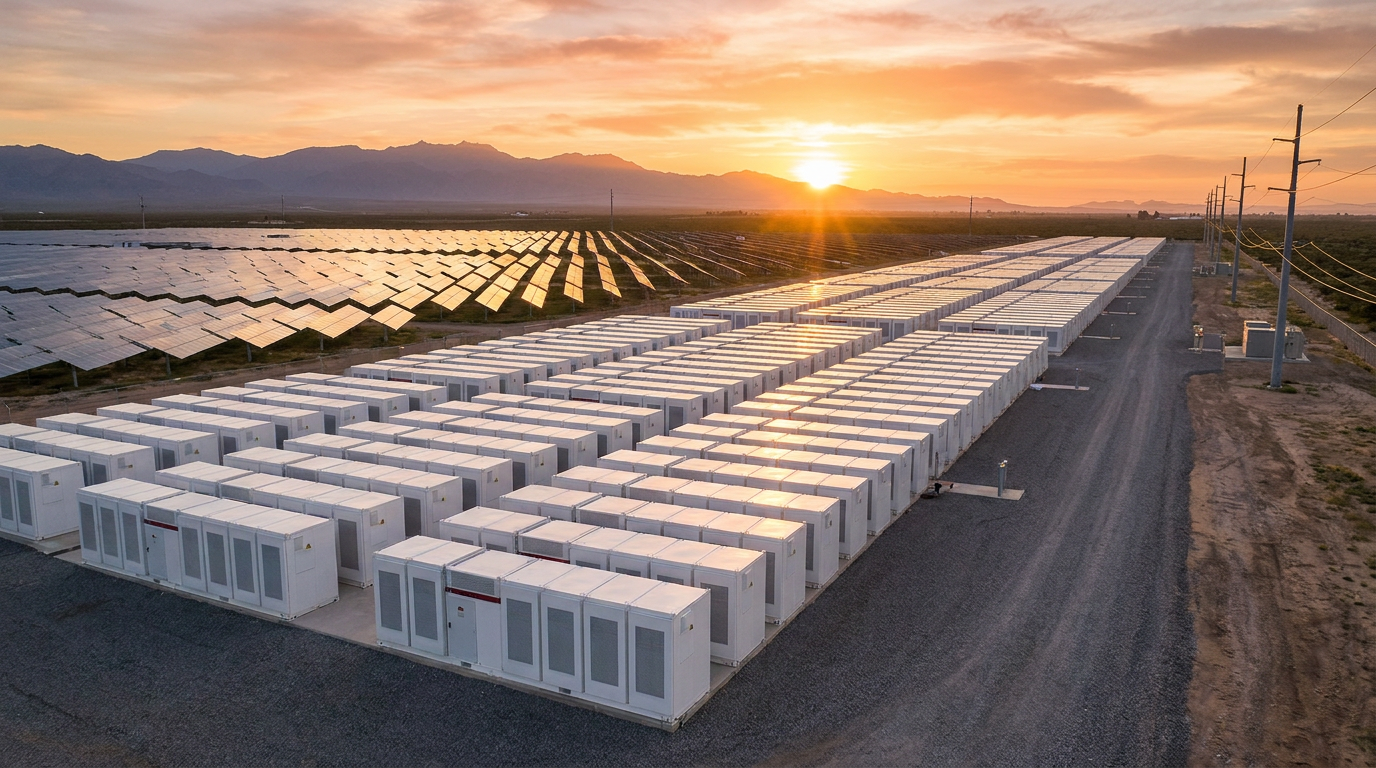
As manufacturers slashed prices to offload this inventory, battery pack prices crashed to a record low of $108 per kilowatt-hour. Grid-scale storage developers eagerly absorbed this surplus, translating cheap cells into massive, containerized battery parks capable of powering entire cities after sunset. This dynamic allowed utility companies to purchase top-tier lithium-ion technology at a fraction of the cost projected just a few years ago, accelerating deployment schedules across the globe. Instead of waiting for next-generation battery chemistries to mature, developers realized they could achieve immediate cost parity using the existing, highly proven lithium-ion supply chain.[4][7]
As manufacturers slashed prices to offload this inventory, battery pack prices crashed to a record low of $108 per kilowatt-hour.
The United States has emerged as a primary engine for this rapid deployment. According to federal data, the U.S. grid is slated to add 26.3 gigawatts of new battery storage capacity in 2026 alone—the largest single-year expansion in the nation's history. Texas, in particular, has become a global hotspot, utilizing batteries to stabilize its isolated and notoriously volatile electricity market. By deploying storage at scale, grid operators in the state can absorb cheap wind power at night and discharge it during scorching summer afternoons when air conditioning demand spikes.[4][7]

This influx of cheap storage is fundamentally changing how new power plants are designed and built. Developers are increasingly abandoning standalone solar farms in favor of hybrid "solar-plus-storage" projects. By co-locating batteries directly alongside solar panels, operators can store excess midday generation and dispatch it during the lucrative evening peak, delivering electricity at a highly competitive average cost of $57/MWh. This hybrid model solves the intermittency problem at the source, allowing renewable plants to bid into energy markets with the same reliability guarantees as traditional coal or gas facilities.[4][7]
The timing of this price collapse is critical, as the global grid faces an unprecedented new strain: the explosive growth of artificial intelligence. The rapid proliferation of AI data centers is driving the first major increase in North American electricity demand in decades, threatening to overwhelm existing infrastructure. S&P Global projects that data center power demand will increase by 14% annually through the end of the decade, requiring massive new injections of reliable electricity to keep the digital economy functioning.[5]
Traditional baseload power sources like nuclear and natural gas face years of permitting hurdles, environmental reviews, and construction delays, making them too slow to meet the immediate needs of the tech sector. Consequently, rapidly deployable battery storage and grid-forming inverters have become the most viable near-term solution to keep the grid stable. By pairing massive battery banks with existing renewable assets, grid operators can provide the rapid-response power and frequency regulation that hyperscale data centers demand without waiting a decade for a new nuclear plant to come online.[5][7]

But the storage revolution is not confined to utility companies and tech giants; it is also decentralizing power at the household level. As residential battery costs fall in tandem with commercial systems, homeowners are increasingly pairing rooftop solar with home batteries to insulate themselves from volatile electricity rates. Research from Harvard Business School indicates that this shift is driven by a desire for self-sufficiency as much as pure economics, with early adopters willing to invest in storage to slash their climate-damaging emissions and reduce their reliance on centralized infrastructure.[6]
Consumers are deliberately storing their own solar power to avoid pulling from the grid during expensive peak hours, fundamentally altering residential load profiles. If widespread battery adoption leads to a projected 38% decline in household grid demand, the traditional volume-based pricing model—where customers pay a flat rate per kilowatt-hour consumed—could become financially unsustainable for grid operators. To survive, utilities are being forced to become nimbler, deploying their own massive battery networks to manage the volatile fluctuations of a grid where millions of homes act as independent micro-power plants.[6][7]

On a macroeconomic scale, the proliferation of cheap storage offers a profound geopolitical advantage. As the energy transition accelerates, countries that rapidly deploy economically competitive clean technologies can significantly reduce their reliance on imported fossil fuels. By decoupling their economies from volatile global commodity markets, nations can insulate themselves from the price shocks, supply chain disruptions, and geopolitical conflicts that have historically defined the energy sector. Ultimately, the 2026 battery market correction proves that the transition to renewable energy is no longer reliant on government subsidies; it is now anchored in undeniable market economics.[1][7]
How we got here
2009
BloombergNEF begins tracking the levelized cost of battery storage, with prices prohibitively high for grid-scale use.
April 2021
Wind and solar combined generate just 245 terawatt-hours globally, less than half of natural gas output.
2024
China's lithium-ion battery production capacity surpasses 2 terawatt-hours, creating a massive global oversupply.
April 2026
Wind and solar generate 22% of the world's electricity, surpassing natural gas for the first time in history.
Viewpoints in depth
Energy Market Analysts
Focusing on the raw economics, cost curves, and the supply chain dynamics driving the shift.
For market analysts, the 2026 battery boom is a classic story of supply and demand. The massive overinvestment in Chinese electric vehicle battery manufacturing created a global glut of lithium-ion cells, forcing prices down to record lows. This oversupply inadvertently solved the utility sector's biggest problem, allowing developers to purchase grid-scale storage at a fraction of historical costs. Analysts emphasize that this shift makes hybrid renewable projects financially superior to new natural gas plants, fundamentally altering long-term investment flows in the energy sector.
Climate & Transition Advocates
Emphasizing the milestone of renewables overtaking fossil fuels and the resulting climate benefits.
Climate advocates view the collapse in storage costs as the final puzzle piece needed to phase out fossil fuels. By solving the intermittency problem of wind and solar, batteries eliminate the need for natural gas 'peaker' plants that historically fired up when the sun went down. Advocates point to the April 2026 milestone—where wind and solar out-generated gas globally—as proof that a fully decarbonized grid is not just technologically possible, but actively unfolding ahead of schedule.
Grid Decentralization Researchers
Highlighting how cheap storage empowers consumers to leave the grid and forces utilities to adapt.
Researchers studying consumer behavior note that cheap batteries are fundamentally changing the relationship between homeowners and utilities. As residential storage becomes affordable, consumers are prioritizing self-sufficiency, storing their own rooftop solar power to avoid peak grid pricing. This decentralization threatens the traditional utility business model, which relies on selling high volumes of electricity. Researchers argue that utilities must rapidly adapt by offering dynamic pricing and deploying their own storage networks, or risk being left behind by a newly independent consumer base.
What we don't know
- How traditional utilities will successfully restructure their pricing models to survive a massive drop in residential grid demand.
- Whether the EV battery oversupply will eventually stabilize, potentially causing storage prices to rebound in the late 2020s.
Key terms
- Levelized Cost of Electricity (LCOE)
- A metric used to compare the lifetime costs of generating energy from different sources, factoring in construction, operation, and fuel.
- Grid-forming inverters
- Advanced technology that allows solar and battery systems to actively stabilize the power grid's frequency, a job traditionally done by spinning turbines in fossil fuel plants.
- Peaker plant
- A power plant, usually running on natural gas, that only operates during times of peak electricity demand, making it expensive and carbon-intensive to run.
- Solar-plus-storage
- A hybrid power facility that combines solar panels with massive battery banks, allowing the site to provide reliable electricity even after the sun goes down.
Frequently asked
Why did battery storage costs drop so quickly in 2026?
The drop was primarily driven by a massive oversupply of lithium-ion batteries from the electric vehicle sector, particularly in China, which forced manufacturers to slash prices.
How do batteries help renewable energy?
Batteries solve the 'intermittency' problem by storing excess energy generated during sunny or windy periods and discharging it when demand is high, such as after sunset.
Will this lower my electricity bill?
In the long term, cheaper grid storage reduces the need for expensive natural gas peaker plants, which can stabilize or lower wholesale electricity costs. Homeowners with their own solar and battery systems can see immediate savings by avoiding peak grid rates.
Sources
Source coverage
7 outlets
3 viewpoints surfaced







[1]BloombergNEFEnergy Market Analysts
New Energy Outlook 2026
Read on BloombergNEF →[2]EmberClimate & Transition Advocates
Renewables overtake coal for the first time in modern era
Read on Ember →[3]ElectrekClimate & Transition Advocates
Wind and solar just hit a major global milestone
Read on Electrek →[4]CarbonCredits.comEnergy Market Analysts
Battery Storage Breaks Records While Solar and Wind Stall
Read on CarbonCredits.com →[5]S&P GlobalEnergy Market Analysts
S&P Global Energy Horizons Top Trends 2026
Read on S&P Global →[6]Harvard Business SchoolGrid Decentralization Researchers
Falling Battery Storage Costs Are Quietly Reshaping Electricity Markets
Read on Harvard Business School →[7]Factlen Editorial TeamEnergy Market Analysts
Synthesis by Factlen editorial team
Read on Factlen Editorial Team →
Every angle. Every day.
Get energy stories with full source coverage and perspective breakdowns delivered to your inbox.