
The 2026 Smartphone Buyer's Guide to On-Device AI: What It Actually Does
As major tech companies shift artificial intelligence from the cloud to the phone in your pocket, dedicated AI chips are fundamentally changing how smartphones handle privacy, battery life, and speed.
By Factlen Editorial Team
- Privacy Advocates
- Argue that keeping personal data on local hardware is the only foolproof way to prevent corporate data harvesting and breaches.
- Hardware Engineers
- Focus on the architectural challenge of maximizing AI performance while minimizing battery drain and heat generation.
- Consumer Tech Analysts
- Emphasize that average buyers care less about chip specifications and more about tangible benefits like offline translation and instant camera edits.
What's not represented
- · Cloud Infrastructure Providers
- · App Developers optimizing for older devices
Why this matters
Understanding on-device AI helps you make informed purchasing decisions, protect your personal data, and unlock powerful smartphone features that work instantly even without an internet connection.
Key points
- On-device AI processes machine learning tasks directly on your smartphone rather than sending data to cloud servers.
- Dedicated Neural Processing Units (NPUs) allow phones to run complex AI without draining the battery.
- Local processing significantly enhances privacy, as sensitive personal data never leaves the device.
- Features like live translation and advanced photo editing can now function instantly, even without an internet connection.
- By 2026, powerful NPUs have become standard across both flagship and mid-range smartphone models.
For years, the artificial intelligence on your smartphone was little more than a remote control. When you asked a voice assistant a question or translated a menu, your phone packaged that data, beamed it to a massive server farm hundreds of miles away, and waited for an answer.[4][6]
In 2026, that architecture has fundamentally flipped. The industry has rapidly transitioned to "on-device AI," a paradigm where complex machine learning models run directly on the silicon inside your pocket. Instead of acting as a middleman, your phone is now the brain itself.[4][8]
This shift is not just a technical milestone; it is a profound change in how consumer electronics handle privacy, speed, and battery life. As buyers navigate a market flooded with AI jargon, understanding what happens locally versus what happens in the cloud has become the most important factor in choosing a new device.[5][8]
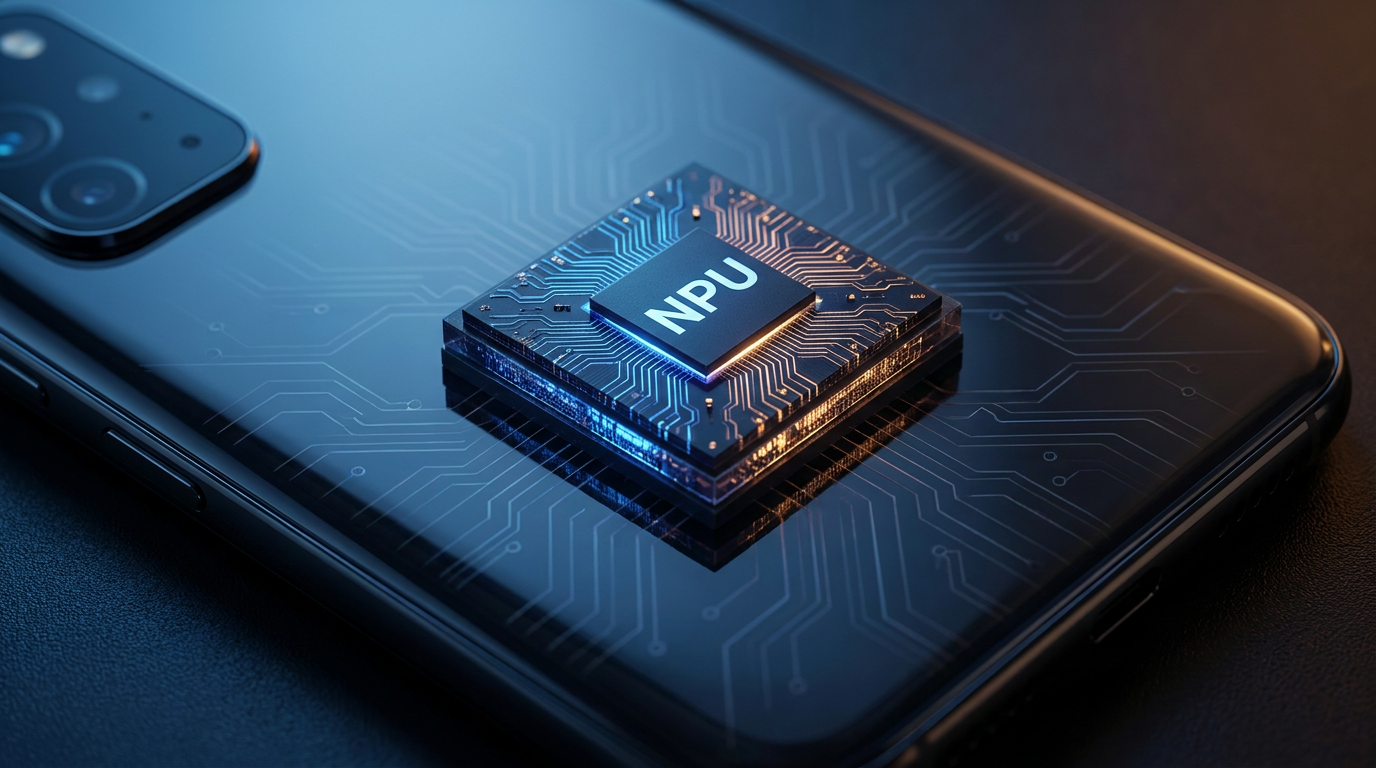
The engine driving this revolution is a specialized piece of hardware called a Neural Processing Unit, or NPU. While traditional Central Processing Units (CPUs) are great for general tasks, and Graphics Processing Units (GPUs) excel at rendering images, neither is optimized for the specific, repetitive math required by modern AI models.[7]

If you try to run a Large Language Model (LLM) on a standard smartphone CPU, the processor will max out, the phone will overheat, and the battery will drain in a matter of hours. NPUs solve this by executing AI algorithms at a fraction of the energy cost, making always-on intelligence viable for mobile devices.[4][7]
Major chipmakers have spent the last few years racing to expand these neural engines. Qualcomm's Snapdragon 8 Gen 4 and 8s Gen 4 platforms feature dedicated Hexagon NPUs that deliver massive leaps in AI performance while sipping power. Similarly, MediaTek's Dimensity series and Google's custom Tensor chips have dedicated vast amounts of silicon real estate to local machine learning.[2][3][7]
For consumers, the most immediate and critical benefit of on-device AI is privacy. When a device processes data locally, sensitive information—like personal photos, health metrics, or private messages—never leaves the hardware.[5][6]
Apple has made this the cornerstone of its Apple Intelligence suite. By defaulting to on-device processing, the system can understand a user's personal context without ever collecting or storing that data on external servers. You cannot intercept or hack data from a server if the data was never transmitted in the first place.[1]
Apple has made this the cornerstone of its Apple Intelligence suite.
Of course, some generative AI tasks are still too massive for a phone to handle alone. For these edge cases, companies have developed hybrid models. Apple, for instance, uses "Private Cloud Compute" for complex requests, ensuring that data sent to the cloud is cryptographically secured, never stored, and immediately deleted after the task is fulfilled.[1]

Beyond privacy, on-device AI eliminates the latency inherent in cloud computing. Because there is no round-trip transmission to a server, features respond instantly. This is why modern AI photography can recognize scenes, adjust lighting, and remove unwanted background objects in the exact millisecond you press the shutter.[6][7]
This local processing also unlocks true offline capability. A traveler navigating a foreign subway system with zero cellular reception can still use real-time voice translation, because the language models live entirely on the device's storage.[4][6]
Google's Tensor chips have pioneered many of these offline features, allowing Pixel phones to run sophisticated speech-to-text transcription and Live Translate without needing a Wi-Fi or cellular connection. The phone simply listens, processes, and outputs the result entirely on its own silicon.[3]
The efficiency gains are equally transformative. Because NPUs are purpose-built for these tasks, they allow smartphones to run background AI features constantly without killing the battery.[7]
This enables "always-sensing" capabilities. A phone can use its low-power AI subsystem to detect when you are looking at the screen, recognize hand gestures, or listen for specific audio cues—all while the main power-hungry CPU remains asleep.[2][7]

As we move through 2026, on-device AI is no longer restricted to ultra-expensive flagship phones. Mid-range processors are now shipping with capable neural engines, democratizing access to advanced computational photography and local voice assistants.[4][7]
The software ecosystem has also matured to match the hardware. Operating systems now include standardized frameworks that allow app developers to easily tap into the phone's NPU, meaning third-party apps can offer the same lightning-fast, private AI features as the built-in tools.[5]
Ultimately, the goal of on-device AI is invisibility. The best implementations don't feel like "using AI"; they simply feel like a phone that understands you better, lasts longer on a charge, and respects your privacy.[8]
How we got here
2017
Apple introduces the A11 Bionic with an early Neural Engine for Face ID.
2021
Google launches the first custom Tensor chip, bringing advanced computational photography to the Pixel.
2024
Apple Intelligence is announced, formalizing the 'Private Cloud Compute' hybrid model.
2026
Dedicated NPUs become standard across both flagship and mid-range smartphone tiers.
Viewpoints in depth
The Privacy First Camp
Advocates who believe local processing is a fundamental digital right.
For privacy advocates and security researchers, the shift to on-device AI is a monumental victory. For the past decade, the tech industry's default model involved vacuuming up user data, sending it to centralized servers, and processing it out of sight. On-device processing flips this dynamic. By keeping sensitive context—like reading habits, personal photos, and private messages—strictly on the silicon in the user's pocket, it eliminates the risk of server-side data breaches and mass surveillance. This camp argues that any AI feature requiring personal context must be processed locally to be considered truly secure.
The Hardware Ecosystem
Chipmakers pushing the boundaries of mobile silicon.
From the perspective of silicon designers at companies like Qualcomm, MediaTek, and Apple, the on-device AI boom is an architectural arms race. Their primary challenge isn't just making the AI smarter; it's making it run within the strict thermal and battery constraints of a smartphone chassis. This camp views the Neural Processing Unit (NPU) as the most important component of the modern smartphone, prioritizing power efficiency and memory bandwidth over raw clock speeds. To them, the success of mobile AI is measured in 'performance per watt.'
The Everyday User
Consumers looking for practical utility rather than technical specs.
While engineers debate TOPS (Trillions of Operations Per Second) and parameter counts, consumer tech analysts note that the average buyer evaluates AI entirely on utility. The everyday user doesn't care that a local Large Language Model is running on an NPU; they care that their voice assistant finally understands them in a noisy room, or that they can translate a menu in a foreign country without paying for cellular roaming. For this camp, on-device AI is only successful if it operates invisibly, removing friction from daily tasks without requiring the user to manage settings or worry about battery drain.
What we don't know
- How quickly older, non-NPU smartphones will become obsolete as app developers prioritize on-device AI features.
- The long-term environmental impact of manufacturing increasingly complex, silicon-heavy mobile processors.
- Whether open-source AI models will eventually match the on-device performance of proprietary models from Apple and Google.
Key terms
- NPU (Neural Processing Unit)
- A specialized chip designed specifically to handle the complex math required by artificial intelligence, using far less power than a standard processor.
- On-Device AI
- Artificial intelligence tasks that are processed entirely on your local hardware, rather than sending data to a remote server.
- Private Cloud Compute
- Apple's system for handling complex AI tasks on secure servers without storing or retaining any user data.
- LLM (Large Language Model)
- The underlying AI technology that powers text generation, summarization, and advanced voice assistants.
Frequently asked
Will on-device AI drain my smartphone's battery?
No. Because these tasks are handled by a dedicated Neural Processing Unit (NPU) rather than the main processor, they are highly power-efficient and actually save battery compared to older methods.
Does on-device AI work without an internet connection?
Yes. Since the AI models are stored directly on your phone's memory, features like live translation and photo editing work perfectly in airplane mode or dead zones.
Can my phone still use cloud AI if needed?
Yes. Most modern smartphones use a hybrid approach, handling sensitive or quick tasks locally while securely connecting to the cloud for massive, complex requests.
Sources
Source coverage
8 outlets
3 viewpoints surfaced








[1]ApplePrivacy Advocates
Apple Intelligence and privacy on iPhone
Read on Apple →[2]QualcommHardware Engineers
Snapdragon 8s Gen 4 Mobile Platform
Read on Qualcomm →[3]GoogleHardware Engineers
Google Tensor: The new chip that gives your Pixel an AI upgrade
Read on Google →[4]ArticsledgeConsumer Tech Analysts
What Is On-Device AI? How It Works in 2026
Read on Articsledge →[5]ELEKSConsumer Tech Analysts
On-Device AI Explained: Benefits, Evolution, and Business Advantages
Read on ELEKS →[6]F22 LabsPrivacy Advocates
What Is On-Device AI? A Complete Guide for 2026
Read on F22 Labs →[7]JuaTech AfricaHardware Engineers
What Is an NPU in Smartphones? How AI Processors Power the Future
Read on JuaTech Africa →[8]Factlen Editorial TeamConsumer Tech Analysts
Synthesis by Factlen editorial team
Read on Factlen Editorial Team →



Every angle. Every day.
Get shopping stories with full source coverage and perspective breakdowns delivered to your inbox.