
The 'Fifth Stroke': The Physics and Evolution of Swimming's Fastest Technique
The underwater dolphin kick is the fastest way a human can move through water unassisted. Here is the biomechanical science and controversial history behind the technique that forced swimming to rewrite its rulebook.
By Factlen Editorial Team
- Sports Biomechanists
- Focus on fluid dynamics, active drag reduction, and the kinematic efficiency of the undulatory motion.
- Swimming Historians
- View the technique as a product of athletic innovation and the constant search for competitive loopholes.
- Regulatory Bodies
- Prioritize athlete safety against hypoxic blackouts and the preservation of traditional stroke definitions.
- Analytical Synthesis
- Integrates historical context with modern biomechanical data to explain the sport's evolution.
What's not represented
- · Amateur swim coaches adapting elite techniques for youth athletes
- · Freedivers who utilize similar undulatory mechanics for depth
Why this matters
The margins of victory in elite swimming are now measured in hundredths of a second. Understanding the underwater dolphin kick reveals how human biomechanics, fluid dynamics, and regulatory limits intersect to push the boundaries of athletic performance.
Key points
- The underwater dolphin kick is the fastest way a human can move through water, bypassing surface wave drag.
- Gliding at least half a meter underwater can reduce total hydrodynamic resistance by up to 50 percent.
- The movement requires a full-body undulatory wave, relying heavily on posterior chain strength for the upward kick.
- David Berkoff revolutionized the sport in 1988 by swimming 33 meters underwater, shattering the backstroke world record.
- World Aquatics instituted a strict 15-meter limit to prevent hypoxic blackouts and preserve traditional surface strokes.
- Elite swimmers use computational fluid dynamics to optimize their breakout timing and ankle flexibility.
The fastest way to win a swimming race is to spend as little time as possible actually swimming on the surface. In the modern era of elite aquatics, the margins between gold and missing the podium entirely are measured in hundredths of a second, and those fractions are won beneath the waves. The secret lies in the underwater dolphin kick, a full-body undulatory motion so powerful and essential that coaches and athletes universally refer to it as the "fifth stroke."[4][5]
Unlike the traditional four strokes—freestyle, backstroke, breaststroke, and butterfly—the fifth stroke is not an event of its own. Instead, it is the critical connective tissue of a race, utilized off the starting block and after every turn. When executed perfectly, an elite swimmer can reach velocities between 2.2 and 3.0 meters per second during their underwater glide and kick sequence, a speed that is physically impossible to sustain once they break the surface and begin their regular arm pulls.[1][3][5]
The reason for this dramatic speed differential comes down to the unforgiving physics of water. When an athlete swims on the surface, they must constantly break the plane between water and air. This displacement creates a bow wave in front of the swimmer, resulting in a phenomenon known as wave drag. Wave drag acts like an invisible, heavy blanket, exponentially increasing resistance the faster the athlete tries to move.[1][5]
Submerging the body entirely changes the hydrodynamic equation. By gliding at least half a meter below the surface, a swimmer completely eliminates wave drag, leaving only form drag and skin friction to overcome. Biomechanical studies utilizing computational fluid dynamics have demonstrated that swimming at a depth of roughly one meter can reduce total hydrodynamic resistance by up to 50 percent compared to surface swimming. The deeper the glide, the cleaner the water, and the faster the human body can travel.[1][2]

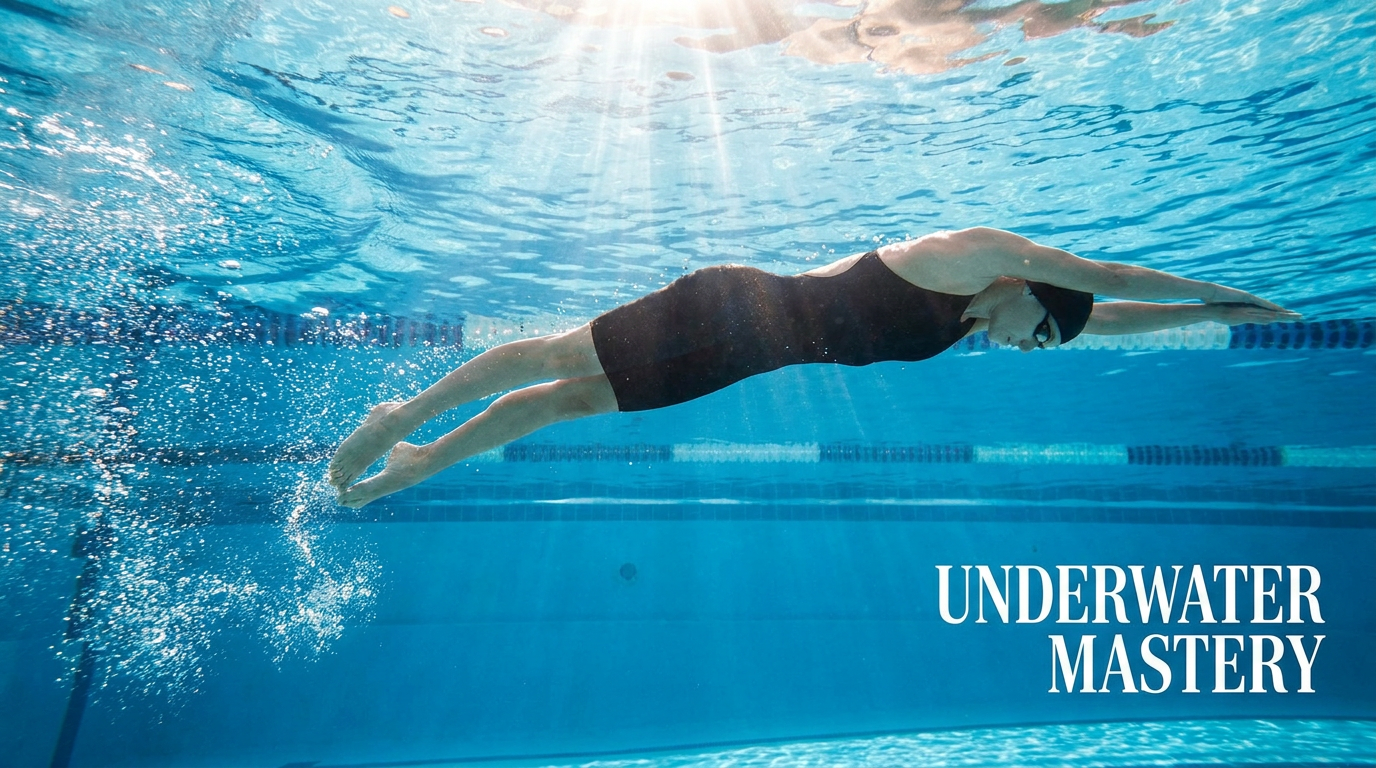
However, simply gliding underwater is not enough; the swimmer must generate propulsion without breaking their streamlined profile. This is where the biomechanics of the dolphin kick come into play. It is a common misconception that the kick is driven merely by bending and straightening the knees. In reality, a world-class dolphin kick is a complex kinematic synergy—a whiplash-like wave of energy that originates in the chest and sternum, travels down through the core and hips, and violently snaps through the ankles and toes.[2][5]
This undulatory motion mimics the tail action of marine mammals, allowing the swimmer to press against the water with the maximum possible surface area of their lower body. The core acts as the engine, while the legs function as a flexible, propulsive fin. The flexibility of the ankle joint is particularly crucial; swimmers with extreme plantar flexion can point their toes so far backward that the tops of their feet act like paddles, pushing water directly backward to drive the body forward.[1][2][5]
The greatest biomechanical challenge of the fifth stroke is human anatomy itself. Because humans evolved for upright, forward locomotion like walking and running, our anterior muscles—specifically the quadriceps—are naturally dominant. This makes the downward phase of the dolphin kick relatively easy to execute with power, as the body relies on its most developed muscle groups.[1][5]
The greatest biomechanical challenge of the fifth stroke is human anatomy itself.
The upward phase of the kick, however, requires immense strength from the posterior chain, including the glutes, hamstrings, and lower back. Most amateur swimmers simply let their legs float back up after a down-kick, wasting half of the propulsive cycle. Elite sprinters train their posterior chains relentlessly, turning the up-kick into an active, force-generating movement that maintains continuous velocity and prevents the body from stalling in the water.[1][5]

The realization that underwater kicking was vastly superior to surface swimming did not happen in a laboratory; it was discovered through athletic experimentation. In the 1970s and early 1980s, pioneers like Jesse Vassallo and Daichi Suzuki began extending their underwater glides to avoid the turbulent wake of larger competitors. But it was American backstroker David Berkoff who pushed the concept to its absolute limit, forever changing the sport.[4][5]
At the 1988 Olympic Games, Berkoff unveiled a technique that the media quickly dubbed the "Berkoff Blastoff." Off the start of the 100-meter backstroke, Berkoff stayed submerged on his back, furiously executing dolphin kicks for an astonishing 33 meters before finally surfacing to swim the remaining 17 meters of the lap. He shattered the world record, proving definitively that surface swimming was obsolete if a swimmer had the lung capacity to stay under.[4][5]
Berkoff's dominance sparked an immediate crisis within the sport's governing body, World Aquatics. Regulators feared that if left unchecked, backstroke and butterfly races would devolve into entirely underwater breath-holding contests, rendering the traditional arm strokes extinct. Furthermore, there was a severe safety concern: pushing athletes to swim 30 or 40 meters without oxygen at maximum exertion dramatically increased the risk of shallow water blackout, a potentially fatal condition caused by hypoxia.[3][4][5]
In response, the governing body instituted the 15-meter rule. The regulation mandates that a swimmer's head must break the surface of the water at or before the 15-meter mark following every start and turn. Originally applied to backstroke in 1991, the rule was eventually expanded to govern freestyle and butterfly events as well, creating a standardized boundary between underwater innovation and traditional surface racing.[3][4]

Today, the 15-meter mark is the most intensely scrutinized line in a swimming pool. Elite athletes aim to surface at exactly 14.9 meters, maximizing their underwater speed advantage without triggering a disqualification. This requires extraordinary spatial awareness and stroke counting, as the swimmer must perfectly time their ascent while their brain is screaming for oxygen.[3][5]
The physiological cost of the fifth stroke is immense. Engaging the massive muscle groups of the core and legs simultaneously burns through oxygen reserves at a ferocious rate. Swimmers must balance the hydrodynamic benefits of staying underwater against the aerobic debt they will carry into the final lengths of a race. If an athlete pushes their underwater kicks too far and accumulates too much lactic acid, their surface stroke will inevitably fall apart.[1][5]
The most critical fraction of a second in any race is the breakout—the exact moment the swimmer transitions from the underwater dolphin kick to their first surface arm pull. If the breakout is timed too early, the swimmer crashes into wave drag before they reach their top surface speed. If it is timed too late, they lose their underwater momentum and stall. The perfect breakout is a seamless transfer of kinetic energy from the fifth stroke into the first stroke.[5]

As the sport looks to the future, the evolution of the underwater dolphin kick is increasingly driven by data. Sports biomechanists are using 3D motion capture, electromyography, and kinematic synergy analysis to map the exact muscle firing sequences of Olympic champions. While the 15-meter rule places a hard physical limit on distance, the quest to optimize the speed, efficiency, and power of the human body's undulatory wave remains the most vital frontier in competitive swimming.[1][2][5]
How we got here
1970s
Jesse Vassallo begins experimenting with short underwater dolphin kicks off turns to avoid the wake of larger swimmers.
1984
Daichi Suzuki pushes the underwater dolphin kick to roughly 25 meters off the start at the Olympic Games.
1988
David Berkoff introduces the 'Berkoff Blastoff,' swimming 33 meters underwater and shattering the 100m backstroke world record.
1991
FINA (now World Aquatics) officially restricts underwater swimming to 10 meters for backstroke, later expanding it to 15 meters.
1998
The 15-meter rule is universally applied to freestyle, backstroke, and butterfly events to standardize competition.
2020s
Computational fluid dynamics and 3D motion capture become standard tools for optimizing elite underwater kicking mechanics.
Viewpoints in depth
Sports Biomechanists' View
Focuses on the data, drag reduction, and the kinematic synergy required to maximize propulsion.
For sports scientists and biomechanists, the fifth stroke is a problem of fluid dynamics and human anatomy. Research published in journals like the Journal of Sports Sciences demonstrates that the human body is inherently inefficient in water, but submerging below the surface tension eliminates wave drag entirely. Biomechanists emphasize that the key to maximizing this advantage is not just leg strength, but 'kinematic synergy'—the ability to transfer energy seamlessly from the core through the hips and down to highly flexible ankles. They view the upward phase of the kick, which utilizes the weaker posterior chain, as the primary frontier for future speed gains.
Swimming Historians' View
Views the technique as a product of athletic innovation and the constant search for competitive loopholes.
Historians of the sport view the evolution of the underwater dolphin kick as a classic example of athletes outsmarting the rulebook. Before the 1980s, the dolphin kick was strictly a butterfly technique. When pioneers like David Berkoff realized the rules did not explicitly forbid staying underwater on the backstroke, they exploited the loophole to devastating effect. The 'Berkoff Blastoff' is remembered not just as a mechanical breakthrough, but as a paradigm shift that proved surface swimming was fundamentally slower, forcing the sport to adapt to the athletes rather than the other way around.
Regulatory Bodies' View
Prioritizes athlete safety against hypoxic blackouts and the preservation of traditional stroke definitions.
For organizations like World Aquatics, the underwater dolphin kick represents a delicate balancing act between allowing athletic progression and ensuring safety. The implementation of the 15-meter rule was driven primarily by the fear of shallow water blackout—a lethal condition where athletes push their oxygen debt too far and lose consciousness underwater. Additionally, regulators argue that without the 15-meter boundary, the distinct disciplines of backstroke, butterfly, and freestyle would merge into a single, monotonous underwater breath-holding contest, destroying the historical integrity of the four strokes.
What we don't know
- The absolute physiological limit of how much propulsive force the human posterior chain can generate during the upward phase of the kick.
- Whether future advancements in computational fluid dynamics will reveal entirely new, more efficient undulatory patterns for human anatomy.
Key terms
- Active Drag
- The hydrodynamic resistance a swimmer faces while actively moving their limbs to generate propulsion through the water.
- Wave Drag
- The specific resistance caused by displacing water at the surface, which creates waves that push back against the swimmer's forward momentum.
- Undulatory Motion
- A wave-like movement pattern that travels down the body, transferring kinetic energy from the core to the extremities.
- Kinematic Synergy
- The highly coordinated activation of multiple joints and muscle groups to produce a smooth, efficient, and powerful movement.
- Shallow Water Blackout
- A dangerous condition where a swimmer faints underwater due to a lack of oxygen to the brain, often caused by prolonged breath-holding.
- Breakout
- The critical moment in a race when a swimmer transitions from their underwater kicking phase to their first surface arm stroke.
Frequently asked
Why is swimming underwater faster than on the surface?
Swimming on the surface creates wave drag, which acts like a physical barrier of water pushing back against the athlete. Staying fully submerged eliminates this surface tension, drastically reducing overall hydrodynamic resistance.
Can breaststrokers use the dolphin kick?
Yes, but it is strictly limited. World Aquatics rules allow only a single downward dolphin kick during the underwater pull-out sequence immediately following a start or a turn.
What happens if a swimmer goes past 15 meters underwater?
The swimmer is immediately disqualified. Their head must visibly break the surface of the water at or before the 15-meter mark.
Why are humans naturally bad at the upward dolphin kick?
Human anatomy is built for forward locomotion like walking, making our anterior muscles (quadriceps) dominant. Our posterior chain (glutes and hamstrings) is less naturally adapted for generating upward propulsive force in a prone position.
Sources
Source coverage
5 outlets
4 viewpoints surfaced





[1]Journal of Sports SciencesSports Biomechanists
Differences in kinematics, kinetics, and muscle activity between underwater dolphin kicking and flutter kicking
Read on Journal of Sports Sciences →[2]Journal of BiomechanicsSports Biomechanists
Joint kinematics and inter-segmental coordination during underwater undulatory swimming
Read on Journal of Biomechanics →[3]World AquaticsRegulatory Bodies
Competition Regulations: Swimming Stroke Rules and the 15-Meter Mark
Read on World Aquatics →[4]Swimming World MagazineSwimming Historians
How the Underwater Dolphin Kick Evolved and Revolutionized the Sport
Read on Swimming World Magazine →[5]Factlen Editorial TeamAnalytical Synthesis
Synthesis by Factlen editorial team
Read on Factlen Editorial Team →

More in sports
See all 8 stories →Standings
T20 Blast 2026 Standings: Hampshire Hawks Soar as Defending Champions Somerset Stumble
8 sources

Injury
Alex Marquez Cleared for MotoGP Return at Brno One Month After Horrific Crash
7 sources

Standings
Hamilton's First Ferrari Victory Shakes Up 2026 F1 Standings as Antonelli Maintains Lead
6 sources

Grass Court Season
Alexandra Eala Stuns World No. 2 Elena Rybakina in Historic Berlin Open Upset
7 sources

Every angle. Every day.
Get sports stories with full source coverage and perspective breakdowns delivered to your inbox.