
The Science of Exercise Mimetics: How New Compounds Aim to Replicate the Benefits of a Workout
Researchers are developing a new class of drugs known as exercise mimetics, designed to trigger the cellular benefits of physical activity without the sweat. While not a replacement for movement, these compounds offer hope for treating muscle atrophy, metabolic decline, and age-related frailty.
By Factlen Editorial Team
- Longevity Scientists
- Argue that targeting exercise pathways is the most viable strategy for extending human healthspan and delaying age-related diseases.
- Clinical Gerontologists
- Focus on the immediate therapeutic applications for frail patients and those recovering from surgery who physically cannot move.
- Public Health Officials
- Emphasize that pharmacological interventions should not distract from global initiatives to increase natural physical activity.
What's not represented
- · Professional Athletes and Anti-Doping Agencies
- · Fitness Industry Professionals
Why this matters
For millions of older adults, people with disabilities, or those recovering from surgery, traditional exercise is physically impossible. Exercise mimetics could provide the metabolic and muscle-preserving benefits of a workout in a pill, potentially extending healthspan and preventing age-related decline.
Key points
- Exercise mimetics are experimental drugs designed to trigger the cellular pathways normally activated by physical activity.
- Biotech companies are advancing these compounds to treat muscle atrophy, metabolic disorders, and age-related frailty.
- Key biological targets include the AMPK enzyme and ERR receptors, which regulate cellular energy and muscle endurance.
- While promising in animal models, these compounds cannot replicate the mechanical benefits of exercise, such as bone density improvement.
- The primary medical goal is not to replace the gym for healthy adults, but to provide therapeutic options for those unable to exercise.
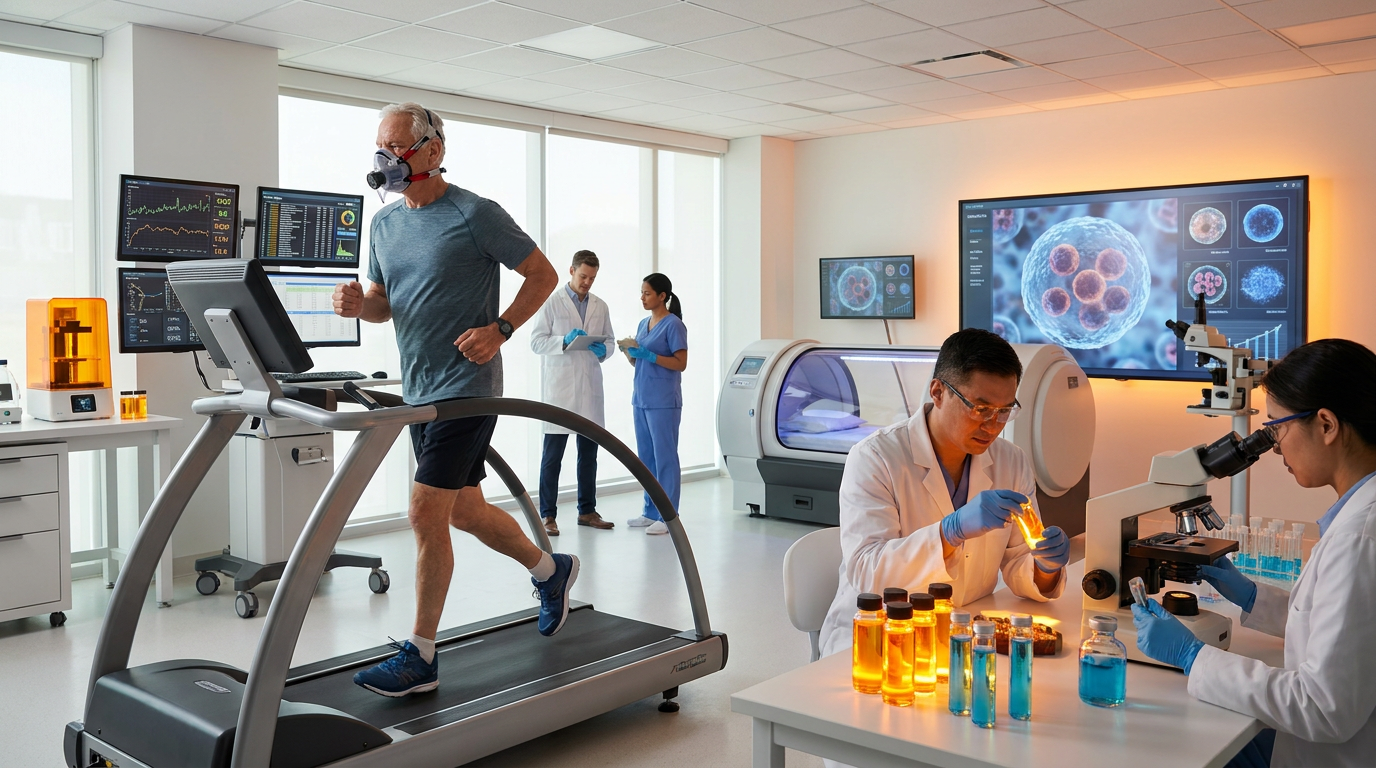
The post-workout glow isn't just a fleeting feeling; it is the result of a massive, systemic biochemical cascade. When human muscles contract repeatedly, they release hundreds of signaling molecules, burn stored lipids, and trigger the creation of new cellular powerhouses. For decades, medical science has viewed this complex physiological symphony as something that can only be earned through sweat, elevated heart rates, and physical exertion.[1][2]
But a new frontier in biotechnology is challenging that fundamental assumption. Researchers are rapidly advancing a class of experimental compounds known as "exercise mimetics"—drugs designed to artificially activate the exact cellular pathways that a five-mile run or a heavy weightlifting session would naturally trigger. By targeting specific enzymes and receptors, these compounds trick the body into believing it is working out.[2]
The recent spotlight on this field comes as biotech firms, including longevity-focused companies like Cambrian, push experimental mimetics closer to clinical viability. These companies are not trying to build a shortcut for healthy people looking to skip the gym. Instead, they are targeting a profound medical need: the millions of people for whom traditional exercise is physically impossible due to age, injury, or disease.[6]
"If exercise could be packaged into a pill, it would be the single most widely prescribed and beneficial medicine in the nation," the National Institute on Aging has long noted in its assessments of human healthspan. Physical activity is the closest thing to a panacea in modern medicine, drastically reducing the risk of cardiovascular disease, neurodegeneration, and metabolic syndrome.[3]

Yet, as the World Health Organization points out, global physical activity levels continue to decline, and for the elderly, the frail, or the paralyzed, the barrier to entry is insurmountable. By age 80, the average adult has lost roughly 30% of their peak muscle mass, a condition known as sarcopenia that drastically increases the risk of falls, hospitalization, and all-cause mortality.[3][7]
To understand how an exercise mimetic works, one must look at the cellular energy sensors that dictate human metabolism. The most famous of these is AMP-activated protein kinase, or AMPK. Think of AMPK as the biological fuel gauge on a cell's dashboard, constantly monitoring the ratio of available energy to consumed energy.[2][5]
When you exercise, your muscle cells rapidly consume ATP, the body's primary energy currency. As ATP levels drop, AMPK senses the depletion and sounds a cellular alarm. It immediately halts energy-consuming processes and activates energy-generating ones, instructing the cell to burn stored fat, pull glucose from the bloodstream, and build new mitochondria to handle future stress.[5]
When you exercise, your muscle cells rapidly consume ATP, the body's primary energy currency.
Early exercise mimetics, such as the experimental compound AICAR, were designed to directly bind to AMPK, tricking the cell into believing it was completely out of energy even when the body was at rest. In landmark animal studies, sedentary mice given AMPK activators suddenly developed the endurance of trained marathon runners, running nearly 50% further on treadmills without any prior physical training.[4][5]

Beyond AMPK, modern researchers are targeting a family of proteins called estrogen-related receptors (ERRs). These receptors act as master genetic switches for muscle endurance and mitochondrial growth. When activated by experimental compounds like SLU-PP-332, ERRs instruct muscle fibers to transition from fast-twitch, easily fatigued states to slow-twitch, highly oxidative states.[4]
The results in preclinical models have been staggering. Mice treated with ERR agonists not only run longer but also maintain lean muscle mass and lose body fat, even when fed a high-fat diet. Crucially, these compounds appear to protect against the severe muscle wasting that typically accompanies prolonged inactivity, casting immobilization, or bed rest.[4]
The transition from mouse models to human clinical trials is now underway, with early Phase 1 studies focusing primarily on safety, dosing, and tolerability. Because these drugs fundamentally alter cellular metabolism, researchers must ensure that keeping the body's "exercise switch" permanently flipped on does not lead to unintended consequences, such as cardiac stress or metabolic exhaustion over the long term.[1][8]
Furthermore, the biotech industry is increasingly viewing exercise mimetics as the perfect companion to the current generation of GLP-1 weight-loss drugs. While GLP-1 agonists are highly effective at reducing overall body weight, a significant portion of that weight loss often comes from lean muscle mass. A mimetic could theoretically preserve vital muscle tissue while the patient sheds fat, improving overall body composition.[6]

Despite the immense promise, scientists are quick to temper expectations regarding what a pill can actually achieve. Exercise is a holistic, whole-body stressor. While a drug might replicate the metabolic signaling within a muscle cell, it cannot replicate the mechanical load required to build bone density, strengthen tendons, and lubricate joints.[2][3]
Traditional physical activity also triggers the release of endorphins, brain-derived neurotrophic factor (BDNF), and other neurochemicals that profoundly benefit mental health and cognitive function. An AMPK activator will not provide the psychological relief of a brisk walk in the park, nor will it offer the cardiovascular elasticity gained from elevated heart rates and increased blood flow.[3][7]
Ultimately, the goal of the exercise mimetic field is not to replace the gym, but to provide a biological bridge. For a patient recovering from a hip fracture, a mimetic could prevent their muscles from atrophying during a month of bed rest, allowing them to eventually return to natural physical therapy. In the quest to extend human healthspan, bottling the biochemical benefits of exercise may prove to be one of the most important medical breakthroughs of the century.[1][2]
How we got here
2008
Researchers discover that the experimental compound AICAR can boost endurance in sedentary mice by nearly 50%.
2017
Advances in understanding the AMPK pathway clarify exactly how human cells sense energy depletion during intense workouts.
2023
Development of ERR agonists like SLU-PP-332 shows significant promise in preserving muscle mass and burning fat in animal models.
June 2026
Biotech firms report accelerated progress on experimental longevity drugs that mimic exercise pathways for human clinical trials.
Viewpoints in depth
Longevity Scientists
Argue that targeting exercise pathways is the most viable strategy for extending human healthspan.
For researchers focused on the biology of aging, exercise mimetics represent a holy grail. This camp views aging not as an inevitable decline, but as a series of metabolic failures that can be pharmaceutically corrected. By artificially keeping the body's energy-sensing pathways active, they believe we can delay the onset of sarcopenia, insulin resistance, and cardiovascular disease. Their primary evidence stems from decades of animal research showing that activating AMPK and ERR pathways extends both lifespan and healthspan in mammalian models.
Clinical Gerontologists
Focus on the immediate therapeutic applications for frail patients and those recovering from surgery.
Medical professionals who treat the elderly are less focused on radical life extension and more concerned with immediate quality of life. For this group, exercise mimetics are a critical tool for preventing the rapid muscle wasting that occurs when an older adult is hospitalized or bedridden. They emphasize that a few weeks of immobility can permanently strip an 80-year-old of their independence. A drug that preserves muscle tissue during recovery could drastically reduce nursing home admissions and fall-related fatalities.
Public Health Officials
Emphasize that pharmacological interventions should not distract from global initiatives to increase natural physical activity.
Public health advocates view the rise of exercise mimetics with cautious optimism mixed with concern. While acknowledging the medical necessity for frail populations, they worry about the cultural narrative of 'exercise in a pill.' This camp stresses that natural physical activity provides holistic benefits—such as bone density reinforcement, joint lubrication, and profound mental health improvements—that no single molecule can replicate. They argue that funding for these drugs must not cannibalize investments in walkable cities, public parks, and community sports programs.
What we don't know
- Whether the dramatic endurance and fat-loss benefits seen in mice will fully translate to complex human biology.
- The long-term safety profile of artificially keeping the body's exercise pathways permanently switched on.
- How these experimental compounds might interact with other longevity or weight-loss medications, such as GLP-1 agonists.
Key terms
- Exercise Mimetic
- A pharmacological compound designed to replicate the physiological and metabolic effects of physical exercise without actual exertion.
- AMPK
- An enzyme that serves as the body's cellular energy sensor, activating fat-burning and mitochondrial growth when energy levels are low.
- Sarcopenia
- The age-related, involuntary loss of skeletal muscle mass and strength.
- Healthspan
- The period of a person's life during which they are generally healthy and free from serious, debilitating disease.
- Mitochondria
- The powerhouses of the cell, responsible for generating the energy needed for muscle contraction and endurance.
Frequently asked
Will an exercise pill replace the need to work out?
No. While mimetics can trigger metabolic changes, they cannot replicate the mechanical stress that builds bone density or the endorphin release that benefits mental health.
Who are these drugs actually designed for?
The primary target demographic includes older adults suffering from frailty, patients on bed rest, and individuals with muscle-wasting diseases who cannot physically exercise.
Are exercise mimetics available to the public now?
No. Most of these compounds are still in preclinical testing or early Phase 1 human trials to ensure they are safe for long-term use.
Sources
Source coverage
8 outlets
3 viewpoints surfaced







[1]Factlen Editorial TeamLongevity Scientists
Synthesis by Factlen editorial team
Read on Factlen Editorial Team →[2]Nature MetabolismLongevity Scientists
Exercise mimetics: targeting the cellular pathways of physical activity
Read on Nature Metabolism →[3]National Institute on AgingClinical Gerontologists
The Biology of Aging and the Protective Effects of Exercise
Read on National Institute on Aging →[4]Cell PressLongevity Scientists
ERR agonists and the preservation of muscle endurance in mammalian models
Read on Cell Press →[5]Journal of Applied PhysiologyPublic Health Officials
Metabolic adaptations to AMPK activation and energy depletion
Read on Journal of Applied Physiology →[6]STAT NewsClinical Gerontologists
STAT+: Cambrian’s experimental longevity drug mimics exercise
Read on STAT News →[7]World Health OrganizationPublic Health Officials
Global action plan on physical activity and healthspan
Read on World Health Organization →[8]ClinicalTrials.govClinical Gerontologists
Safety and tolerability of novel exercise mimetics in older adults
Read on ClinicalTrials.gov →

More in health
See all 7 stories →Exercise Mimetics
The Science of 'Exercise in a Pill': How New Longevity Drugs Mimic Physical Activity
7 sources
Brain Health
How Deep Sleep Washes the Brain: The Science of the Glymphatic System
7 sources

Longevity Science
The Postbiotic Promise: How Urolithin A Recycles Aging Cells
6 sources

Vaccine Research
Shingles Vaccine Linked to 24% Lower Risk of Dementia in Major New Study
7 sources
Every angle. Every day.
Get health stories with full source coverage and perspective breakdowns delivered to your inbox.