
The Airbag Revolution: How Snowboarding Safely Reached the 2340-Degree Spin
Massive sloped airbags and AI motion capture have eliminated the physical consequences of trial-and-error, allowing snowboarders to safely master six-and-a-half rotations.
By Factlen Editorial Team
- Progression Advocates
- Focus on pushing human limits, breaking records, and the necessity of airbags to evolve the sport.
- Safety & Biomechanics Experts
- Focus on how airbags and AI motion capture extend careers and prevent catastrophic injuries.
- Style Purists
- Acknowledge the progression but emphasize that snowboarding must retain its aesthetic style rather than just becoming aerial gymnastics.
What's not represented
- · Casual recreational snowboarders
- · Resort operators managing public park safety
Why this matters
By replacing hard-packed ice with forgiving inflatables, the sport has found a way to push the absolute limits of human flight while drastically reducing catastrophic injuries and extending athletes' careers.
Key points
- Snowboarders are now landing 2340-degree spins (6.5 rotations) in competition.
- The progression is driven by massive sloped airbags that eliminate the risk of hard snow landings.
- Athletes can practice high-consequence tricks dozens of times a day without fear of catastrophic injury.
- U.S. Ski & Snowboard is using new AI smartphone technology to track 3D biomechanics without sensor suits.
- Judges are adapting to ensure style and execution are still rewarded alongside sheer rotation numbers.
The 2026 Milano Cortina Winter Olympics are showcasing a level of aerial acrobatics that would have seemed like science fiction just a decade ago. At the forefront of this progression is the 2340-degree spin—a dizzying six and a half full rotations suspended in mid-air.[1]
When Japanese prodigy Hiroto Ogiwara first landed the 2340 in competition at the 2025 X Games, it sent shockwaves through the winter sports community. He launched off a massive ramp, tucked into a tight mute grab, and spun so fast he became a blur before stomping the landing perfectly.[2][5]
But the real story isn't just that human beings are suddenly capable of spinning like tops. The secret behind this exponential leap in progression lies in the infrastructure where these athletes spend their summers.[7]
Welcome to the "airbag revolution." Across Europe and North America, specialized training facilities have fundamentally altered the risk-to-reward ratio of freestyle snowboarding.[1]

Historically, learning a new trick meant launching off an icy jump and praying for a clean landing. The penalty for under-rotating a triple cork was a catastrophic injury—blown knees, shattered collarbones, or severe concussions.[7]
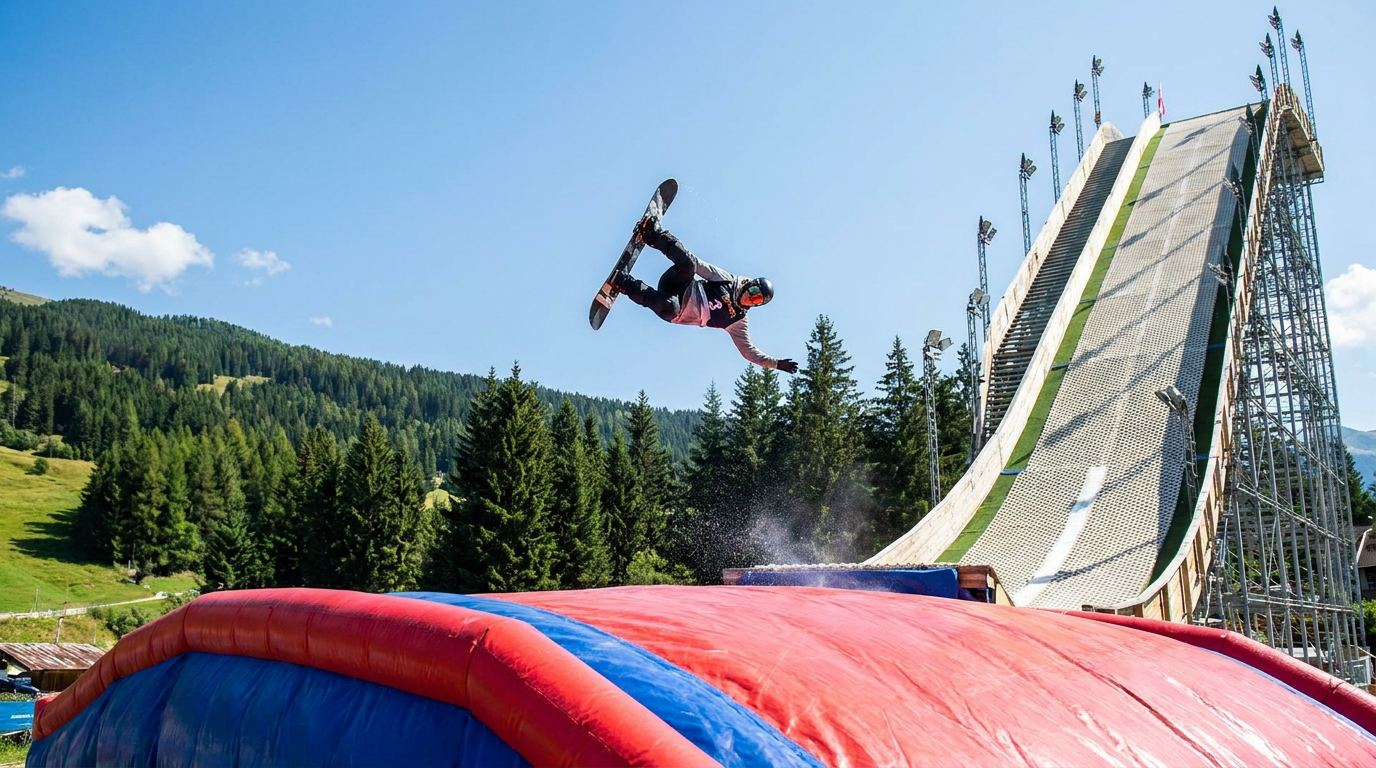
Modern facilities like Austria's Banger Park and Switzerland's Stomping Grounds have replaced the hard-packed snow landing with massive, sloped inflatable cushions.[6]
Unlike the flat stunt airbags of the past, these modern inflatables are pitched at the exact downward angle of a real mountain landing. If a rider lands perfectly, they simply ride out the bottom of the bag. If they crash, the forgiving surface absorbs the impact, allowing them to stand up, brush off, and hike back up for another attempt.[6][7]
This technological safety net has completely removed the fear factor from the learning process. Athletes can now attempt a trick fifty times in a single afternoon, building the crucial muscle memory and spatial awareness required for quintuple corks without risking their careers.[3]

This technological safety net has completely removed the fear factor from the learning process.
The results are undeniable. Beyond Ogiwara's 2340, China's Su Yiming recently set a Guinness World Record by landing back-to-back 1980s.[1]
The progression is equally staggering in the women's field. Japan's Kokomo Murase recently secured Olympic gold by landing a frontside triple cork 1440—a trick that was considered the absolute pinnacle of men's snowboarding just a few Olympic cycles ago.[1]
To complement the physical safety of airbags, teams are now deploying advanced software to fine-tune biomechanics. In early 2026, U.S. Ski & Snowboard partnered with Google Cloud to introduce an industry-first AI video-analysis tool.[4]
For decades, elite motion capture required athletes to wear fragile, sensor-covered suits that were entirely impractical for sub-zero mountain environments.[4]

The new experimental AI tool utilizes DeepMind's spatial intelligence to map a human body in three dimensions using only standard smartphone video. It can "see" through bulky winter gear, providing coaches with near real-time, data-driven insights into a rider's trajectory, axis, and rotation speed.[4]
By combining the physical safety of sloped airbags with the analytical precision of AI motion capture, athletes are optimizing their airtime with mathematical perfection.[7]
However, this rapid evolution has sparked a philosophical debate within the snowboarding community. As spins push past 2160 and 2340 degrees, some purists argue the sport is losing its soul, morphing into a dizzying math equation rather than an expression of style.[5]
Judges are now tasked with the incredibly difficult job of counting rotations in real-time while simultaneously evaluating the aesthetic quality of the grabs and the fluidity of the landing.[7]

To combat the "spin-to-win" critique, modern scoring heavily penalizes riders who sacrifice style for rotations. A perfectly executed, heavily tweaked 1800 will often score higher than a sloppy, flailing 2160.[7]
Yet, the athletes themselves seem entirely unfazed by the debate. For riders like Ogiwara, the joy lies in pushing the absolute limits of human flight.[3]
As the sport looks beyond Milano Cortina, the ceiling remains entirely unknown. With airbags protecting their bodies and AI refining their technique, the next generation of snowboarders is already looking toward the 2520.[7]
How we got here
2018
1440s and 1800s become the standard for men's Olympic podiums.
2022
Airbag training facilities proliferate, allowing year-round safe trick progression.
Jan 2025
Hiroto Ogiwara lands the first-ever 2340 in competition at the X Games.
Oct 2025
Su Yiming sets a Guinness World Record with back-to-back 1980s.
Feb 2026
U.S. Ski & Snowboard introduces AI smartphone motion capture for training.
Viewpoints in depth
Progression Advocates
Focus on human limits and the thrill of breaking records.
For progression advocates, the airbag revolution is the greatest thing to happen to snowboarding since the invention of the twin-tip board. They argue that human beings have an innate desire to see how far they can push the limits of flight, and airbags simply remove the biological penalty for trying. By eliminating the fear of shattered bones, athletes can focus entirely on the physics of the spin, unlocking a new era of aerial acrobatics that keeps the sport fresh and exciting for global audiences.
Safety & Biomechanics Experts
Focus on how airbags and AI extend careers and prevent catastrophic injuries.
Sports scientists and coaches view the airbag not just as a progression tool, but as a necessary medical intervention. In the past, freestyle snowboarders often aged out of the sport in their early twenties due to the cumulative toll of concussions and joint reconstructions. Today, biomechanics experts use AI motion capture to analyze a rider's axis in real-time, ensuring they have the spatial awareness to land safely before they ever touch real snow. This scientific approach is extending careers and protecting the long-term health of teenage prodigies.
Style Purists
Focus on the tension between adding more spins and maintaining the aesthetic 'soul' of snowboarding.
A vocal contingent of traditionalists worries that the sport is losing its identity. They argue that snowboarding was born out of surf and skate culture, where the aesthetic style of a trick mattered more than the sheer athletic difficulty. For purists, a slow, heavily tweaked 540-degree spin is more impressive than a frantic, flailing 2340. They caution that if judging criteria lean too heavily on rotation counts, snowboarding risks turning into a sterile gymnastics competition rather than an art form.
What we don't know
- Whether the human body can withstand the G-forces of a 2520-degree spin.
- How judging criteria will evolve if spins become too fast for the human eye to count accurately.
Key terms
- 2340
- A trick consisting of six and a half full rotations in the air (2340 degrees).
- Airbag Training
- Massive sloped inflatable cushions that mimic the pitch of a snowy landing, allowing athletes to practice high-consequence tricks safely.
- Cork
- An off-axis rotation where the snowboarder flips while spinning.
- Dryslope
- Synthetic bristle-like surfaces that simulate snow, allowing year-round jump training without winter weather.
- Big Air
- A competition format featuring one massive jump where riders perform their single most difficult trick.
Frequently asked
Do airbags feel like landing on snow?
No, they are softer and more forgiving, but modern sloped airbags mimic the exact downward angle of a snow landing so riders can ride away smoothly.
Who landed the first 2340?
Japanese snowboarder Hiroto Ogiwara landed the first 2340 in competition at the 2025 X Games.
How does the new AI tracking work?
It uses smartphone video and DeepMind spatial intelligence to map a rider's 3D biomechanics without requiring them to wear bulky sensor suits.
Are these tricks dangerous on real snow?
Yes. While airbags reduce training injuries, taking a 2160 or 2340 to hard-packed snow still carries immense risk of high-speed impact.
Sources
Source coverage
7 outlets
3 viewpoints surfaced







[1]Olympics.comProgression Advocates
Snowboarding big air and slopestyle tricks continue to progress at a staggering pace ahead of Milano Cortina 2026
Read on Olympics.com →[2]X GamesProgression Advocates
Hiroto Ogiwara makes history with world-first 2340
Read on X Games →[3]Red BullProgression Advocates
The first rider ever to land a 2340 Mute Grab
Read on Red Bull →[4]U.S. Ski & SnowboardSafety & Biomechanics Experts
U.S. Ski & Snowboard and Google Announce Industry-First AI Video-Analysis Tool
Read on U.S. Ski & Snowboard →[5]The GuardianStyle Purists
X Games debutant Hiroto Ogiwara makes history with first ever 2340
Read on The Guardian →[6]Banger ParkSafety & Biomechanics Experts
Banger Park Scharnitz | Freestyle Training in Tyrol
Read on Banger Park →[7]Factlen Editorial TeamSafety & Biomechanics Experts
Synthesis by Factlen editorial team
Read on Factlen Editorial Team →

More in sports
See all 8 stories →Standings
T20 Blast 2026 Standings: Hampshire Hawks Soar as Defending Champions Somerset Stumble
8 sources

Injury
Alex Marquez Cleared for MotoGP Return at Brno One Month After Horrific Crash
7 sources
Standings
Hamilton's First Ferrari Victory Shakes Up 2026 F1 Standings as Antonelli Maintains Lead
6 sources

Grass Court Season
Alexandra Eala Stuns World No. 2 Elena Rybakina in Historic Berlin Open Upset
7 sources

Every angle. Every day.
Get sports stories with full source coverage and perspective breakdowns delivered to your inbox.