
How Biomechanics and AI Pitch Design Are Revolutionizing Baseball
High-speed optical tracking and artificial intelligence have transformed baseball player development, allowing pitchers to engineer new pitches and optimize their mechanics. This data-driven approach is extending careers and redefining the physics of the sport, though it also raises new questions about the physical limits of the human arm.
By Factlen Editorial Team
- Biomechanists & Technologists
- Focus on optimizing human movement, discovering new efficiencies, and using AI to unlock velocity and movement that the naked eye cannot see.
- Sports Medicine & Injury Researchers
- Focused on the workload paradox—balancing the benefits of efficient mechanics against the absolute physical limits of the human elbow.
- Player Development Specialists
- Viewing the technology as a democratizing force that allows undrafted or struggling players to reinvent themselves and extend their careers.
What's not represented
- · Amateur and youth coaches lacking access to expensive technology
- · Hitters forced to adapt to engineered pitches
Why this matters
The integration of AI and biomechanics in sports demonstrates how technology can unlock human potential and extend athletic careers. For fans and athletes alike, understanding these invisible forces reveals the hidden physics and chess match happening in every single pitch.
Key points
- MLB stadiums now use 300-fps cameras to track 29 skeletal points on players in real time.
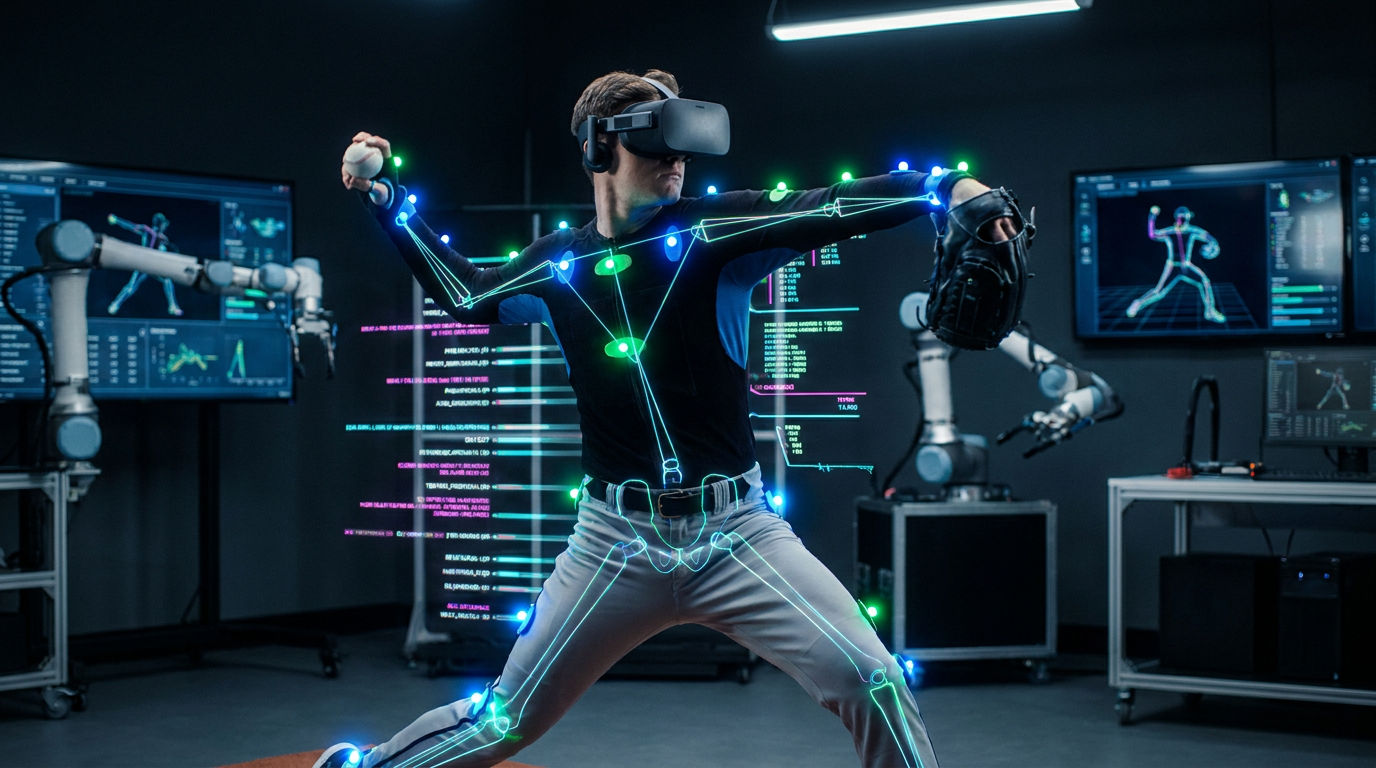
- Motion capture labs use force plates to map a pitcher's 'kinematic sequence' and optimize energy transfer.
- Pitch design technology has birthed new pitches like the 'sweeper' by utilizing seam-shifted wake aerodynamics.
- Machine learning helps teams predict prospect success and flag mechanical inefficiencies before injuries occur.
- A 'workload paradox' exists where optimized mechanics generate velocities that still test the physical limits of the elbow.
Baseball has always been a game of inches, but in 2026, it is a game of frames per second and sub-millimeter joint angles. The era of pitchers relying solely on "feel" or a coach's naked eye has been entirely eclipsed by the biomechanics revolution. Today, player development is driven by artificial intelligence, high-speed optical tracking, and fluid dynamics, transforming the mound into a real-time physics laboratory.[8]
The catalyst for this transformation was the league-wide adoption and continuous upgrading of Hawk-Eye Innovations' tracking technology. Originally known for tennis line calls, Hawk-Eye's baseball system now utilizes 12 specialized cameras arrayed around every Major League ballpark. Five of these cameras operate at an astonishing 300 frames per second, specifically dedicated to capturing the granular movements of the pitcher and hitter.[1][6]
This optical tracking system uses advanced computer vision to monitor 29 distinct skeletal points on an athlete's body in real time. By tracking the shoulders, hips, ankles, and wrists without the need for wearable sensors during live games, teams can generate a complete three-dimensional biomechanical model of every single pitch thrown in a season.[1][7]

But the true laboratory work happens away from the stadium lights. At independent facilities like Driveline Baseball and in proprietary team complexes, pitchers undergo exhaustive biomechanical assessments. Athletes strip down and are fitted with dozens of reflective markers while throwing off mounds equipped with force plates.[2]
These force plates measure the exact kinetics—the forces and torques—an athlete generates against the ground. The data is then synced with high-speed cameras to map the pitcher's "kinematic sequence." This sequence is the precise order and speed at which energy transfers through the body: from the pelvis, to the torso, up through the arm, and finally out through the fingertips.[2]
When a pitcher's kinematic sequence is perfectly optimized, they can generate maximum velocity with minimal wasted effort. Conversely, if the torso rotates a fraction of a second too early, energy leaks, velocity drops, and the arm is forced to compensate, increasing the risk of injury. Machine learning models now instantly flag these mechanical inefficiencies, allowing coaches to prescribe targeted drills to correct them.[2][3]

When a pitcher's kinematic sequence is perfectly optimized, they can generate maximum velocity with minimal wasted effort.
Beyond body mechanics, this technological leap has fundamentally altered how the baseball itself behaves in flight—a practice known as "pitch design." Armed with high-speed cameras that capture the exact moment the ball leaves the hand, pitchers can manipulate their grip and finger pressure to alter the ball's spin axis and aerodynamic profile.[2][8]
The most famous byproduct of the pitch design era is the "sweeper." While it resembles a traditional slider, the sweeper is engineered to maximize horizontal movement rather than downward drop. It achieves this not just through the Magnus effect—the standard physics of a spinning sphere—but through a phenomenon called "seam-shifted wake."[5][8]
Seam-shifted wake occurs when a pitcher grips the ball so that the seams catch the air asymmetrically during flight. This creates a pressure differential that physically pushes the ball sideways, resulting in late, dramatic movement that defies traditional aerodynamic expectations. The sweeper has become the ultimate weapon against the modern hitter's uppercut swing.[5]

The integration of machine learning platforms allows front offices to process the terabytes of data generated by these systems. Teams can now project how a minor-league prospect's raw biomechanical traits might translate to Major League success in three to four years, uncovering hidden gems who were overlooked by traditional scouting because they lacked conventional polish.[3][7]
However, the biomechanics boom has introduced a complex uncertainty known as the "workload paradox." As pitchers use technology to optimize their mechanics and throw harder than ever before, the sheer physical limit of the human elbow is being tested.[4][8]
Studies indicate that while better mechanics can distribute force more efficiently, the absolute elbow varus torque—the stress placed on the ulnar collateral ligament—still increases with extreme velocity. The debate continues over whether the spike in arm injuries is due to poor mechanics, the pitch clock reducing recovery time, or simply the human body not being built to throw 100 mph repeatedly.[4][5]

To combat this, teams are now using biomechanical data defensively. By establishing a baseline "healthy" skeletal model for each pitcher, organizations can monitor in-game tracking data for subtle deviations. If a pitcher's arm slot drops by two degrees or their hip-shoulder separation decreases, it triggers an algorithmic red flag indicating fatigue before a catastrophic injury occurs.[6][8]
Ultimately, the AI and biomechanics revolution is not about replacing human coaches with computers. It is about equipping coaches with superhuman vision. By translating complex physics into actionable, plain-language cues, the modern baseball ecosystem is extending careers, democratizing elite velocity, and pushing the boundaries of human athletic potential.[7][8]
How we got here
2020
Hawk-Eye tracking systems are first introduced as the primary Statcast provider in Major League Baseball.
2021
MLB bans sticky substances, forcing pitchers to rely on aerodynamic pitch design rather than raw friction.
2023
Hawk-Eye upgrades its pitching and hitting cameras to 300 frames per second across all 30 MLB stadiums.
2024
The 'sweeper' pitch sees a massive surge in usage as teams master seam-shifted wake mechanics.
2026
Teams increasingly use real-time biomechanical tracking defensively to monitor pitcher fatigue and prevent injuries.
Viewpoints in depth
Biomechanists & Technologists
Focus on optimizing human movement and using AI to unlock velocity and movement that the naked eye cannot see.
For data scientists and biomechanists, the human body is a complex physics equation waiting to be solved. By utilizing high-frame-rate cameras and machine learning, they argue that pitching is no longer an innate talent but a learnable skill. They view the integration of technology as a way to eliminate guesswork, allowing coaches to prescribe exact mechanical adjustments that maximize a player's natural kinetic energy.
Sports Medicine Professionals
Focused on the workload paradox and the absolute physical limits of the human elbow.
Medical researchers acknowledge that biomechanical optimization makes pitching more efficient, but they warn of a dangerous 'workload paradox.' Even with perfect mechanics, throwing a baseball 100 mph places immense varus torque on the ulnar collateral ligament. Sports medicine experts emphasize that while technology can flag fatigue, it cannot change the biological reality that the human arm was not evolved to withstand the extreme forces generated by modern pitch design.
Player Development Coaches
Viewing the technology as a democratizing force that allows struggling players to reinvent themselves.
For coaches on the ground, biomechanics labs are the ultimate equalizer. They argue that technology democratizes elite performance, allowing undrafted free agents or aging veterans to add velocity and movement to their arsenals. By translating complex data into simple, actionable cues, these coaches use pitch design to extend careers and turn fringe prospects into reliable Major League contributors.
What we don't know
- Whether the long-term use of extreme pitch designs like the sweeper will lead to new types of arm injuries.
- How hitters will ultimately adapt their swing mechanics to counter the rise of seam-shifted wake pitches.
- If the 'workload paradox' can be solved without fundamentally changing the rules or the physical baseball itself.
Key terms
- Kinematic Sequence
- The precise order and speed at which energy transfers through a pitcher's body, typically moving from the pelvis to the torso, arm, and finally the hand.
- Seam-Shifted Wake (SSW)
- An aerodynamic effect where the orientation of a baseball's seams alters the airflow around it, causing sudden and deceptive movement.
- Elbow Varus Torque
- The twisting force placed on the inside of the elbow (specifically the ulnar collateral ligament) during the throwing motion.
- Force Plates
- Specialized sensors built into a pitching mound that measure the exact amount of force and direction a pitcher exerts against the ground.
- Sweeper
- A modern variation of the slider pitch engineered to prioritize extreme horizontal movement over vertical drop.
Frequently asked
What is the difference between a slider and a sweeper?
A traditional slider moves downward and horizontally due to standard spin, while a sweeper is engineered to maximize horizontal movement using aerodynamic forces like seam-shifted wake.
How do cameras track biomechanics without sensors?
Systems like Hawk-Eye use high-speed cameras operating at 300 frames per second and computer vision algorithms to track 29 specific skeletal points on a player's body in real time.
Does throwing with better mechanics prevent injuries?
It helps distribute force more efficiently, but researchers note a 'workload paradox' where the extreme velocities generated by optimized mechanics still place immense absolute stress on the elbow.
What is seam-shifted wake?
It is an aerodynamic phenomenon where the seams of a spinning baseball catch the air asymmetrically, creating a pressure differential that pushes the ball in unexpected directions.
Sources
Source coverage
8 outlets
3 viewpoints surfaced








[1]Hawk-Eye InnovationsBiomechanists & Technologists
Skeletal Tracking and Biomechanics in Baseball
Read on Hawk-Eye Innovations →[2]Driveline BaseballPlayer Development Specialists
Hitting and Pitching Biomechanics: The Motion Capture Lab
Read on Driveline Baseball →[3]DatabricksBiomechanists & Technologists
Revolutionizing Baseball Player Development with Biomechanics
Read on Databricks →[4]National Institutes of HealthSports Medicine & Injury Researchers
Biomechanical Analysis of Baseball Pitching and Elbow Varus Torque
Read on National Institutes of Health →[5]Society for American Baseball ResearchSports Medicine & Injury Researchers
Individual Muscle Capacity and Pitch Design Analytics
Read on Society for American Baseball Research →[6]Sports Business JournalBiomechanists & Technologists
Hawk-Eye partners with Reboot Motion to refine MLB biomechanics models
Read on Sports Business Journal →[7]Medium Data ScienceBiomechanists & Technologists
Computer Vision and Player Development in Modern Baseball
Read on Medium Data Science →[8]Factlen Editorial TeamPlayer Development Specialists
Synthesis by Factlen editorial team
Read on Factlen Editorial Team →

More in sports
See all 9 stories →Standings
T20 Blast 2026 Standings: Hampshire Hawks Soar as Defending Champions Somerset Stumble
8 sources

Injury
Alex Marquez Cleared for MotoGP Return at Brno One Month After Horrific Crash
7 sources

Standings
Hamilton's First Ferrari Victory Shakes Up 2026 F1 Standings as Antonelli Maintains Lead
6 sources

Grass Court Season
Alexandra Eala Stuns World No. 2 Elena Rybakina in Historic Berlin Open Upset
7 sources

Every angle. Every day.
Get sports stories with full source coverage and perspective breakdowns delivered to your inbox.