
The 2026 Tony Awards: How 'Schmigadoon!' Won Big and the Mechanism Behind Broadway's Biggest Night
The 79th Tony Awards celebrated a mix of screen-to-stage adaptations and classic revivals, but behind the glitz of Radio City Music Hall lies a complex, 831-person voting mechanism that dictates who takes home the medallion.
By Factlen Editorial Team
- Theatrical Traditionalists
- Value classic revivals and original stage plays, arguing that Broadway's primary role is to preserve and elevate canonical dramatic literature.
- Commercial Innovators
- Support screen-to-stage adaptations and pop-culture integration, believing that leveraging existing IP is essential for bringing new audiences to live theater.
- Industry Mechanics
- Focus on the rigorous voting rules, attendance requirements, and the economic 'Tony bump' that sustains the theater ecosystem.
What's not represented
- · Off-Broadway Creators
- · Touring Production Casts
- · General Theater Audiences
Why this matters
The Tony Awards dictate the economic survival of Broadway productions and shape the theatrical landscape nationwide. Understanding how these 831 voters make their decisions reveals why certain shows tour the country for decades while others close within weeks.
Key points
- The 79th Tony Awards celebrated both commercial adaptations like Schmigadoon! and classic revivals like Death of a Salesman.
- A rotating Nominating Committee of 50 industry professionals determines the initial nominees via secret ballot.
- Approximately 831 eligible voters, including producers and union representatives, decide the final winners.
- Voters are strictly required to see every nominated production in a category before casting a ballot for it.
- An independent accounting firm tabulates the secure online votes, keeping the results secret until the live telecast.
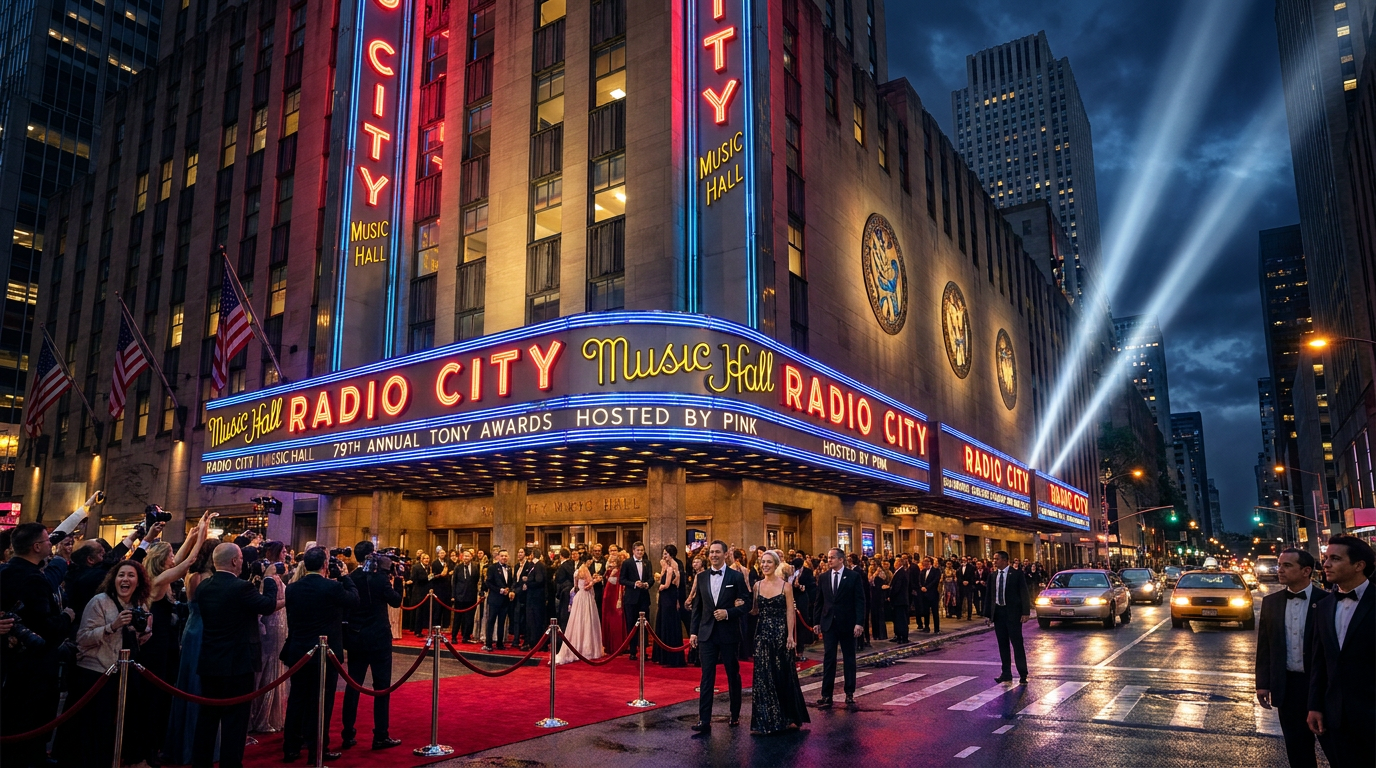
The 79th Annual Tony Awards transformed Radio City Music Hall into a celebration of theatrical resilience and cross-media innovation on June 7, 2026. Hosted by pop icon Pink, the ceremony capped off a vibrant 2025–2026 Broadway season that balanced prestige drama with commercial spectacle. Broadcast live on CBS and Paramount+, the evening served as both an industry coronation and a national advertisement for live theater. While millions tuned in for the musical numbers and emotional acceptance speeches, the results reflected a highly specific, rigorously governed voting process that dictates the highest honors in American theater. Understanding who takes home the silver medallion requires looking past the red carpet and into the complex mechanics of Broadway's governing bodies.[2][4]
The night’s most coveted prize, Best Musical, went to Schmigadoon!, a vibrant stage adaptation of the hit television series. The production also secured awards for its co-creator Cinco Paul, alongside wins for choreography and scenic design. Its victory underscores a growing trend on Broadway: the successful translation of screen properties into stage juggernauts. By leveraging existing intellectual property with a built-in fanbase, Schmigadoon! managed to capture both commercial success and critical acclaim. The win proves that television-to-stage pipelines can yield top-tier theatrical art when executed with precision, offering a financial lifeline to an industry that relies heavily on recognizable titles to attract international tourists.[2][4]
While new musicals embraced pop-culture crossovers, the play categories were dominated by foundational classics. A critically hailed revival of Arthur Miller’s Death of a Salesman, directed by Joe Mantello, swept the evening with six awards. It claimed Best Revival of a Play, while its cast and creative team were showered with accolades. The production’s triumph highlights Broadway’s enduring reliance on canonical texts, demonstrating that fresh directorial visions can still extract new relevance and award-winning performances from mid-century American masterpieces. In a season filled with flashy new works, the voters signaled that profound, text-driven drama remains the bedrock of theatrical prestige.[2][3]

Acting honors across the board celebrated a mix of stage veterans and dynamic musical performers. John Lithgow took home the award for Best Performance by an Actor in a Leading Role in a Play for his commanding work in Giant, while Lesley Manville won the corresponding actress prize for her devastating turn in Oedipus. In the musical categories, the revival of Ragtime proved to be a powerhouse, with Joshua Henry and Caissie Levy winning the leading actor and actress awards, respectively. These victories emphasize the sheer vocal and dramatic stamina required to anchor a Broadway production eight times a week, rewarding performers who carry the emotional weight of massive productions.[1][2]
Beyond the glitz of the telecast, the distribution of these awards is the result of a complex, multi-tiered mechanism designed to ensure fairness and industry-wide consensus. The journey to a Tony Award begins long before the envelopes are opened, governed jointly by the American Theatre Wing and The Broadway League. Only productions that open in one of the 41 designated Broadway theaters in Manhattan by a strict springtime cutoff date are eligible for consideration. This geographic and temporal boundary immediately filters out Off-Broadway sensations and touring productions, ensuring the awards remain hyper-focused on the specific economic ecosystem of Times Square.[4][6]
The first major hurdle for any eligible production is the Tony Awards Nominating Committee. This rotating group consists of approximately 50 working theater professionals—ranging from actors and directors to designers and casting agents—who serve overlapping three-year terms. These committee members are tasked with the monumental responsibility of attending every single eligible new Broadway production during the season. Shortly after the eligibility deadline, they convene to cast secret ballots, determining which shows and individuals will make the final cut for nominations. Their decisions shape the narrative of the entire season, elevating certain productions while quietly ending the momentum of others.[4][6]

The first major hurdle for any eligible production is the Tony Awards Nominating Committee.
Once the nominations are announced, the power shifts to the broader Tony voting body, which currently consists of approximately 831 eligible voters. This electorate is a carefully curated cross-section of the theatrical industry. It includes members of The Broadway League, the board of directors of the American Theatre Wing, and representatives from major theatrical unions like Actors' Equity Association and the Dramatists Guild. Select theater critics, casting directors, and press agents also hold voting privileges. This diverse pool of industry insiders ensures that the final winners are chosen by peers who deeply understand the artistic and logistical challenges of mounting a Broadway show.[5][6]
To maintain the integrity of the awards, the Tony Administration Committee enforces a strict attendance rule: voters are only permitted to cast a ballot in a specific category if they have seen all the nominated productions within that category. To facilitate this, nominated shows provide complimentary tickets to voters during the frantic weeks between the nominations and the voting deadline. Voters must log their attendance in an online Tony Voter Portal, creating a digital paper trail of their theatrical viewing. This system is designed to prevent blind voting based on popularity, cast albums, or personal relationships.[5][6]
If a voter fails to attend a performance of a nominated production, they are automatically locked out of voting in any category where that production is competing. While this system is robust in theory, industry insiders acknowledge that it relies heavily on the honor system and the physical stamina of the voters. The sheer logistics of seeing every nominated show in a compressed timeframe often leads to frantic scheduling. Consequently, producers host luncheons, send promotional materials, and campaign aggressively to ensure their shows remain top-of-mind and that voters actually show up to their designated seats before the voting window closes.[5][6]

The actual voting process is conducted via a secure online platform managed by an independent firm, under the strict supervision of certified public accountants. Ballots are made available to voters at least 14 days prior to the ceremony, and the final votes are tabulated at least 50 hours before the telecast begins. The results are guarded with extreme secrecy; not even the Tony Awards Administration Committee knows the outcome. Only a select few representatives from the accounting firm are aware of the winners before the envelopes are opened onstage, preserving the genuine surprise that defines the live broadcast.[5][6]
When a winner's name is called, they receive one of the most iconic trophies in the entertainment industry. The Tony Award medallion, designed in 1949 by Herman Rosse, is a silver disk depicting the classic masks of comedy and tragedy. Mounted on a black armature and base, the trophy stands nearly nine and a half inches tall and weighs 3.5 pounds. Even those who do not win the physical trophy are recognized; all nominees receive official certificates and commemorative pins acknowledging their achievement at the highest level of American theater, a distinction that permanently alters their professional resumes.[4]

Winning a Tony Award carries implications far beyond the physical medallion. It is the final, and often most elusive, component of the coveted EGOT status—the grand slam of American entertainment comprising an Emmy, Grammy, Oscar, and Tony. For composers, directors, and actors, securing a Tony Award cements their legacy across multiple mediums. Furthermore, for the productions themselves, a Tony win—particularly for Best Musical or Best Play—often triggers the 'Tony bump.' This significant surge in box office sales can sustain a show for years, recoup millions in investments, and launch highly lucrative national tours that bring the production to the rest of the country.[2][4]
The 2026 Tony Awards perfectly encapsulated the dual nature of modern Broadway: an industry that fiercely protects its historical legacy while aggressively pursuing new audiences. The triumph of Death of a Salesman honors the theatrical canon, while the coronation of Schmigadoon! signals a willingness to embrace multimedia synergy. As the 831 voters cast their ballots this year, they were not just evaluating performances; they were actively shaping the economic and artistic future of the American theater. The rigorous mechanism behind the magic proves that Broadway takes its highest honors just as seriously as the art it puts on stage.[2][5]
How we got here
April 2026
The official eligibility cutoff date for the 2025-2026 Broadway season passes, locking in the pool of contenders.
May 2026
The 50-member Nominating Committee announces the official nominees after seeing all eligible productions.
Late May 2026
The ~831 eligible voters scramble to see all nominated shows and log their attendance in the online Voter Portal.
June 5, 2026
Voting officially closes 50 hours before the ceremony, and ballots are securely tabulated by an independent accounting firm.
June 7, 2026
The 79th Annual Tony Awards are broadcast live from Radio City Music Hall, revealing the closely guarded results.
Viewpoints in depth
Theatrical Traditionalists
Advocates for the preservation of classic dramatic literature and original stagecraft.
This camp views Broadway as the ultimate guardian of the American theatrical canon. They celebrate the sweeping success of revivals like Death of a Salesman and Ragtime as proof that audiences still crave profound, text-driven storytelling over flashy spectacle. For traditionalists, the Tony Awards should primarily reward artistic excellence and raw performance stamina, resisting the urge to simply crown the most commercially recognizable intellectual property.
Commercial Innovators
Proponents of leveraging television and film IP to secure Broadway's financial future.
Facing rising production costs and a reliance on tourism, this perspective argues that Broadway must adapt to survive. They champion the victory of Schmigadoon! as a necessary evolution, proving that screen-to-stage adaptations can be both artistically valid and commercially vital. By bringing established fanbases into the theater, these innovators believe Broadway can cultivate a younger, more diverse audience that will eventually explore original works as well.
Industry Mechanics
Insiders focused on the logistical integrity and economic impact of the voting process.
For producers, union representatives, and theater owners, the Tony Awards are fundamentally an economic engine. This viewpoint emphasizes the rigorous 831-member voting process and the strict attendance rules that legitimize the awards. They focus on the 'Tony bump'—the surge in ticket sales following a win—as the true prize, noting that a Best Musical victory can mean the difference between a show recouping its multi-million dollar investment or closing prematurely.
What we don't know
- The exact margin of victory in each category, as vote tallies are permanently sealed by the accounting firm.
- How many of the 831 eligible voters were forced to recuse themselves from specific categories due to the strict attendance requirements.
- The long-term box office impact of the 2026 'Tony bump' on the winning revivals compared to the new commercial adaptations.
Key terms
- EGOT
- An acronym for the Emmy, Grammy, Oscar, and Tony Awards, representing the grand slam of American entertainment.
- The Broadway League
- The national trade association for the Broadway industry, whose members make up a significant portion of the Tony voting body.
- Tony Voter Portal
- The online system where eligible voters must log their attendance for nominated shows to maintain their voting privileges.
- The Tony Bump
- The sudden, significant increase in box office ticket sales that a production typically experiences immediately after winning a major Tony Award.
Frequently asked
Can anyone buy a ticket to the Tony Awards?
Yes, a limited number of tickets are made available for the general public to purchase, though the dress rehearsal remains strictly invitation-only.
Are Off-Broadway shows eligible for a Tony?
No. Only productions that open in one of the 41 designated Broadway theaters in Manhattan are eligible for Tony Awards consideration.
What happens if a voter doesn't see a nominated show?
If a voter fails to attend a nominated production, they are barred from voting in any category in which that specific show is nominated.
Who counts the Tony Award votes?
An independent accounting firm tabulates the secure online votes, keeping the results entirely secret until the live telecast.
Sources
Source coverage
6 outlets
3 viewpoints surfaced






[1]American Theatre WingIndustry Mechanics
2026 Tony Award Winners
Read on American Theatre Wing →[2]Los Angeles TimesTheatrical Traditionalists
Tony Awards 2026: 'Schmigadoon!' wins best musical in a season saved by revivals
Read on Los Angeles Times →[3]The GuardianTheatrical Traditionalists
Tony awards 2026: Death of a Salesman triumphs, as Lesley Manville and John Lithgow also win
Read on The Guardian →[4]Tony Awards OfficialIndustry Mechanics
Rules, Eligibility, and Voting
Read on Tony Awards Official →[5]BroadwayWorldCommercial Innovators
How the Tony Awards Voting Process Works
Read on BroadwayWorld →[6]Musical Stage CompanyIndustry Mechanics
How Do The Tony Awards Work?
Read on Musical Stage Company →
Every angle. Every day.
Get entertainment stories with full source coverage and perspective breakdowns delivered to your inbox.