
The Economic Ripple Effects of the US-Iran Deal and the Reopening of the Strait of Hormuz
The U.S. Navy has lifted its blockade of Iranian ports following a landmark peace agreement, sending global oil prices plummeting. However, experts warn that consumers may not see significant relief at the gas pump until late 2026 as global supply chains recalibrate.
By Factlen Editorial Team
- U.S. Administration
- Argues the deal secures global energy markets without costing U.S. taxpayers, relying on GCC funding and strict compliance.
- Energy Market Analysts
- Focused on supply chain mechanics, noting that while crude prices drop, consumer relief will lag due to inventory deficits.
- Gulf & Regional Actors
- Weighing the financial burden of the $300 billion fund against the economic benefits of regional stability and secure shipping lanes.
- Macroeconomic Watchers
- Monitoring how the sudden drop in energy costs will impact central bank policies and broader inflation trends.
What's not represented
- · U.S. Domestic Consumers
- · Environmental Monitoring Groups
Why this matters
The reopening of the world's most critical oil chokepoint removes a massive risk premium from global energy markets, directly impacting inflation trajectories and central bank policies. For consumers, it signals an eventual easing of fuel costs, though the timeline depends heavily on how quickly depleted global stockpiles can be replenished.
Key points
- The U.S. Navy has ended its blockade of Iranian ports, reopening the Strait of Hormuz.
- Global crude oil prices plummeted as the geopolitical risk premium evaporated.
- Retail gasoline prices are unlikely to drop significantly until late 2026 due to depleted stockpiles.
- The Trump administration states a $300 billion reconstruction fund will be financed by Gulf states, not U.S. taxpayers.
- Iran's access to the reconstruction funds is strictly conditional on full compliance with the peace agreement.
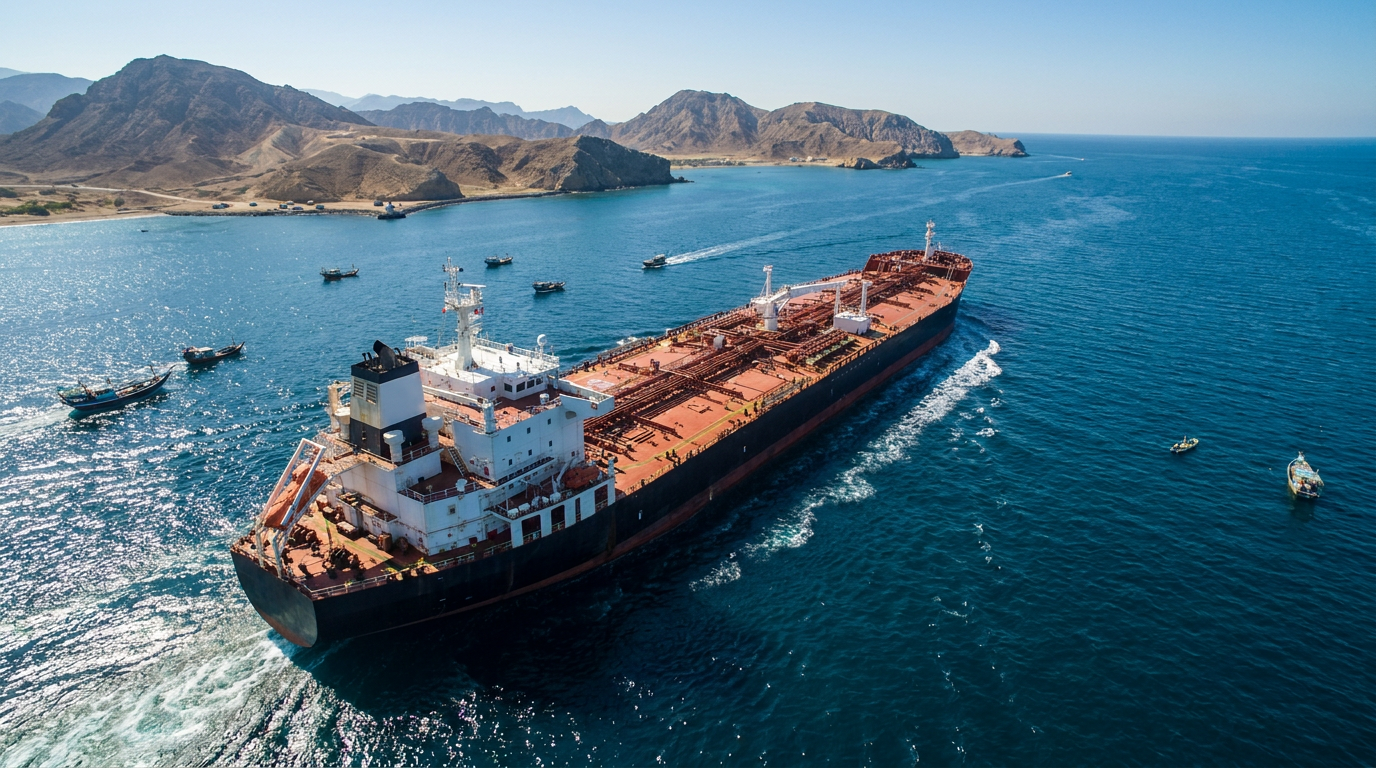
The United States Navy officially terminated its maritime blockade of Iran’s ports and coastal territories on Thursday, executing a direct directive from President Donald Trump following the finalization of a landmark U.S.-Iran peace agreement. The cessation of these naval operations marks the immediate de-escalation of a severe geopolitical standoff that had effectively choked off the Strait of Hormuz, universally recognized as the world's most critical maritime chokepoint for energy transit. For global financial markets, this diplomatic breakthrough triggered an instantaneous and aggressive repricing of energy assets. Global crude oil benchmarks plummeted in early trading as the massive "war premium"—a pricing buffer that had artificially inflated energy costs due to the persistent threat of supply disruption—began to rapidly evaporate from the market.[1][5]
The Strait of Hormuz, a narrow and highly strategic waterway connecting the Persian Gulf to the Gulf of Oman, serves as the primary artery for Middle Eastern energy exports, with roughly twenty percent of the world's daily oil consumption typically navigating its waters. During the height of the blockade, the severe constriction of this vital transit route forced global energy markets into a state of structural deficit. This artificial scarcity drove up operational costs across the global economy, impacting everything from aviation fuel and maritime shipping rates to the baseline manufacturing inputs for industrial goods. The sudden reopening of the strait is viewed by macroeconomic analysts as a massive deflationary catalyst, removing a primary driver of recent supply-side inflation that had complicated central bank policies worldwide.[5][8]
To understand the magnitude of the economic relief, one must examine how the blockade physically altered global maritime trade. For months, commercial shipping conglomerates were forced to reroute massive tanker fleets away from the Persian Gulf, relying instead on longer, more expensive alternative routes or tapping into strategic petroleum reserves. The maritime insurance industry effectively redlined the entire region, hiking premiums to commercially unviable levels for any vessel attempting to navigate near Iranian coastal waters. The U.S. Navy's official stand-down order immediately nullifies these extreme risk assessments, allowing major maritime insurers to normalize their coverage rates, which in turn dramatically lowers the baseline overhead costs for global shipping logistics.[1][5]

However, while the precipitous drop in wholesale crude prices offers immediate relief to commodity traders and institutional buyers, the translation to actual consumer savings at the retail level will require significant patience. Energy analysts and market economists warn that a rapid return to three-dollar-per-gallon gasoline in the United States is highly unlikely to materialize in the near term. The lag between plunging crude oil benchmarks and cheaper retail gasoline is deeply rooted in the physical mechanics of the global energy supply chain. Refineries across North America and Europe have spent months operating with severely depleted stockpiles of both raw crude oil and finished gasoline products, prioritizing immediate distribution over inventory building during the crisis.[2][8]
Industry experts project that these critical commercial inventories will not be fully replenished until the final quarter of 2026 at the earliest. Because refineries must first purchase the newly discounted crude, process it, and then rebuild their baseline reserves before passing the lower costs down the distribution network, retail prices at the pump will remain stubbornly sticky even as the underlying commodity cheapens on the global exchanges. This dynamic means that while the macroeconomic threat of spiraling energy costs has been neutralized, the average consumer will continue to bear the residual financial burden of the blockade for several more months as the physical market slowly normalizes.[2]

Industry experts project that these critical commercial inventories will not be fully replenished until the final quarter of 2026 at the earliest.
Beyond the immediate mechanics of the global energy market, the underlying financial architecture of the peace agreement has sparked intense political scrutiny and partisan debate in Washington. Central to the controversy is a proposed three-hundred-billion-dollar reconstruction fund intended to rebuild Iranian civilian and energy infrastructure that deteriorated during the prolonged period of economic isolation and maritime blockade. The sheer scale of this proposed financial vehicle has drawn sharp criticism from political opponents, who have raised alarms about the potential misuse of funds and the optics of financing a historical adversary. This backlash has prompted swift and aggressive defensive maneuvers from the Trump administration, with the President repeatedly and forcefully denying that any United States taxpayer dollars will be utilized to finance the reconstruction effort.[3][9]
Vice President JD Vance has taken a leading role in defending the economic structure of the deal, stating unequivocally in recent interviews that the United States is not giving Iran "a cent" of domestic resources. Instead, the administration claims that the entirety of the three-hundred-billion-dollar reconstruction fund will be capitalized by the Gulf Cooperation Council (GCC), a political and economic union of wealthy Arab states bordering the Persian Gulf, including Saudi Arabia and the United Arab Emirates. The administration argues that these regional actors have the most direct financial interest in maintaining a stable, conflict-free Persian Gulf, making them the logical underwriters for the regional security pact.[1][3][6]
The actual mechanics of securing this GCC funding, however, remain a subject of intense diplomatic negotiation and skepticism among international financial analysts. While Gulf states undeniably benefit from the resumption of unimpeded maritime trade and the reduction of regional hostilities, securing binding, liquid financial commitments of that magnitude requires incredibly complex multilateral agreements. Furthermore, access to these proposed funds is strictly conditional. According to detailed briefings from administration officials, the financial resources will be held in escrow and only unlocked in tranches if Tehran demonstrates full, verifiable, and ongoing compliance with the stringent terms of the peace agreement, subject to international monitoring.[3][6][9]

In Tehran, the lifting of the naval blockade is being heralded by state media as a critical economic lifeline for a nation that has been severely battered by restricted maritime access. The blockade had crippled Iran's ability to export its own crude oil and import essential industrial and consumer goods, leading to severe domestic inflation and currency devaluation. The return of Iranian barrels to the open market is now the next major variable for energy economists to model. Prior to the escalation, Iran was a significant global producer, and the speed at which its national oil company can ramp up production, secure international shipping insurance, and find willing buyers will heavily dictate the pace of global price stabilization.[7]
The physical reintegration of Iranian crude into the global market presents its own set of complex logistical challenges. Prior to the escalation, Iran possessed a formidable production capacity, but months of enforced idleness and restricted access to foreign maintenance technology have inevitably degraded some of its extraction and export infrastructure. Energy economists are currently modeling the speed at which the National Iranian Oil Company can safely ramp up production to pre-crisis levels. Furthermore, Tehran must now aggressively compete to win back market share from rival producers who stepped in to fill the void during the blockade, a dynamic that could incentivize Iran to offer steep discounts on its crude, further accelerating the downward pressure on global energy prices.[7][8]
The sudden evaporation of the geopolitical risk premium in energy markets is also sending immediate ripple effects through global macroeconomic policy, particularly concerning the United States Federal Reserve. Prior to the peace agreement, the threat of a prolonged blockade and spiking oil prices had raised fears of a secondary wave of supply-driven inflation. Interestingly, despite the deflationary relief provided by falling crude prices, Federal Reserve Chairman Kevin Warsh recently delivered notably hawkish remarks that reverberated through financial markets. Warsh's tough stance indicates that while the energy shock has been averted, the central bank remains hyper-vigilant about underlying core inflation and is prepared to maintain restrictive monetary policy, signaling to investors that the Hormuz reopening alone will not guarantee an immediate pivot to aggressive rate cuts.[4][5]

Looking ahead, the durability of this economic recalibration hinges entirely on the strict enforcement of the agreement's diplomatic guardrails. International monitors and energy traders are acutely focused on the "snapback" mechanisms embedded within the treaty, which would automatically reinstate the naval blockade and severe economic sanctions if any party violates the established terms. This persistent underlying risk means that while the immediate crisis has passed, a baseline level of volatility will remain priced into Middle Eastern energy assets. Nevertheless, if the compliance framework holds, the GCC capital is successfully deployed for reconstruction, and Iranian crude smoothly reintegrates into the global supply chain, the global economy stands to benefit from a sustained period of energy stability heading into the next decade.[6][9]
How we got here
Pre-2026
Tensions escalate, leading to a U.S. naval blockade of Iranian ports and the Strait of Hormuz.
Early June 2026
The Trump administration brokers a landmark peace agreement with Iran.
June 18, 2026
The U.S. Navy officially lifts the blockade, causing global oil prices to plummet.
Late 2026 (Projected)
Global oil and gasoline stockpiles are expected to replenish, potentially lowering retail prices.
Viewpoints in depth
The U.S. Administration's View
The administration frames the deal as a masterclass in securing global stability without domestic financial burden.
White House officials and Vice President JD Vance are aggressively messaging that the peace agreement achieves two major goals simultaneously: neutralizing a global economic threat and shifting the financial burden of regional stability onto the Gulf states. By insisting that the $300 billion reconstruction fund will be entirely capitalized by the GCC, the administration aims to preempt domestic criticism regarding the optics of financing a historical adversary. They emphasize that the strict, verifiable compliance mechanisms ensure the U.S. retains ultimate leverage over the region.
Energy Market Analysts
Market experts are focused on the physical lag between wholesale crude drops and retail consumer relief.
While commodity traders celebrated the immediate evaporation of the geopolitical risk premium, supply chain economists are urging caution regarding consumer expectations. Analysts point out that the global refining sector has operated on a hand-to-mouth basis for months, severely depleting commercial inventories. The consensus among market watchers is that refineries will prioritize rebuilding their own baseline reserves before passing the newly discounted crude costs down to the retail distribution network, meaning the deflationary impact at the gas pump will be delayed until late 2026.
Gulf Cooperation Council (GCC) States
Regional powers are weighing the massive financial commitment against the existential need for maritime security.
For the wealthy Arab states bordering the Persian Gulf, the proposed $300 billion reconstruction fund represents a staggering financial commitment, even for nations with vast sovereign wealth. However, diplomatic sources indicate that these states view the expenditure as a necessary insurance policy. The unimpeded flow of maritime trade through the Strait of Hormuz is an existential requirement for their own economies. By underwriting the peace deal, the GCC hopes to purchase long-term regional stability, though they are expected to demand rigorous international oversight to ensure the funds are not diverted.
Macroeconomic Watchers
Economists are analyzing how the sudden drop in energy costs will alter central bank interest rate trajectories.
The reopening of the Strait of Hormuz fundamentally alters the macroeconomic calculus for central banks worldwide. Prior to the deal, the threat of a prolonged blockade had raised fears of a secondary wave of supply-driven inflation. While the drop in crude prices provides significant deflationary relief, Federal Reserve Chairman Kevin Warsh's recent hawkish remarks suggest that central bankers remain hyper-vigilant about underlying core inflation. Macroeconomic watchers believe the Fed will use the breathing room provided by lower energy costs to maintain restrictive monetary policy longer than markets initially anticipated.
What we don't know
- Whether the Gulf Cooperation Council states have formally committed the full $300 billion in liquid capital.
- How quickly Iran can scale up its crude oil production and export capacity after months of restricted access.
- The exact verification mechanisms that will dictate Iran's compliance and access to the escrowed funds.
Key terms
- Strait of Hormuz
- A vital maritime chokepoint between the Persian Gulf and the Gulf of Oman, essential for global energy transit.
- Risk Premium
- The additional cost embedded in commodity prices due to the threat of geopolitical conflict or supply disruption.
- Gulf Cooperation Council (GCC)
- A political and economic union of six Arab states bordering the Persian Gulf, including Saudi Arabia and the United Arab Emirates.
- Snapback Mechanism
- A diplomatic provision that automatically reinstates sanctions or penalties if a party violates the terms of an agreement.
Frequently asked
Why aren't gas prices dropping immediately?
Refineries have depleted their stockpiles of crude oil and gasoline during the crisis. It will take months to replenish these inventories before retail prices fully reflect the drop in wholesale crude costs.
Is the U.S. paying for Iran's reconstruction?
The Trump administration and Vice President JD Vance have explicitly denied that U.S. taxpayer money will be used, stating the $300 billion fund will be capitalized by Gulf Cooperation Council (GCC) states.
How much oil goes through the Strait of Hormuz?
Roughly 20% of the world's daily oil consumption passes through the strait, making it the most critical energy transit chokepoint globally.
Sources
Source coverage
9 outlets
4 viewpoints surfaced








[1]CNBCU.S. Administration
U.S. Navy ends blockade of Iran's ports and coastal areas, CENTCOM says
Read on CNBC →[2]BloombergEnergy Market Analysts
A Return to $3 Gasoline? Here’s What It Will Take
Read on Bloomberg →[3]ForbesU.S. Administration
Trump Again Denies U.S. Is Providing Iran With $300 Billion For Reconstruction Fund
Read on Forbes →Markets are set for a much more hawkish Warsh Fed than expected
Read on CNBC Markets →[5]ReutersMacroeconomic Watchers
Global crude benchmarks plunge as Hormuz risk premium evaporates
Read on Reuters →[6]Financial TimesGulf & Regional Actors
Gulf states weigh financial commitments in US-brokered Iran pact
Read on Financial Times →[7]Al JazeeraGulf & Regional Actors
Tehran welcomes end of naval blockade as economic lifeline
Read on Al Jazeera →[8]S&P GlobalEnergy Market Analysts
Oil market fundamentals and the Iranian crude return
Read on S&P Global →[9]WSJEnergy Market Analysts
The mechanics of the $300 billion Iran reconstruction fund
Read on WSJ →

Every angle. Every day.
Get business stories with full source coverage and perspective breakdowns delivered to your inbox.