
The 2026 Laptop Divide: Snapdragon X Elite Windows PCs vs. Apple Silicon MacBooks
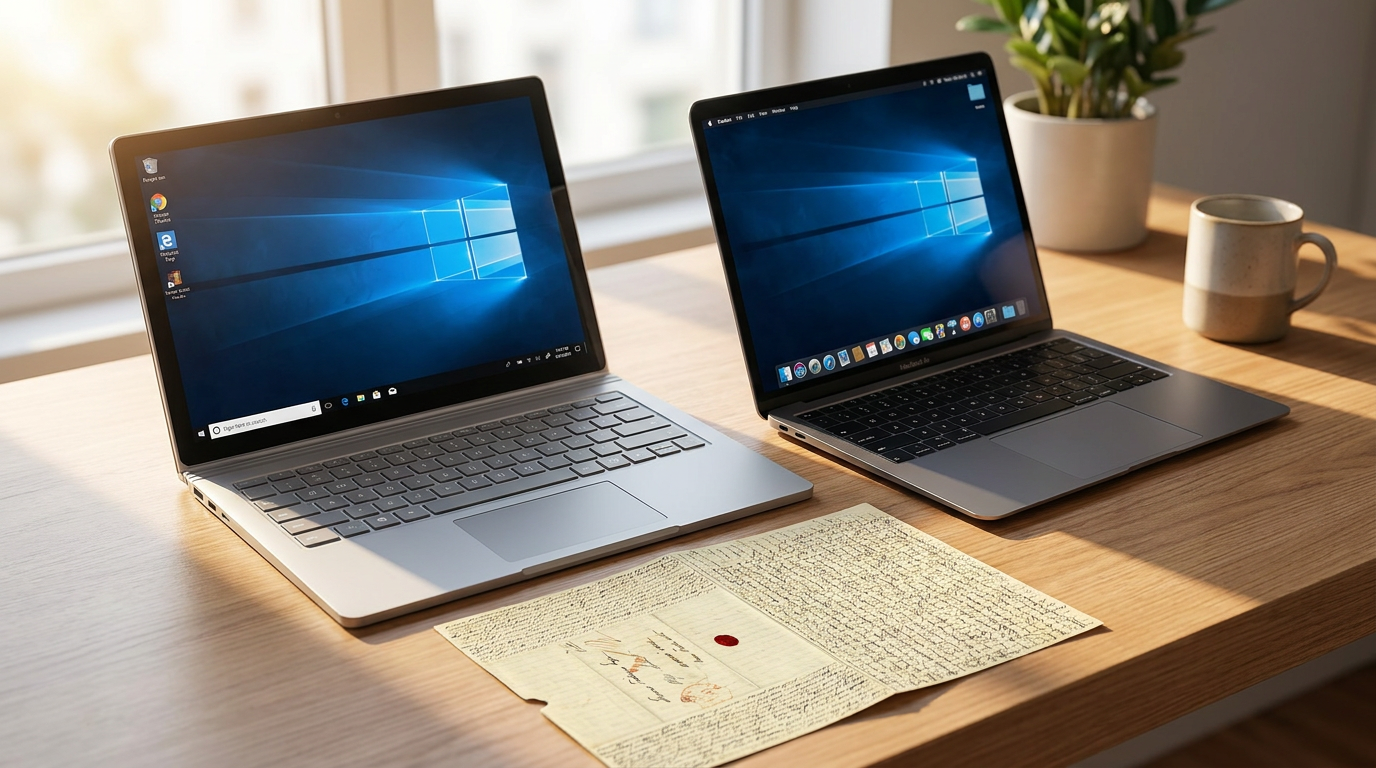
With Windows ARM laptops now matching MacBooks in battery life and multi-core performance, consumers face the most competitive laptop market in a decade. We break down the trade-offs between Qualcomm's Snapdragon X Elite and Apple's M-Series chips.
By Factlen Editorial Team
- Windows Ecosystem Loyalists
- Users who value hardware flexibility, Copilot+ AI integration, and enterprise software compatibility.
- Apple Ecosystem Users
- Users who prioritize seamless hardware-software integration, single-core speed, and creative applications.
- Enterprise IT Decision Makers
- Professionals focused on deployment scale, total cost of ownership, and workforce uptime.
What's not represented
- · Linux Developers
- · Hardcore PC Gamers
Why this matters
For the first time since 2020, Windows users no longer have to sacrifice battery life to get top-tier performance. This silicon rivalry means consumers in 2026 get cooler, faster, and longer-lasting machines regardless of which operating system they prefer.
Key points
- Windows laptops powered by ARM chips now routinely deliver 18 to 22 hours of battery life.
- Apple's M-Series chips maintain a significant lead in single-core performance and integrated graphics.
- The Snapdragon X Elite features 12 high-performance cores, allowing it to match or beat Apple in multi-threaded tasks.
- Microsoft's Copilot+ initiative leverages the Snapdragon's 45 TOPS NPU for advanced on-device AI.
- Emulation for legacy x86 apps on Windows has improved, but native ARM applications still perform best.
For years, buying a laptop required a strict compromise. Consumers who wanted the vast software library and hardware flexibility of Windows had to accept mediocre battery life and fans that roared to life during basic tasks. Conversely, those who wanted silent operation and all-day battery life had to migrate to Apple's macOS. In 2026, that long-standing divide has finally collapsed. Thanks to major breakthroughs in processor architecture, the laptop market is experiencing a golden age of efficiency. Premium Windows machines are now routinely crossing the 20-hour battery mark, putting them in direct, fierce competition with Apple's industry-leading MacBook Air and MacBook Pro lineups.[6]
The catalyst for this shift is the widespread adoption of ARM architecture across the PC industry. Originally designed for the low-power constraints of smartphones, ARM chips have been scaled up to handle desktop-class workloads. Apple proved the concept's viability in 2020 with its M-series transition, but the Windows ecosystem initially struggled with false starts and sluggish emulation. That changed with Qualcomm's Snapdragon X Elite. Built on a highly efficient 4-nanometer process, the X Elite features 12 high-performance cores that deliver massive multi-threaded power without draining the battery. Microsoft capitalized on this silicon by heavily optimizing Windows 11, resulting in a new class of Copilot+ PCs that finally match Apple's hardware efficiency.[3][4][5]
Apple, however, has not surrendered its crown. The Cupertino company's M3 and M4 processors, built on an even denser 3-nanometer manufacturing node, continue to set the benchmark for performance-per-watt. Apple's distinct advantage lies in its vertical integration; because the company designs both the silicon and the operating system, it can eliminate software bloat and optimize every background process. While Qualcomm relies on a brute-force approach of 12 high-performance cores, Apple utilizes a hybrid design, mixing performance cores with high-efficiency cores to sip power during light web browsing and ramp up instantly for heavy rendering.[3][4][5]

When looking at raw CPU performance, the rivalry breaks down into two distinct categories: single-core and multi-core speeds. In single-core tasks—which govern how snappy a laptop feels when opening apps or browsing the web—Apple's M-series remains virtually untouchable. Benchmark tests consistently show the M3 and M4 chips leading the Snapdragon X Elite by significant margins in single-threaded workloads. However, when all cores are fired up for heavy multitasking or code compilation, the Snapdragon's 12-core array flexes its muscle. In multi-core benchmarks, the Snapdragon X Elite frequently trades blows with, and sometimes edges out, Apple's silicon, making it a powerhouse for users juggling dozens of complex applications simultaneously.[2][4]
Graphics performance tells a slightly different story. Apple's integrated GPUs, powered by its proprietary Metal graphics API, dominate the visual benchmarks. Whether exporting 4K video or rendering 3D models, the M-series chips deliver desktop-class graphical output while consuming a fraction of the power. The Snapdragon X Elite utilizes an Adreno GPU, which is highly capable for everyday tasks and media consumption but falls behind Apple in raw graphical throughput. It is worth noting that neither platform is designed for hardcore PC gaming; MacBooks suffer from a limited game library, while Snapdragon laptops often struggle with emulation overhead when running legacy x86 game titles.[2][3][4]
Apple's integrated GPUs, powered by its proprietary Metal graphics API, dominate the visual benchmarks.
Thermals and heat management are where consumers will feel the most immediate quality-of-life improvements. Because both chips are incredibly efficient, modern thin-and-light laptops rarely need to spin up their internal fans. In thermal stress tests, Apple's M3 chip runs remarkably cool, often maxing out around 35 to 45 degrees Celsius under full load. The Snapdragon X Elite runs slightly warmer, occasionally hitting 50 degrees Celsius during intense benchmarking, but still remains vastly cooler than the older Intel processors it replaced. For the end user, this means working with a laptop actually on their lap no longer results in uncomfortable heat.[1]

The defining battleground of 2026 is artificial intelligence. Microsoft's Copilot+ initiative demands heavy on-device AI processing, and the Snapdragon X Elite delivers with a massive Neural Processing Unit capable of 45 Trillion Operations Per Second. This allows Windows laptops to run live translation, advanced background blurring, and local AI assistants without touching the cloud. Apple has countered with its own Neural Engine, which powers Apple Intelligence features across macOS. While Apple's NPU speed is slightly lower on paper, its tight software integration ensures that AI tasks run seamlessly and securely in the background.[3][4][5]
When evaluating Apple Silicon MacBooks, the argument for the platform centers on unmatched single-core speed, superior integrated graphics, and a frictionless software ecosystem. The argument against it remains its rigid hardware ecosystem and premium pricing for memory upgrades. The evidence from 2026 benchmarking shows the M3 and M4 chips consistently beating rivals in single-core tasks, while maintaining chassis temperatures roughly five degrees Celsius cooler than Windows counterparts under heavy load. Furthermore, Apple's Rosetta 2 translation layer ensures that even older, non-native applications run without noticeable lag.[1][2][5]

Conversely, the argument for Snapdragon X Elite Windows laptops hinges on multi-core dominance, enterprise IT compatibility, and class-leading neural processing for AI tasks. The argument against Qualcomm's silicon is the lingering performance penalty when running legacy x86 applications through emulation. The evidence reveals that while the Snapdragon's 12 Oryon cores can edge out Apple in multi-threaded workloads, non-native applications still suffer noticeable frame drops and battery drain compared to native ARM64 software. However, with enterprise adoption pushing native app usage above 90 percent, this emulation penalty is rapidly becoming a non-issue for most users.[3][4][5]
Ultimately, deciding between the two platforms comes down to daily workflows rather than raw power. The Apple Silicon ecosystem fits perfectly when your daily routine involves creative applications, video editing, or a reliance on tight iPhone integration, but it does not fit when you require legacy enterprise software or prefer hardware customization. The Snapdragon X Elite platform fits perfectly when you need a flexible Windows environment, heavy multitasking across office applications, and native Copilot+ AI features, but it does not fit when your workflow relies on niche x86 software that has not yet been optimized for the ARM architecture.
How we got here
Late 2020
Apple launches the M1 chip, revolutionizing laptop battery life and performance.
October 2023
Qualcomm announces the Snapdragon X Elite, promising to bring ARM efficiency to Windows.
Mid 2024
The first wave of Copilot+ PCs featuring Snapdragon chips hit the market.
Early 2026
Windows ARM laptops achieve parity with MacBooks in enterprise adoption and real-world battery tests.
Viewpoints in depth
Enterprise IT Decision Makers
Focused on fleet management, total cost of ownership, and native app support.
For corporate IT departments, the shift to ARM-based Windows 11 is a monumental relief. After years of watching Apple users enjoy all-day battery life, enterprises can finally deploy Windows machines that offer 18 to 22 hours of uptime. Their primary metric is the 'native app usage ratio,' aiming for over 90 percent to ensure employees aren't losing performance to emulation overhead.
Creative Professionals
Prioritizing single-core speed, GPU acceleration, and software integration.
The creative sector continues to lean heavily toward Apple Silicon. Video editors, music producers, and graphic designers rely on the M-Series' unified memory architecture and superior integrated graphics. Because Apple controls both the hardware and the software, applications like Final Cut Pro and Logic run with zero friction, making the Mac ecosystem highly sticky for those who need sustained, unthrottled performance for rendering.
Everyday Productivity Users
Looking for the best value, battery life, and web browsing experience.
For the average consumer whose workflow consists of web browsing, office applications, and video calls, the playing field is entirely level. This camp benefits the most from the current silicon war, as both platforms now offer machines that run silently, stay cool on the lap, and easily survive a cross-country flight without needing a charger.
What we don't know
- How quickly the remaining legacy Windows applications will be rewritten natively for ARM architecture.
- Whether Qualcomm's future chip iterations will be able to close the gap in single-core speeds against Apple's upcoming M5 generation.
Key terms
- ARM Architecture
- A type of computer processor design known for high efficiency and low power consumption, originally used in smartphones but now powering modern laptops.
- NPU (Neural Processing Unit)
- A specialized chip designed specifically to accelerate artificial intelligence and machine learning tasks locally on the device.
- TOPS
- Trillions of Operations Per Second, a metric used to measure the performance and speed of an NPU.
- Emulation
- A software process that allows a computer to run applications designed for a different type of processor architecture, often at the cost of some performance.
Frequently asked
Can I play PC games on a Snapdragon X Elite laptop?
While some lighter games run well, the Snapdragon X Elite is not recommended for heavy gaming. Many games require emulation from x86 to ARM, which can cause frame drops or prevent the game from running entirely.
Which laptop has better battery life?
Both platforms now offer exceptional battery life. Apple MacBooks typically deliver 20 to 24 hours of light use, while Snapdragon-powered Windows laptops closely follow with 18 to 22 hours.
Do all my old Windows apps work on ARM?
Most popular apps have been updated to run natively on ARM. For older legacy apps, Windows uses an emulator called Prism, which runs them smoothly but may consume slightly more battery power.
Sources
Source coverage
6 outlets
3 viewpoints surfaced






[1]LaptopMediaEnterprise IT Decision Makers
Thermal Performance Comparison: Snapdragon X Elite vs Apple M3 vs Intel Core Ultra 7
Read on LaptopMedia →[2]XDA DevelopersWindows Ecosystem Loyalists
Snapdragon X Elite vs Apple M4: Benchmarks
Read on XDA Developers →[3]MakeUseOfApple Ecosystem Users
Which Processor Should Power Your Next Laptop?
Read on MakeUseOf →[4]TechPPApple Ecosystem Users
Apple M4 vs Snapdragon X Elite
Read on TechPP →[5]GrowthHQEnterprise IT Decision Makers
Windows 11 on ARM: A New Frontier in Enterprise IT
Read on GrowthHQ →[6]The South India TimesWindows Ecosystem Loyalists
Windows Laptops Challenge MacBook Dominance With Massive Battery Life Gains in 2026
Read on The South India Times →

More in shopping
See all 106 stories →E-Bikes
The 2026 E-Bike Buying Guide: How to Choose the Right Electric Bicycle
8 sources

Gear Showdown
Garmin inReach Mini 2 vs. Zoleo: Which Satellite Communicator Belongs in Your Pack?
9 sources

Material Science
Plant-Based Leather vs. Traditional Leather: The 2026 Material Comparison
11 sources

Used EVs
The 2026 Guide to Buying a Used EV: Navigating Battery Health, Depreciation, and the Post-Tax-Credit Market
8 sources

Every angle. Every day.
Get shopping stories with full source coverage and perspective breakdowns delivered to your inbox.