
Structured Exercise Cuts Colon Cancer Recurrence by 28% and Death by 37%, Landmark Trial Finds
A 17-year randomized clinical trial demonstrates that a supervised, moderate-intensity exercise program significantly improves survival rates for colon cancer patients following chemotherapy.
By Maya Khalil


- Clinical Oncologists
- Viewing exercise not as a lifestyle choice, but as a potent, measurable medical intervention.
- Exercise Oncology Specialists
- Emphasizing the need for tailored, supervised programs over generic fitness advice.
- Healthcare Payers & Policymakers
- Grappling with the logistics and economics of funding long-term fitness interventions.
Why it matters
For cancer survivors, this research transforms physical activity from a generic wellness tip into a proven, life-saving medical treatment that rivals the efficacy of expensive pharmaceuticals. It provides a tangible, empowering action patients can take to actively reduce their risk of relapse.
For decades, the standard advice following a grueling bout of cancer treatment was simple: rest, recover, and take it easy. If you or a loved one has navigated chemotherapy, you know the profound fatigue that makes even walking to the mailbox feel like a marathon. But a paradigm-shifting body of evidence is rewriting that script, revealing that carefully structured movement might be one of the most powerful tools you have to reclaim your health and keep the disease at bay.[6]
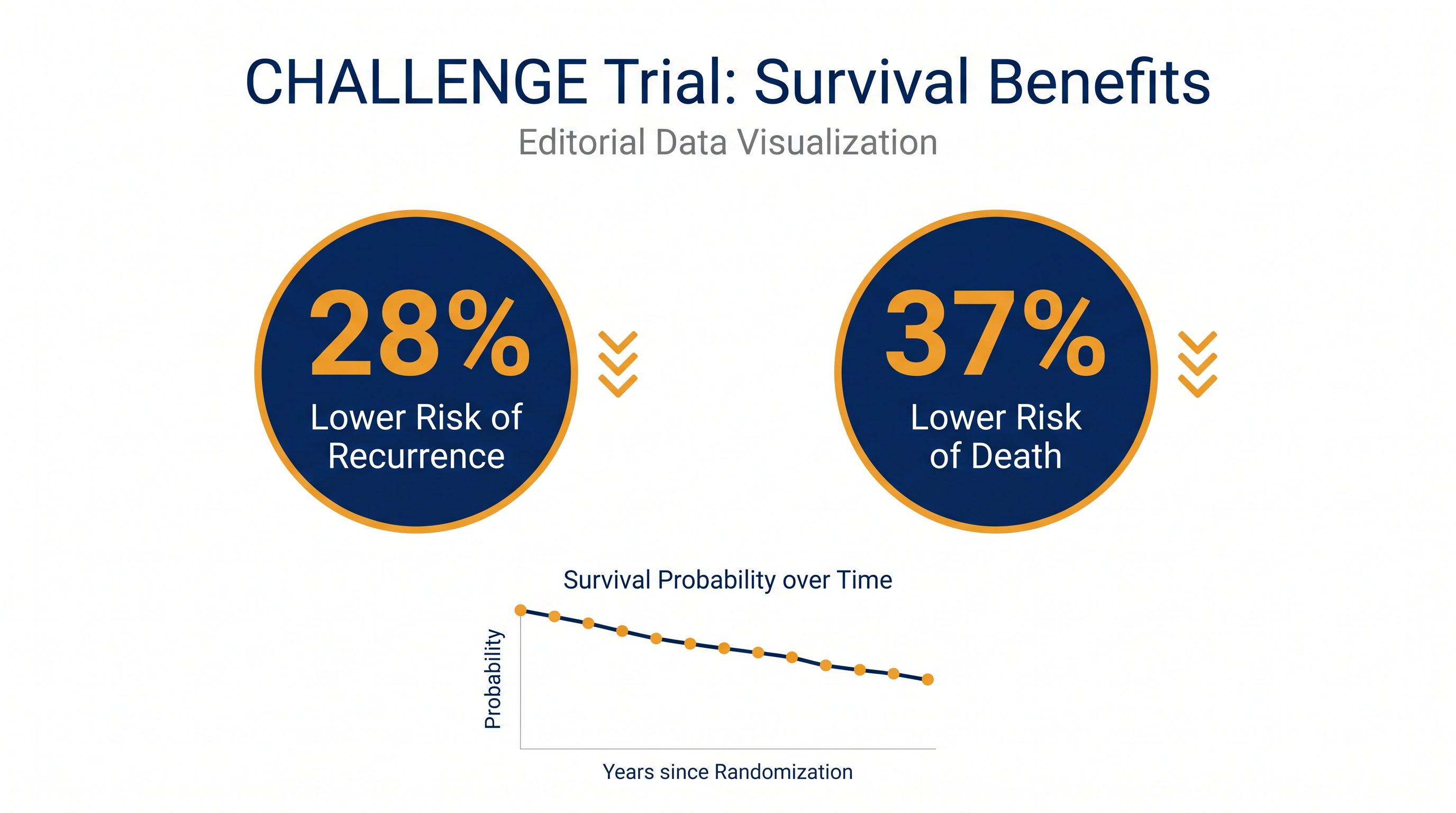
The definitive proof arrived with the publication of the landmark CO.21 CHALLENGE trial in The New England Journal of Medicine. Following hundreds of patients for nearly a decade, the study demonstrated that a structured, three-year exercise program reduced the risk of colon cancer recurrence by 28%. Even more remarkably, it reduced the risk of death from any cause by 37%, elevating physical activity from a mere wellness suggestion to a life-saving medical intervention.[1][2]
Colorectal cancer remains the second leading cause of cancer-related deaths worldwide. The standard of care for high-risk stage II and stage III colon cancer involves surgical removal of the tumor followed by a taxing regimen of adjuvant chemotherapy. Yet, even with these aggressive and necessary treatments, approximately 30% of patients eventually experience a relapse, leaving both doctors and patients searching for ways to improve those odds.[2][4]
Historically, observational studies hinted that patients who naturally stayed active had better survival rates. However, correlation is not causation; it was entirely possible that healthier, cancer-free people simply felt well enough to exercise. Oncologists lacked the gold standard randomized controlled trial data needed to formally prescribe exercise as a targeted therapy with the same confidence they prescribe chemotherapy drugs.[5][6]
To find the truth, researchers initiated the CHALLENGE trial, recruiting 889 patients across Canada, Australia, and other nations. Participants, all of whom had recently completed chemotherapy, were randomly divided into two groups. One group received standard health education materials, while the other was enrolled in a rigorous, supervised exercise program tailored to their recovery status.[3][4]
The exercise group worked directly with physical activity consultants, aiming to achieve at least 150 minutes of moderate-intensity aerobic exercise each week. This wasn't about running ultramarathons; patients engaged in brisk walking, cycling, or sports like pickleball. The program provided bi-weekly coaching sessions for the first six months, tapering to monthly check-ins over three years, ensuring patients had the support to safely push through treatment-induced fatigue.[2][3]
The exercise group worked directly with physical activity consultants, aiming to achieve at least 150 minutes of moderate-intensity aerobic exercise each week.
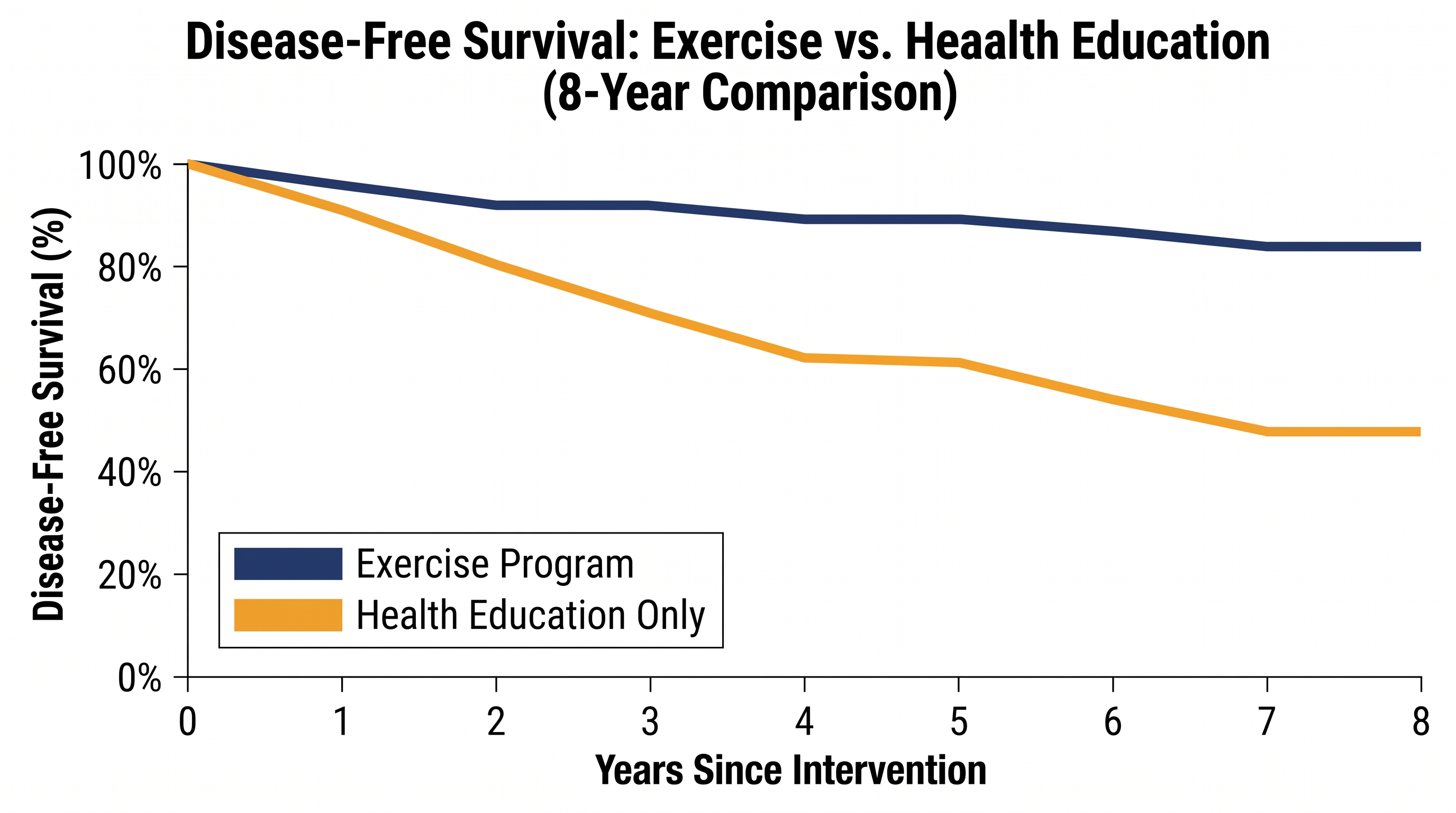
The outcomes were staggering and provide a clear roadmap for survivorship. After five years, 80.3% of the patients in the exercise cohort remained entirely disease-free, compared to 73.9% in the control group. The data showed a distinct separation in the survival curves that began just one year into the program and continued to widen over the next decade, proving the long-term durability of the intervention.[1][2]
The overall survival benefits were equally profound. At the eight-year mark, 90.3% of the exercising patients were still alive, contrasting with 83.2% of those who only received educational pamphlets. Clinical experts noted that the magnitude of this benefit rivals, and in some cases exceeds, the efficacy of newly approved, highly expensive cancer drugs, making it a remarkably potent addition to standard care.[1][4]
How does breaking a sweat stop rogue cells from multiplying? Researchers point to several biological mechanisms that translate directly to how your body functions. First, moderate-to-vigorous exercise significantly improves insulin sensitivity. High levels of circulating insulin and insulin-like growth factors are known to create a hospitable environment for tumor growth; regular exercise effectively starves the cancer of this metabolic fuel.[5][6]
Second, physical activity fundamentally alters the body's immune landscape. Exercise mobilizes natural killer cells and cytotoxic T cells, pushing them into the bloodstream where they can hunt down and eradicate microscopic cancer cells that may have survived chemotherapy. Simultaneously, regular movement reduces chronic systemic inflammation, a known driver of cancer progression and recurrence.[5][6]
It is important to note that the intervention was not without minor risks, and patients should always consult their care team before starting a regimen. Patients in the exercise group reported a higher incidence of musculoskeletal issues, such as muscle strains and joint pain. However, clinical experts emphasize that these minor orthopedic setbacks pale in comparison to the life-saving oncological benefits, making the risk-reward ratio overwhelmingly favorable.[1][2]

Despite the clear evidence, integrating exercise into standard oncology care presents logistical hurdles for the healthcare system. Most cancer centers are brilliantly equipped to administer intravenous drugs, but lack the infrastructure to provide long-term fitness coaching. Reimbursement models, insurance coverage gaps, and a shortage of specialized oncology exercise physiologists remain significant barriers to widespread, equitable access.[3][6]
Nevertheless, the CHALLENGE trial marks a critical turning point in how we view survivorship. Medical societies are already moving to update clinical guidelines, shifting exercise from a nice-to-have lifestyle recommendation to a need-to-have pillar of post-treatment recovery. For patients navigating the uncertainty of life after cancer, it offers something equally vital: a tangible, empowering, and scientifically proven way to actively participate in their own survival.[2][4][6]
Where opinion splits
Clinical Oncologists
Viewing exercise not as a lifestyle choice, but as a potent, measurable medical intervention.
For decades, oncologists have relied on surgery, radiation, and pharmaceuticals to fight cancer. The CHALLENGE trial forces a paradigm shift within the medical community, providing the rigorous Phase 3 data required to treat physical activity with the same clinical gravity as a new chemotherapy agent. Leading oncologists argue that failing to prescribe structured exercise is now akin to withholding a proven, life-saving drug, urging a rapid update to global survivorship guidelines.
Exercise Oncology Specialists
Emphasizing the need for tailored, supervised programs over generic fitness advice.
Kinesiologists and physical therapists stress that simply telling a recovering cancer patient to 'go to the gym' is insufficient and potentially unsafe. They advocate for specialized, supervised programs that account for treatment-induced fatigue, neuropathy, and biomechanical changes. This camp argues that the trial's success hinged on the bi-weekly coaching and personalized progression, highlighting the urgent need to fund and train a dedicated workforce of oncology exercise specialists.
Healthcare Systems and Payers
Grappling with the logistics and economics of funding long-term fitness interventions.
From a health economics perspective, a three-year exercise program costing a few thousand dollars is vastly cheaper than treating a cancer recurrence with novel therapeutics. However, hospital administrators and insurance providers face structural hurdles in implementing this care model. Current reimbursement frameworks are designed for discrete medical procedures and pharmaceuticals, not ongoing behavioral coaching, prompting calls for systemic reform in how survivorship care is funded.
Unanswered questions
- Whether the exact same 28% reduction in recurrence applies to other forms of cancer, though observational data is highly promising.
- How healthcare systems will restructure insurance reimbursement to cover the cost of long-term, specialized exercise coaching.
- The optimal minimum 'dose' of exercise required to achieve these benefits for patients who cannot meet the 150-minute weekly threshold.
Sources
Source coverage
6 outlets
3 viewpoints surfaced






[1]The New England Journal of MedicineClinical Oncologists
Exercise after Chemotherapy for Colon Cancer
Read on The New England Journal of Medicine →[2]American Society of Clinical OncologyClinical Oncologists
Structured Exercise Lowers Risk of Colon Cancer Recurrence & Death
Read on American Society of Clinical Oncology →[3]Canadian Cancer SocietyHealthcare Payers & Policymakers
Clinical trial confirms exercise improves survival for colon cancer
Read on Canadian Cancer Society →[4]University of SydneyExercise Oncology Specialists
Exercise cuts colon cancer recurrence and boosts survival, study finds
Read on University of Sydney →[5]National Institutes of HealthHealthcare Payers & Policymakers
The CHALLENGE trial provides robust evidence that regular, structured aerobic exercise significantly improves survival
Read on National Institutes of Health →[6]Factlen Editorial TeamExercise Oncology Specialists
Synthesis by Factlen editorial team
Read on Factlen Editorial Team →
Comments



Every angle. Every day.
Get fitness stories with full source coverage and perspective breakdowns delivered to your inbox.