
SpaceX Raises Record $75 Billion in Historic Public Market Debut
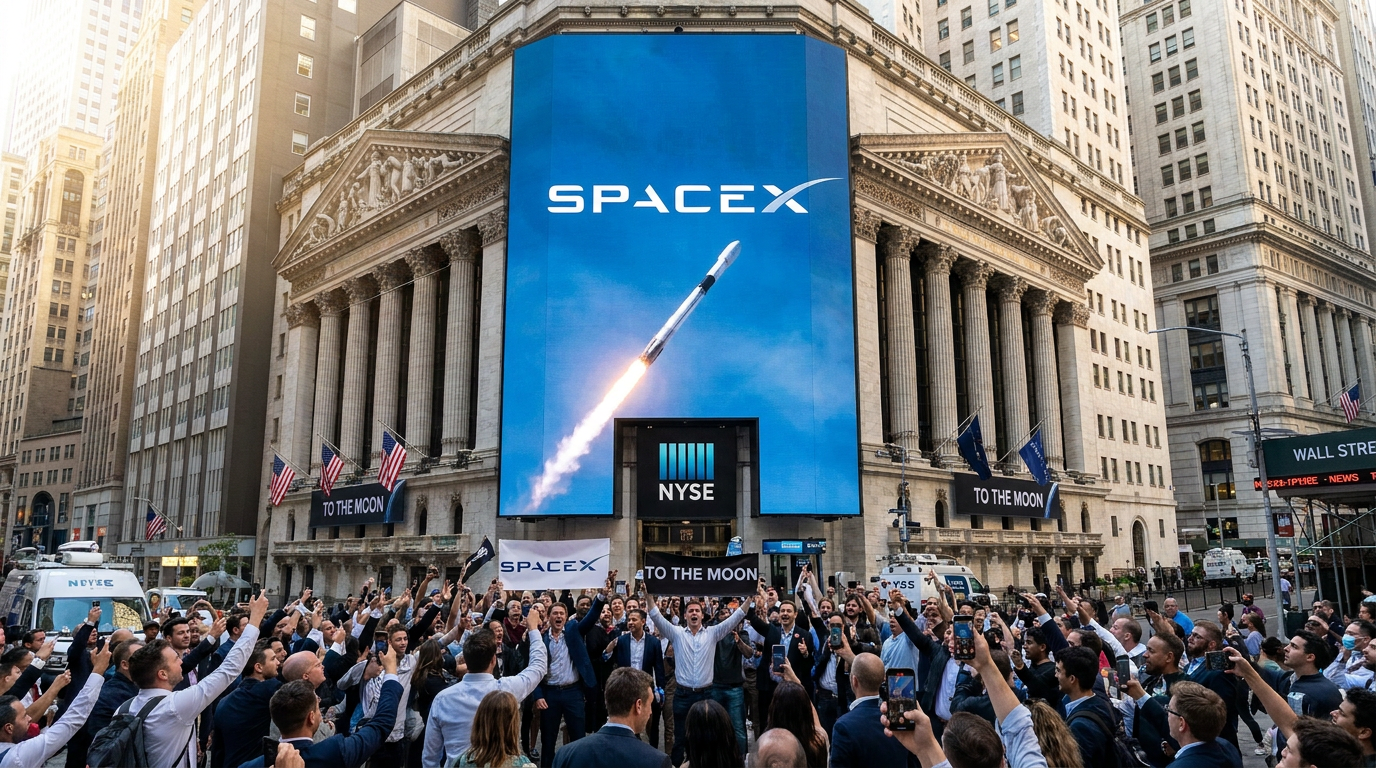
Aerospace giant SpaceX has successfully completed the largest initial public offering in history, raising $75 billion while bypassing traditional Wall Street underwriting norms.
By Factlen Editorial Team
- Retail & Tech Bulls
- View the IPO as a democratizing milestone that allows everyday investors to participate in the space economy and rewards Musk's unconventional approach.
- Institutional Investors
- Focus on the fundamental valuation, driven heavily by Starlink's recurring revenue, while adjusting to the new reality of reduced underwriting allocations.
- Market Traditionalists
- Acknowledge the historic success of the raise but caution about the volatility and the long-term implications of bypassing traditional banking safeguards.
What's not represented
- · Regulatory agencies overseeing space commercialization
- · International space agencies competing with SpaceX
Why this matters
The unprecedented scale and unconventional structure of the SpaceX IPO opens one of the world's most valuable private companies to everyday retail investors. It also provides a new blueprint for how mega-cap tech firms can go public without relying on traditional, expensive investment banking fees.
Key points
- SpaceX raised $75 billion in its public market debut, shattering all previous IPO records.
- The company bypassed traditional Wall Street underwriting, saving billions in fees and prioritizing retail access.
- Starlink's recurring revenue from 10 million subscribers provided the financial foundation for the massive valuation.
- The newly raised capital will secure the financial runway for the Starship deep-space exploration program.
- The successful listing is expected to thaw the broader tech IPO market and force consolidation among aerospace competitors.
SpaceX has officially entered the public markets, shattering previous financial records by raising a staggering $75 billion in its initial public offering. The aerospace manufacturer and satellite internet provider, founded by Elon Musk in 2002, saw immense demand from both institutional and retail investors, pushing its post-IPO valuation well past the $350 billion mark. The debut marks a watershed moment not just for the space industry, but for global financial markets, as the company successfully executed the largest public offering in history.[1][2]
The sheer scale of the capital raise eclipses previous mega-IPOs, easily surpassing Saudi Aramco's $29.4 billion debut in 2019 and Alibaba's $25 billion offering in 2014. Market analysts noted that the enthusiasm surrounding the stock was driven by a combination of SpaceX's near-monopoly on commercial rocket launches and the explosive revenue growth of its Starlink satellite internet division. By offering a substantial tranche of shares directly to the public, the company capitalized on years of pent-up demand from investors who had previously been locked out of the private funding rounds.[2][3]

What makes the SpaceX IPO particularly historic is not just the amount raised, but how the company went about raising it. Bucking decades of Wall Street tradition, Musk and his executive team opted for a hybrid direct-listing approach that severely curtailed the role—and the lucrative fees—of traditional investment banks. By utilizing a modernized digital auction system to price the shares, SpaceX managed to retain billions in capital that would have otherwise been paid out to underwriters, setting a new precedent for how highly valued tech companies might approach the public markets in the future.[1][4][6]
This unconventional structure was explicitly designed to democratize access to the stock. Historically, the most lucrative IPO allocations are reserved for institutional whales and preferred clients of major banks, leaving retail investors to buy in only after the stock [4][6]
Despite being sidelined from the primary underwriting process, traditional financial institutions are still finding significant upside in the event. Major banks and trading desks reported record-breaking transaction volumes as the stock began trading on the open market. Analysts at leading financial firms pointed out that the sheer liquidity and volatility generated by a $350 billion company entering the public sphere will provide a massive boost to trading revenues in the second quarter, softening the blow of the missed underwriting fees.[1][4]
Despite being sidelined from the primary underwriting process, traditional financial institutions are still finding significant upside in the event.
The financial engine driving this astronomical valuation is Starlink, SpaceX's constellation of low-Earth orbit satellites. Financial disclosures released ahead of the IPO revealed that Starlink has crossed 10 million active subscribers globally, transforming from a capital-intensive research project into a massive cash cow. The recurring revenue from the internet service provides a stable financial bedrock that offsets the highly variable and expensive nature of the company's rocket development programs.[2][5]

With $75 billion in fresh capital, SpaceX is now uniquely positioned to accelerate its most ambitious projects. The primary beneficiary of the new funding will be the Starship program, the fully reusable super-heavy lift launch vehicle designed to carry humans to the Moon and eventually Mars. The influx of cash ensures that SpaceX can maintain its aggressive testing and manufacturing cadence without needing to return to private debt markets, effectively securing the financial runway needed for the next decade of deep-space exploration.[3][5]
The successful debut is also sending ripples through the broader tech and aerospace sectors. For the broader market, the SpaceX IPO is being viewed as the ultimate icebreaker, thawing a multi-year freeze in tech listings and signaling that investor appetite for high-growth, capital-intensive companies has returned. Several other late-stage private companies are reportedly accelerating their own IPO timelines in response to the overwhelming market reception.[2][6]

For legacy aerospace competitors, however, the news presents a daunting challenge. Companies that have traditionally relied on government cost-plus contracts must now compete with a publicly traded juggernaut armed with an unprecedented war chest. Industry experts suggest that the capitalization of SpaceX will force a wave of consolidation and accelerated innovation among rival launch providers who are struggling to match the cadence and cost-efficiency of the Falcon 9 and Starship platforms.[3][5]
Looking ahead, the transition from a tightly controlled private entity to a publicly traded corporation will bring new levels of scrutiny to SpaceX. The company will now be subject to quarterly earnings reports, shareholder votes, and strict regulatory disclosures. Yet, for the millions of investors who bought into the debut, the IPO represents more than just a financial transaction; it is an opportunity to own a tangible stake in the infrastructure of the modern space age.[1][6]
How we got here
2002
Elon Musk founds Space Exploration Technologies Corp. (SpaceX) with the goal of reducing space transportation costs.
2014
Alibaba sets a major IPO record by raising $25 billion.
2019
Saudi Aramco breaks the global IPO record, raising $29.4 billion.
2025
Starlink crosses the 10 million active subscriber mark, solidifying SpaceX's recurring revenue model.
June 2026
SpaceX executes a hybrid direct-listing IPO, raising $75 billion and becoming a publicly traded company.
Viewpoints in depth
Retail Investors' View
Everyday investors celebrate the democratization of access to one of the world's most innovative companies.
For years, retail investors have watched from the sidelines as private venture capital firms reaped the rewards of SpaceX's exponential growth. The unique structure of this IPO, which bypassed traditional institutional gatekeepers, is being hailed as a major victory for the democratization of finance. Retail advocates argue that allowing the public to buy in at the ground floor of the public offering—rather than waiting for institutional whales to flip their shares at a premium—sets a new standard for fairness in capital markets.
Traditional Wall Street's View
Investment banks are adapting to a landscape where mega-cap companies no longer need their underwriting services.
While trading desks are enjoying the massive volume and volatility generated by the listing, the investment banking divisions are viewing the SpaceX IPO as a dangerous precedent. By successfully raising $75 billion without paying standard underwriting fees, SpaceX has proven that highly sought-after companies can leverage digital auction mechanics to go public on their own terms. Traditionalists warn that bypassing the rigorous due diligence and price stabilization mechanisms provided by banks could expose future, less-established companies to dangerous market volatility.
Aerospace Competitors' View
Rival launch providers face an existential threat from a newly capitalized, publicly funded juggernaut.
For legacy aerospace firms like Boeing, Lockheed Martin, and Arianespace, the SpaceX IPO represents a worst-case scenario. These companies have already struggled to compete with the cost-efficiency of the reusable Falcon 9 rocket. Now, they are facing a competitor armed with a $75 billion war chest that can be deployed immediately into research, development, and aggressive pricing strategies. Industry analysts predict that this massive capitalization will force legacy providers to either consolidate their operations or seek massive new subsidies from their respective governments to remain viable.
What we don't know
- How the typically secretive Elon Musk will adapt to the rigorous quarterly reporting and transparency requirements of a public company.
- Whether the hybrid direct-listing model used by SpaceX will become the new standard for other highly valued private tech companies.
- How the stock will perform in its first few months of trading once the initial retail enthusiasm stabilizes.
Key terms
- Initial Public Offering (IPO)
- The process by which a private company offers shares of its stock to the public for the first time, allowing it to raise capital from everyday investors.
- Direct Listing
- A method of taking a company public where existing shares are sold directly to the public without the use of underwriters or the creation of new shares.
- Underwriting Fees
- The compensation paid to investment banks for managing an IPO, assessing risk, and selling the initial shares to institutional clients.
- Retail Investor
- An individual, non-professional investor who buys and sells securities for their personal account, rather than on behalf of an institution.
Frequently asked
How much money did SpaceX raise in its IPO?
SpaceX raised a record-breaking $75 billion, making it the largest initial public offering in history.
Why didn't SpaceX use traditional investment banks?
The company opted for a hybrid direct-listing approach to bypass expensive underwriting fees and offer more shares directly to retail investors.
What will SpaceX do with the $75 billion?
The capital will primarily be used to accelerate the development of the Starship program and expand the Starlink satellite internet constellation.
How does this compare to previous IPOs?
It easily surpasses the previous records set by Saudi Aramco ($29.4 billion in 2019) and Alibaba ($25 billion in 2014).
Sources
Source coverage
6 outlets
3 viewpoints surfaced






[1]MarketWatchRetail & Tech Bulls
How Elon Musk nailed the SpaceX IPO: ‘I’m not sure that this could have gone much better’
Read on MarketWatch →[2]CNBCInstitutional Investors
SpaceX raises record $75 billion in historic public market debut
Read on CNBC →[3]Fox BusinessMarket Traditionalists
Elon Musk's SpaceX shatters Wall Street records with massive IPO
Read on Fox Business →[4]BloombergInstitutional Investors
SpaceX Valuation Soars as IPO Defies Traditional Banking Norms
Read on Bloomberg →[5]The VergeRetail & Tech Bulls
SpaceX is officially a public company, and it just made history
Read on The Verge →[6]Wall Street JournalMarket Traditionalists
Inside the SpaceX IPO: How Musk bypassed the usual Wall Street playbook
Read on Wall Street Journal →

More in finance
See all 6 stories →Retirement Strategy
The Late-Career Roth 401(k) Switch: What the Evidence Actually Shows
7 sources

Cross-Border Payments
Stablecoins Quietly Overhaul Global Remittances, Slashing Cross-Border Fees Under 1%
7 sources

Roth Strategies
The Evidence for Switching to a Roth 401(k) in Your 50s
6 sources

Assumable Mortgages
The Homebuyer's Guide to Assumable Mortgages in a High-Rate Market
7 sources

Every angle. Every day.
Get finance stories with full source coverage and perspective breakdowns delivered to your inbox.