
SpaceX Prepares for Index Inclusion Following Blockbuster IPO
After a historic public debut, SpaceX is poised to enter major stock indexes, a move expected to trigger billions in mandatory buying from passive funds.
By Factlen Editorial Team
- Institutional Analysts
- Focus on valuation fundamentals, capital structure, and broader market impacts.
- Index Methodology Providers
- Focus on strict inclusion rules, float requirements, and benchmark tracking.
- Retail Market Participants
- Focus on short-term price action, momentum, and front-running institutional buying.
What's not represented
- · Early Venture Capital Backers
- · ESG-Focused Fund Managers
Why this matters
Even if you didn't buy SpaceX stock on its opening day, you are likely about to own it. As the company enters major stock indices, the passive mutual funds and ETFs in your 401(k) or retirement account will automatically purchase shares, linking your financial future to the commercial space industry.
Key points
- SpaceX's recent IPO has shifted from an initial retail frenzy to a phase of structural, institutional accumulation.
- The company is expected to be added to major indices like the Russell 1000, triggering mandatory buying from passive funds.
- Index weighting will initially be based only on the freely traded public float, excluding locked-up insider shares.
- A planned $20 billion bond sale will also force fixed-income ETFs to integrate SpaceX debt into conservative portfolios.
- The successful debut serves as a vital proof of concept for other highly valued private companies considering public offerings.
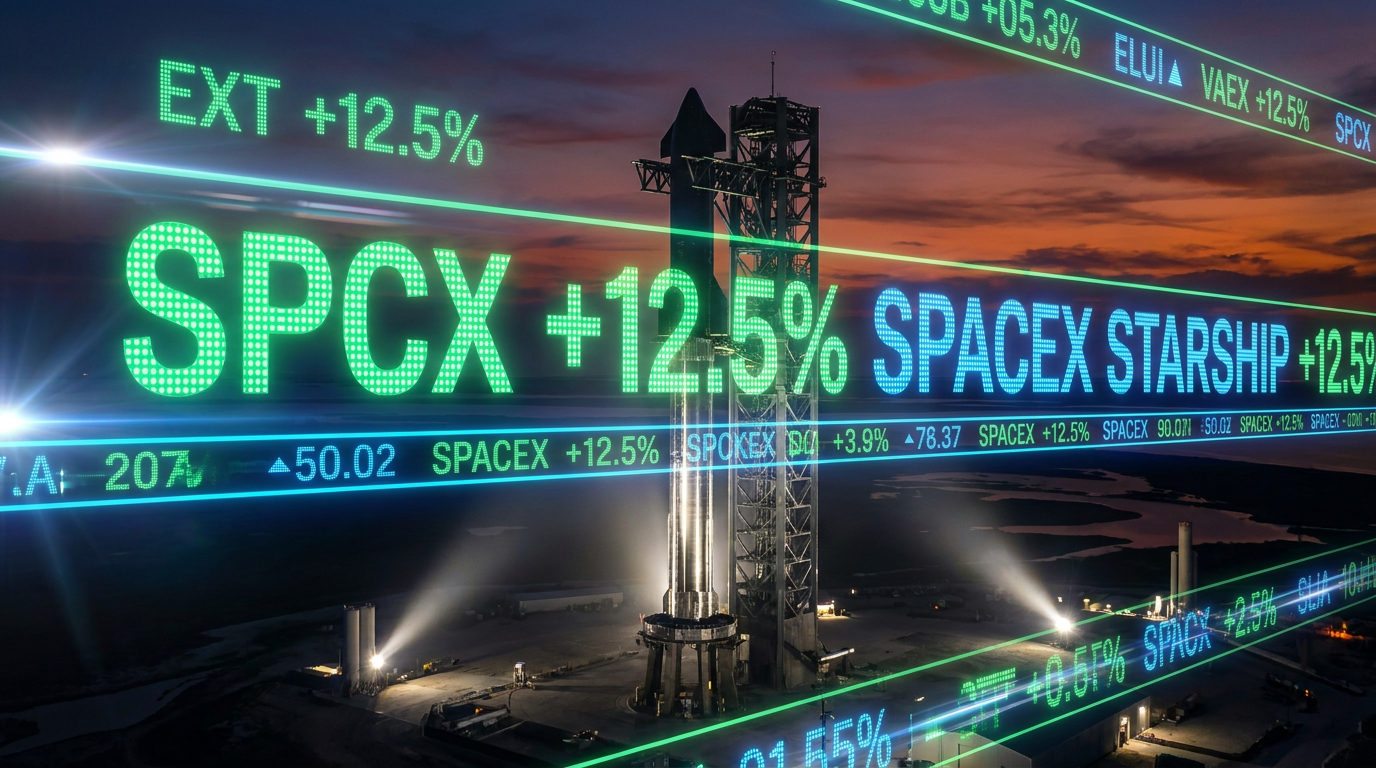
The June 12, 2026, public debut of Space Exploration Technologies Corp. stands as one of the most consequential liquidity events in modern financial history. Pricing at $135 per share, the stock surged 67% in its opening days, briefly touching $225 before settling into a more normalized trading range around $190. For retail investors and early institutional backers, the initial public offering represented the culmination of a two-decade wait to access the aerospace giant's equity. Yet, as the opening bell euphoria subsides, the market is preparing for a secondary, entirely mechanical wave of capital deployment.[1]
This impending capital influx is driven not by sentiment or future earnings projections, but by the rigid rules of passive investing. Trillions of dollars in global wealth are tethered to major equity benchmarks, most notably the Russell 1000 and the S&P 500. When a company of SpaceX's unprecedented market capitalization enters the public markets, it inevitably triggers a mandatory reallocation across the passive fund ecosystem. Portfolio managers who track these indices do not have the discretion to ignore the stock; they are contractually obligated to purchase shares to mirror the benchmark's composition.[6]
The timeline for this forced buying is dictated by index providers' specific reconstitution schedules. FTSE Russell, which manages the widely tracked Russell US Indexes, evaluates newly public companies on a quarterly basis for inclusion. Because SpaceX went public in mid-June, it aligns perfectly with the upcoming quarterly IPO addition cycle. Market analysts anticipate that the aerospace company will secure its Russell 1000 entry in the coming weeks, an event that will force mutual funds and exchange-traded funds to absorb millions of shares from the open market regardless of the prevailing price.[1][4]

While Russell inclusion is largely a function of market capitalization, entry into the S&P 500 requires clearing a higher, more subjective hurdle. S&P Dow Jones Indices mandates that a candidate must report positive as-reported earnings over the most recent quarter, as well as over the sum of its trailing four consecutive quarters. According to the company's Form S-1 registration statement filed with the Securities and Exchange Commission, SpaceX has achieved consistent GAAP profitability, driven by its Starlink satellite broadband division and its monopoly on domestic heavy-lift launch services.[3][5]
Meeting the profitability metric makes SpaceX technically eligible for the S&P 500, but the index committee retains discretion over the exact timing of its addition. Historically, mega-cap additions were phased in to prevent massive liquidity shocks. Given SpaceX's estimated valuation exceeding $2 trillion, a sudden inclusion could force index funds to sell billions of dollars of other constituent stocks just to make room for the aerospace manufacturer, potentially causing widespread market distortions.[3][6]
A critical variable in this index math is the concept of the public float. Index providers do not calculate a company's weight based on its total outstanding shares, but rather on the shares that are freely available to trade. Currently, the vast majority of SpaceX equity remains locked up by insiders, early venture capital backers, and founder Elon Musk. This restricted supply means that the initial index weighting will be artificially low, only reflecting the shares issued during the IPO and those not subject to lock-up agreements.[4][5]

A critical variable in this index math is the concept of the public float.
The standard IPO lock-up period typically lasts 180 days, meaning a massive tranche of SpaceX shares will become eligible for sale in December 2026. As these shares enter the public float, index providers will adjust SpaceX's weighting upward in their subsequent rebalancing events. This creates a staggered schedule of mandatory buying: an initial wave upon index entry, followed by subsequent waves as the float expands. Active traders often attempt to front-run these adjustments, buying shares in anticipation of the forced passive demand.[6]
Beyond equity indices, SpaceX is simultaneously reshaping the fixed-income landscape. The company is reportedly planning a $20 billion bond sale to refinance existing bridge loans and fund the capital-intensive development of its Starship program. Having recently secured investment-grade credit ratings, this debt issuance will force inclusion into major corporate bond indices. Just as equity index funds must buy the stock, fixed-income ETFs will be required to purchase SpaceX debt, integrating the company into the core of conservative yield-seeking portfolios.[1][6]
The sheer scale of the SpaceX listing has also catalyzed a frenzy of derivative products. Within days of the IPO, competing asset management firms launched over a dozen leveraged and inverse exchange-traded funds tied exclusively to the SPCX ticker. These instruments allow traders to make outsized bets on the stock's daily volatility without utilizing margin accounts. However, the proliferation of these derivatives adds a layer of structural complexity, as the funds must constantly buy and sell the underlying stock to maintain their leverage ratios, exacerbating intraday price swings.[1]
One area where SpaceX may face friction in the passive ecosystem is within Environmental, Social, and Governance (ESG) funds. Early reports indicate that major rating agencies have assigned the company exceptionally low ESG scores. Concerns range from the environmental impact of frequent orbital launches and orbital debris management to corporate governance structures that heavily concentrate voting power. Consequently, funds with strict ESG mandates may be forced to exclude SpaceX, slightly dampening the overall passive demand.[6]

The successful absorption of SpaceX into the public markets is being closely monitored by other highly valued private companies. The capital influx and sustained investor enthusiasm have sparked intense anticipation for potential public offerings from artificial intelligence leaders like OpenAI and Anthropic. For years, the IPO market had been starved of mega-cap technology debuts, leading to a buildup of late-stage private capital. SpaceX's ability to transition smoothly into the public sphere and secure index inclusion serves as a vital proof of concept for these AI unicorns.[2]
Active institutional managers are currently navigating a delicate balancing act. On one hand, the fundamental valuation of SpaceX requires modeling complex, long-term cash flows from satellite internet subscriptions and interplanetary logistics—a notoriously difficult task. On the other hand, the impending index inclusion creates a near-term supply-demand imbalance that favors price appreciation. Many active managers are choosing to hold the stock despite valuation concerns, simply because being underweight a massive new index constituent poses a severe risk to their relative performance benchmarks.[2][5]
For retail investors, the transition of SpaceX from a speculative venture capital darling to a foundational index component marks a profound shift. Once the exclusive domain of accredited investors and private equity firms, the financial returns of the commercial space industry will soon be embedded in the 401(k)s and pension plans of millions of ordinary workers. As index funds mechanically accumulate shares over the coming months, the company's financial trajectory will become inextricably linked to the broader health of the American retirement system.[1][6]
How we got here
June 12, 2026
SpaceX completes its highly anticipated initial public offering, pricing shares at $135.
Mid-June 2026
Shares surge 67% in early trading before stabilizing around the $190 mark.
Late June 2026
FTSE Russell begins its quarterly evaluation for IPO additions to the Russell 1000 index.
December 2026
The standard 180-day lock-up period expires, significantly expanding the stock's public float.
Viewpoints in depth
Index Methodology Providers
Focused on strict inclusion rules, float requirements, and benchmark tracking.
Index providers like S&P Dow Jones and FTSE Russell operate on rigid, transparent methodologies. Their primary concern with a mega-cap IPO like SpaceX is ensuring that the addition does not cause severe liquidity shocks or tracking errors for the trillions of dollars benchmarked to their indices. They carefully calculate the public float to ensure that passive funds are only required to buy shares that are actually available on the open market, often phasing in massive companies over several quarters.
Institutional Analysts
Focused on valuation fundamentals, capital structure, and broader market impacts.
Active portfolio managers and financial analysts face a complex dilemma. While many struggle to justify SpaceX's multi-trillion-dollar valuation based on traditional discounted cash flow models, they cannot afford to ignore the stock. Being underweight a massive new index constituent poses a severe risk to their relative performance. Consequently, many institutions are holding the stock despite fundamental reservations, driven by the near-term momentum of forced index buying.
Retail Market Participants
Focused on short-term price action, momentum, and front-running institutional buying.
Retail traders and momentum-focused hedge funds view the impending index inclusion as a predictable catalyst. By purchasing shares before the official index reconstitution dates, these participants aim to 'front-run' the mandatory buying from passive ETFs and mutual funds. This camp is also heavily utilizing the newly launched leveraged ETFs to amplify their exposure to the stock's daily volatility during this high-catalyst window.
What we don't know
- The exact date S&P Dow Jones Indices will choose to add SpaceX to the S&P 500, and whether the inclusion will be phased in over multiple quarters.
- How the expiration of the 180-day lock-up period in December will impact the stock price as millions of insider shares flood the market.
Key terms
- Passive Index Fund
- An investment fund designed to automatically track the performance of a specific market benchmark, like the S&P 500, rather than relying on a manager to pick stocks.
- Public Float
- The portion of a company's shares that are freely available to be traded by the public, excluding shares held by insiders or restricted by lock-up agreements.
- Lock-up Period
- A predetermined window of time after an IPO during which company insiders and early investors are legally prohibited from selling their shares.
- Reconstitution
- The periodic process by which an index provider reviews and updates the list of companies included in its benchmark to ensure it accurately reflects the current market.
Frequently asked
Why do index funds have to buy SpaceX stock?
Passive index funds are contractually obligated to mirror the composition of their benchmark index. If SpaceX is added to the Russell 1000 or S&P 500, these funds must purchase the stock to match its weight in the index.
When will SpaceX be added to the S&P 500?
While SpaceX meets the profitability requirements, the exact timing is at the discretion of the S&P index committee. Mega-cap additions are often phased in carefully to avoid disrupting the broader market.
What happens when the IPO lock-up period expires?
Typically 180 days after the IPO, insiders and early investors can sell their shares. This increases the 'public float,' which will subsequently cause index providers to increase SpaceX's weight in their benchmarks, triggering another wave of passive buying.
Sources
Source coverage
6 outlets
3 viewpoints surfaced






[1]MarketWatchRetail Market Participants
The initial SpaceX frenzy is cooling off — but a new wave of cash is waiting to strike
Read on MarketWatch →[2]BloombergInstitutional Analysts
SpaceX IPO Sparks Anticipation for OpenAI and Anthropic
Read on Bloomberg →[3]S&P Dow Jones IndicesIndex Methodology Providers
S&P U.S. Indices Methodology
Read on S&P Dow Jones Indices →[4]FTSE RussellIndex Methodology Providers
Russell US Indexes Reconstitution Rules and IPO Additions
Read on FTSE Russell →[5]U.S. Securities and Exchange CommissionInstitutional Analysts
Space Exploration Technologies Corp. Form S-1 Registration Statement
Read on U.S. Securities and Exchange Commission →[6]Factlen Editorial TeamInstitutional Analysts
Synthesis by Factlen editorial team
Read on Factlen Editorial Team →


Every angle. Every day.
Get finance stories with full source coverage and perspective breakdowns delivered to your inbox.