
Smart Bassinets vs. Traditional Sleepers: The 2026 Trade-Off Analysis
A comprehensive comparison of high-tech automated bassinets and traditional bedside sleepers, weighing cost, convenience, and safety for newborns.
By Factlen Editorial Team
- Tech-Assisted Sleep Advocates
- Parents and reviewers who view smart bassinets as essential tools for surviving newborn sleep deprivation.
- Minimalist & Budget Parents
- Caregivers who prefer low-tech, affordable solutions that prioritize portability and parent-led soothing.
- Pediatric Safety Purists
- Medical professionals focused strictly on the AAP's ABCs of safe sleep, wary of unnecessary technology.
What's not represented
- · Families of multiples (twins/triplets)
- · Second-hand market buyers
Why this matters
Choosing a bassinet is one of the most consequential purchases for new parents, directly impacting how much sleep the entire household gets during the grueling newborn phase. Understanding the trade-offs between manual and automated soothing helps families protect their budget and their mental health.
Key points
- Traditional bassinets offer simplicity, portability, and lower costs ($150–$350), but require manual soothing from parents.
- Smart bassinets ($1,000–$1,700) use microphones and motors to automatically rock and shush crying babies back to sleep.
- Both styles must adhere to strict AAP guidelines requiring a firm, flat, non-inclined sleep surface.
- The SNOO features an FDA-authorized swaddle system that prevents infants from rolling onto their stomachs.
- Experts warn that smart bassinets can create sleep associations, requiring a weaning process before transitioning to a crib.
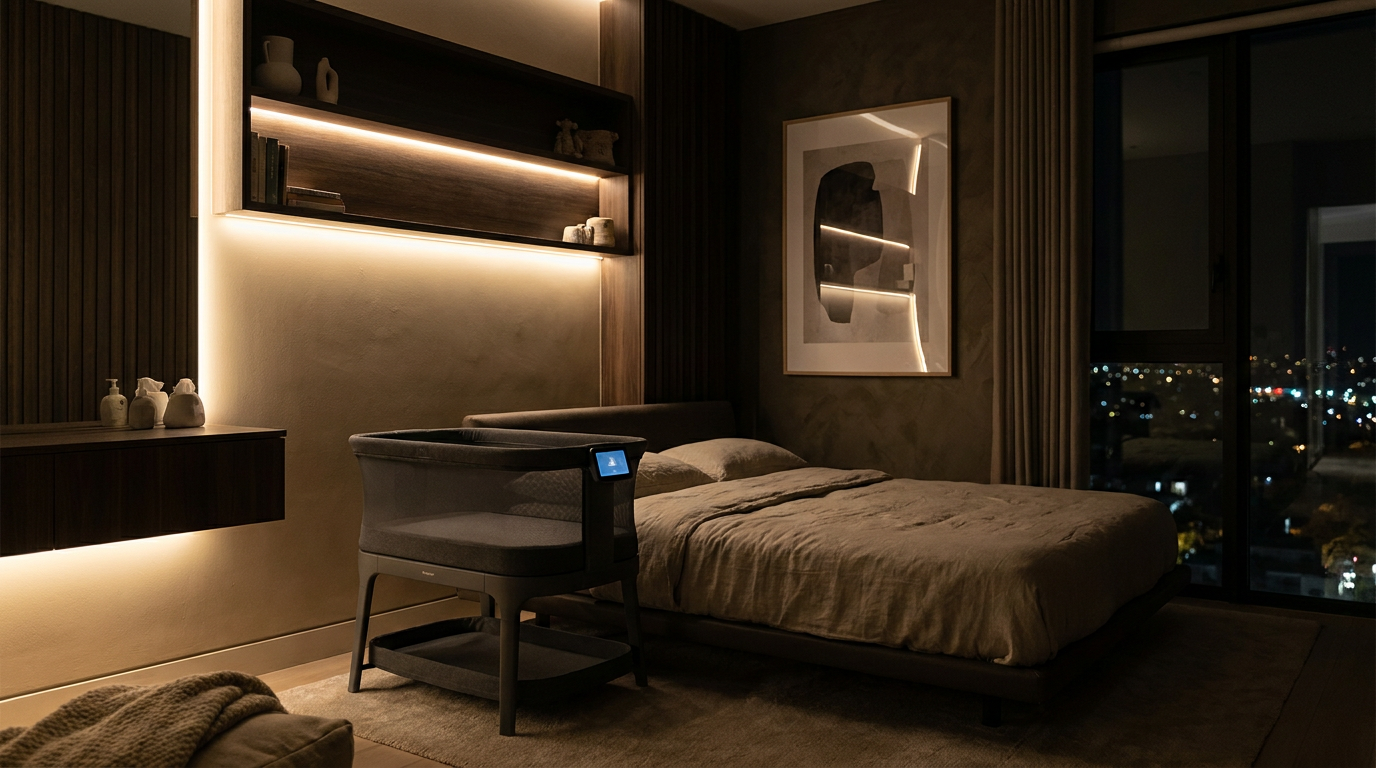
The arrival of a newborn brings an immediate, universal challenge: severe sleep deprivation. For decades, the solution was a simple, static basket placed next to the parents' bed. But in 2026, the baby gear market has bifurcated into two distinct philosophies. On one side are traditional bassinets, which provide a safe, flat surface and rely entirely on the parent for soothing. On the other side are smart bassinets—internet-connected, motorized beds that use microphones and sensors to detect a baby's cries and automatically respond with rocking and white noise. Deciding between the two is no longer just a matter of aesthetics; it is a choice about parenting philosophy, budget, and how much technology belongs in the nursery. Parents are increasingly forced to weigh the high upfront cost of automated assistance against the physical toll of manual nighttime soothing.[3][8]
Regardless of the technology involved, the baseline for infant sleep remains identical. The American Academy of Pediatrics (AAP) updated its safe sleep guidelines in 2025 and 2026, reinforcing the strict "ABC" rule: babies must sleep Alone, on their Back, in a Crib or bassinet with a firm, flat, non-inclined surface. Both traditional and smart bassinets must meet these federal Consumer Product Safety Commission standards to be sold legally. Pediatric nurses and safety experts emphasize that motion, sounds, and smartphone app controls are optional soothing extras, not safety features. The core requirement is a clutter-free sleep space without loose blankets, pillows, or breathable bumpers, alongside room-sharing for at least the first six months. Any device that inclines more than 10 degrees is strictly prohibited for unsupervised sleep.[1][6]
The argument for traditional bassinets centers on simplicity, portability, and cost. Models like the Halo BassiNest or the Newton Baby Bassinet typically retail between $150 and $350. They do not require a Wi-Fi connection, a wall outlet, or a smartphone app to function. Many feature 360-degree swivel bases and drop-down sides, which are particularly beneficial for mothers recovering from C-sections who need to reach their baby without bending or standing. Because they are relatively lightweight and untethered from power cords, traditional bassinets can easily be moved from the bedroom to the living room during the day, offering a flexible, low-tech safe sleep space that integrates seamlessly into a home without adding digital complexity.[3][4]

The primary argument against traditional bassinets is the manual labor they require from exhausted parents. When a baby wakes at 2:00 a.m. needing to be rocked back to sleep, the parent is the engine. There is no automated intervention to bridge sleep cycles. If the baby requires motion or white noise, parents must provide it themselves or purchase separate devices, such as standalone sound machines. For families dealing with high-need infants, colic, or parents facing severe sleep deprivation that threatens their mental health, the lack of automated assistance can make the newborn phase significantly more grueling. The physical toll of repeatedly leaning over a bed to manually jiggle a mattress cannot be understated.[8]
The primary argument against traditional bassinets is the manual labor they require from exhausted parents.
The case for smart bassinets, such as the SNOO Smart Sleeper or the Cradlewise, is built on the promise of automated relief. These devices act as a virtual night nurse. When the bassinet's sensors detect fussing, an algorithm automatically triggers incrementally faster rocking and louder white noise to soothe the baby before they fully wake. Proponents argue this intervention can add one to two hours of continuous sleep per night. Furthermore, the SNOO specifically features a clip-in swaddle system that earned it FDA De Novo authorization for keeping babies safely on their backs. This provides immense peace of mind for anxious parents terrified of their infant rolling over in the night, effectively outsourcing a major source of postpartum anxiety to the machine.[2][7]
The argument against smart bassinets focuses on their exorbitant cost, potential over-reliance on technology, and the eventual weaning process. Premium smart sleepers retail between $1,000 and $1,700, a massive investment for a product that a baby will outgrow in five to six months. Skeptics raise concerns about the constant exposure to white noise, noting that some smart bassinets can reach up to 86 decibels when fully activated—well above the 50-decibel limit recommended by audiologists for continuous exposure. Additionally, parents must eventually transition their baby to a stationary crib. This transition can be notoriously difficult if the infant has developed a strong sleep association with constant, motorized motion, requiring a dedicated weaning mode to slowly break the habit.[5][6]

The evidence regarding the efficacy of smart bassinets is mixed but generally positive for short-term parental relief. Internal data from Happiest Baby claims their device boosts sleep by an average of one hour a night and significantly reduces parental anxiety. Independent surveys of neonatal intensive care nurses also report high satisfaction with responsive bassinets in clinical settings. However, critical reviews point out a lack of peer-reviewed, long-term studies proving that smart bassinets permanently improve sleep architecture. The consensus among pediatric sleep consultants is that while these devices are highly effective at soothing young infants, the motion features should be gradually reduced by three to four months of age to prevent entrenched sleep dependencies that backfire later in the first year.[2][5]
A smart bassinet fits well when budget is not a primary constraint and parents are prioritizing maximum sleep preservation. It is an excellent choice for families with high-need, fussy babies, parents returning to work very early, or those who suffer from severe postpartum anxiety regarding sleep safety. The FDA-authorized back-sleeping swaddle of the SNOO is particularly valuable for parents who want an absolute guarantee against nighttime rolling. For those who balk at the retail price, rental programs—typically around $150 per month—make the technology more accessible for the brief newborn window, allowing families to test the automated soothing without committing to a permanent piece of high-tech furniture.[2][4][7]

A smart bassinet does not fit when families are on a strict budget, prefer a minimalist approach to parenting, or want a highly portable sleep solution. It is also unnecessary for naturally calm babies who sleep well without constant motion. A traditional bassinet fits perfectly for parents who want a reliable, safe sleep surface that can be easily moved around the house, or for those who prefer to manually soothe their baby to build early bonding routines without the intervention of an algorithm. Ultimately, both options provide the firm, flat safety that newborns require; the choice simply dictates whether a parent or a computer does the rocking at three in the morning.[4][8]
How we got here
2002
Dr. Harvey Karp publishes 'The Happiest Baby on the Block', introducing the 5 S's soothing method.
2016
The SNOO Smart Sleeper launches, creating the premium smart bassinet category.
2022
AAP updates safe sleep guidelines, reinforcing the ban on inclined sleepers.
2023
The FDA grants De Novo authorization to the SNOO for keeping sleeping babies on their backs.
2026
New federal bassinet safety standards take effect, ensuring all sleep products meet strict firmness and flat-surface rules.
Viewpoints in depth
Pediatric Safety Purists
Medical professionals focused strictly on the AAP's ABCs of safe sleep, wary of unnecessary technology.
This camp, which includes the American Academy of Pediatrics and cautious nursing advocates, emphasizes that a firm, flat surface is the only non-negotiable requirement for infant sleep. They argue that while smart features are not inherently dangerous if the bed is flat, they are unnecessary luxuries that can introduce new risks, such as excessive decibel levels from built-in speakers or entrenched sleep associations. Their primary concern is that parents might rely on technology rather than safe sleep fundamentals.
Tech-Assisted Sleep Advocates
Parents and gear reviewers who view smart bassinets as essential tools for surviving newborn sleep deprivation.
For this group, the exorbitant cost of a smart bassinet is justified by the return of parental sanity. They point to the FDA authorization of the SNOO's swaddle system as a massive leap forward in preventing accidental rolling. Advocates argue that by automating the rocking and shushing required to bridge infant sleep cycles, these devices act as a 'night nurse,' significantly reducing postpartum exhaustion and anxiety during the most difficult months of early parenthood.
Minimalist & Budget Parents
Caregivers who prefer low-tech, affordable solutions that prioritize portability and parent-led soothing.
This perspective argues that spending over $1,000 on a piece of furniture used for only six months is an unnecessary financial strain. They champion traditional bassinets with practical features like drop-down sides and 360-degree swivels, which aid in C-section recovery without relying on Wi-Fi or wall outlets. This camp believes that manual soothing builds stronger early bonding and avoids the headache of eventually weaning a baby off a robotic rocking machine.
What we don't know
- Whether the constant motion of smart bassinets has any long-term impact on a child's vestibular development.
- If the high decibel levels of built-in white noise machines pose a definitive risk to infant hearing over extended periods.
- How the upcoming 2026 federal safety standards will impact the design of next-generation smart sleepers.
Key terms
- AAP Safe Sleep Guidelines
- The American Academy of Pediatrics' recommendations for infant sleep, emphasizing a firm, flat surface without loose bedding.
- FDA De Novo Authorization
- A regulatory pathway for novel medical devices, granted to the SNOO for its ability to keep babies safely on their backs.
- Sleep Association
- A condition or object a baby learns to rely on to fall asleep, such as rocking, white noise, or a pacifier.
- White Noise
- A consistent, ambient sound that masks background noises and mimics the auditory environment of the womb.
Frequently asked
Are smart bassinets safe for newborns?
Yes, provided they meet CPSC standards for a firm, flat surface and are used according to AAP guidelines without loose bedding.
Do babies get addicted to the motion of a smart bassinet?
Infants can develop sleep associations with constant motion. Experts recommend utilizing built-in weaning modes by three to four months of age.
Is the SNOO the only smart bassinet available?
No, competitors like the Cradlewise, Graco Sense2Snooze, and Maxi-Cosi Starling offer similar responsive technology at various price points.
Can I rent a smart bassinet instead of buying one?
Yes, companies offer monthly rentals (typically around $150 per month), which is often more cost-effective for the brief newborn phase.
Sources
Source coverage
8 outlets
3 viewpoints surfaced






[1]HealthyChildren.orgPediatric Safety Purists
Safe Sleep: AAP Policy Explained
Read on HealthyChildren.org →[2]Happiest BabyTech-Assisted Sleep Advocates
SNOO Smart Sleeper Science and Research
Read on Happiest Baby →[3]BabylistTech-Assisted Sleep Advocates
Best Bassinets of 2026: Smart vs. Traditional
Read on Babylist →[4]Kido BebeMinimalist & Budget Parents
Halo BassiNest vs SNOO vs the Best Bassinet Alternatives in Canada (2026 Guide)
Read on Kido Bebe →[5]NDC InstitutePediatric Safety Purists
Eight reasons not to purchase or rent a Snoo Smart Sleeper
Read on NDC Institute →[6]HarborPediatric Safety Purists
Smart Bassinets: What Parents Need to Know (From a Pediatric Nurse)
Read on Harbor →[7]PoppylistTech-Assisted Sleep Advocates
Cradlewise vs. SNOO: Which Smart Sleeper is Best?
Read on Poppylist →[8]Factlen Editorial Team
Synthesis by Factlen editorial team
Read on Factlen Editorial Team →
More in shopping
See all 9 stories →E-Bike Tech
The 2026 E-Bike Buying Guide: Motors, Classes, and the Safety Specs You Can't Ignore
7 sources
EV Tech
The 2026 Electric Motorcycle Buyer's Guide: Range, Charging, and the Solid-State Shift
7 sources

TV Tech
OLED vs. Mini-LED TVs in 2026: The Complete Technology Comparison
7 sources
Summer Sales
Amazon Shifts Prime Day to June, Triggering Massive Summer Retail Showdown
6 sources
Every angle. Every day.
Get shopping stories with full source coverage and perspective breakdowns delivered to your inbox.