
SEC Establishes New Financial Reporting and Accounting Unit to Target Corporate Fraud
The U.S. Securities and Exchange Commission has launched a specialized enforcement unit dedicated to investigating complex accounting fraud and auditor misconduct.


- Enforcement Advocates
- Believe specialized technical teams are essential to catch sophisticated accounting fraud and protect market integrity.
- Compliance Skeptics
- Question how effective the unit will be while the broader SEC pursues a deregulatory agenda that reduces corporate reporting.
- Audit Practitioners
- Focus on the practical implications for audit firms and corporate controllers facing heightened scrutiny of their workpapers.
How we got here
2002
Congress passes the Sarbanes-Oxley Act in response to major accounting scandals, fundamentally changing corporate governance and audit requirements.
2013
The SEC forms the Financial Reporting and Audit Task Force to detect improper reporting and analyze industry trends.
April 2026
David Woodcock, a former auditor and head of the 2013 task force, is appointed Director of the SEC's Division of Enforcement.
May 2026
Timothy Zimmerman joins the SEC's Division of Enforcement as a senior advisor to the Director.
August 5, 2026
The SEC officially announces the creation of the specialized Financial Reporting and Accounting Unit.
Why it matters
When public companies manipulate their financial statements, the resulting stock collapses wipe out retail portfolios and pension funds overnight. The SEC's new specialized unit means corporate executives and their auditors will face a team of dedicated experts actively hunting for aggressive accounting, fundamentally raising the stakes for how companies report their earnings.
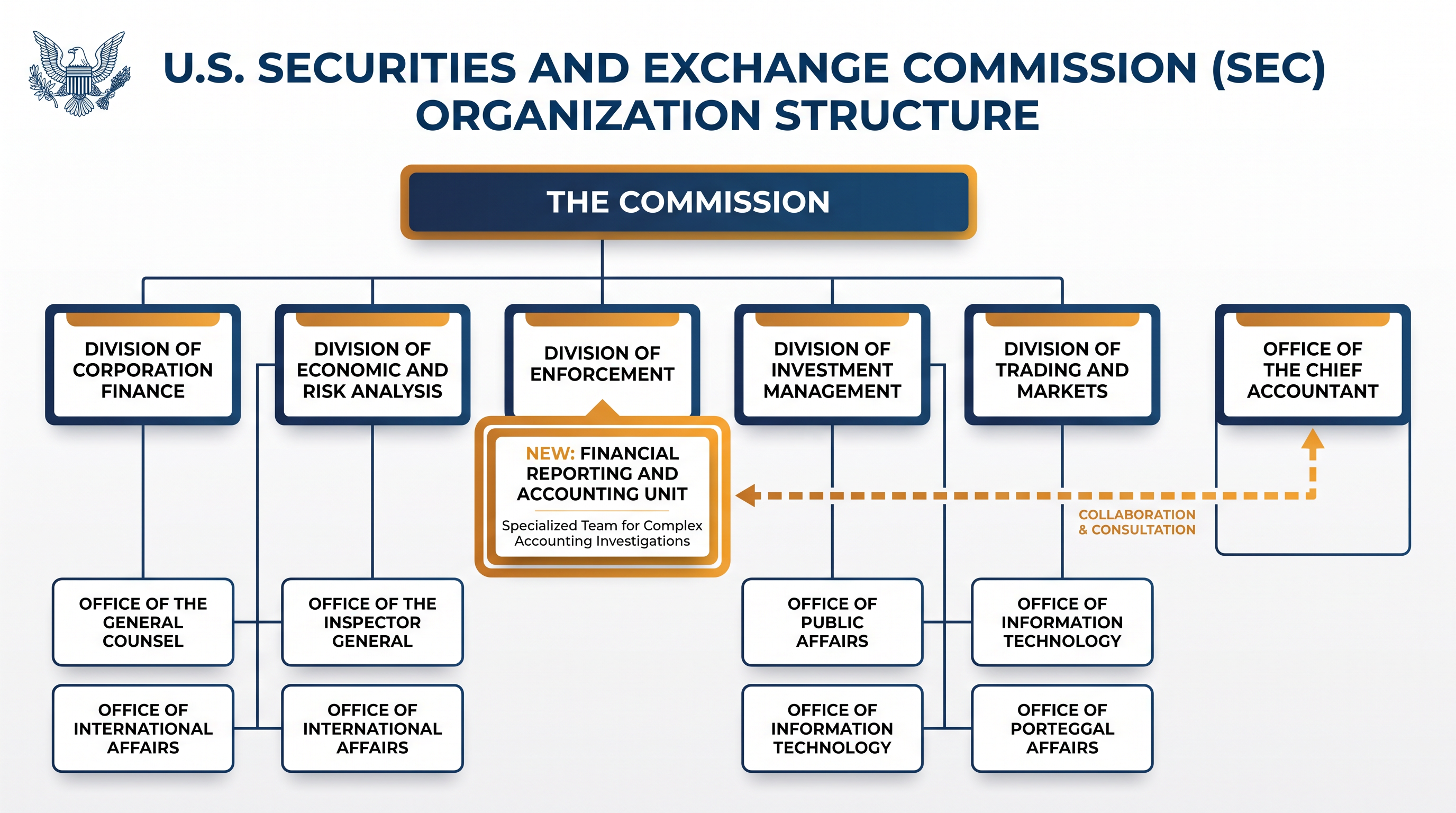
What everyone gets wrong about corporate accounting fraud is the assumption that it begins with a cinematic, orchestrated heist. The reality is far more banal—and expensive. A single aggressive accounting assumption, such as a pulled-forward revenue recognition or a delayed impairment charge, can quietly spiral into a multi-billion-dollar restatement that wipes out shareholder equity overnight. To target the precise mechanisms of these quiet catastrophes, the U.S. Securities and Exchange Commission (SEC) announced on August 5, 2026, the creation of a specialized Financial Reporting and Accounting Unit within its Division of Enforcement.[1]
The new unit is designed to provide the dedicated expertise, focus, and capacity required to pursue complex financial reporting fraud and auditor misconduct. Rather than relying on generalist enforcement attorneys to parse dense financial statements, the SEC is assembling a multidisciplinary team of lawyers and accountants who specialize in the arcane rules of securities regulation and audit procedures.[1][2][5][7]
Timothy Zimmerman, a veteran lawyer who joined the SEC in May 2026 as a senior advisor, has been appointed to lead the initiative. Zimmerman brings a highly specific resume to the role: he spent 12 years at the international law firm Gibson, Dunn & Crutcher before serving as deputy general counsel at the audit and professional services firm RSM. His background signals a clear intent to scrutinize not just corporate executives, but the external auditors who sign off on their math.[1][3][4][6][8]
The establishment of this unit represents a formalization of priorities set by David Woodcock, the director of the SEC's Division of Enforcement. Woodcock, who began his career as an auditor with Ernst & Young, previously chaired a Financial Reporting and Audit Task Force created at the SEC in 2013. Upon returning to lead the enforcement division in 2026, Woodcock emphasized that cracking down on bad actors in the accounting profession would be a core mission area.[1][2][4][5][8]
For investors and financial professionals, the stakes of this enforcement shift are intensely practical. When a public company manipulates its earnings or obscures its liabilities, the resulting stock collapse directly impacts retail portfolios, pension funds, and market liquidity. By dedicating resources specifically to financial reporting, the SEC aims to catch aggressive accounting practices before they metastasize into catastrophic market events.[5][6][7]
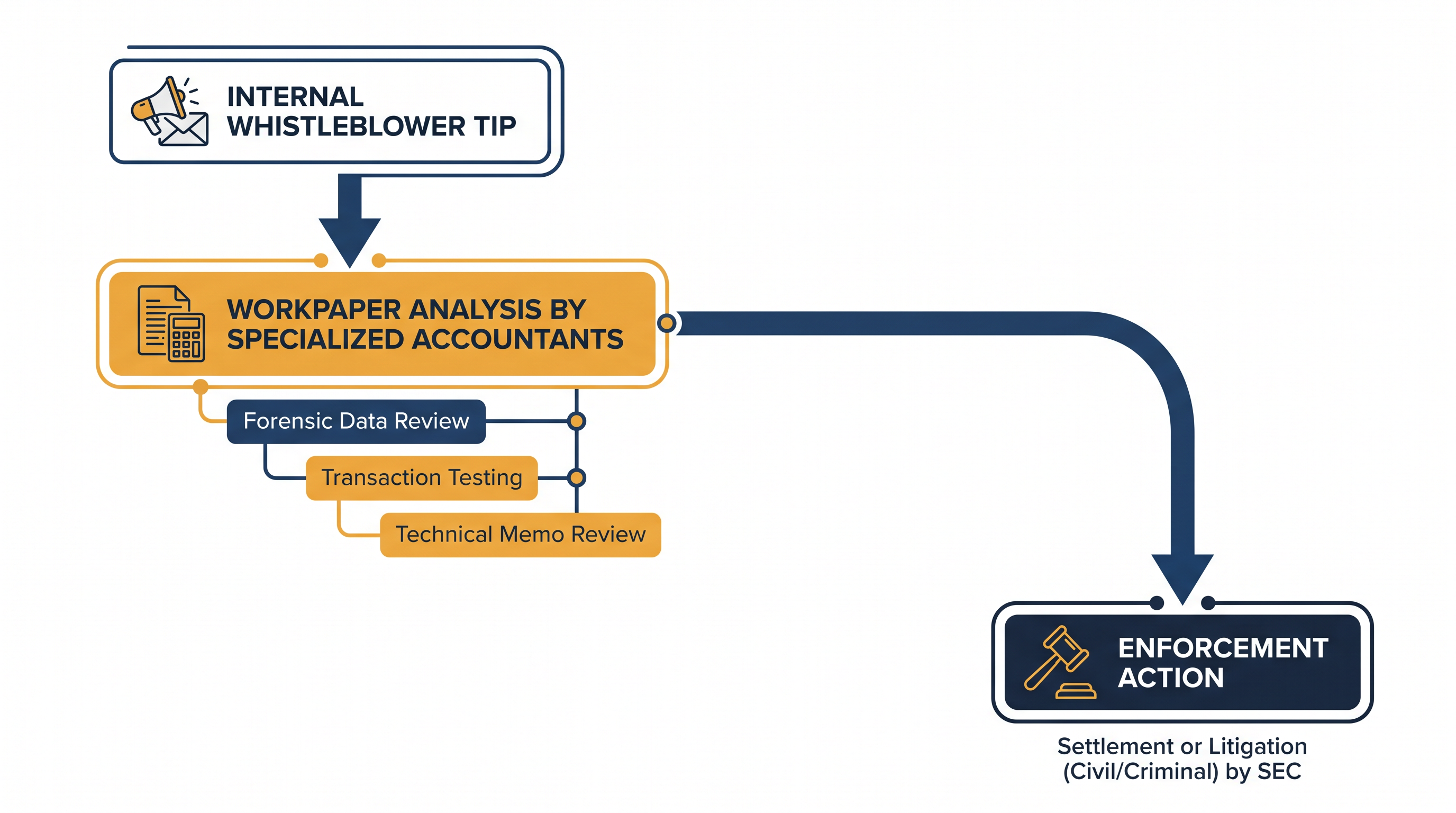
The mechanics of these investigations are notoriously resource-intensive. Proving accounting fraud requires regulators to reconstruct how a specific financial decision was made, who challenged it internally, what documentation was provided to auditors, and whether the audit workpapers align with the final public disclosures. The new unit will coordinate closely with the SEC's Office of the Chief Accountant and the Division of Corporation Finance to analyze these granular details.[1][5][8]

The mechanics of these investigations are notoriously resource-intensive.
Interestingly, the launch of this aggressive enforcement unit presents a strategic contrast to the broader posture of the SEC under Chair Paul Atkins. Atkins has generally pursued a deregulatory agenda, focusing on easing burdens on public companies. Observers have noted the apparent contradiction between an enforcement division staffing up to fight financial fraud and a commission leadership that has proposed allowing semi-annual rather than quarterly reporting.[2][3]
Legal analysts suggest that this dynamic makes the new unit's mandate both critical and complex. While the broader SEC may be rolling back certain corporate governance and disclosure requirements, the Enforcement Division is simultaneously signaling that it will ruthlessly police the disclosures that remain. This 'back-to-basics' approach to enforcement focuses strictly on the accuracy of the numbers rather than expansive new regulatory frameworks.[2][3]
A significant driver of the unit's future caseload is expected to be internal whistleblowers. Corporate accounting departments and audit committees are increasingly the source of tips regarding manipulated forecasts or ignored internal controls. With a dedicated unit now ready to process these highly technical complaints, companies are being advised to pay special attention to internal reports regarding financial reporting conduct.[2][7]
The scrutiny will not stop at the CFO's desk. The SEC has explicitly stated that the unit will pursue misconduct in the auditing area, putting external audit firms and engagement partners on notice. Auditors are now operating in an environment where their procedures, consultations, and supporting documentation will be evaluated by a specialized team that understands exactly where the bodies are typically buried in a balance sheet.[1][7][8]
To identify these suspicious reporting patterns, the new unit is expected to leverage advanced data analytics. The SEC has historically utilized tools like the Accounting Quality Model to screen public filings for anomalous discretionary accruals and unusual accounting choices. By combining these algorithmic sweeps with the specialized human expertise of the new unit, the Enforcement Division can more effectively flag companies that deviate significantly from their industry peers.[5][8]

Ultimately, the Financial Reporting and Accounting Unit is not discovering accounting fraud for the first time; it is applying fresh structure and technical muscle to one of the SEC's oldest responsibilities. Whether this translates into a wave of high-profile fraud charges or simply serves as a potent deterrent remains to be seen.[2][8]
What to know
- The SEC has launched a new Financial Reporting and Accounting Unit within its Division of Enforcement.
- The unit is staffed by specialized attorneys and accountants dedicated to pursuing complex financial fraud and auditor misconduct.
- Timothy Zimmerman, a former deputy general counsel at an audit firm, has been appointed to lead the initiative.
- The move formalizes the 'back-to-basics' enforcement priorities of Division Director David Woodcock.
- Legal experts advise companies and audit committees to rigorously document accounting judgments and prioritize internal whistleblower complaints.
Where opinion splits
Regulatory Enforcement Advocates
This camp views the specialized unit as a necessary return to the SEC's core mission of protecting investors from financial deception.
Proponents argue that complex accounting fraud cannot be effectively policed by generalist attorneys. By combining specialized accountants and lawyers, the SEC can match the technical sophistication of the corporate executives and Big Four auditors they are investigating. They view this 'back-to-basics' enforcement as essential for maintaining baseline trust in the capital markets, ensuring that public financial statements reflect economic reality rather than creative accounting.
Corporate Compliance Skeptics
Observers who question the practical impact of the unit given the broader deregulatory posture of the current SEC leadership.
Skeptics point to a perceived contradiction within the agency: while the Enforcement Division is staffing up to fight accounting fraud, the SEC under Chair Paul Atkins has simultaneously proposed rolling back longstanding corporate governance and disclosure requirements. Critics argue that reducing the frequency and depth of mandatory reporting will inherently make financial fraud harder to identify, potentially undermining the new unit's effectiveness before it even begins its work.
Audit and Legal Practitioners
Professionals who anticipate a significant increase in regulatory scrutiny over internal controls and audit workpapers.
For law firms and accounting professionals, the announcement is a clear warning shot. Practitioners expect the new unit to aggressively scrutinize not just the final numbers, but the internal debates, accounting judgments, and auditor consultations that produced them. This camp is advising corporate clients to rigorously document their financial decisions and treat internal whistleblower complaints with heightened urgency, knowing that the SEC now has a dedicated team ready to parse the technical details.
Key terms
- Restatement
- The revision and republication of one or more of a company's prior financial statements to correct a material error or fraud.
- Impairment charge
- A process used by businesses to write off worthless goodwill or reduce the value of assets on their balance sheet.
- Workpapers
- The internal documents, schedules, and analyses prepared by auditors that support their final opinion on a company's financial statements.
- Internal controls
- The mechanisms, rules, and procedures implemented by a company to ensure the integrity of financial and accounting information.
- Revenue recognition
- The accounting principle that determines the specific conditions under which income becomes realized as revenue.
Unanswered questions
- How many active investigations will be transferred from general enforcement to the new specialized unit.
- Whether the unit will focus primarily on massive, headline-grabbing corporate frauds or pursue smaller, routine accounting violations.
- How the unit's aggressive enforcement mandate will reconcile with the SEC's broader proposals to reduce corporate reporting requirements.
Reader questions
Why did the SEC create this specific unit now?
The SEC created the unit to provide dedicated expertise and capacity to investigate complex accounting fraud, formalizing a priority set by Enforcement Director David Woodcock upon his return to the agency in 2026.
Who is leading the new Financial Reporting and Accounting Unit?
The unit is led by Timothy Zimmerman, a veteran lawyer who previously served as deputy general counsel at an international audit firm and spent 12 years at Gibson, Dunn & Crutcher.
Will this unit only target corporate executives?
No. The SEC has explicitly stated that the unit will also pursue misconduct by external auditors and accounting professionals who sign off on misleading financial statements.
How does this fit with the SEC's broader deregulatory agenda?
It presents a strategic contrast. While SEC leadership has proposed easing certain corporate reporting burdens, the Enforcement Division is taking a 'back-to-basics' approach to strictly police the accuracy of the disclosures that remain.
Sources
Source coverage
8 outlets
3 viewpoints surfaced








[1]U.S. Securities and Exchange CommissionEnforcement Advocates
SEC Establishes New Financial Reporting and Accounting Unit
Read on U.S. Securities and Exchange Commission →[2]CFO DiveCompliance Skeptics
SEC launches new enforcement unit aimed at accounting fraud
Read on CFO Dive →[3]Radical ComplianceCompliance Skeptics
SEC Forms New Accounting Fraud Unit
Read on Radical Compliance →[4]The AccountantAudit Practitioners
SEC creates new unit to tackle accounting fraud
Read on The Accountant →[5]Cleary GottliebEnforcement Advocates
SEC Announces New Financial Reporting and Accounting Unit
Read on Cleary Gottlieb →[6]FSTechAudit Practitioners
SEC establishes specialist accounting fraud enforcement unit
Read on FSTech →[7]Securities Lawyer 101Enforcement Advocates
SEC Announces New Financial Reporting and Accounting Unit
Read on Securities Lawyer 101 →[8]My-CPEAudit Practitioners
SEC Creates Specialized Accounting Fraud Unit
Read on My-CPE →
Comments
Every angle. Every day.
Get business stories with full source coverage and perspective breakdowns delivered to your inbox.