
OLED vs. Mini-LED: The 2026 TV Display Technology Comparison
As OLED and Mini-LED technologies reach new performance heights in 2026, choosing the right TV comes down to a strict trade-off between absolute contrast and sheer brightness.
By Factlen Editorial Team
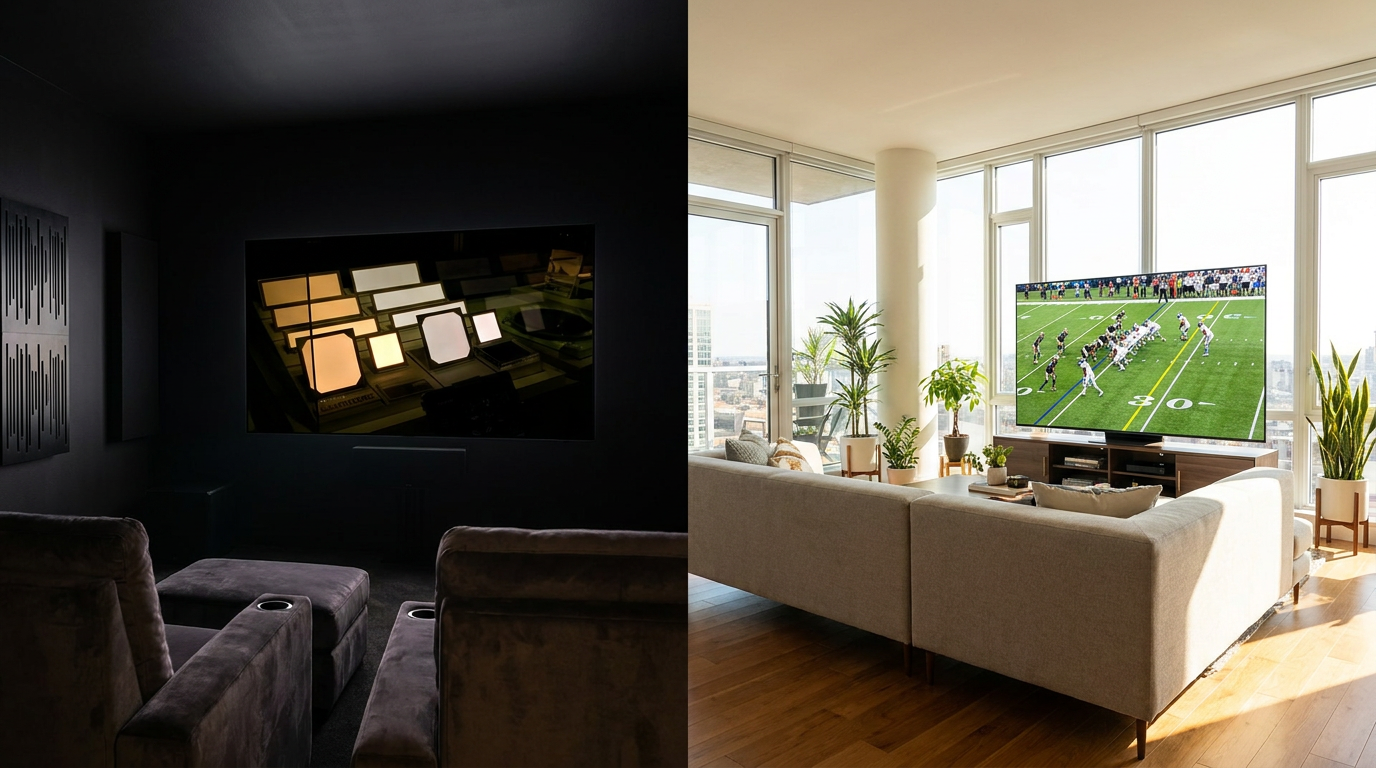
- Home Theater Purists
- Argue that infinite contrast, perfect blacks, and pixel-level precision make OLED the only acceptable choice for cinematic viewing.
- Bright-Room Pragmatists
- Emphasize that most people watch TV in sunlit living rooms, making Mini-LED's massive brightness and lack of burn-in the superior everyday choice.
- Value & Scale Maximizers
- Focus on the cost-per-inch metric, arguing that Mini-LED's ability to deliver 85-inch to 115-inch screens affordably makes it the true market winner.
What's not represented
- · Projector Enthusiasts
- · Micro-LED Early Adopters
Why this matters
A premium television is a multi-year investment that dictates how you experience entertainment. Understanding the specific environmental strengths of OLED and Mini-LED ensures you don't spend thousands of dollars on a screen that underperforms in your specific living room.
Key points
- OLED panels offer perfect black levels and infinite contrast by turning individual pixels completely off.
- Mini-LED displays utilize thousands of backlight zones to achieve massive peak brightness, making them ideal for sunlit rooms.
- 2026 OLED advancements like Tandem and QD-OLED have significantly improved brightness, though they still trail Mini-LED in full-screen luminance.
- Mini-LED technology scales much more affordably at massive screen sizes of 85 inches and above.
The television market in 2026 is dominated by two heavyweight display technologies: OLED and Mini-LED. For years, the buying advice was strictly dictated by budget, but as manufacturing costs have stabilized, the choice has evolved into a fundamental architectural decision. Both technologies have reached remarkable heights of performance, yet they serve entirely different environments and viewing habits. Choosing between them requires a clear understanding of their underlying mechanics, as picking the wrong panel for a specific room can severely compromise the viewing experience.[1][2][3]
The core difference between the two lies in how they generate light. OLED, which stands for Organic Light-Emitting Diode, is a self-emissive technology. This means that each individual pixel on the screen produces its own light and color independently. Mini-LED, conversely, is an evolution of traditional LCD technology. It relies on a liquid crystal display to create colors, which is illuminated from behind by a backlight consisting of thousands of microscopic LEDs. These tiny lights are grouped into specific local dimming zones that can brighten or dim based on the content being displayed.[1][6]
The case for OLED centers entirely on absolute, microscopic precision. Because each of its roughly eight million pixels in a 4K display operates independently, an OLED panel can turn individual pixels completely off. When a scene calls for black, the pixel emits zero light. This capability results in an infinite contrast ratio, delivering perfect, inky blacks that serve as a flawless canvas for the surrounding colors. There is no light bleed, no glowing edges, and no compromise in the darkest areas of the picture.[1][4][7]
The evidence for OLED’s dominance in controlled lighting is overwhelming, with reviewers consistently praising its cinematic depth. Furthermore, 2026 advancements have directly addressed the technology's historical weakness: brightness. New architectures like LG’s Tandem OLED—which stacks multiple emissive layers—and Samsung’s refined QD-OLED panels have pushed peak highlight brightness to nearly 2,000 nits. This means that specular highlights, such as a flashlight beam or a glint of sun on a car bumper, punch through the darkness with startling intensity, creating a highly realistic and immersive high-dynamic-range experience.[2][5]

However, the case against OLED involves its limitations with full-screen brightness and long-term panel longevity. While small highlights are blindingly bright, organic panels are restricted by an Automatic Brightness Limiter (ABL). To prevent the organic compounds from overheating and degrading, the ABL software aggressively dims the screen during bright, full-screen scenes—such as a hockey game, a snowscape, or a bright news studio. In a sun-drenched room, this automatic dimming can make the image feel flat and lacking in overall vibrancy compared to its backlit rivals.[1][3]
Furthermore, OLED carries a slight but persistent risk of permanent image retention, commonly known as burn-in. Because the pixels are organic, they degrade over time with use. If static elements—such as a cable news ticker, a sports score bug, or a video game heads-up display—are left on the screen for thousands of cumulative hours, those specific pixels wear out faster than the rest of the screen, leaving a faint, permanent ghost image behind. While modern pixel-shifting algorithms have heavily mitigated this risk, it remains a physical reality of the technology.[1][4][7]
The case for Mini-LED is built on sheer, unadulterated horsepower and environmental versatility. By packing thousands of independent dimming zones behind the LCD panel, modern Mini-LED televisions from manufacturers like TCL, Hisense, and Sony can sustain massive full-screen brightness without the need for aggressive thermal throttling. Because they rely on inorganic LED backlights rather than degradable organic compounds, they are entirely immune to burn-in, offering total peace of mind for users who leave their televisions running all day on static channels.[3][5][7]
The case for Mini-LED is built on sheer, unadulterated horsepower and environmental versatility.
The evidence for Mini-LED’s bright-room superiority is easily quantified in its raw light output. Flagship 2026 models routinely push between 2,500 and 5,000 nits of peak brightness, with some extreme models pushing even higher. This overwhelming luminance allows the television to easily overpower direct sunlight, heavy window glare, and bright overhead lighting. When watching a daytime football game in a living room with open blinds, a Mini-LED display maintains its saturated colors and intense contrast, whereas an OLED might struggle to cut through the ambient light.[2][3][5]

Mini-LED also wins the size-to-value ratio by a significant margin. Manufacturing flawless organic panels becomes exponentially more difficult and costly as the screen size increases, causing OLED prices to skyrocket once they surpass the 77-inch mark. Mini-LED technology, however, scales highly efficiently across massive substrates. This manufacturing advantage has made massive 85-inch, 98-inch, and even 115-inch displays surprisingly accessible for consumer living rooms. For buyers looking to replicate a true projector-scale home theater experience, Mini-LED allows them to prioritize sheer, wall-filling immersion without spending five figures on a single premium television.[4][5][7]
The case against Mini-LED focuses primarily on light bleed, a visual artifact commonly known as blooming or haloing. Because the backlight zones—even on high-end models with thousands of them—are still significantly larger than individual pixels, they cannot achieve true pixel-level precision. When a bright object is displayed against a pitch-black background, such as white subtitles on a dark letterbox bar or a starfield in a sci-fi movie, the light from the active zone spills over into the adjacent dark pixels, creating a faint, distracting glowing aura.[1][4]
Additionally, Mini-LED panels generally suffer from narrower viewing angles compared to their OLED counterparts. Because the light must pass through multiple LCD and quantum dot layers, the image can degrade when viewed from off-center. If a viewer sits far to the left or right of the screen, they may notice a distinct shift in color accuracy, a drop in contrast, and an exacerbation of the blooming effect. This makes Mini-LED less ideal for wide, U-shaped seating arrangements where multiple people are watching from extreme angles.[1][3][6]
When it comes to gaming, the trade-offs between the two technologies remain distinct but highly competitive. Both formats now routinely offer 144Hz refresh rates, Variable Refresh Rate (VRR), and full HDMI 2.1 bandwidth. However, OLED holds the edge for competitive players due to its near-instantaneous sub-millisecond response times, which virtually eliminate motion blur during fast camera pans. Mini-LED counters by offering complete immunity to static HUD burn-in and delivering punchier, more vibrant HDR highlights in brightly lit gaming environments.[3][6][7]

Ultimately, the decision between these two premium display technologies comes down to the viewing environment rather than a single objective winner. OLED fits exceptionally well when the display is placed in a light-controlled room, a dedicated basement home theater, or a space with wide seating arrangements. It remains the undisputed champion for cinematic viewing, where absolute black levels, pixel-level contrast, and three-dimensional depth are the highest priorities for the viewer. If the goal is to watch moody, atmospheric films exactly as the director intended, OLED provides an unmatched canvas.[1][4][7]
Conversely, OLED does not fit well in sun-drenched living rooms featuring massive, uncovered windows, or for households that treat the television as constant background noise. If the primary use case involves leaving cable news networks, financial tickers, or static sports channels running all day, the inherent risk of burn-in becomes a genuine concern. Furthermore, the aggressive automatic dimming triggered by bright rooms will leave the OLED panel looking washed out and underpowered, making it a stressful and suboptimal choice for that specific, high-glare lifestyle.[1][3][7]
Mini-LED fits exceptionally well when the television must actively compete with heavy daylight. It is the definitive choice for bright, open-concept living spaces where drawing the blinds is not an option. It also fits perfectly for buyers who want an 85-inch or larger screen without draining their savings, or for households where sports, daytime viewing, and bright HDR gaming are the primary activities. The sheer luminance and durability of the panel make it a bulletproof option for heavy, mixed-use environments.[2][5][7]
However, Mini-LED does not fit well for pitch-black viewing environments where its minor blooming artifacts become highly visible and distracting. For dedicated videophiles who demand absolute pixel-level contrast above all else, the faint glowing halos around subtitles and bright highlights will inevitably break the cinematic illusion. In the end, there is no universal victor in the display wars. Buyers must honestly assess their room lighting, their seating layout, and their daily viewing habits to declare the true winner for their specific home theater or living room.[1][4][7]
How we got here
2013
The first OLED TVs hit the consumer market, introducing perfect black levels but struggling with low peak brightness.
2021
Mini-LED technology goes mainstream, offering a high-brightness alternative with vastly improved local dimming over traditional LEDs.
2024
QD-OLED and Micro Lens Array (MLA) technologies push OLED peak brightness past the 1,000-nit barrier.
2026
Flagship Mini-LEDs breach 5,000 nits of brightness, while Tandem OLED architectures bring unprecedented durability and highlight punch to organic panels.
Viewpoints in depth
Home Theater Purists
Argue that absolute contrast is the only metric that matters for cinematic immersion.
This camp points out that in a light-controlled room, OLED's pixel-level precision and lack of blooming create a three-dimensional depth that no backlit LCD can replicate. They argue that the director's intent relies on absolute black levels to frame the shot, making OLED the definitive choice for film enthusiasts who prioritize image accuracy over sheer brightness.
Bright-Room Pragmatists
Contend that lab-tested black levels are irrelevant if the TV cannot overpower afternoon sunlight.
This viewpoint values Mini-LED's sheer luminance and immunity to burn-in, arguing that a television should function flawlessly in a heavily windowed living room without requiring the owner to draw the blackout curtains. They emphasize that for everyday viewing—sports, news, and daytime gaming—Mini-LED provides a vastly superior and less stressful ownership experience.
Value & Scale Maximizers
Focus on the rising consumer demand for massive screens and the cost-per-inch metric.
These analysts note that while an 83-inch OLED carries a massive premium, 85-inch and 98-inch Mini-LEDs have become aggressively priced. They argue that Mini-LED is the only logical choice for buyers who prioritize sheer screen real estate and immersive sports viewing, as it delivers a projector-scale experience without the five-figure price tag.
What we don't know
- Whether upcoming Micro-LED technology will eventually become affordable enough to replace both OLED and Mini-LED in the consumer market.
- Exactly how long the new Tandem OLED architectures will extend panel lifespans before any signs of degradation appear.
Key terms
- OLED
- Organic Light-Emitting Diode; a display technology where each individual pixel generates its own light and can turn off completely for perfect blacks.
- Mini-LED
- An advanced backlight technology for LCD TVs that uses thousands of microscopic LEDs grouped into dimming zones for precise brightness control.
- Nits
- A unit of measurement for screen brightness; the higher the number, the brighter the display can get.
- Blooming
- A visual artifact where light from bright objects bleeds into adjacent dark areas of the screen, common in backlit televisions.
- Burn-in
- Permanent image retention caused by leaving static elements, like logos or gaming HUDs, on an organic screen for thousands of hours.
- Local Dimming Zones
- Specific clusters of LEDs behind an LCD screen that can dim or brighten independently to improve contrast.
Frequently asked
Does Mini-LED suffer from burn-in?
No. Because Mini-LED relies on a traditional LCD panel and an inorganic LED backlight rather than organic compounds, it is immune to permanent image retention, making it perfectly safe for static content.
Can OLED TVs get bright enough for a living room?
Yes, modern OLEDs—especially 2026 QD-OLED and Tandem OLED models—are significantly brighter than older generations and perform well in moderately lit rooms, though they still trail Mini-LED in direct sunlight.
Why are OLED TVs so expensive at larger sizes?
Manufacturing flawless organic panels becomes exponentially more difficult and costly as the screen size increases, causing prices to spike dramatically for models 83 inches and larger.
What is blooming or haloing on a TV?
Blooming occurs on Mini-LED TVs when the backlight zones illuminating a bright object bleed light into the surrounding dark pixels, creating a faint glowing aura around things like subtitles or stars.
Sources
Source coverage
7 outlets
3 viewpoints surfaced







[1]RTINGSHome Theater Purists
OLED vs Mini LED: Which Panel Technology Is Better?
Read on RTINGS →[2]CNETValue & Scale Maximizers
OLED vs. Mini-LED: The biggest battle in TV tech
Read on CNET →[3]Tom's GuideBright-Room Pragmatists
OLED vs Mini-LED: Which TV technology is better?
Read on Tom's Guide →[4]What Hi-Fi?Home Theater Purists
Mini LED vs OLED: which is the best TV technology?
Read on What Hi-Fi? →[5]Data Wire SolutionsValue & Scale Maximizers
Best TVs for 2026: 10 OLED and Mini-LED Picks by Room, Brightness, and Install Reality
Read on Data Wire Solutions →[6]ASUSBright-Room Pragmatists
Mini LED vs OLED: Which Display is Right for You?
Read on ASUS →[7]Doms TV MountingBright-Room Pragmatists
OLED vs. Mini LED: Which TV Technology is Right for Your Home?
Read on Doms TV Mounting →

More in shopping
See all 105 stories →Gear Showdown
Garmin inReach Mini 2 vs. Zoleo: Which Satellite Communicator Belongs in Your Pack?
9 sources

Material Science
Plant-Based Leather vs. Traditional Leather: The 2026 Material Comparison
11 sources

Used EVs
The 2026 Guide to Buying a Used EV: Navigating Battery Health, Depreciation, and the Post-Tax-Credit Market
8 sources

Sleep Tech
What Consumer Sleep Trackers Actually Measure: An Evidence Review
6 sources
Every angle. Every day.
Get shopping stories with full source coverage and perspective breakdowns delivered to your inbox.