
Memory Stocks Are Having Their Best Year Ever. Why Do They Still Look So Cheap?
Driven by the AI boom, memory chipmakers are reporting record revenues and profit margins, yet their stocks trade at surprisingly low valuations. The market is deeply divided on whether High Bandwidth Memory (HBM) has permanently broken the industry's historic boom-and-bust cycle.
By Factlen Editorial Team
- Secular Growth Bulls
- Argue that AI has fundamentally changed memory from a cyclical commodity to a high-margin, custom strategic asset.
- Cyclical Bears
- Warn that massive capital expenditure and historical boom-bust patterns mean a supply glut is inevitable.
- Market Share Pragmatists
- Focus on the execution race between SK Hynix, Samsung, and Micron for HBM4 dominance.
What's not represented
- · Hyperscaler Cloud Providers (Google, AWS, Microsoft)
- · GPU Designers (Nvidia, AMD)
Why this matters
Memory chips have quietly become the single biggest bottleneck in artificial intelligence. Understanding whether this sector has permanently transformed or is simply repeating a historic boom-and-bust cycle is crucial for anyone investing in the broader tech and AI ecosystem.
Key points
- Memory chipmakers are reporting record revenues and margins due to massive AI data center demand.
- High Bandwidth Memory (HBM) solves the 'Memory Wall,' a critical bottleneck in AI processing speeds.
- SK Hynix currently dominates the HBM market, with Samsung and Micron racing to catch up.
- Despite sold-out production, memory stocks trade at low valuations due to fears of a future supply glut.
- The industry is investing tens of billions in new fabrication plants to meet projected 2027 demand.
The artificial intelligence boom has minted a new class of trillion-dollar tech giants, but one corner of the hardware market is sending a confusing signal to investors. Memory chip manufacturers like Micron Technology and SK Hynix are reporting their best financial years in history, driven by insatiable demand for the specialized memory that powers AI data centers. Yet, despite soaring revenues, record-breaking profit margins, and production lines that are entirely sold out for the foreseeable future, these stocks are trading at valuation multiples that look surprisingly cheap compared to their logic-chip peers.[1][6]
This valuation gap is the result of a profound tug-of-war in the financial markets. On one side are the staggering numbers generated by the global AI infrastructure buildout, which has transformed memory from a cheap, interchangeable commodity into a high-margin, strategic bottleneck. On the other side is Wall Street’s deep-seated muscle memory of the semiconductor industry’s brutal boom-and-bust cycles, leaving investors hesitant to fully buy into the narrative that this time is genuinely different. Analysts and portfolio managers are deeply divided on whether the current supercycle represents a permanent structural shift in the economics of computing, or simply a larger, more expensive version of the cyclical peaks that have historically ended in painful supply gluts and crashing prices.[5][6]
To understand why memory stocks are simultaneously breaking records and flashing warning signs, investors must look inside the architecture of modern artificial intelligence. The debate in Silicon Valley is no longer just about which company designs the fastest graphics processing unit (GPU). Instead, the limiting factor for how fast artificial intelligence can actually run has become the memory sitting right next to that processor. As AI models grow exponentially larger, they require vast oceans of data to be fed into the computing cores at blistering speeds. If the memory cannot keep up with the processor, the world's most advanced and expensive AI chips simply sit idle, waiting for information to arrive.[4]
Computer scientists refer to this constraint as the "Memory Wall." AI models do not just require raw computational math; they require moving enormous datasets between the memory and the processor millions of times per second. Training a single large language model like GPT-3 requires hundreds of gigabytes of memory bandwidth per second, a speed that standard server memory simply cannot deliver. For decades, processor speeds increased much faster than memory speeds, creating a widening performance gap. In traditional computing, this was a manageable inefficiency. But in the era of generative AI, where thousands of GPUs are strung together to process trillions of parameters, the Memory Wall became an existential threat to the entire industry's progress.[4]

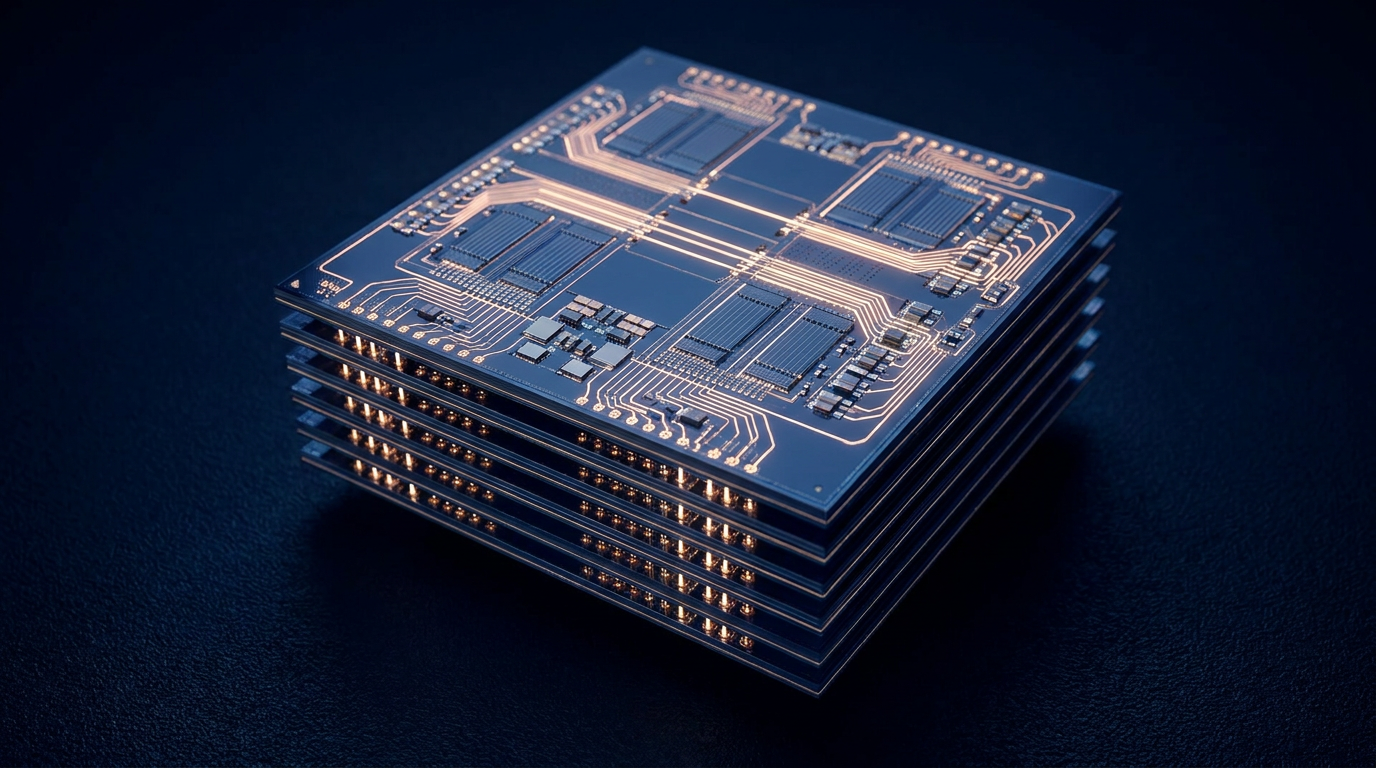
A common industry analogy compares the GPU to a world-class chef who can cook 10,000 dishes a minute. If that chef only has one helper fetching ingredients from the pantry, the kitchen slows to the helper's pace. High Bandwidth Memory (HBM) solves this by stacking memory chips vertically and widening the data highway, effectively giving the chef 50 helpers working simultaneously. By utilizing advanced packaging techniques to stack silicon dies on top of one another and connecting them with microscopic vertical wires called through-silicon vias (TSVs), HBM delivers up to twelve times the bandwidth of conventional memory. The cooking speed finally matches the cooking capacity, allowing the AI data center to operate at maximum efficiency.[4]
This architectural shift has completely rewired the economics of the memory industry. Historically, Dynamic Random Access Memory (DRAM) was a standardized product. A gigabyte of memory from Samsung was virtually identical to a gigabyte from Micron, meaning companies competed primarily on price and manufacturing scale. HBM, however, is a highly customized, complex product that requires deep co-engineering with GPU designers like Nvidia. Because HBM must be physically bonded to the processor on the same silicon interposer, memory makers are no longer just selling standalone components; they are delivering integrated subsystems. This tight integration creates high switching costs and deep strategic partnerships, fundamentally altering the traditional buyer-supplier dynamic.[4][6]
Because of this complexity, HBM commands massive price premiums and generates gross margins that were previously unthinkable for memory manufacturers. In its recent earnings, Micron reported gross margins touching nearly 75%, while its overall revenue jumped threefold compared to the previous year. SK Hynix similarly reported that its operating profits are being driven almost entirely by its HBM division. These are not the financial profiles of commodity hardware vendors. They look more like the margins of elite software companies. For an industry that spent the last three decades fighting brutal price wars over pennies, the sudden influx of high-margin, custom-ordered AI memory has completely transformed corporate balance sheets and funded massive new research and development initiatives.[1][4]
The sheer scale of the spending shift is staggering. Memory components now account for approximately 30% of the total hardware expenditure by hyperscalers like Google, Microsoft, and Amazon. Goldman Sachs projects that HBM demand specifically for custom AI chips will grow by 82% in the coming years, making it one of the fastest-growing sub-sectors in the entire global economy. As cloud providers race to build out their AI infrastructure, the capital flowing into memory has reached unprecedented levels. Some analysts forecast that the total market size for HBM alone could surpass the entire traditional DRAM market by the end of the decade, cementing memory's status as the foundational bedrock of the artificial intelligence revolution.[4][7]
Memory components now account for approximately 30% of the total hardware expenditure by hyperscalers like Google, Microsoft, and Amazon.
Currently, the HBM market is an oligopoly controlled by three players. According to Counterpoint Research data from early 2026, South Korea's SK Hynix holds a dominant 58% market share, largely due to its early lock-in as the primary supplier for Nvidia's flagship AI accelerators. Samsung and the U.S.-based Micron trail with roughly 21% each. This concentration of power means that the entire global AI supply chain is highly dependent on the execution capabilities of just three corporations. While new entrants from China are attempting to break into the broader memory market, the extreme technical difficulty of manufacturing and packaging HBM creates a formidable moat that protects the incumbents from low-cost competition.[2]

All three companies have announced that their HBM production capacity is entirely sold out through the end of 2026, and executives have warned investors that AI-driven memory shortages will likely persist through at least 2027. This guaranteed revenue pipeline is what makes the current stock valuations so perplexing to retail investors. If the companies are sold out of a high-margin product for the next two years, why are their Price-to-Earnings (P/E) ratios hovering at levels that suggest an impending crash? In a normal market, a company with guaranteed, high-margin revenue locked in for years would trade at a massive premium. Yet, the market is pricing these memory giants as if their current earnings are a temporary anomaly that will inevitably revert to the mean.[1][4]
The answer lies in the massive capital expenditures required to build the next generation of memory chips. To meet the insatiable demand from AI data centers, memory makers are pouring tens of billions of dollars into new fabrication plants. Micron alone is slated to spend over $25 billion in its 2026 fiscal year. Building a modern semiconductor fab is one of the most expensive and complex engineering projects on Earth. These facilities require specialized extreme ultraviolet (EUV) lithography machines, pristine cleanrooms, and years of construction time. The sheer scale of this investment terrifies some analysts, who worry that the industry is collectively building more capacity than the market can ultimately absorb.[7]
Veteran semiconductor investors have seen this movie before. The memory industry has a long history of overestimating long-term demand during boom times. Companies race to build new factories, and when those facilities finally come online years later, they flood the market with supply just as demand begins to cool. The resulting supply glut historically causes memory prices to collapse, taking profit margins and stock prices down with them. This boom-and-bust cycle has played out repeatedly over the last forty years, driven by the rise of personal computers, the internet boom, smartphones, and cryptocurrency mining. Each time, the industry convinced itself that a 'new paradigm' had arrived, only to suffer brutal price corrections when the music eventually stopped.[5]
"In the long run, it's a pretty dreadful industry," noted William de Gale, a portfolio manager at BlueBox Asset Management, highlighting the sector's tendency to swing violently between shortages and oversupply. Bears argue that the current AI wave is just a larger version of past cycles. When the new fabs open in 2027 and 2028, they warn, the pricing power of HBM will evaporate. These skeptics point out that while AI is undoubtedly a massive technological shift, the underlying economics of semiconductor manufacturing remain unchanged. If all three major players successfully execute their aggressive expansion plans, the resulting wave of new supply could quickly turn today's severe shortages into tomorrow's crippling inventory gluts.[5]
Bulls counter that HBM is fundamentally different. Because it is custom-packaged alongside the processor, it cannot be easily overproduced and dumped on the open market like traditional DRAM. Furthermore, the technical difficulty of manufacturing HBM—particularly the advanced packaging required to stack 12 or 16 layers of silicon—creates a natural ceiling on how fast supply can actually grow. Yield rates—the percentage of chips that function perfectly off the manufacturing line—remain a closely guarded challenge for all three manufacturers. Stacking microscopic silicon layers without introducing defects is incredibly difficult, meaning that even with massive new factories, the actual output of usable HBM chips may remain constrained for years to come.[4][6]

The technological race is already moving to the next generation. SK Hynix recently announced the shipment of 12-layer HBM4E samples, boasting 20% higher data processing efficiency and improved thermal management. This next-generation memory is expected to be adopted in Nvidia's upcoming Rubin Ultra platform, slated for launch in 2027. Passing these early customer testing phases is critical, as it secures a head start in subsequent customization and locks in long-term orders. The rapid pace of updates—moving from HBM3 to HBM3E, and now to HBM4 and HBM4E in just a few years—forces manufacturers to constantly innovate just to maintain their current market position.[8]
For Samsung and Micron, the transition to HBM4 represents a critical window to claw back market share from SK Hynix. Samsung, as the first supplier of HBM4 to Nvidia, is expected to gradually increase its footprint, while Micron is leveraging its strong position in the U.S. market to secure long-term contracts with domestic cloud providers. This three-way battle for dominance ensures that the pace of innovation will not slow down. However, it also raises the stakes for execution; any misstep in yield rates or delivery timelines could result in billions of dollars in lost revenue and a permanent demotion in the AI hardware hierarchy.[2][8]
Ultimately, the cheap valuation of memory stocks is a real-time pricing of uncertainty. The market is demanding proof that the AI supercycle has permanently altered the economics of the memory business. If HBM truly represents a structural shift toward custom, high-margin silicon, the current stock prices may indeed be a historic bargain. Investors are essentially being asked to underwrite a paradigm shift. If the bulls are right, memory has graduated from a cyclical commodity to a foundational, high-margin pillar of the modern economy, and the companies producing it will enjoy years of sustained, highly profitable growth.[1][3]
But if the laws of semiconductor gravity still apply, the billions currently being spent on new fabrication plants will eventually lead to the same oversupply that has defined the industry for decades. Until that question is answered, memory stocks will remain the most hotly debated, and heavily scrutinized, foundational layer of the artificial intelligence economy. For now, the memory wall remains the defining physical constraint on artificial intelligence. As long as the world's most powerful AI models remain hungry for faster data delivery, the companies that build the digital highways will continue to wield unprecedented influence over the future of technology.[5][6]
How we got here
2024
The AI boom triggers unprecedented demand for High Bandwidth Memory (HBM) to pair with Nvidia GPUs.
Early 2025
SK Hynix establishes a dominant market lead as the primary supplier of HBM3E chips.
March 2026
Micron reports a threefold jump in annual revenue, signaling memory's shift to a high-margin asset.
June 2026
SK Hynix begins shipping samples of next-generation 12-layer HBM4E chips.
2027 (Projected)
Massive new fabrication plants from Micron and Samsung are slated to come online.
Viewpoints in depth
Secular Growth Bulls
Argue that AI has fundamentally changed memory from a cyclical commodity to a high-margin, custom strategic asset.
This camp, which includes major investment banks and the chipmakers themselves, points to the customized nature of HBM. Because these chips are co-engineered with GPU designers and cannot be easily swapped, they argue the historical risk of a massive supply glut is overstated. They emphasize that memory now accounts for nearly a third of all data center hardware spending, representing a permanent structural upgrade in the industry's economics.
Cyclical Bears
Warn that massive capital expenditure and historical boom-bust patterns mean a supply glut is inevitable.
Veteran semiconductor investors caution that the industry is repeating its classic mistake: over-extrapolating short-term demand. With companies like Micron spending upwards of $25 billion a year on new fabrication plants, bears argue that when these facilities become fully operational in 2027 and 2028, the market will be flooded with supply. They believe the current low P/E ratios correctly reflect the risk that today's record profit margins will eventually collapse.
Market Share Pragmatists
Focus on the execution race between SK Hynix, Samsung, and Micron for HBM4 dominance.
Rather than debating the macro cycle, this viewpoint focuses on the intense technological race between the big three manufacturers. They note that while SK Hynix currently holds a commanding 58% market share, the transition to next-generation HBM4 and HBM4E chips resets the playing field. For these analysts, the key metric is yield rate—the ability to mass-produce complex, 12-layer stacked chips without defects—which will determine who captures the next wave of Nvidia orders.
What we don't know
- Whether the massive capital expenditures planned for 2026 and 2027 will result in an oversupply of memory chips.
- How quickly competitors like Samsung and Micron can close the technological gap with SK Hynix in the HBM4 generation.
- The exact yield rates (manufacturing success rates) for the newest 12-layer and 16-layer HBM chips, which companies keep strictly confidential.
Key terms
- High Bandwidth Memory (HBM)
- A high-performance RAM interface that stacks memory chips vertically, allowing massive amounts of data to be processed simultaneously.
- The Memory Wall
- A computing bottleneck where the processor's speed outpaces the memory's ability to deliver data, leaving the processor idle.
- DRAM (Dynamic Random Access Memory)
- The standard type of memory used in traditional computers and servers to store data temporarily for quick access.
- Capex (Capital Expenditure)
- The money a company spends to buy, maintain, or improve its fixed assets, such as building new chip fabrication plants.
- P/E Ratio (Price-to-Earnings)
- A valuation metric that measures a company's current share price relative to its per-share earnings.
Frequently asked
What is High Bandwidth Memory (HBM)?
HBM is a specialized type of computer memory that stacks chips vertically to drastically increase the speed at which data moves to the processor.
Why is memory so important for AI?
AI models require moving massive amounts of data millions of times per second. Without fast memory, even the most powerful AI processors sit idle waiting for data—a bottleneck known as the 'Memory Wall.'
Who makes HBM chips?
The market is dominated by three companies: South Korea's SK Hynix and Samsung, and the US-based Micron Technology.
Why are memory stocks considered cyclical?
Historically, memory chips were interchangeable commodities. Companies would overbuild factories during good times, leading to a supply glut and crashing prices a few years later.
Sources
Source coverage
8 outlets
3 viewpoints surfaced








[1]MarketWatchCyclical Bears
Memory stocks are having their best year ever. Why do they still look so cheap?
Read on MarketWatch →[2]Counterpoint ResearchMarket Share Pragmatists
Global DRAM and HBM Market Share: Quarterly
Read on Counterpoint Research →[3]SK Hynix NewsroomSecular Growth Bulls
2026 Market Outlook – Focus on the HBM-Led Memory Supercycle
Read on SK Hynix Newsroom →[4]INDmoneySecular Growth Bulls
AI Memory Chips: The $100B Investment Thesis Behind HBM Stocks
Read on INDmoney →[5]CNBCCyclical Bears
Investors Warn of Boom-Bust Cycle in Memory Stocks Amid AI Frenzy
Read on CNBC →[6]Factlen Editorial TeamMarket Share Pragmatists
Synthesis by Factlen editorial team
Read on Factlen Editorial Team →[7]Goldman SachsSecular Growth Bulls
HBM and the AI Supercycle: 2026 Outlook
Read on Goldman Sachs →[8]TradingKeyMarket Share Pragmatists
SK Hynix Officially Ships 12-Layer HBM4E Samples, Shares Rise Nearly 5% to Hit Record High
Read on TradingKey →

More in finance
See all 6 stories →Intergenerational Wealth
How to Financially Support Adult Children Without Ruining Their Independence
6 sources

Decumulation Strategy
The Evidence for Dynamic Retirement Spending: Why Retirees May Be Able to Spend More
6 sources

SpaceX IPO
SpaceX Options Volume Explodes Following Historic IPO and $60 Billion Cursor Acquisition
7 sources

Assumable Mortgages
The 3% Time Machine: How Homebuyers Are Using Assumable Mortgages to Beat 2026 Rates
6 sources

Every angle. Every day.
Get finance stories with full source coverage and perspective breakdowns delivered to your inbox.