
How Generative AI is Democratizing Game Development for Solo Creators
In 2026, generative AI tools have moved from experimental tech demos to essential production pipelines, allowing small indie studios to build massive, dynamic worlds that once required hundreds of developers.
By Factlen Editorial Team
- Indie Creators
- View AI as a democratizing force that allows small teams to build AAA-scale experiences.
- Traditional Developers
- Express concern over creative homogenization and the devaluation of specialized artistic skills.
- Tool Providers
- Focus on removing technical friction to onboard millions of new creators into the medium.
What's not represented
- · Players and Consumers
- · Voice Actors and Performers
Why this matters
As the technical and financial barriers to game creation collapse, players will gain access to an unprecedented variety of innovative, deeply personal games. For aspiring creators, it means the ability to bring complex interactive worlds to life without needing millions of dollars or a massive studio.
Key points
- Generative AI tools have matured from experimental demos into standard production pipelines for indie game developers in 2026.
- AI coding assistants are reducing the time required for routine C++ and visual scripting by up to 50 percent.
- Dynamic AI character engines are replacing rigid dialogue trees, allowing NPCs to reason, remember, and react in real-time.
- Engine providers like Unity are pushing toward no-code authoring, aiming to let creators prompt entire games into existence.
- Despite the productivity gains, 52 percent of industry professionals express concern over AI's potential to homogenize creative output.
For decades, creating a massive, immersive video game required the GDP of a small island nation. Building a sprawling open world, populating it with believable characters, and writing thousands of lines of branching dialogue demanded armies of programmers, 3D artists, and narrative designers. The barrier to entry was a towering wall that kept countless creative ideas locked in the concept phase.
In 2026, that wall is rapidly dismantling. Generative artificial intelligence has fundamentally shifted the economics and logistics of game development, transforming how interactive entertainment is built. What began a few years ago as experimental tech demos has now matured into robust, production-ready pipelines that sit inside the daily workflows of independent studios.
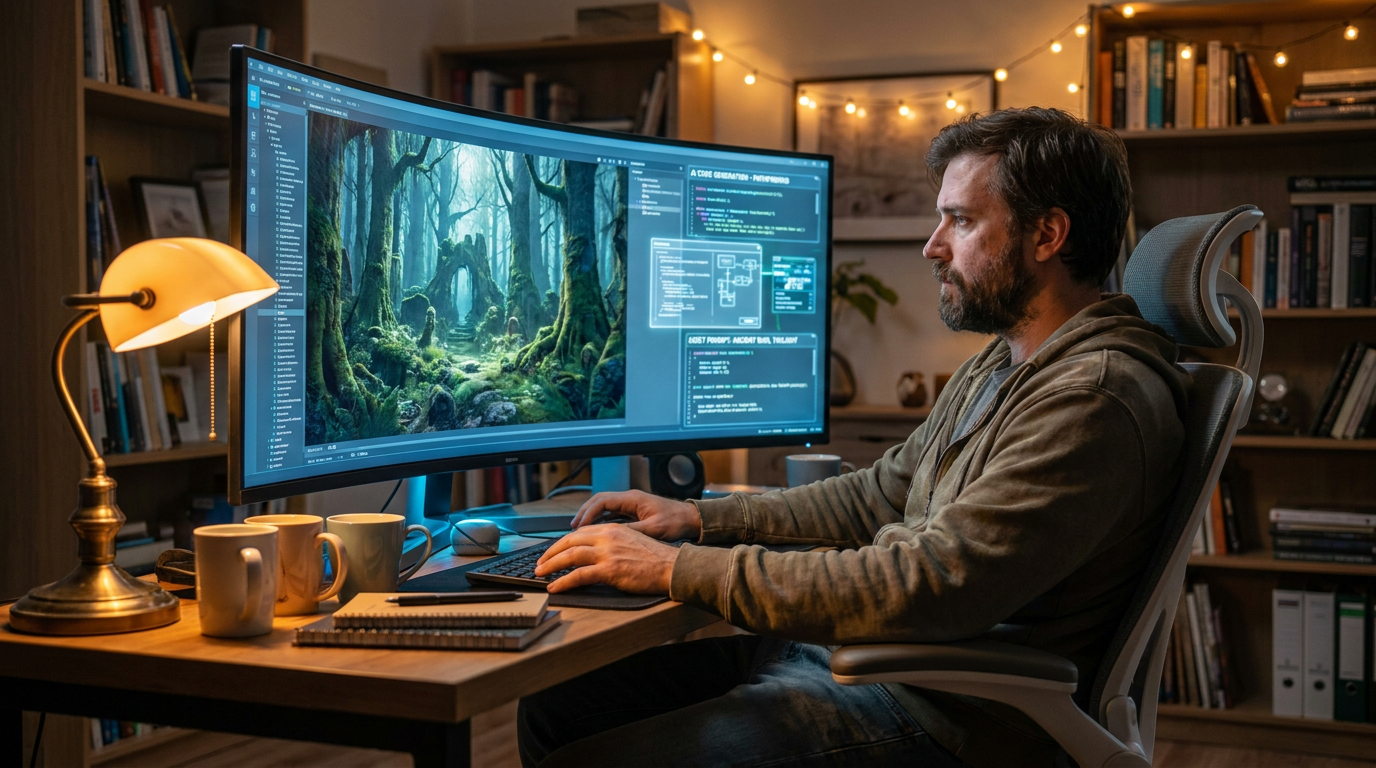
The most immediate impact is being felt in the code itself. AI coding assistants like Cursor and GitHub Copilot are now deeply integrated into game engines like Unreal Engine 5 and Unity. For solo developers and small teams, these tools are cutting the time required for routine C++ programming and visual scripting by roughly 30 to 50 percent.[3]
"The tools we point at every day are no longer toys; they are part of how we ship," notes a recent development log from Althera Games, an independent studio. By offloading the scaffolding—the foundational game logic, user interface wiring, and debugging—developers are freed to focus entirely on creative direction and gameplay feel.[3]

Beyond code, the creation of 3D assets and environments has seen a massive bottleneck removed. Historically, modeling, texturing, and rigging a single character or building could take weeks. Today, platforms like Unity's newly upgraded AI beta allow creators to generate physics-aware props and consistent environmental textures using natural language prompts.[1]
Unity CEO Matthew Bromberg highlighted this shift during the company's early 2026 earnings call, leading up to the Game Developers Conference (GDC). Bromberg announced that Unity's AI assistant aims to "democratize" game development, eventually enabling creators to prompt casual games into existence without writing a single line of code.[1]
The goal, according to engine makers, is to remove friction from the creative process, acting as a universal bridge between a spark of inspiration and a playable digital experience. This frictionless environment is expected to invite tens of millions of new creators into the medium, much like smartphone cameras democratized photography.[1]

This frictionless environment is expected to invite tens of millions of new creators into the medium, much like smartphone cameras democratized photography.
But the AI revolution in gaming extends far beyond the developer's toolkit; it is actively reshaping the player's experience, particularly through Non-Player Characters (NPCs). For decades, NPCs have relied on rigid, handwritten dialogue trees. Once a player exhausted the pre-written options, the character became a lifeless mannequin repeating the same phrase.
In 2026, dynamic NPC intelligence is becoming a major frontier. Companies like Inworld AI have developed character engines that utilize large language models and real-time text-to-speech generation to create characters that reason, remember, and react.[4]
These AI-driven NPCs do not simply pull from a list of scripted responses. They are assigned specific personality traits, goals, and knowledge bases. When a player interacts with them, the NPC generates a contextual response on the fly, remembering past interactions and adjusting its emotional state accordingly.[4]
"Players immediately began mentioning how magical it was talking to our NPCs," reported one studio utilizing Inworld's Realtime TTS-2 engine. This dynamic interaction allows for procedural social ecosystems where characters form opinions of the player and each other, creating a world that feels genuinely alive.[4]

However, integrating live AI models into games presents a unique challenge: the cost of inference. Every time a player speaks to an AI NPC, the game must query a cloud-based language model, incurring a compute cost. If a player spends hours chatting with a companion character, those fractions of a cent quickly add up, creating a negative incentive for developers.
To solve this, the industry is adopting hybrid approaches. Critical story moments and complex reasoning are handled by cloud-based frontier models, while ambient chatter and basic reactions are processed locally on the player's hardware using smaller, optimized models.
Despite the rapid technological advancements, the integration of AI is not without friction. The 2026 GDC State of the Game Industry report revealed a deeply divided workforce. While 36 percent of game industry professionals are actively using generative AI in their daily work, a significant 52 percent expressed concern that AI is negatively impacting the industry.[2]
The strongest opposition comes from visual artists, narrative designers, and programmers who fear that AI-generated content could lead to homogenization. There is a palpable anxiety that relying on algorithms for art and story will strip games of their unique "soul," resulting in a flood of technically competent but creatively bankrupt titles.[2]

Proponents argue the exact opposite. They view AI as a collaborative partner rather than a replacement. By automating the tedious, high-volume tasks that often lead to developer burnout, AI allows human creators to spend their energy on the strategic and emotional decisions that matter most.[5]
Ultimately, the democratization of game development means that the defining factor of a successful game is no longer the size of the studio's budget, but the strength of the creator's vision. As the technical barriers to entry continue to fall, the industry is bracing for an unprecedented explosion of diverse, unpredictable, and deeply personal interactive experiences.[6]
How we got here
2023
Early AI companion chat and experimental NPC tech demos capture industry attention.
2024
AI coding assistants like Copilot begin gaining widespread traction among independent developers.
March 2026
Unity unveils an upgraded AI beta at the Game Developers Conference, aiming for no-code game authoring.
Mid-2026
Generative AI tools transition from experimental toys to standard fixtures in indie production pipelines.
Viewpoints in depth
Solo and Indie Developers
Small teams leveraging AI to compete with massive AAA studios.
For independent creators, generative AI is the ultimate equalizer. By utilizing AI coding assistants and procedural asset generators, solo developers can build expansive, feature-rich games that would have previously required millions of dollars in funding. They view the technology as a liberating force that removes technical bottlenecks, allowing them to focus purely on game design, storytelling, and mechanical innovation.
Traditional Studio Artists and Writers
Industry veterans concerned about job security and creative homogenization.
Many specialized professionals—particularly concept artists, 3D modelers, and narrative designers—view the rapid adoption of AI with deep skepticism. They argue that relying on machine learning models trained on existing art can lead to derivative, homogenized game worlds that lack human intentionality. Furthermore, there are widespread concerns that studio executives will use AI as an excuse to shrink creative teams and depress wages, prioritizing efficiency over artistic integrity.
Engine and Tool Providers
Companies building the infrastructure to make game creation frictionless.
Platforms like Unity, Epic Games, and specialized AI startups view their role as democratizing the medium. Their philosophy is that game development has been gatekept by steep learning curves for too long. By integrating natural language processing and AI-driven authoring directly into game engines, they aim to empower millions of non-coders to bring their interactive ideas to life, expanding the gaming market to unprecedented sizes.
What we don't know
- How the widespread use of AI will impact entry-level jobs for junior programmers and concept artists in the long term.
- Whether players will fully embrace AI-generated dialogue over meticulously handcrafted, human-written narratives.
- How copyright and intellectual property laws will adapt to games built entirely using generative AI assets.
Key terms
- Procedural Content Generation (PCG)
- The algorithmic creation of game data—such as levels, landscapes, or items—rather than manually building them by hand.
- Non-Player Character (NPC)
- Any character in a video game that is not controlled by the player, typically serving as enemies, allies, or background citizens.
- Inference Cost
- The computational expense and financial cost incurred every time an AI model is queried to generate a response or action in real-time.
- Large Language Model (LLM)
- An advanced artificial intelligence system trained on vast amounts of text, capable of understanding and generating human-like language.
Frequently asked
Can AI generate an entire video game from scratch?
While tools are advancing rapidly, AI cannot yet generate a polished, commercial-quality game entirely on its own. It acts as a powerful co-pilot, generating code snippets, 3D assets, and dialogue, but still requires a human developer to assemble, refine, and direct the final product.
How do AI NPCs differ from traditional game characters?
Traditional NPCs rely on pre-written dialogue trees, meaning they can only say what a writer explicitly programmed. AI NPCs use large language models to understand context, remember past interactions, and generate unique, real-time responses based on their assigned personality.
Will AI replace human game developers?
Industry consensus suggests AI will augment rather than replace developers. While it automates tedious tasks like routine coding and basic asset generation, the core creative direction, gameplay balancing, and emotional storytelling still require human intuition and oversight.
Sources
Source coverage
6 outlets
3 viewpoints surfaced






[1]Game DeveloperTool Providers
Unity says its AI tech will soon be able to 'prompt full casual games into existence'
Read on Game Developer →[2]GiantyTraditional Developers
GDC 2026 State of the Game Industry Report: AI in the Pipeline
Read on Gianty →[3]Althera GamesIndie Creators
AI Game Development in 2026: A Practical Toolkit for Indie Studios
Read on Althera Games →[4]Inworld AITool Providers
The Future of Gaming: Inworld AI's AI-Driven NPCs and Immersive Experiences
Read on Inworld AI →[5]Lorien GlobalTool Providers
How AI is Reshaping Game Development Roles in 2026
Read on Lorien Global →[6]Factlen Editorial TeamTool Providers
Synthesis by Factlen editorial team
Read on Factlen Editorial Team →
Every angle. Every day.
Get gaming esports stories with full source coverage and perspective breakdowns delivered to your inbox.