
Is the OCC and FDIC's CRA 'Modernization' a Stealth Deregulation That Will Starve Community Lending?
A new proposal by federal banking regulators aims to update the Community Reinvestment Act for the digital age by raising asset thresholds. While the industry welcomes the reduced compliance burden, advocates warn it could exempt hundreds of banks from critical community development requirements.
By Rohan Kapoor


- Community Reinvestment Advocates
- Argue the changes dilute accountability and will starve marginalized areas of capital.
- Banking Industry Advocates
- Believe modernized thresholds reduce paperwork and enable more actual lending.
- Regulatory Pragmatists
- View the proposal as a necessary compromise to update obsolete rules and survive court challenges.
How we got here
1977
The Community Reinvestment Act is enacted to combat redlining and encourage local lending.
1995
Federal banking agencies significantly revise CRA regulations to focus on performance rather than process.
October 2023
The OCC, FDIC, and Federal Reserve issue a joint final rule to comprehensively modernize the CRA.
March 2024
A federal court issues a preliminary injunction against the 2023 rules following an industry lawsuit.
July 2026
The OCC and FDIC propose new, targeted amendments raising asset thresholds, without the Federal Reserve.
Why it matters
The Community Reinvestment Act dictates how trillions of dollars in bank capital flow into local neighborhoods. Changes to these rules determine whether small businesses get loans, affordable housing gets built, and marginalized communities have equitable access to the financial system.
On July 31, 2026, a regulatory proposal quietly reclassified roughly 800 U.S. banks, shifting them out of the most stringent compliance tier of a landmark 1977 civil rights law. The Office of the Comptroller of the Currency (OCC) and the Federal Deposit Insurance Corporation (FDIC) issued a joint Notice of Proposed Rulemaking to amend the Community Reinvestment Act (CRA). This move represents the latest chapter in a nearly decade-long struggle to update the nation's primary mechanism for ensuring equitable access to capital. By fundamentally altering which banks are subject to the most rigorous lending tests, the proposal has reignited a fierce debate over the balance between regulatory efficiency and community protection.[1]
The Community Reinvestment Act was originally enacted to combat the insidious practice of redlining—the discriminatory system where banks systematically refused to lend in low- and moderate-income (LMI) neighborhoods while continuing to take deposits from the residents who lived there. For nearly fifty years, the law has served as a cornerstone of financial civil rights, mandating that federally insured banks affirmatively meet the credit needs of the exact communities in which they operate. Regulators enforce this by evaluating a bank's lending, investment, and service records within its designated geographic assessment areas.[5]
However, the definition of a 'community' has fundamentally fractured in the twenty-first century. The original 1977 legislative framework assumed that banks served their customers through physical, brick-and-mortar branches. Today, the rapid proliferation of digital banking allows financial institutions to hold billions of dollars in deposits from customers scattered across the country without operating a single local storefront. This structural evolution has rendered the geographic assessment areas of the past increasingly obsolete, creating a glaring mismatch between how banks operate and how they are regulated.[1][6]
This technological shift has triggered a prolonged regulatory identity crisis. How do federal agencies measure local lending when the very concept of 'local' no longer applies to modern banking models? Previous attempts to modernize the CRA rules in 2020 and 2023 ended in administrative rescissions and federal court injunctions, leaving the banking sector trapped in a state of perpetual uncertainty. Regulators have repeatedly found themselves caught between industry demands for modernization and advocacy groups' insistence on stringent oversight.[1]
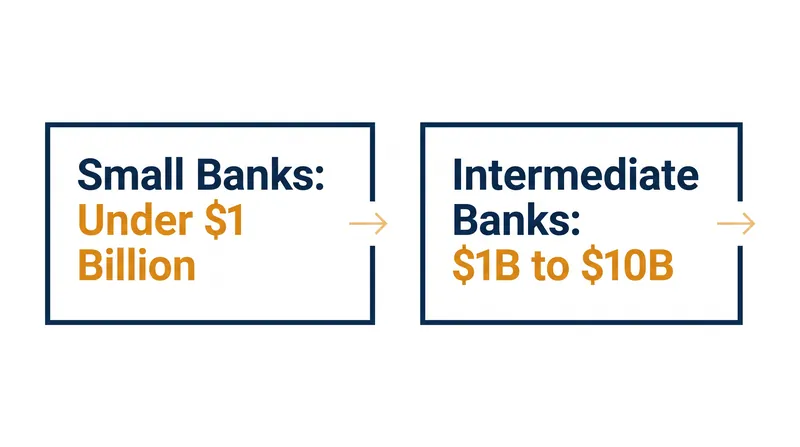
The July 2026 proposal attempts to cut this regulatory Gordian knot by radically adjusting the asset thresholds that determine how heavily a bank is scrutinized. Under the newly proposed framework, banks holding less than $1 billion in assets would be treated as 'small banks.' This represents a massive increase from the previous $412 million threshold, effectively reclassifying hundreds of community banks into a tier with significantly lighter compliance and reporting obligations. This shift acknowledges the reality of inflation and industry consolidation, aiming to calibrate oversight to the actual systemic footprint of smaller institutions.[2]
Furthermore, the proposal dictates that banks with between $1 billion and $10 billion in assets would be classified as 'intermediate,' a dramatic jump from the prior $1.65 billion ceiling. As a result of these sweeping reclassifications, only institutions holding more than $10 billion in assets—amounting to roughly 86 banks, or a mere 3% of all financial institutions—would remain subject to the full, rigorous large-bank CRA examination. The vast majority of the industry would operate under streamlined evaluation criteria.[2][3]
For the banking industry, this reclassification is viewed as a long-overdue and necessary correction. The Consumer Bankers Association and other industry advocates argue that the new thresholds will establish a durable, objective regulatory regime that reduces crushing compliance burdens on smaller community banks. They contend that the previous framework forced mid-sized institutions to dedicate disproportionate resources to administrative overhead rather than community service. By aligning the asset thresholds with the modern economic reality, industry leaders believe the OCC and FDIC are finally providing the clarity required for banks to operate efficiently without the constant threat of technical compliance failures.[4]
For the banking industry, this reclassification is viewed as a long-overdue and necessary correction.
Industry advocates maintain that by freeing community and mid-sized banks from the complex, data-heavy reporting requirements of the large-bank test, these institutions can redirect their capital and human resources toward what they actually do best. Instead of employing teams of compliance officers to manage regulatory paperwork, banks can focus on providing direct loans, financing local small businesses, and supporting affordable housing initiatives. From this perspective, reducing the regulatory burden does not mean reducing community investment; it means removing the friction that slows that investment down.[4][6]
However, community development advocates view the threshold adjustments through a vastly different lens, characterizing the proposal as a stealth deregulation that threatens the financial lifeblood of vulnerable neighborhoods. The National Community Reinvestment Coalition (NCRC) warns that the proposal effectively eliminates separate community development tests for hundreds of banks. By combining lending, investment, and service evaluations into a single streamlined test for intermediate banks, advocates argue the distinct incentive to provide complex community development financing is entirely erased.[2]
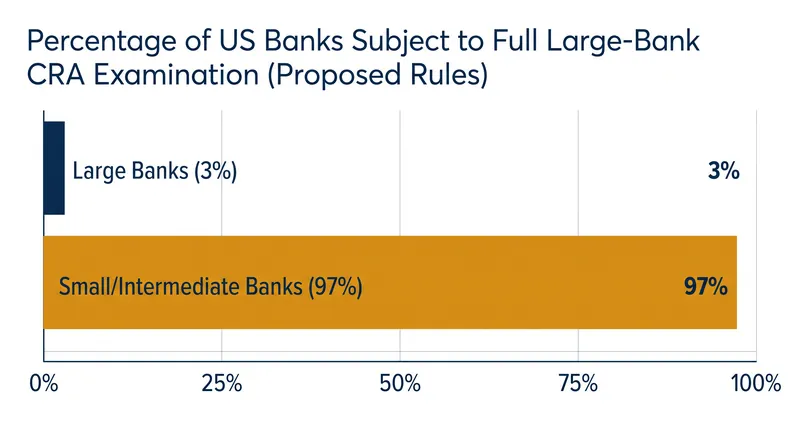
Under the proposed rules, banks reclassified from 'large' to 'intermediate' would no longer face distinct, granular scrutiny for their community development investments and branch services. The NCRC estimates this regulatory shift could result in the loss of over half a billion dollars per year in community development loans and investments. For neighborhoods that rely on these specific CRA-motivated grants to fund affordable housing projects and local nonprofits, the dilution of the testing criteria represents a catastrophic loss of guaranteed capital.[2]
Furthermore, the new rules would exempt banks under the $10 billion threshold from collecting and reporting specific CRA data on small business and small farm loans. Critics argue this severe reduction in transparency will hide critical lending gaps and make it significantly harder for regulators and the public to hold mid-sized banks accountable for discriminatory practices. Without mandatory data collection, advocates fear a return to the invisible redlining practices that the CRA was originally designed to eliminate.[2][6]
The debate over the 2026 proposal is further complicated by a glaring administrative absence: the Federal Reserve Board. While the OCC and FDIC jointly issued the July rulemaking, the Federal Reserve conspicuously did not join them. Instead, the central bank opted to continue applying the older 1995 regulations to the specific state-chartered banks it supervises, signaling a deep philosophical divide among the nation's top financial regulators. This lack of interagency consensus highlights the intense political and economic friction surrounding CRA modernization, suggesting that a unified national standard remains entirely out of reach.[1]

This regulatory fracture means that a bank's CRA obligations now depend heavily on its primary federal regulator, creating an uneven and highly fragmented playing field. A state-chartered bank supervised by the Federal Reserve faces a completely different compliance reality than a national bank supervised by the OCC, even if they operate in the exact same geographic market and hold the exact same amount of assets. This arbitrage opportunity undermines the core premise of a universal community reinvestment standard.[1][6]
Ultimately, the CRA modernization debate represents a high-stakes collision between necessary technological adaptation and the preservation of hard-won civil rights safeguards. While no serious party disputes that the 1977 branch-based framework is obsolete in the era of smartphone banking, the consensus on how to replace it remains entirely elusive. Regulators are trapped in a zero-sum game where any attempt to streamline compliance for the industry is immediately interpreted as an abandonment of marginalized communities.[5][6]
As the public comment period opens for the OCC and FDIC proposal, the banking sector and community advocates are preparing for yet another protracted administrative battle. Whether the 2026 proposal successfully establishes a durable new standard or becomes just another casualty in the ongoing, decade-long CRA modernization saga will depend entirely on how regulators balance the undeniable demand for operational efficiency with the statutory mandate for economic equity.[6]
What to know
- The OCC and FDIC proposed raising CRA asset thresholds, reclassifying roughly 800 banks.
- Banks under $10 billion would no longer face the most stringent large-bank compliance tests.
- Industry groups argue the changes will reduce crushing regulatory burdens on community banks.
- Advocates warn the proposal will reduce transparency and cut billions in community development funding.
- The Federal Reserve did not join the proposal, creating a fractured regulatory landscape.
Where opinion splits
Banking Industry Advocates
Argue that updated thresholds reduce compliance burdens and allow community banks to focus on lending.
Industry groups like the Consumer Bankers Association contend that the CRA's original intent has been buried under layers of outdated, branch-centric compliance paperwork. They argue that raising the asset thresholds acknowledges the reality of inflation and bank consolidation over the past two decades. By exempting banks under $10 billion from the most exhaustive reporting requirements, these institutions can redirect capital from compliance departments directly into local loans and affordable housing initiatives.
Community Reinvestment Advocates
Warn that raising asset thresholds is a deregulatory move that will reduce investments in vulnerable neighborhoods.
Organizations such as the National Community Reinvestment Coalition view the threshold increases as a direct threat to low- and moderate-income communities. They argue that removing the distinct community development test for banks between $1.65 billion and $10 billion removes the primary incentive for these institutions to invest in local grants and services. Without mandatory reporting on small business and farm loans for these mid-sized banks, advocates fear a return to the invisible redlining practices the CRA was designed to eliminate.
Regulatory Pragmatists
Focus on the necessity of updating the rules for digital banking while navigating legal constraints.
From a structural perspective, regulators are attempting to solve an almost impossible puzzle: enforcing a geographically based law on a borderless digital banking system. Following the federal court injunction against the comprehensive 2023 rules, the OCC and FDIC's 2026 proposal represents a pragmatic, if controversial, retreat. By focusing on targeted threshold adjustments rather than a complete philosophical overhaul, they are attempting to create a framework that can actually survive judicial scrutiny, even if it means moving forward without the Federal Reserve.
Key terms
- Community Reinvestment Act (CRA)
- A 1977 federal law designed to encourage commercial banks and savings associations to help meet the needs of borrowers in all segments of their communities.
- Redlining
- The discriminatory practice of denying financial services to residents of certain areas based on their race or ethnicity.
- Assessment Area
- The geographic area where a bank has its main office, branches, and deposit-taking ATMs, used by regulators to evaluate CRA performance.
- Notice of Proposed Rulemaking (NPRM)
- A public notice issued by law when an independent agency of the US government wishes to add, remove, or change a rule or regulation.
Unanswered questions
- Whether the Federal Reserve will eventually align with the OCC and FDIC or maintain a separate framework.
- How the proposed reduction in data reporting will specifically impact lending rates in rural and LMI communities.
- If the new proposal will face the same legal challenges that halted the 2023 modernization effort.
Reader questions
Why are the CRA rules being updated?
The original rules were designed for a banking system based on physical branches. Regulators are trying to update the framework to account for the rise of digital and interstate banking.
How does the new proposal change bank classifications?
It raises the asset threshold for 'small banks' to $1 billion and 'intermediate banks' to $10 billion, meaning fewer banks will face the most rigorous compliance tests.
Why is the Federal Reserve not part of this proposal?
The Federal Reserve opted not to join the OCC and FDIC in this specific 2026 proposal, choosing instead to continue applying the older 1995 regulations to the state-chartered banks it supervises.
Sources
Source coverage
6 outlets
3 viewpoints surfaced






[1]Consumer Finance MonitorRegulatory Pragmatists
OCC and FDIC Propose Targeted Amendments to CRA Regulations
Read on Consumer Finance Monitor →[2]National Community Reinvestment CoalitionCommunity Reinvestment Advocates
Proposed CRA Rule Weakens Bank Obligations to LMI Communities
Read on National Community Reinvestment Coalition →[3]AP NewsCommunity Reinvestment Advocates
Bank regulators propose new CRA rules, drawing criticism
Read on AP News →[4]Consumer Bankers AssociationBanking Industry Advocates
CBA Statement On Joint CRA Proposal
Read on Consumer Bankers Association →[5]Brookings InstitutionRegulatory Pragmatists
The Community Reinvestment Act: Effectiveness and Regulatory Debates
Read on Brookings Institution →[6]Factlen Editorial TeamRegulatory Pragmatists
Synthesis by Factlen editorial team
Read on Factlen Editorial Team →
Comments

Every angle. Every day.
Get opinion stories with full source coverage and perspective breakdowns delivered to your inbox.