
China Launches 29-Nation World AI Cooperation Organization, Formalizing New Global Governance Bloc
Twenty-nine countries have signed an agreement in Shanghai to establish the World Artificial Intelligence Cooperation Organization (WAICO). The China-led intergovernmental body aims to shape global AI governance and provide open-source AI infrastructure to the Global South, presenting a direct alternative to Western regulatory frameworks.
By Wei Zhang
- Western Analysts & Observers
- Commentators and policymakers concerned about the splintering of global AI standards and the geopolitical implications of a China-led bloc.
- Global South Advocates
- Developing nations and researchers prioritizing affordable AI access, open-source capacity building, and technological sovereignty.
- Independent Synthesis
- Evaluates the structural shift in global governance and the commercial reality of open-weight AI commoditization.
How we got here
July 2025
Chinese Premier Li Qiang first proposes the creation of a world artificial intelligence cooperation organization.
October 2025
President Xi Jinping reiterates the proposal at the APEC summit, recommending Shanghai as the headquarters.
July 16, 2026
Representatives from 29 countries sign the formal agreement establishing WAICO in Shanghai.
July 17, 2026
President Xi Jinping delivers a keynote at the World AI Conference, pledging 5,000 AI training opportunities for developing nations.
Why it matters
The establishment of WAICO marks the first formal institutional split in global AI governance. For developers, businesses, and policymakers, it signals a future where AI standards, data localization rules, and model safety protocols may diverge sharply between Western frameworks and a new Global South coalition.
The United States and the European Union have spent the last two years racing to write the definitive rulebook for artificial intelligence, assuming the rest of the world would eventually adopt their standards. But on July 16, 2026, a different reality materialized in Shanghai.[2][6]
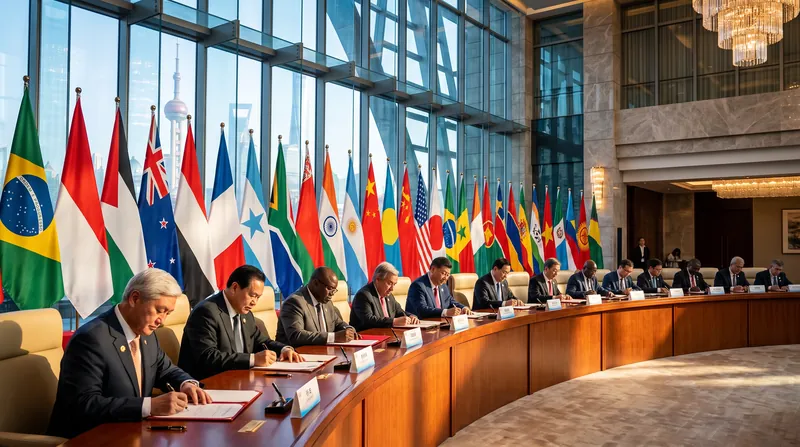
Twenty-nine countries signed an agreement to establish the World Artificial Intelligence Cooperation Organization (WAICO), an independent intergovernmental body headquartered in China. The founding members include Russia, Brazil, Pakistan, Indonesia, and two dozen other nations across Africa, Asia, and Latin America. Major Western AI powers were notably absent.[1][2][3]
This is not merely a diplomatic photo opportunity; it is the formalization of a parallel track for global AI governance. WAICO represents a concerted effort to build an alternative to Western frameworks like the EU's AI Act and the G7's Hiroshima Process, focusing instead on the needs and technological sovereignty of the Global South.[2][4][5][6]
To understand WAICO, one must look past the broad marketing language of "shared benefits" and "win-win cooperation" to see the actual capabilities being offered. China is not just exporting rules; it is exporting the underlying infrastructure.[5][6]
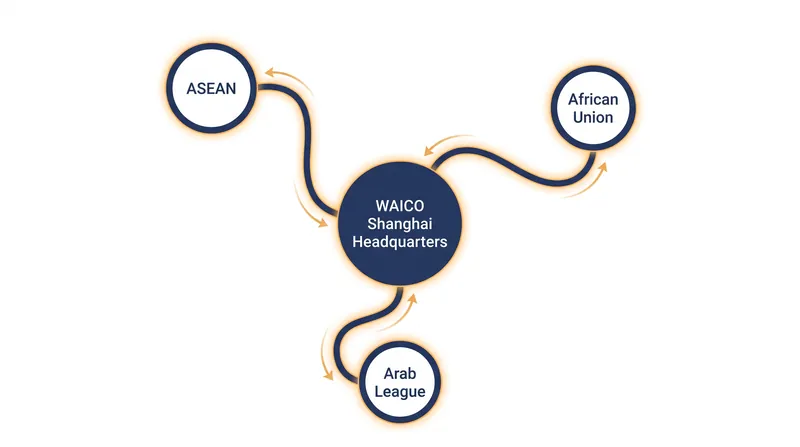
At the core of this strategy is a pivot toward open-source—or more accurately, open-weight—AI models. While American frontier labs have largely built proprietary, closed platforms that lock users into paid ecosystems, Chinese developers like DeepSeek, Alibaba, and Moonshot AI have released highly capable models with open weights.[3][5]
This means anyone can download, fine-tune, and deploy these systems locally. For developing nations where cost and access are critical barriers, the appeal is immediate. Chinese open-weight models have already seen adoption rates surge, capturing significant usage even among Western companies due to their lower inference costs.[3][5]
By making open-weight systems the global default, Beijing aims to commoditize the model layer of the AI stack. If frontier-level AI is freely available, the pricing power of closed Western models erodes. WAICO serves as the institutional vehicle to standardize and distribute this open-source approach across its 29 member states.[4][5][6]
By making open-weight systems the global default, Beijing aims to commoditize the model layer of the AI stack.
However, it is crucial to distinguish between what has actually shipped and what is merely announced. The Shanghai agreement establishes WAICO's legal personality and its headquarters, but the organization's specific funding mechanisms, binding regulations, and operational bureaucracy remain largely undefined.[1][4][6]
What has shipped are concrete capacity-building commitments. During the 2026 World Artificial Intelligence Conference, Chinese President Xi Jinping pledged 5,000 AI training opportunities for developing countries over the next five years. China also announced the creation of international AI application cooperation centers with the African Union, the Arab League, and ASEAN.[2][3]
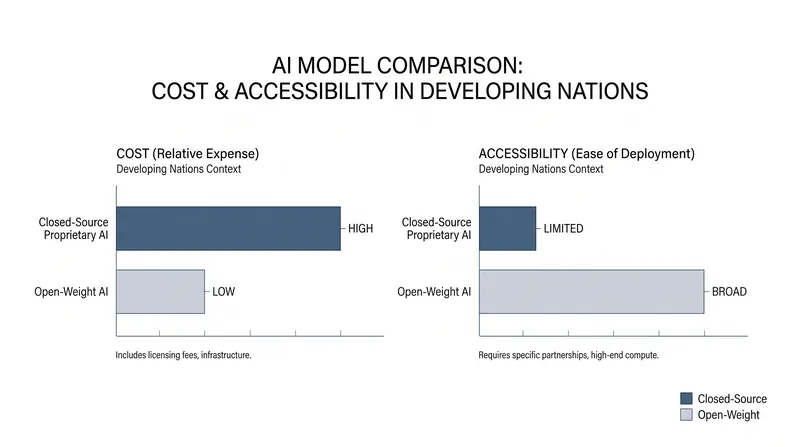
These initiatives address a genuine anxiety in the Global South: the fear of an "AI divide." Many developing nations worry they will be relegated to mere consumers of AI technologies, entirely dependent on a handful of Silicon Valley monopolies. WAICO's charter explicitly emphasizes state sovereignty, capacity transfer, and the reduction of technological inequality.[3][4]
Yet, this alternative governance model comes with its own trade-offs. The rhetoric of "cyber sovereignty" championed by WAICO aligns with a model of digital governance that prioritizes state control over information. For multinational corporations, the emergence of a "Chinese track" for AI governance presents a complex compliance landscape.[1][5]
Companies operating globally may soon face diverging standards for model safety, data governance, and algorithmic transparency. Just as data localization laws fractured the global internet, WAICO's rise could lead to a splintered AI ecosystem where hardware and software stacks are segregated by geopolitical alignment.[1][5][6]

The presence of United Nations Secretary-General António Guterres at the signing ceremony underscored the high stakes of this institutional shift. While WAICO claims to uphold the purposes of the UN Charter, its creation outside the formal UN system signals a frustration with existing multilateral channels.[2][3][6]
Ultimately, WAICO is an emerging institution in a rapidly shifting regime complex. It proves that competitiveness in artificial intelligence is no longer just about who has the fastest chips or the largest parameter counts. It is about who can build a self-reinforcing ecosystem of technological innovation, industrial deployment, and international governance.[4][5][6]
What to know
- 29 countries signed an agreement in Shanghai to establish the World Artificial Intelligence Cooperation Organization (WAICO).
- The China-led intergovernmental body aims to shape global AI governance outside Western frameworks.
- WAICO emphasizes state sovereignty, capacity building, and the distribution of open-weight AI models to the Global South.
- China pledged 5,000 AI training opportunities and the creation of international AI cooperation centers.
- The organization's launch signals a potential splintering of global AI standards and compliance requirements.
Where opinion splits
Global South Member States
Developing nations seeking technological sovereignty and affordable AI access.
For the 29 founding members, WAICO represents an escape hatch from the looming "AI divide." These nations argue that Western regulatory frameworks, such as the EU AI Act, are designed by and for wealthy economies, imposing compliance costs that stifle local innovation. By aligning with WAICO, they gain access to open-weight models, computing infrastructure, and training programs that allow them to build domestic AI capabilities rather than merely renting access from foreign tech monopolies.
Western Policymakers & Regulators
US and European officials concerned about the fracturing of global safety standards.
Western regulators view WAICO with deep skepticism, seeing it as a vehicle to legitimize authoritarian tech stacks and state control over information under the guise of "cyber sovereignty." They argue that the proliferation of open-weight frontier models without stringent, universally agreed-upon safety guardrails poses severe proliferation risks. Furthermore, they warn that a parallel governance track undermines ongoing multilateral efforts at the UN and the G7 to establish a unified, rights-based framework for artificial intelligence.
Multinational Tech Enterprises
Global companies navigating a newly splintered regulatory landscape.
For the private sector, the formalization of WAICO signals the end of a unified global market for AI deployment. Enterprise leaders anticipate a future where they must engineer separate AI stacks to comply with Western transparency mandates on one side, and WAICO's data localization and cyber sovereignty rules on the other. This regulatory divergence threatens to increase compliance costs and complicate cross-border data flows, echoing the fragmentation previously seen in global telecommunications and internet governance.
Key terms
- Open-weight model
- An artificial intelligence model whose pre-trained parameters are publicly released, allowing developers to run and modify the system locally.
- Cyber sovereignty
- The concept that a state has the right to govern its own network space and digital infrastructure without external interference.
- AI divide
- The growing technological and economic gap between nations that develop advanced artificial intelligence and those that only consume it.
- Foundation model
- A large-scale AI model trained on a vast quantity of data that can be adapted to a wide range of downstream tasks.
Unanswered questions
- How WAICO will enforce its governance standards or fund its long-term operations across 29 member states.
- Whether major Western multinational corporations will be forced to build separate AI stacks to operate in WAICO jurisdictions.
- How the organization will handle the inherent tension between open-source AI proliferation and state-level information control.
Reader questions
What is WAICO?
The World Artificial Intelligence Cooperation Organization (WAICO) is a new intergovernmental body headquartered in Shanghai, founded by 29 countries to promote international cooperation and establish alternative global AI governance standards.
Which countries are founding members?
The 29 founding members include China, Russia, Brazil, Indonesia, Pakistan, Kazakhstan, and various other nations across Asia, Africa, and Latin America. Major Western nations are not members.
How does WAICO differ from Western AI regulations?
While Western frameworks like the EU AI Act focus heavily on risk mitigation, safety guardrails, and rights-based principles, WAICO emphasizes state sovereignty, open-source technology transfer, and bridging the AI divide for developing nations.
What is an "open-weight" AI model?
An open-weight model is an AI system where the core parameters (the "weights" learned during training) are made publicly available, allowing anyone to download, modify, and run the model locally without paying a central provider.
Sources
Source coverage
6 outlets
3 viewpoints surfaced






[1]ForbesWestern Analysts & Observers
A new World Artificial Intelligence Cooperation Organization (WAICO) has been suddenly announced in Shanghai
Read on Forbes →[2]TNWWestern Analysts & Observers
World AI Cooperation Organization founded in Shanghai
Read on TNW →[3]WikipediaGlobal South Advocates
World Artificial Intelligence Cooperation Organization
Read on Wikipedia →[4]arXivGlobal South Advocates
World Artificial Intelligence Cooperation Organization (WAICO): Mapping an Emerging Institution in the Global AI Governance Regime Complex
Read on arXiv →[5]CEIASWestern Analysts & Observers
CEIAS Considers: China's World AI Cooperation Organization and the future of AI governance
Read on CEIAS →[6]Factlen Editorial TeamIndependent Synthesis
Synthesis by Factlen editorial team
Read on Factlen Editorial Team →
Comments
Every angle. Every day.
Get meta stories with full source coverage and perspective breakdowns delivered to your inbox.