
AFC Champions League Elite Kicks Off Preliminary Stage After Landmark Expansion to 32 Teams
The 2026-27 AFC Champions League Elite begins its high-stakes preliminary knockout round, introducing an expanded 32-team format that reshapes the financial and competitive landscape of Asian club football.
By Ryder James


- Emerging Football Markets
- Clubs and federations from developing Asian leagues who view the expanded 32-team format as a vital bridge to top-tier financial growth and global exposure.
- Established Powerhouses
- Heavyweight clubs from top-ranked nations who see the ruthless one-off knockouts as a necessary filter to maintain the tournament's elite standard.
- The Asian Football Confederation
- The continental governing body, which argues the new format perfectly balances inclusivity with high-stakes commercial appeal.
At a glance
- The 2026-27 AFC Champions League Elite expands from 24 to 32 teams, split evenly between the East and West regions.
- Four winner-takes-all preliminary matches on August 11 determine the final entrants to the lucrative league stage.
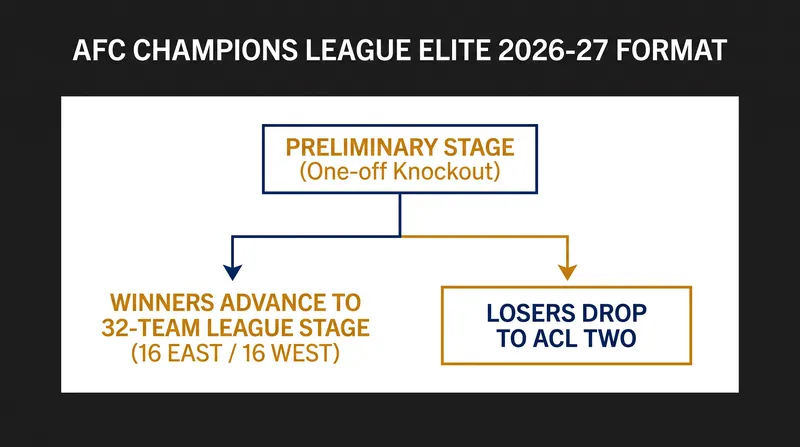
- Clubs that lose their preliminary knockout match will immediately drop into the second-tier AFC Champions League Two.
- The expansion aims to boost inclusivity for emerging markets while maintaining a ruthless qualification standard.
Why it matters now
The winner-takes-all preliminary stage determines which clubs access the lucrative top-tier league phase and which drop to the second-tier ACL Two, directly impacting club revenues, global exposure, and national coefficient rankings across Asia.
Casual fans often assume the preliminary rounds of continental tournaments are just a formality—a preseason tune-up where the big clubs stretch their legs against overmatched opponents before the real tournament begins. The reality? In the newly expanded AFC Champions League Elite, these one-off knockout matches are the most financially consequential 90 minutes of the entire season. There is no second leg to overturn a deficit, no safety net for a poor performance, and absolutely no margin for error. When the 2026-27 campaign kicks off on August 11, the clubs stepping onto the pitch are playing for their entire continental identity.[5]
The stakes for these four winner-takes-all ties spread across Asia could not be higher. The victors immediately punch their tickets to the brand-new 32-team league phase, securing a guaranteed slate of high-profile fixtures. The losers suffer an immediate, precipitous drop into the second-tier AFC Champions League Two. The gap in prestige, broadcast revenue, and global sporting profile between those two outcomes is staggering, turning these August fixtures into high-wire acts where a single defensive lapse dictates a club's trajectory for the next ten months.[1][5]
This season marks a watershed moment for the Asian Football Confederation. Following the initial 2024-25 restructuring that created the "Elite" moniker, the AFC Competitions Committee pushed through a landmark expansion from 24 to 32 teams for the 2026-27 edition. The league stage is now split evenly, with 16 teams in the East Region and 16 in the West. The governing body engineered this expansion to boost competitiveness and inclusion across Asian club football, providing a wider platform while ensuring the qualification pathway remains brutally unforgiving.[2][7]
In the East Region, the tension is palpable as Australia's Adelaide United hosts Vietnam's Công An Hà Nội FC (CAHN) at Coopers Stadium. Because Australia sits fifth in the East Region coefficient rankings compared to Vietnam's seventh, Adelaide earned the crucial home-field advantage for this single-elimination clash. For CAHN, a club that provides a significant core of players to the Vietnamese national team, advancing to the Elite stage is viewed as a critical milestone for the country's broader footballing development and regional respect.[3]
In the East Region, the tension is palpable as Australia's Adelaide United hosts Vietnam's Công An Hà Nội FC (CAHN) at Coopers Stadium.
Meanwhile, South Korea's Gangwon FC welcomes Japan's Gamba Osaka to Gangneung Stadium in another massive East Region collision. Gamba Osaka earned their shot at promotion by winning last year's ACL Two title, and they now face a hostile away environment to prove they belong back among the continent's absolute heavyweights. The dichotomy is stark: the winner joins the East's elite 16, while the loser is immediately relegated back to the exact second-tier tournament Gamba just spent a year conquering.[5][6]
The West Region features equally heavyweight collisions that threaten to derail massive ambitions. UAE powerhouse Al Jazira welcomes Saudi Arabian giants Al Ittihad to the Mohammad Bin Zayed Stadium in Abu Dhabi. Despite Al Ittihad's higher global profile and massive financial backing, Al Jazira's home advantage levels the playing field in a one-off scenario. For a Saudi club built to compete at the FIFA Club World Cup level, dropping into the ACL Two in August would represent a catastrophic failure of investment.[4]

Further north in Tashkent, Uzbekistan's Pakhtakor seeks its twentieth modern Champions League appearance as it hosts Jordanian double-winners Al-Hussein. The Jordanian side arrives aiming to take part in the expanded League Stage for the first time in their history, carrying the hopes of a rapidly improving domestic league. They represent the exact kind of emerging market the AFC's 32-team expansion was designed to accommodate—a rising domestic power looking to test itself against the established old guard of Asian football on the biggest stage available.[4]
Ultimately, this preliminary stage isn't just about individual club glory; it serves as a proxy war for national coefficient rankings. Every single victory secures vital points that determine how many automatic qualification slots a country receives in future continental tournaments. The expansion to 32 teams was explicitly designed to widen the tent and bring more nations into the fold, but by forcing these bubble teams into a one-off crucible, the AFC ensures that only the most battle-tested squads actually reach the league phase.[1][2]
The surviving clubs from this preliminary round will join the automatic qualifiers for the highly anticipated league-stage draw in Kuala Lumpur on August 14. From there, the 32-team gauntlet will run through the winter, culminating in a centralized final stage hosted in Saudi Arabia in 2027. With the ultimate champion securing a prestigious berth in the expanded FIFA Club World Cup, the road to global relevance is clear—but it requires surviving the most ruthless 90 minutes of the summer first.[1][5]
Terms to know
- AFC Champions League Elite
- The newly rebranded and expanded top-tier continental club football competition in Asia, featuring the continent's 32 best teams.
- AFC Champions League Two
- The second-tier continental club competition, which absorbs the teams that fail to advance past the Elite preliminary stage.
- Coefficient Rankings
- A mathematical ranking system based on past performance that determines how many qualification slots and home-field advantages each nation receives.
- League Stage Format
- A tournament structure where teams play a set number of matches against different opponents, ranked in a single regional table rather than traditional small groups.
The backstory
August 2023
The Asian Football Confederation announces the restructuring of its club competitions, creating the top-tier AFC Champions League Elite.
April 2026
The AFC Competitions Committee confirms a landmark expansion of the Elite tier from 24 to 32 teams starting in the 2026-27 season.
August 11, 2026
The 2026-27 preliminary stage kicks off with four high-stakes, winner-takes-all knockout matches.
August 14, 2026
The official draw for the new 32-team league stage takes place in Kuala Lumpur.
Different angles
Emerging Football Markets
Clubs and federations from developing Asian leagues who view the expanded 32-team format as a vital bridge to top-tier financial growth and global exposure.
For nations like Vietnam and Jordan, the expansion from 24 to 32 teams represents a generational opportunity. Federations in these emerging markets argue that access to the Elite league stage is the only way to bridge the financial gap with the continent's heavyweights. By securing guaranteed fixtures against top-tier Japanese, South Korean, or Saudi clubs, developing teams gain access to broadcast revenue and high-level competitive experience that directly accelerates their domestic development and national team quality.
Established Powerhouses
Heavyweight clubs from top-ranked nations who see the ruthless one-off knockouts as a necessary filter to maintain the tournament's elite standard.
Clubs from traditional strongholds like Saudi Arabia, Japan, and South Korea view the preliminary stage as a vital quality-control mechanism. While they support the 32-team expansion in theory, they argue that the Elite tier must remain fiercely competitive to retain its commercial value and prestige. From their perspective, the unforgiving one-off knockout format ensures that any emerging club reaching the league phase has genuinely earned its place by surviving a high-pressure, high-stakes environment, rather than simply being gifted a spot to fill a quota.
The Asian Football Confederation
The continental governing body, which argues the new format perfectly balances inclusivity with high-stakes commercial appeal.
The AFC views the 2026-27 expansion as the culmination of a multi-year strategy to elevate Asian club football. By expanding the top tier to 32 teams, the governing body broadens the tournament's geographic footprint and engages new fanbases. Simultaneously, by structuring the preliminary stage as a sudden-death shootout where losers drop to the ACL Two, the AFC creates immediate, highly marketable television inventory in August, ensuring the competition generates massive regional interest before the league phase even begins.
Still unresolved
- It remains to be seen how the expanded 32-team league stage will impact domestic league scheduling and player fatigue across different Asian nations.
- The exact financial distribution and broadcast revenue shares for the newly expanded league phase have not been fully detailed by the AFC.
Questions readers ask
What happens to the losers of the preliminary stage?
Teams that lose their preliminary knockout match are immediately relegated to the group stage of the second-tier AFC Champions League Two.
How does the new 32-team format work?
The league stage is split evenly into an East Region and a West Region, with 16 teams each. Teams play eight matches against different opponents within their region to determine who advances to the knockouts.
Why are the preliminary matches only one leg?
The AFC designed the preliminary stage as a single-elimination knockout to raise the stakes and create immediate, high-pressure fixtures. The higher-ranked team based on national coefficients hosts the match.
Sources
Source coverage
7 outlets
3 viewpoints surfaced







[1]Asian Football ConfederationThe Asian Football Confederation
2026/27 line-ups confirmed for AFC men's club competitions
Read on Asian Football Confederation →[2]South China Morning PostEmerging Football Markets
AFC recommends expansion of Champions League Elite to 32-team tournament from 2026-27 season
Read on South China Morning Post →[3]VietnamNetEmerging Football Markets
CAHN to face Adelaide United in AFC Champions League Elite play-off
Read on VietnamNet →[4]Arab NewsEstablished Powerhouses
Saudi's Al-Ittihad set to face UAE's Al-Jazira in AFC Champions League Elite preliminary stage
Read on Arab News →[5]WikipediaThe Asian Football Confederation
2026–27 AFC Champions League Elite
Read on Wikipedia →[6]Gamba Osaka OfficialEstablished Powerhouses
August 11th (Tue) AFC Champions League Elite 2026/27 Preliminary Stage Match against Gangwon FC - Match Information
Read on Gamba Osaka Official →[7]Football360Established Powerhouses
AFC Champions League Elite expands to 32 teams for 2026-27 season
Read on Football360 →
Comments
More in sports
See all 23 stories →Football Legends
AC Milan and Italy Legend Franco Baresi Dies at 66
7 sources

Football Officiating
La Liga Adopts Major Rule Changes for 2026-27 Season, Targeting Time-Wasting and VAR Use
6 sources

Olympic Oval
$52 Million Government Investment Secures Future of Calgary Olympic Oval
5 sources

UWCL Draw
UEFA Women's Champions League Third Qualifying Round Set: Chelsea, PSG, and Real Madrid Learn Final Opponents
4 sources

Every angle. Every day.
Get sports stories with full source coverage and perspective breakdowns delivered to your inbox.