
How a 3,600-Year-Old City in Kazakhstan Rewrote the History of the Eurasian Steppe
The discovery of Semiyarka, a sprawling Bronze Age metropolis complete with industrial metallurgy, has overturned the long-held belief that the ancient steppe was inhabited solely by nomadic pastoralists.

- The New Urban Consensus
- Argues that steppe societies developed complex, permanent infrastructure and indigenous metallurgy.
- Traditional Steppe Historians
- Viewed the Bronze Age steppe as exclusively inhabited by mobile pastoralists.
Summary
- Semiyarka is a 346-acre Bronze Age settlement in Kazakhstan dating to 1600 B.C.
- The site features rectilinear earthworks, residential blocks, and a monumental central building.
- Archaeologists discovered a massive industrial zone dedicated to tin bronze production.
- The findings overturn the belief that the ancient Eurasian steppe was inhabited solely by nomadic pastoralists.
- The city likely served as a major economic hub, controlling trade along the Irtysh River.
For decades, the story of the Eurasian steppe during the Bronze Age was a remarkably simple one, painted in broad, nomadic strokes. Historians and archaeologists envisioned a vast, open sea of grass, traversed exclusively by mobile pastoralists who lived in temporary tents, herded their animals across the plains, and left behind little more than scattered graves and seasonal campsites. The very idea of a permanent, planned city rising from this harsh and expansive landscape seemed as likely as a skyscraper appearing in the middle of the Sahara. The academic consensus held that complex urban planning and advanced, industrial-scale metallurgy were the exclusive domain of settled, agricultural civilizations in places like the Near East or ancient China. The steppe, it was assumed, was merely a highway for these technologies, not a birthplace for them.[1][2]
But the earth beneath northeastern Kazakhstan held a profound secret that would eventually shatter that long-standing narrative. Perched strategically on a promontory above the winding Irtysh River, a site known to locals and researchers as Semiyarka—or the "City of Seven Ravines"—has emerged from the soil to claim its place as one of the most significant archaeological discoveries in Central Asia in decades. Initially identified in the early 2000s by researchers from Kazakhstan's Toraighyrov University, the site's true magnitude remained hidden beneath compacted soil and wild grasses. It wasn't until an international consortium of scientists brought advanced surveying technology to the region that the sheer scale of the ancient settlement finally came into focus, revealing a metropolis that defied every conventional expectation of steppe life.[4][5]
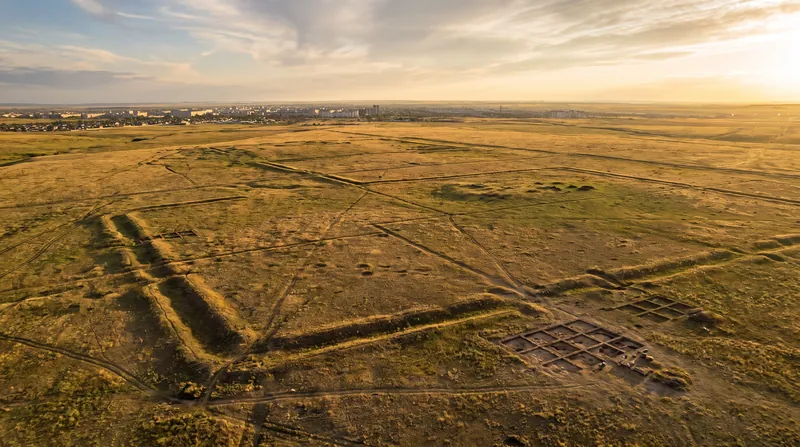
Dating back to approximately 1600 B.C., during the height of the Late Bronze Age, Semiyarka is not a mere village, a temporary gathering place, or a seasonal outpost. It is a sprawling, meticulously planned 346-acre (140-hectare) metropolis that dominated the surrounding landscape. To put that immense footprint into perspective, the city is more than four times larger than any other contemporaneous settlement ever discovered in the region, covering an area roughly equivalent to 260 American football fields. This was a place where people lived, worked, and built for generations, establishing a permanent footprint in a region that modern history had entirely written off as the exclusive territory of wanderers and herders.[4][6]
The sheer scale of the site forces a fundamental rewrite of prehistoric social organization and architectural ambition. Researchers from University College London, Durham University, and Toraighyrov University have spent years mapping its contours, revealing a level of urban planning previously thought impossible for steppe societies. Rather than a haphazard collection of dwellings, the city exhibits deliberate, highly organized civic engineering. The layout suggests a society with a complex hierarchy, capable of marshaling the labor and resources required to construct massive public works. This level of coordination implies a centralized authority or a highly cooperative communal structure that could sustain long-term building projects in a challenging environment.[1][5]
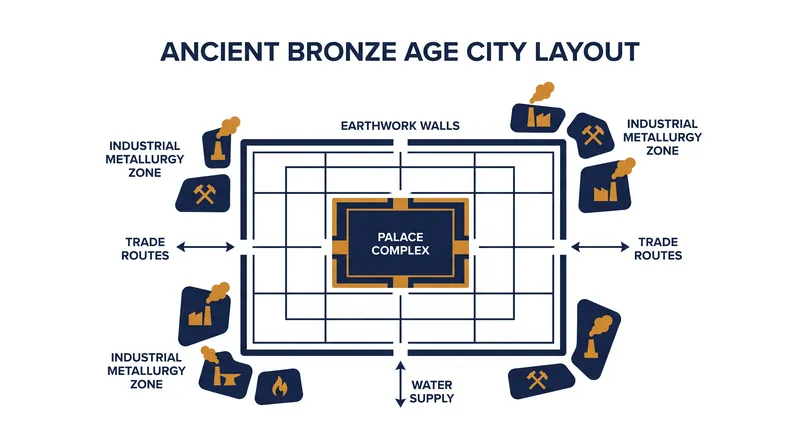
Using advanced magnetometry, satellite imagery, and Cold War-era Corona spy photographs, archaeologists were able to peel back the layers of compacted soil without lifting a single trowel. What they found were the city's bones: two massive rows of rectilinear earthworks, stretching over a kilometer across the plateau. These large banks of soil served as the foundational walls for enclosed, multi-room households built from mud brick. The magnetometry scans revealed that these residential blocks were not randomly placed; they were aligned and divided into distinct, structured compounds, indicating a formal division of property and a sophisticated understanding of spatial organization that rivals the early cities of Mesopotamia.[1][6]
At the very heart of these organized residential blocks sits a monumental central structure that anchors the entire settlement. Aligned east to west and significantly larger than any of the surrounding domestic homes, this building likely served as a ceremonial or administrative core—the beating heart of a highly organized society. Whether it was used for religious rituals, governance, or the distribution of resources, its prominent placement and massive scale indicate that Semiyarka possessed a complex civic life. The existence of such a building proves that the city's inhabitants were not just surviving on the steppe; they were engaging in sophisticated cultural and political practices that required dedicated, monumental architecture.[1][4]
Yet, the most paradigm-shifting revelation at Semiyarka isn't just its massive size, its rectilinear earthworks, or its monumental architecture. It is what the city's inhabitants were actually doing there on a daily basis. On the southeastern edge of the settlement, safely positioned away from the main residential blocks, researchers uncovered a massive industrial zone entirely dedicated to the production of tin bronze. This was not a small, localized forge used by a single family to repair tools; it was a dedicated manufacturing sector that indicates the city was operating as a major industrial powerhouse, fundamentally altering our understanding of ancient steppe economies.[1][2]
Yet, the most paradigm-shifting revelation at Semiyarka isn't just its massive size, its rectilinear earthworks, or its monumental architecture.
The Bronze Age, as the name explicitly suggests, was defined by the mastery of this crucial alloy. Tin bronze—created by smelting copper with a specific percentage of tin—allowed for the creation of significantly sturdier tools, lethal weapons, and intricate ornaments, driving massive technological and economic shifts across the ancient world. But until the detailed surveys of Semiyarka, archaeologists had found virtually no evidence of large-scale tin bronze production anywhere on the Eurasian steppe. While hundreds of thousands of bronze artifacts have been recovered from steppe graves over the years, the actual manufacturing sites remained a mystery, leading many to assume the metal was entirely imported from distant, settled empires.[2][6]
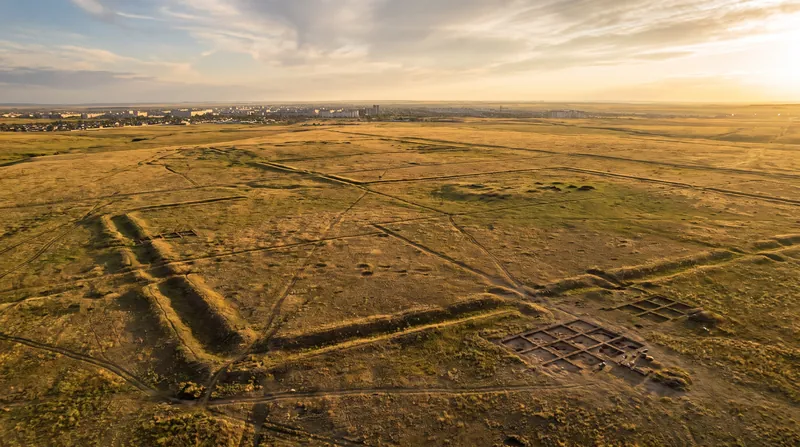
The industrial zone at Semiyarka shatters that assumption completely. The area is heavily littered with the unmistakable debris of heavy industry: broken crucibles, thick layers of metallic slag, and discarded metal artifacts. The sheer volume of this waste material proves that this was a complex, centralized manufacturing hub. The city's metallurgists were operating at an industrial scale, churning out the very materials that fueled the era's economy. They possessed the advanced pyrotechnological knowledge required to maintain high-temperature furnaces and perfectly balance the copper-to-tin ratios, demonstrating a mastery of chemistry and engineering that was entirely indigenous to the steppe.[1][4]
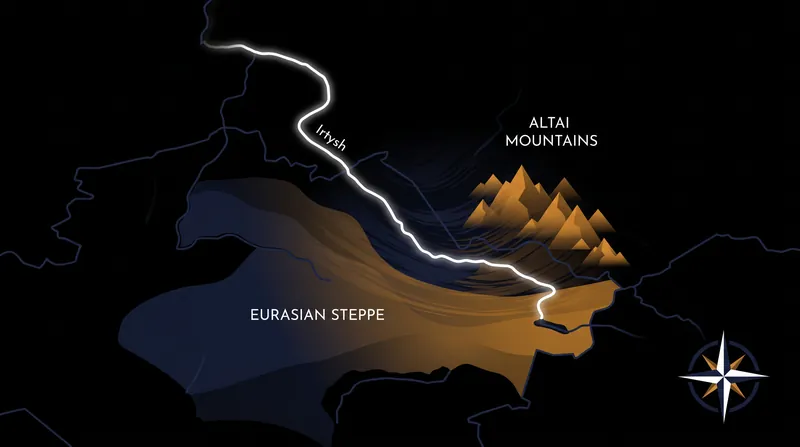
The raw materials required for this massive metallurgical operation didn't simply materialize out of thin air. Semiyarka is strategically located in close proximity to the Altai Mountains, a rugged region historically renowned for its rich, accessible deposits of both copper and tin. By positioning their city near these vital resources, the founders of Semiyarka likely established a dominant economic monopoly over the region's mineral wealth. The city would have served as the primary processing center where raw ore brought down from the mountains was transformed into valuable, finished bronze goods, giving the settlement immense leverage in regional trade and politics.[3][4]
Furthermore, the city's specific placement on a high promontory above the Irtysh River was no accident. The Irtysh is a massive waterway that stretches from the Altai mountains all the way to the Arctic, cutting through modern-day Kazakhstan, China, and Russia. This river connected Semiyarka to vast, long-distance trade networks that spanned the continent. The city wasn't just producing bronze for its own internal use; it was almost certainly exporting it. By controlling the flow of goods along the river, Semiyarka served as a crucial node in the circulation of technology, weapons, and wealth across Eurasia, acting as a vital bridge between the East and the West.[4][5]
This immense industrial capacity fundamentally challenges the long-held, deeply entrenched assumption that advanced metallurgy was the exclusive domain of settled, agricultural civilizations. For generations, the historical narrative dictated that the people of the steppe were merely passive recipients of bronze technology, trading their horses and livestock for the metal goods produced by "advanced" societies. The metallurgists of Semiyarka prove definitively that steppe communities were active, innovative producers in their own right. They built the infrastructure, mastered the science, and controlled the supply chains, operating on a level of sophistication that demands a total reevaluation of Bronze Age power dynamics.[1][7]
The discovery of the city also introduces a fascinating and highly complex demographic dynamic to the historical record. While the massive earthworks and mud-brick homes suggest a permanent, year-round population of several hundred people, the archaeological evidence doesn't stop at the city walls. A structured surface survey revealed that the scatter of pottery and artifacts extends far beyond the city's central core, covering the entirety of the 346-acre plateau. Researchers hypothesize that Semiyarka hosted a massive, rotating population of nomadic pastoralists who lived in yurts and temporary shelters on the city's sprawling outskirts, drawn to the settlement for trade, protection, and ceremony.[1][7]
This unique arrangement paints a vivid picture of a deeply hybrid society—a permanent, industrialized urban center that simultaneously served as a vital anchor for a much wider, mobile population. It was a bustling, cosmopolitan hub where nomadic herders and settled city-dwellers interacted daily, trading livestock for bronze tools, sharing news from across the continent, and collaborating on massive civic projects. This blurs the rigid, academic lines that have traditionally separated settled and mobile lifestyles, suggesting that the ancient world was far more fluid, interconnected, and adaptable than modern historians have previously given it credit for.[7]
As excavations continue and more of the city's secrets are slowly pulled from the earth, Semiyarka stands as a powerful, undeniable testament to the ingenuity of ancient steppe societies. It serves as a stark reminder that human history is rarely as simple or as linear as the textbooks suggest. The vast, open grasslands of Central Asia were not just an empty void waiting to be crossed; they were home to dynamic, complex, and highly industrialized cities that rivaled any in the ancient world. The City of Seven Ravines has finally reclaimed its place on the map, forever changing how we view the dawn of civilization.[7]
Definitions
- Tin Bronze
- An alloy made by combining copper with a small amount of tin, resulting in a harder and more durable metal that defined the technological advancements of the Bronze Age.
- Rectilinear Earthworks
- Large, straight-lined banks of soil constructed by ancient peoples, often used as the foundational walls or boundaries for buildings and compounds.
- Magnetometry
- A non-invasive geophysical survey technique that measures patterns of magnetism in the soil to map buried archaeological structures without digging.
- Slag
- The stony waste matter separated from metals during the smelting or refining of ore, which serves as key evidence of ancient metallurgical activity.
Chronology
Early 2000s
Researchers from Kazakhstan's Toraighyrov University first identify the Semiyarka site and note unusual surface artifacts.
2018
An international team begins the first major, high-resolution geophysical survey of the settlement.
Nov 2025
A landmark study is published in Antiquity, formally detailing the city's massive scale and its industrial bronze production.
Analysis by camp
Traditional Steppe Historians
Scholars who historically viewed the Eurasian steppe as a domain exclusive to mobile pastoralists.
For decades, the prevailing academic consensus held that the harsh environment of the Central Asian steppe precluded the development of permanent urban centers. This viewpoint, built on the vast numbers of temporary campsites and burial mounds found across the region, argued that Bronze Age populations were entirely nomadic. In this framework, complex metallurgy and urban planning were seen as technologies imported from settled agricultural societies in the Near East or China, rather than indigenous developments.
The New Urban Consensus
Archaeologists arguing that steppe societies developed complex, permanent infrastructure alongside nomadic traditions.
Armed with high-resolution geophysical surveys and massive new excavation data, a growing coalition of international researchers argues that the steppe hosted a hybrid social model. They point to Semiyarka's rectilinear earthworks and industrial-scale tin bronze production as proof that mobile communities could build and sustain permanent, highly organized settlements. This camp views the steppe not as an empty highway for nomads, but as a dynamic landscape capable of indigenous urban innovation and complex economic control.
Questions & answers
Where is Semiyarka located?
The site is located on a promontory above the Irtysh River in northeastern Kazakhstan, near the Altai Mountains.
How old is the city?
Semiyarka dates back to approximately 1600 B.C., placing it in the Late Bronze Age.
Why is tin bronze production so important?
Tin bronze is a durable alloy that was crucial for making tools and weapons during the Bronze Age. Finding a large-scale production site on the steppe proves these communities manufactured their own advanced materials rather than just trading for them.
Did nomads live in the city?
Researchers believe the site hosted a permanent population in its central earthworks, while a rotating population of nomadic pastoralists likely lived in temporary shelters on the city's outskirts.
Limits of the evidence
- The exact population size of the city at its peak.
- Whether the tin bronze produced at Semiyarka was exported to specific distant empires.
- The specific religious or administrative functions of the city's central monumental building.
Significance
The discovery of Semiyarka fundamentally rewrites the history of human civilization in Central Asia. By proving that ancient steppe communities built complex, industrial cities, it forces us to rethink the origins of urban planning and technological innovation outside of traditional agricultural empires.
Sources
Source coverage
7 outlets
2 viewpoints surfaced







[1]AntiquityThe New Urban Consensus
A major city of the Kazakh Steppe? Investigating Semiyarka's Bronze Age legacy
Read on Antiquity →[2]CNNThe New Urban Consensus
Archaeologists may have uncovered a Bronze Age metropolis in Kazakhstan's steppe
Read on CNN →[3]WikipediaTraditional Steppe Historians
Semiyarka
Read on Wikipedia →[4]Live ScienceThe New Urban Consensus
'Sophisticated' Bronze Age City Unearthed in Kazakhstan
Read on Live Science →[5]CBS NewsThe New Urban Consensus
An expansive ancient city has been unearthed in central Asia
Read on CBS News →[6]Smithsonian MagazineThe New Urban Consensus
Twenty years after its discovery, archaeologists are finally revealing the secrets of Semiyarka
Read on Smithsonian Magazine →[7]Factlen Editorial TeamThe New Urban Consensus
Synthesis by Factlen editorial team
Read on Factlen Editorial Team →
Comments

Every angle. Every day.
Get culture stories with full source coverage and perspective breakdowns delivered to your inbox.