
Active vs. Passive Flexibility: The Science of Stretching and Joint Control
While passive stretching increases overall tissue extensibility, active mobility builds the neurological control required to safely use that new range of motion.
By Aylin Aksoy

- Mobility and Performance Coaches
- Advocate for active, dynamic stretching to build strength at end-ranges and prepare the nervous system for movement.
- Flexibility and Circus Arts Instructors
- Emphasize a balance of passive stretching to expand range of motion and active stretching to safely control it.
- Factlen Editorial Team
- Synthesizes the biomechanical evidence to provide practical, everyday guidance for general fitness.
Perspectives this story doesn't cover
- Yoga purists who exclusively practice passive holds
At a glance
- Passive flexibility relies on external forces like gravity or straps to lengthen resting muscles.
- Active flexibility requires your own muscle strength to move a joint through its range of motion.
- A large gap between your passive and active flexibility can increase the risk of joint injury.
- Dynamic, active stretching is best used as a warm-up to prepare the nervous system for exercise.
- Static, passive stretching is highly effective for post-workout recovery and long-term tissue extensibility.
- 15–60 seconds
- Optimal hold time for passive static stretches during recovery
- 2%
- Average vertical jump performance increase after dynamic warm-ups
- 0
- External force used during active flexibility training
If you have ever felt stiff before a walk or sore after a workout, your stretching routine might be the culprit. Many people make the common mistake of holding deep stretches on cold muscles, assuming it will prepare their joints for the work ahead. In reality, this approach can actually hinder performance and do more harm than good. The solution lies in understanding that not all flexibility is created equal. Your body needs active, movement-based stretches to warm up and gentle, sustained holds to cool down and recover.[3]
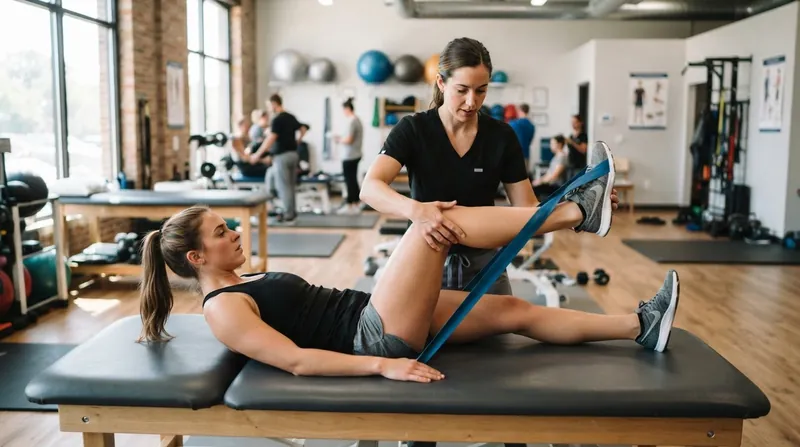
Flexibility is fundamentally the range of motion available at a joint. But sports physiotherapists and biomechanics experts divide this into two distinct categories: active flexibility and passive flexibility. Passive flexibility is the amount that you can move into an end range with help from an external force, whether it is pulling with a strap, pushing from a coach, or gravity pressing you to the floor. It is the measurement of pure tissue extensibility.[2]
Active flexibility, on the other hand, is the range of motion a joint can move into without any external force helping it go there. It requires strength in the body part you are moving. For example, lifting a straight leg up toward your nose while standing relies entirely on the strength of your hip flexors and core to overcome the resistance of your hamstrings. This is often referred to as mobility.[1][2]
Usually, your passive flexibility is larger than your active flexibility. You can almost always pull your leg higher with your hands than you can lift it using just your muscles. However, if there is a very big difference between your active and passive flexibility in any particular joint, it creates a vulnerability. You are essentially creating a range of motion that your nervous system does not have the strength to control.
Usually, your passive flexibility is larger than your active flexibility.
Although stretching is undoubtedly part of injury prevention and health, passive flexibility alone does not automatically improve our ability to stabilize our joints. We are usually weakest at our outer ranges of motion—exactly where we are trying to stretch into. Think about how your leg gets positioned when you catch an edge skiing or slip on the ice; injuries happen when a joint is forced into a range it cannot actively support.
The science of preparation heavily favors active mobility. Studies have shown that prolonged static stretching immediately before an activity may temporarily decrease maximal strength, power output, sprint speed, and jump performance. By holding a stretch, you are signaling the nervous system to relax the muscle, which is the exact opposite of what you want before explosive movement.[3]
Conversely, holding a passive static stretch for a long period is highly effective for recovery. It allows the muscle in that lengthened position to release fully, alleviating tightness and promoting relaxation. This teaches your nervous system to tolerate a larger range of motion over time, expanding the absolute limits of your joint mobility.
The most resilient bodies are built by closing the gap between these two metrics. By using active mobility to build strength at the end-ranges of your passive flexibility, you create stable, usable movement. Understanding when to apply each method allows you to safely achieve advanced flexibility milestones while ensuring that your body is strong enough to return from whatever positions it reaches.[1][3]
Different angles
Active Mobility (Dynamic Stretching)
Using muscle strength to move joints through their full range of motion, prioritizing control and preparation.
Active flexibility—often referred to as mobility or dynamic stretching—relies on your own muscle fibers to achieve a stretch without external assistance. This approach acts as a neurological wake-up call. By actively moving and engaging one muscle group to stretch its opposing group, you increase blood flow, raise muscle temperature, and enhance neuromuscular activation. Because you are your own limiting factor, the risk of overstretching is significantly reduced. Evidence shows that dynamic stretching before an activity improves sprinting, jumping, and power performance. It fits perfectly as a pre-workout warm-up or for building joint stability at end-ranges, but it requires more energy and is less effective for deep, relaxing tissue release.
Passive Flexibility (Static Stretching)
Relying on external forces like gravity or props to lengthen resting muscles, prioritizing tissue extensibility and relaxation.
Passive flexibility involves moving a muscle into a stretched position and holding it for 15 to 60 seconds with the help of an external force—be it a strap, the floor, or a partner. This method targets the resting length of your muscles and connective tissues, teaching your nervous system to tolerate a larger range of motion. It is highly effective for increasing overall joint extensibility and reducing feelings of muscle tightness. However, because an outside force is doing the work, passive stretching does not build the strength needed to control that new range of motion, which can leave hypermobile individuals prone to joint instability. It fits best during post-workout recovery or dedicated flexibility sessions when muscles are already warm, but it should be avoided immediately before explosive athletic performance.
The Combined Approach
Integrating both methods to close the gap between what your joints can access and what your muscles can control.
Rather than treating active and passive flexibility as mutually exclusive, sports physiotherapists advocate for a blended approach to minimize the delta between the two. You will always have more passive flexibility than active flexibility, but a large gap between them indicates a range of motion that you cannot safely control—a prime zone for injuries like muscle strains or ligament tears. By using dynamic movements to build strength at the end-ranges of your passive flexibility, you create stable, usable mobility. This combined method fits well for anyone looking to achieve advanced flexibility milestones safely, ensuring that the body is both pliable enough to reach a position and strong enough to return from it.
Sources
Source coverage
3 outlets
3 viewpoints surfaced



- [1]Arkansas Circus ArtsFlexibility and Circus Arts Instructors
Active VS. Passive Flexibility
Read on Arkansas Circus Arts → - [2]Camilla MiaFlexibility and Circus Arts Instructors
Active vs. Passive Flexibility
Read on Camilla Mia → - [3]Factlen Editorial TeamFactlen Editorial Team
Synthesis by Factlen editorial team
Read on Factlen Editorial Team →
Comments
More in Fitness
See all →Heart Rate Training
The Heart Rate Reserve Method: How the Karvonen Formula Precisely Defines Training Zones by Accounting for Resting Heart Rate
8 sources

Fitness Tech
The 42 Percent Overestimation: How Cardio Equipment Calorie Counters Systematically Fail to Account for Individual Physiology and Biomechanics
10 sources
Body Composition
The 25-Point Fat-Free Mass Index Ceiling: Evaluating the Natural Limit of Human Muscularity
7 sources
Sleep Science
The 7.56 Percent Performance Drop: How Acute Sleep Loss Quantifiably Impairs Strength, Endurance, and Power
9 sources

Every angle. Every day.
Get Fitness stories with full source coverage and perspective breakdowns delivered to your inbox.