
Inside the Kinetic Cyber Range: How Defenders Train for Physical Hacks
The FBI and cybersecurity agencies are building physical 'fake towns' to train defenders against digital attacks that have real-world consequences. These kinetic cyber ranges bridge the gap between software vulnerabilities and physical infrastructure, empowering IT teams to protect hospitals and power grids.
By Factlen Editorial Team
- Federal Cyber Defenders
- Focus on national security, critical infrastructure resilience, and standardizing incident response across agencies.
- OT Security Researchers
- Emphasize the unique vulnerabilities of legacy industrial hardware and the need for realistic, physical simulation.
- Tech & Policy Analysts
- Highlight the novelty of the facilities and the broader implications for the cybersecurity industry's evolution.
What's not represented
- · Private sector utility operators
- · Insurance actuaries pricing cyber risk
Why this matters
As hackers increasingly target hospitals, power grids, and gas pipelines, traditional software training is no longer enough. Kinetic cyber ranges ensure that the defenders protecting our critical infrastructure know exactly how to respond when a digital breach causes a physical crisis.
Key points
- The FBI has opened a 22,000-square-foot physical town in Alabama to simulate cyberattacks on critical infrastructure.
- Unlike traditional digital training, 'kinetic' ranges connect network hacks to physical consequences like failing hospital equipment.
- The facility helps bridge the gap between IT (data systems) and OT (physical machinery), which require vastly different defense strategies.
- Agencies like CISA and university researchers are also building kinetic ranges to train municipal workers and test new defenses.
- The immersive training aims to build muscle memory and reduce cognitive overload during real-world infrastructure crises.
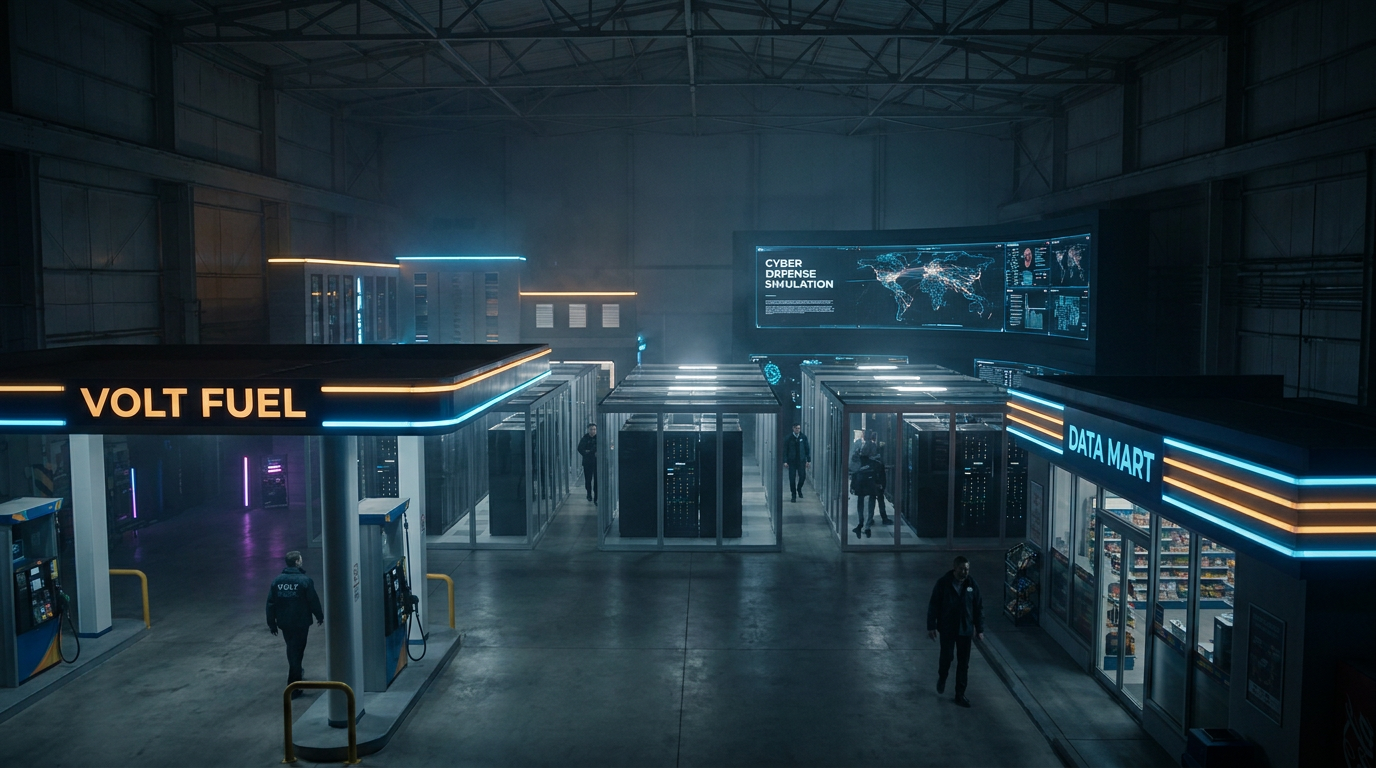
Deep in Huntsville, Alabama, a new kind of town has quietly appeared. It features a convenience store, a gas station, a hospital, and fully furnished houses, yet no one actually lives there. Instead, this 22,000-square-foot facility is a battleground. Built by the FBI, it is a state-of-the-art 'kinetic cyber range'—a physical sandbox designed to simulate catastrophic digital attacks on real-world infrastructure.[1]
For decades, the FBI has trained field agents at Hogan's Alley, a mock town in Virginia used for tactical firearms and raid training. The Huntsville facility serves as the modern, digital equivalent. But rather than kicking down doors, the agents and cybersecurity professionals training here are battling invisible adversaries who seek to shut down power grids, poison water supplies, or lock hospital doors.[1][2]
The core innovation of the Huntsville facility is its 'kinetic' nature. In military and cybersecurity parlance, a kinetic event is one that causes a physical effect in the real world. Traditional cyber ranges are purely digital, consisting of virtual machines, simulated networks, and endless logs of code. A kinetic range connects those digital networks to actual physical hardware—valves, pumps, medical monitors, and cash registers.[4][5]
This physical connection bridges a critical gap in modern cybersecurity: the divide between Information Technology (IT) and Operational Technology (OT). IT governs data—emails, databases, and web servers. OT governs physical machinery—the programmable logic controllers (PLCs) that tell a centrifuge to spin, a traffic light to turn red, or a pipeline valve to close.[3][4]

Securing OT is fundamentally different from securing IT. If an IT server is breached, administrators can simply take it offline, wipe it, and restore from a backup. If an OT system controlling a municipal water supply is breached, taking it offline might mean cutting off water to a million people. Furthermore, OT systems often rely on legacy code written decades ago, making them fragile and difficult to patch without causing physical disruptions.[3][5]
The Huntsville range allows defenders to experience the visceral reality of an OT breach. When a 'Red Team' (the simulated attackers) successfully deploys a payload, the 'Blue Team' (the defenders) doesn't just see a red alert on a dashboard. They hear physical alarms blaring. They watch the lights in the mock hospital flicker and die. They see the pressure gauges on the simulated gas station drop to zero.[1][2]
This sensory feedback is crucial for training. In a real-world crisis, cognitive overload is one of the greatest threats to a rapid response. By forcing defenders to troubleshoot network logs while physical sirens are wailing and simulated patients are at risk, the FBI aims to build muscle memory that cannot be replicated in a quiet server room.[1][5]
In a real-world crisis, cognitive overload is one of the greatest threats to a rapid response.
The hospital simulation is particularly sobering. As ransomware attacks on healthcare facilities have surged globally, the stakes of medical cybersecurity have shifted from data privacy to patient survival. In the Huntsville range, defenders must figure out how to isolate a compromised network segment without disabling the life-support simulators connected to it, requiring a delicate balance of IT triage and medical triage.[1][4]

The FBI is not alone in this push toward kinetic training. The Cybersecurity and Infrastructure Security Agency (CISA) has been steadily expanding its own OT training programs, recognizing that the next major conflict will likely target civilian infrastructure long before traditional military assets. CISA's initiatives aim to bring this level of rigorous, physical simulation to municipal IT workers who manage local power and water grids.[3]
Academic institutions are also entering the fray. University researchers are designing modular, open-source kinetic ranges that can be built on a smaller scale, allowing students to practice defending miniature water treatment plants or robotic assembly lines. These academic ranges are vital for testing new defensive theories before they are deployed to protect actual critical infrastructure.[4]
One of the most significant challenges in building these ranges is keeping them relevant. Hackers constantly develop new 'zero-day' exploits—vulnerabilities previously unknown to the software vendor. To ensure the Huntsville facility doesn't become obsolete, the FBI continuously updates the town's digital architecture, importing the latest malware strains captured in the wild.[2][5]
Artificial intelligence is also reshaping how these simulations operate. Advanced kinetic ranges are beginning to use AI-driven Red Teams that can adapt their attack strategies in real-time based on the Blue Team's defensive maneuvers. This creates a dynamic, unpredictable training environment that closely mimics the ingenuity of a human adversary.[4][5]

However, maintaining a physical town is vastly more expensive and complex than spinning up virtual servers. When a simulated attack intentionally 'bricks' a physical piece of hardware—rendering it permanently inoperable—that hardware must be physically replaced before the next training session. This limits the frequency and scale of the most destructive simulations.[4]
Despite the costs, the investment in kinetic ranges represents a necessary evolution in national defense. For years, the cybersecurity industry has warned of a 'cyber Pearl Harbor'—a massive, coordinated attack on physical infrastructure. By building places like the Huntsville range, agencies are ensuring that if such an event occurs, the defenders will have already fought the battle a hundred times before.[2][3]
Ultimately, the creation of these physical-digital training grounds is a deeply empowering development. It signals a shift from reactive panic to proactive resilience. By bringing the invisible war of code into the physical world, defenders are gaining the tools, the experience, and the confidence needed to keep the lights on and the water flowing.[1][5]
How we got here
2010
The Stuxnet worm successfully targets Iranian nuclear centrifuges, demonstrating the devastating potential of kinetic cyberattacks.
May 2021
A ransomware attack on the Colonial Pipeline forces a shutdown of fuel distribution across the US East Coast, highlighting OT vulnerabilities.
2023
CISA expands its Control Systems Cyber Security Training programs to better equip municipal defenders.
2025
The FBI officially opens its 22,000-square-foot kinetic Cyber Range in Huntsville, Alabama.
Viewpoints in depth
Federal Cyber Defenders
Agencies focus on national security and standardizing incident response across critical infrastructure.
For federal agencies like the FBI and CISA, kinetic ranges are a matter of national security. They view the protection of civilian infrastructure—water, power, and healthcare—as the primary front in modern geopolitical conflict. Their goal with these facilities is to standardize incident response, ensuring that a municipal IT worker in Ohio has the same rigorous, stress-tested training as a federal agent in Washington. They argue that without physical simulation, defenders will freeze when digital alerts translate into real-world chaos.
OT Security Researchers
Researchers emphasize the unique fragility of legacy industrial hardware compared to modern software.
Industrial cybersecurity researchers point out that Operational Technology (OT) is fundamentally less resilient than Information Technology (IT). Many water treatment plants and power grids run on programmable logic controllers designed decades ago, long before internet connectivity was standard. These researchers advocate for kinetic ranges because they expose the physical limitations of legacy hardware. They argue that you cannot simply 'patch' a 30-year-old physical valve with a software update, making physical simulation the only way to test defensive workarounds safely.
Municipal IT Defenders
Local defenders focus on the practical application of training for underfunded, real-world grids.
For the IT professionals actually running local utilities, kinetic ranges offer a rare opportunity to practice worst-case scenarios without risking their own communities. These defenders often operate with limited budgets and outdated equipment. They view kinetic training not just as a tactical exercise, but as a crucial tool for demonstrating risk to local governments. By experiencing a simulated grid failure firsthand, they can better advocate for the funding needed to upgrade vulnerable physical infrastructure back home.
What we don't know
- How quickly kinetic ranges can be updated to simulate novel, AI-generated zero-day exploits before they are used in the wild.
- Whether the high cost of replacing physically 'bricked' hardware will limit the scale of these training facilities.
- How effectively the lessons learned in federal facilities will trickle down to underfunded local municipalities.
Key terms
- Kinetic Cyber Range
- A physical training facility where digital networks are connected to real-world hardware to simulate cyberattacks with physical consequences.
- Operational Technology (OT)
- Hardware and software that detects or causes a change through the direct monitoring and control of physical devices, processes, and events.
- Programmable Logic Controller (PLC)
- An industrial computer control system that continuously monitors the state of input devices and makes decisions to control physical machinery.
- Red Team
- A group of cybersecurity professionals authorized to simulate an attack on an organization's systems to test its defenses.
Frequently asked
What is a kinetic cyberattack?
A kinetic cyberattack is a digital breach that causes a physical effect in the real world, such as shutting down a power grid, altering water pressure, or disabling medical equipment.
Why can't defenders just train on regular computers?
Traditional computer training doesn't replicate the sensory overload and physical stakes of an infrastructure attack. Kinetic ranges force defenders to manage physical alarms and failing hardware alongside network logs.
What is the difference between IT and OT?
IT (Information Technology) manages data and software, like emails and databases. OT (Operational Technology) manages physical machinery, like factory assembly lines, traffic lights, and pipeline valves.
Sources
Source coverage
5 outlets
3 viewpoints surfaced





[1]The VergeTech & Policy Analysts
The FBI built a small town to simulate cyberattacks
Read on The Verge →[2]FBI OfficialFederal Cyber Defenders
Cyber Action Team and Kinetic Training Initiatives
Read on FBI Official →[3]CISAFederal Cyber Defenders
Control Systems Cyber Security Training
Read on CISA →[4]arXivOT Security Researchers
Design and Implementation of Kinetic Cyber Ranges for Critical Infrastructure
Read on arXiv →[5]Factlen Editorial TeamOT Security Researchers
Synthesis by Factlen editorial team
Read on Factlen Editorial Team →

More in technology
See all 5 stories →

Every angle. Every day.
Get technology stories with full source coverage and perspective breakdowns delivered to your inbox.