
Induction vs. Gas Cooktops: The 2026 Performance and Efficiency Comparison
As induction technology matures and health concerns surrounding gas stoves grow, the debate over kitchen cooktops has shifted from pure culinary preference to a major infrastructure decision.
By Factlen Editorial Team
- Efficiency & Health Advocates
- Prioritize indoor air quality, climate impact, and the thermodynamic superiority of electromagnetic heating.
- Appliance Analysts
- Focus on measurable performance metrics like boil times, temperature precision, and total cost of ownership.
- Culinary Traditionalists
- Value the tactile feedback of an open flame, universal cookware compatibility, and proven reliability.
What's not represented
- · Renters who cannot modify their kitchen infrastructure
- · Electric grid operators managing peak residential load
Why this matters
Choosing between induction and gas dictates not only how quickly and safely your meals cook, but also impacts your home's indoor air quality and long-term energy bills. With electrical panel upgrade costs and health data increasingly driving the conversation, this decision is the most consequential infrastructure choice in a modern kitchen remodel.
Key points
- Induction cooktops transfer 85 to 90 percent of their energy directly to the pan, making them significantly more efficient than gas.
- Gas ranges lose up to 60 percent of their heat to the surrounding air but offer universal cookware compatibility and visual flame control.
- High-powered induction zones can boil water 30 to 40 percent faster than premium gas burners.
- Unvented gas stoves emit nitrogen dioxide and particulate matter, making induction the safer choice for indoor air quality.
- Switching to induction often requires a dedicated 240-volt electrical circuit, which can add substantial upfront installation costs in older homes.
The decision between an induction and gas cooktop has evolved from a simple culinary preference into one of the most consequential infrastructure choices in a modern kitchen remodel. As homeowners weigh the tactile familiarity of an open flame against the rapid advancements in electromagnetic cooking, the landscape in 2026 offers compelling arguments for both technologies. Appliance experts and culinary professionals are increasingly analyzing not just how these cooktops heat a pan, but how they impact household energy bills, indoor air quality, and long-term property value.[6][8]
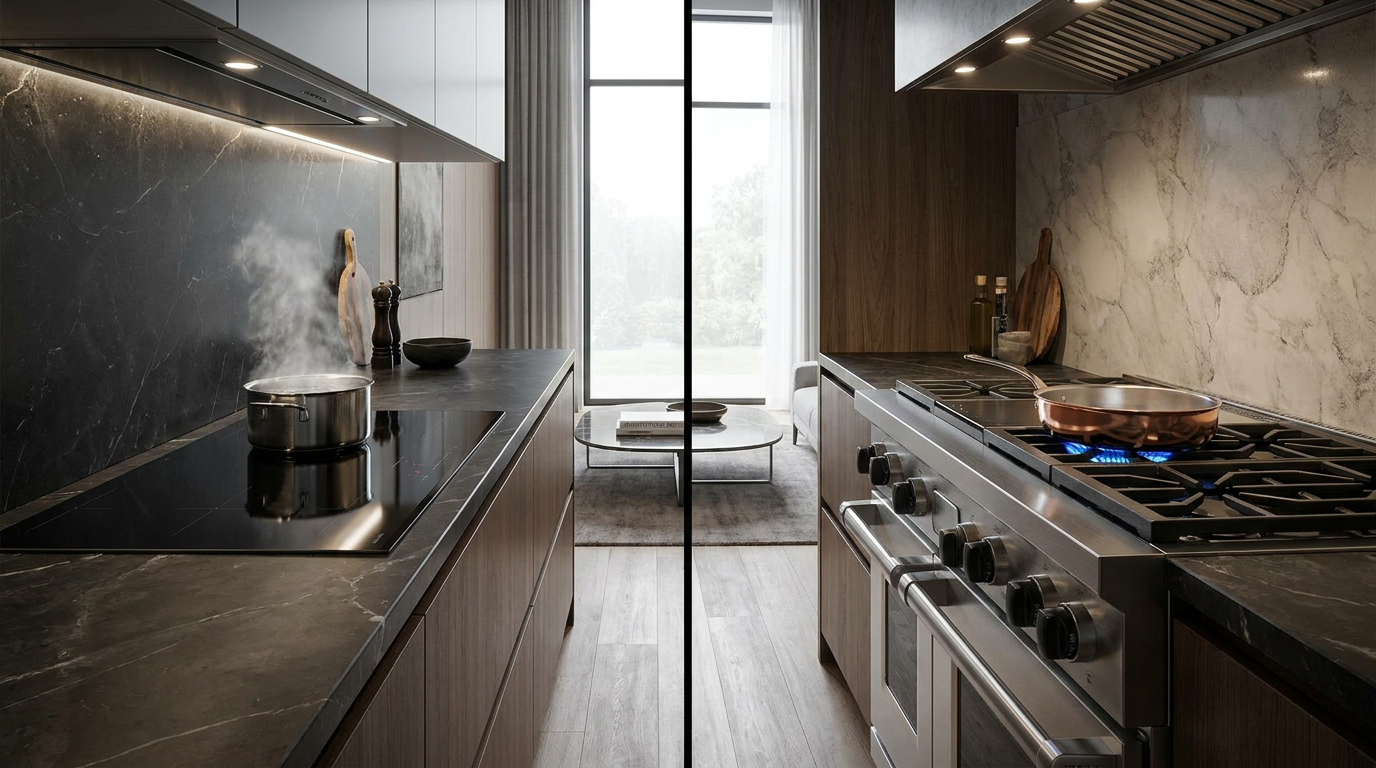
The fundamental difference between the two platforms lies in how heat is generated and transferred. Gas cooktops rely on the combustion of natural gas or propane to create an open flame, which then heats the bottom of the cookware and, inevitably, the surrounding air. Induction, by contrast, uses copper coils beneath a glass surface to generate a magnetic field. When a ferromagnetic pan is placed on the zone, this field induces eddy currents within the metal, turning the cookware itself into the heat source while the glass surface remains relatively cool.[4][6]
When it comes to raw speed and boiling performance, induction holds a commanding lead. In standardized test kitchen benchmarks, a high-powered induction zone can bring six quarts of room-temperature water to a rolling boil in under four minutes. A premium 18,000 BTU gas burner requires more than six minutes to accomplish the same task. Because induction transfers energy directly into the metal of the pot, it eliminates the thermal lag associated with heating heavy cast-iron grates and ambient air, resulting in a 30 to 40 percent reduction in time spent waiting for water to boil or oil to shimmer.[2][3]
This direct transfer of energy also translates into a massive efficiency gap. Data from the U.S. Department of Energy and independent energy analysts confirms that induction cooktops operate at 85 to 90 percent thermal efficiency. Gas stoves, hampered by combustion heat escaping around the sides of the cookware, manage an efficiency rate of just 32 to 40 percent. This means that an induction cooktop requires less than half the total site energy to deliver the same amount of useful cooking heat to a meal, simultaneously easing the workload on home HVAC systems during summer months by keeping the kitchen noticeably cooler.[1][5]

Temperature control presents a more nuanced comparison, with each technology excelling in different culinary contexts. Gas provides immediate visual feedback; a cook can see exactly how high the flame is and adjust it intuitively, a feature traditionally favored for wok cooking and aggressive charring. Induction, however, offers unparalleled digital precision, particularly at the lower end of the temperature spectrum. Modern induction units can hold a delicate simmer or melt chocolate without a double boiler, maintaining exact temperatures with a variance of just one to three degrees, whereas gas burners often struggle to maintain a low enough output without extinguishing.[2][7]
Temperature control presents a more nuanced comparison, with each technology excelling in different culinary contexts.
Indoor air quality has become a defining factor in the 2026 cooktop debate. Extensive environmental health studies have demonstrated that unvented gas stoves emit nitrogen dioxide and fine particulate matter at levels that frequently exceed outdoor air quality standards, contributing to elevated risks of childhood asthma. Induction cooking produces zero point-of-use emissions, entirely eliminating combustion byproducts from the kitchen environment. For households without high-capacity, externally vented range hoods, the transition to induction offers an immediate and measurable improvement in respiratory safety.[1][3]

The transition to induction does require specific equipment, which remains a primary hurdle for some home chefs. Because the technology relies on magnetic fields, it only functions with ferromagnetic cookware such as cast iron, enameled iron, and most magnetic stainless steel. Aluminum, copper, and glass pans will not heat up on an induction surface. Gas cooktops offer universal compatibility, allowing cooks to utilize any vessel in their collection, including traditional round-bottom woks that rely on the enveloping heat of an open flame.[4][6]
Maintenance and daily cleanup heavily favor the smooth glass surface of an induction cooktop. Because the glass itself does not generate heat, spills and splatters are far less likely to bake or carbonize onto the surface. A simple wipe with a damp cloth is usually sufficient to restore the cooktop to a pristine condition. Gas ranges, with their heavy cast-iron grates, burner caps, and intricate crevices, require significantly more labor to disassemble, degrease, and scrub after a heavy cooking session.[2][8]
Financial considerations present a complex calculus of upfront investment versus long-term savings. While the purchase price of induction ranges has decreased, they generally command a premium over standard gas models. More significantly, switching from gas to induction often requires a dedicated 40- or 50-amp electrical circuit. In older homes, upgrading the electrical panel to support this load can add thousands of dollars to the installation cost. Conversely, homes already equipped with gas lines can replace a gas stove with minimal installation friction.[1][3]

Ultimately, the decision hinges on specific household priorities and existing infrastructure. Induction fits exceptionally well for homeowners who prioritize energy efficiency, rapid cooking speeds, and effortless cleanup. It is the definitive choice for families concerned about indoor air quality and child safety, given the lack of open flames and the rapid cooling of the cooking surface. For those already planning a kitchen remodel or electrical upgrade, the long-term performance and environmental benefits of induction make it a highly compelling investment.[5][6]
Conversely, gas remains a highly practical option under specific conditions. It fits well for culinary traditionalists who rely on visual flame control, frequent wok users, and those with extensive collections of copper or aluminum cookware. It is also the most logical choice for homeowners in regions with frequent power outages, as gas burners can often be ignited manually without electricity. For kitchens already plumbed for gas but lacking the electrical capacity for a 240-volt circuit, a modern gas cooktop continues to deliver reliable, high-performance cooking without the burden of expensive infrastructure upgrades.[3][7]
How we got here
Early 1900s
The first patents for induction heating are filed, though the technology remains confined to industrial applications.
1970s
Westinghouse introduces the first consumer induction cooktop, but high costs prevent widespread adoption.
2010s
Induction technology matures and drops in price, gaining massive popularity in Europe and Asia.
2022–2024
Growing awareness of indoor air quality and gas stove emissions accelerates induction adoption in the US market.
2026
Induction cooktops reach near price-parity with premium gas models, becoming a primary choice in many new kitchen builds.
Viewpoints in depth
Efficiency & Health Advocates
Focusing on the environmental and respiratory benefits of eliminating indoor combustion.
For environmental researchers and public health advocates, the transition away from gas is an urgent necessity. They point to extensive data showing that unvented gas stoves routinely spike indoor nitrogen dioxide levels past EPA outdoor safety limits, significantly increasing the risk of childhood asthma. Beyond the immediate health benefits, this camp emphasizes the thermodynamic superiority of induction. By transferring 90 percent of energy directly into the cookware, induction drastically reduces the total energy required to cook a meal, easing the strain on the electrical grid and lowering household carbon footprints.
Culinary Traditionalists
Defending the versatility, visual feedback, and proven reliability of gas cooking.
Many professional chefs and passionate home cooks remain loyal to gas for its tactile and visual feedback. They argue that the ability to see a flame allows for intuitive, instantaneous heat adjustments that digital touch controls cannot replicate. This camp also highlights the limitations of induction's cookware requirements, noting that traditional wok cooking, which relies on flames licking the sides of a round-bottomed pan, is fundamentally compromised on a flat glass surface. Furthermore, they point out that gas stoves provide crucial resilience, allowing families to cook during winter power outages.
Appliance Analysts
Evaluating the practical trade-offs of speed, cost, and installation friction.
Industry analysts view the debate through a lens of practical utility and total cost of ownership. They universally praise induction for its unmatched boiling speeds, precise low-temperature simmering, and effortless cleanup. However, they caution buyers about the hidden costs of electrification. While an induction cooktop might save $50 to $100 a year in energy costs, the requirement to upgrade an older home's electrical panel to support a 50-amp circuit can erase decades of those savings. Their consensus is that induction is the superior technology, but gas remains the more pragmatic choice for homes without modern electrical infrastructure.
What we don't know
- How quickly the secondary market for used gas ranges will decline as local electrification mandates expand.
- Whether future induction technology will successfully adapt to heat non-magnetic metals like copper and aluminum efficiently.
- The exact long-term impact of grid decarbonization on the lifetime carbon footprint of induction stoves in heavily coal-dependent regions.
Key terms
- Induction Cooking
- A cooking method that uses copper coils to generate a magnetic field, inducing heat directly within ferromagnetic cookware rather than heating the stove's surface.
- Ferromagnetic
- Materials that have a high susceptibility to magnetization, such as iron or certain steel alloys, which are required for induction cooktops to function.
- Thermal Efficiency
- The percentage of energy consumed by the appliance that is actually transferred into the food being cooked, rather than lost to the surrounding air.
- BTU (British Thermal Unit)
- A traditional unit of heat measurement used to rate the power output and fuel consumption of gas burners.
Frequently asked
Can I use my current pots and pans on an induction cooktop?
Only if they are magnetic. Cast iron and most stainless steel work perfectly, but aluminum, copper, and glass will not heat up on an induction surface.
Does induction cooking use more electricity than a standard electric stove?
No, induction is actually more efficient. It transfers about 85 to 90 percent of its energy directly to the cookware, compared to 70 to 80 percent for traditional electric radiant coils.
Is it expensive to switch from gas to induction?
The cooktop itself may cost slightly more, but the biggest expense is often electrical. Switching from gas usually requires installing a dedicated 40- or 50-amp 240V circuit, which can cost $1,500 to $3,000 depending on your home's wiring.
Do induction cooktops scratch easily?
While the ceramic glass surface is durable, it can be scratched if heavy cast iron pans are dragged roughly across it. However, because food doesn't bake onto the cool surface, aggressive scrubbing is rarely needed.
Sources
Source coverage
8 outlets
3 viewpoints surfaced







[1]Energy SolutionsEfficiency & Health Advocates
Induction vs Gas Cooktops: The Definitive Health, Efficiency & Economic Analysis (2026)
Read on Energy Solutions →[2]Cooktop HunterAppliance Analysts
Induction vs gas: which cooktop wins on speed, precision, running cost
Read on Cooktop Hunter →[3]Yale ApplianceAppliance Analysts
Induction vs Gas 2026: Pros & Cons
Read on Yale Appliance →[4]KitchenAidCulinary Traditionalists
Gas vs. Induction: how to choose the best option for your kitchen
Read on KitchenAid →[5]FOTILEEfficiency & Health Advocates
Induction vs Gas vs Electric Ranges: 2025 Stats Guide
Read on FOTILE →[6]Stahl KitchensAppliance Analysts
Induction vs Gas Cooktops: Which One Is the Better Choice in 2026?
Read on Stahl Kitchens →[7]Become a ChefCulinary Traditionalists
Comparative Analysis: Induction vs Gas Cooking
Read on Become a Chef →[8]Shop AppliancesAppliance Analysts
Gas vs. Induction Ranges in 2026
Read on Shop Appliances →

More in shopping
See all 5 stories →


Every angle. Every day.
Get shopping stories with full source coverage and perspective breakdowns delivered to your inbox.