
How to Spot AI-Generated Images and Deepfakes in 2026
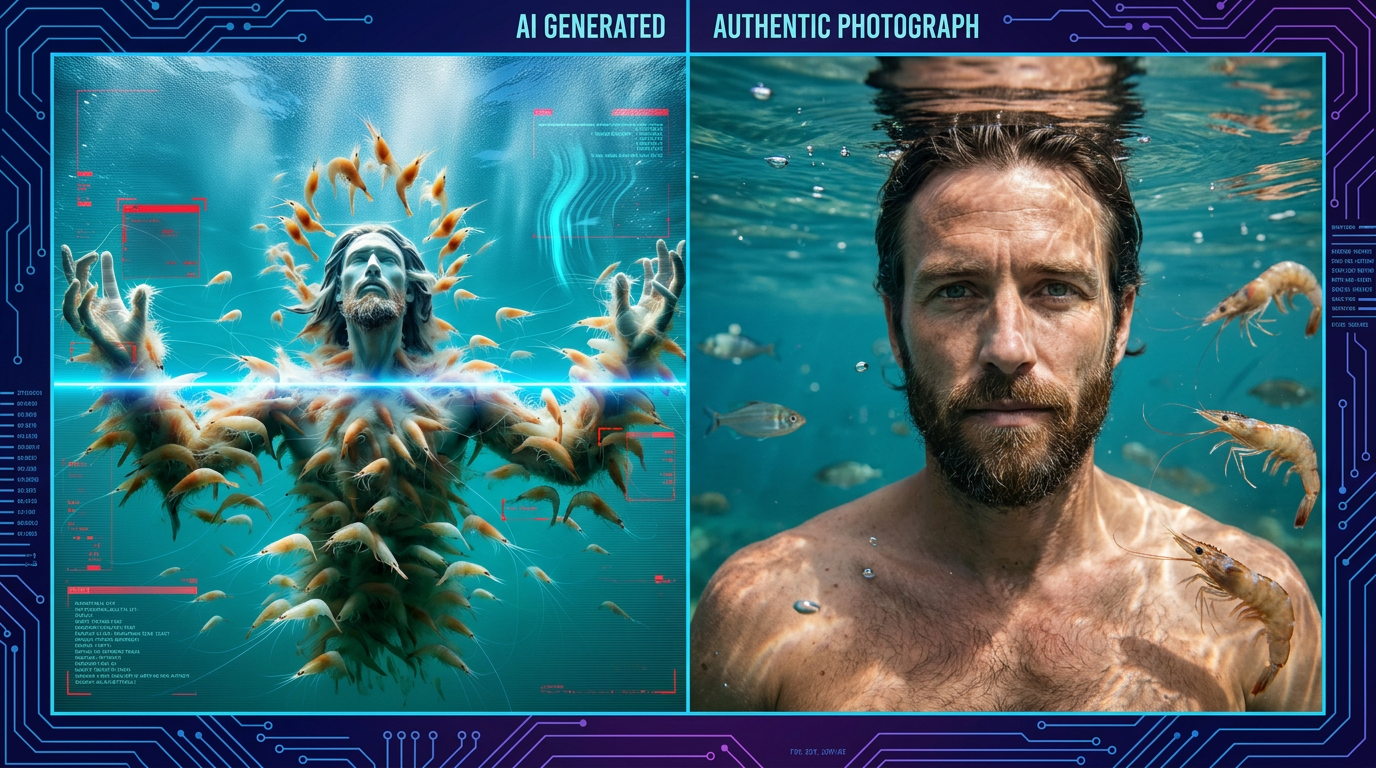
As generative AI models achieve photorealism, traditional visual tells like distorted hands are no longer reliable. This comprehensive guide explores the subtle physics, biological cues, and cryptographic tools needed to verify digital media today.
By Factlen Editorial Team
- Cybersecurity & Detection Experts
- This camp argues that human visual detection is obsolete and relies on technical tools and cryptographic provenance.
- Media Literacy Educators
- This viewpoint emphasizes training the public to critically evaluate the context and source of digital media.
- AI Researchers & Technologists
- This group focuses on the rapid democratization of AI tools and the underlying mechanics of generative models.
What's not represented
- · Social Media Platform Moderators
- · Legal Professionals Adjudicating Evidence
Why this matters
With 34 million AI images generated daily and deepfakes surging across social media and corporate environments, the ability to verify digital reality is a critical modern survival skill. Understanding how to spot synthetic media protects your finances, your vote, and your worldview from manipulation.
Key points
- Traditional advice for spotting AI images, like looking for distorted hands, is largely obsolete in 2026.
- Modern visual tells include structural impossibilities in backgrounds, inconsistent lighting, and gibberish text.
- Video deepfakes often fail at biological cues, such as spontaneous blinking, natural breathing, and profile rotations.
- Cryptographic provenance, which embeds secure metadata at the source, is replacing visual detection as the gold standard.
- Experts recommend a multi-layered approach combining conscious viewing, reverse image searches, and AI detection tools.
In 2026, the digital landscape is flooded with synthetic media, fundamentally altering how society consumes visual information. Industry reports estimate that 34 million AI-generated images are now created every single day, fueling a global market valued at $12.4 billion. The era of easily identifiable, low-quality fakes has definitively ended. Today, generative models like Midjourney v8, Stable Diffusion XL Turbo, and OpenAI's latest iterations produce photorealistic visuals in seconds, indistinguishable to the naked eye from authentic photography. This rapid proliferation has transformed deepfakes from a niche science-fiction concept into a daily reality, with the volume of deepfakes surging by nearly 900% annually over the past few years.[1][4]
The barrier to entry for creating highly convincing synthetic media has completely collapsed. Previously, generating a realistic deepfake required specialized equipment, deep technical expertise, and massive computing power. Now, open-source models like LTX-2 allow anyone with a standard gaming PC to generate 4K deepfake videos at 50 frames per second, complete with synchronized audio. A bad actor can harvest just three seconds of clear audio from a public social media profile to clone a voice with remarkable accuracy. Consequently, creating a deepfake takes seconds and costs pennies, while proving it is fake requires hours of forensic analysis.[2]
The real-world impact of this technological shift touches nearly every sector of the economy and public life. Insurance companies face claims supported by artificially generated photos of property damage, while the real estate market battles listings featuring entirely synthetic interior designs. In the media and legal realms, fake event images are shared as genuine reporting, and the authenticity of photographic evidence is increasingly challenged in courtrooms. Cybersecurity leaders view this as a critical threat to digital trust, with over half of businesses in the U.S. and U.K. reporting deepfake scam attempts.[1][4]

As the technology has advanced, the traditional advice for spotting AI-generated images has become obsolete. In the early days of generative AI, users were taught to look for obvious visual flaws: hands with six fingers, unreadable text, or wildly asymmetrical facial features. However, modern models have largely solved these glaring anatomical errors. According to recent studies, only 0.1% of people can reliably detect modern deepfakes without the assistance of specialized tools. The battle has shifted from spotting obvious mistakes to identifying subtle breakdowns in physics and human behavior.[1][2][4]
Despite these advancements, visual clues still exist for those who know exactly where to look. Because generative models focus the majority of their computational power on the main subject of an image, the surrounding environment often receives significantly less precision. A close inspection of background elements frequently reveals structural impossibilities: tree branches that merge inexplicably into buildings, fences that dissolve into nothingness, or crowds of people with blurred, distorted faces. These contextual errors occur because AI struggles to maintain coherent three-dimensional geometry and spatial relationships across a two-dimensional plane.[6][9]
Lighting and shadows provide another critical layer of visual verification. AI-generated images often feature unnaturally perfect, cinematic lighting that makes the subject look like a highly polished movie still or magazine cover. However, when examined closely, the shadows cast by different objects may not align with a single, consistent light source. Furthermore, surfaces might appear too clean, lacking the natural scratches, dust, or wear and tear that characterize the physical world. These subtle inconsistencies in texture and illumination can betray an image's synthetic origins.[6][7][9]
Text and intricate patterns remain a persistent challenge for generative models. While AI has improved at rendering coherent letters in primary focal points, it still struggles with contextually accurate text on background signage, clothing, or distant labels. Often, the text will appear as gibberish, nonsensical characters, or letters that melt into one another. Similarly, complex patterns like plaid shirts, chainlink fences, or woven materials frequently lose their structural coherence halfway across an object, dissolving into a solid color or an entirely different design.[1][9]

Text and intricate patterns remain a persistent challenge for generative models.
When evaluating video deepfakes, the tells become biological rather than strictly visual. Modern deepfakes fail at the edges of human behavior, struggling with the tiny, unconscious movements that are computationally expensive to render correctly. For instance, real humans blink spontaneously every two to ten seconds, accompanied by subtle muscle movements around the eyes. AI-generated faces often stare for unnaturally long periods, and when they do blink, the motion appears mechanical and disconnected from the surrounding facial muscles.[2]
Audio synchronization and breathing patterns offer further clues in synthetic video. Human speech includes natural, rhythmic breathing that aligns with the syntax of the sentence. AI audio models frequently insert breath sounds at syntactically incorrect moments or loop identical breath sounds unnaturally. Additionally, lip-sync algorithms can struggle to match mouth movements perfectly with phoneme sounds, resulting in micro-delays or gaps that break the illusion of authentic speech.[2][3]
Physical interactions and profile rotations are the ultimate stress tests for video deepfakes. Most deepfake models are trained primarily on front-facing data. When a synthetic face rotates to a full profile, the rendering often breaks down: the jawline may detach from the neck, ears might blur, or glasses can appear to melt into the skin. Furthermore, current real-time deepfakes struggle significantly when hands occlude the face, making a simple request to wave a hand in front of the camera a highly effective verification technique during live video calls.[2]
Because visual inspection is no longer foolproof, experts advocate for a multi-layered detection approach that relies heavily on metadata and cryptographic verification. Every digital photograph contains hidden EXIF metadata that records details such as the camera model, exposure settings, and the exact time and location the image was captured. AI-generated images typically lack this authentic metadata, or feature metadata that has been artificially stripped or altered. Tools like online EXIF viewers allow users to inspect this hidden data layer to flag suspicious files.[7][8]

The technology industry is increasingly moving toward cryptographic provenance to solve the deepfake crisis. Standards like C2PA (Coalition for Content Provenance and Authenticity) embed secure Content Credentials into media at the moment of creation. These digital watermarks track the image's origin and any subsequent edits, providing a verifiable chain of custody. In 2026, the paradigm is shifting from trying to detect fake images to cryptographically proving the authenticity of real ones at the source.[4][5]
For images lacking cryptographic signatures, specialized AI detection tools have become essential. These platforms utilize deep learning neural networks trained on vast datasets of both real and synthetic media to identify pixel-level inconsistencies and texture irregularities. Some advanced systems employ hybrid spectral analysis, evaluating the frequency of the image alongside high-level semantic checks to detect manipulations that are invisible to the human eye.[5]
Reverse image searching remains one of the most accessible and effective verification strategies for the general public. By uploading a suspicious image to search engines like Google Images or TinEye, users can trace the visual back to its original source or see where else it has appeared online. If a highly dramatic or newsworthy image exists nowhere else on the internet, or if it first appeared on an unverified social media account rather than a credible news outlet, its authenticity is highly questionable.[4][7]

Ultimately, the first line of defense against synthetic media is a psychological shift in how society consumes digital content. Cybersecurity experts call this 'conscious viewing'—the practice of pausing to question anomalies rather than immediately accepting an image or video as absolute truth. This involves recognizing the bifurcation fallacy, where viewers assume content must be either entirely real or entirely fake, ignoring the reality that even authentic photos can be presented out of context to mislead.[1]
As generative AI continues to evolve, the arms race between creation models and detection tools will only intensify. A synthetic image detector trained on last year's models may struggle to identify outputs from the latest generation of AI, requiring continuous updates and development. In this rapidly shifting landscape, technical tools must be paired with robust media literacy education, empowering individuals to critically evaluate the context, source, and subtle physical realities of the media they consume every day.[5][6]
How we got here
2022-2023
Early generative models gain popularity, characterized by obvious visual flaws like distorted hands and unreadable text.
2024
Deepfake incidents surge globally, with businesses reporting a massive increase in synthetic media scam attempts.
2025
Open-source models democratize high-quality video generation, bringing the estimated number of deepfakes online to 8 million.
2026
The industry shifts focus toward cryptographic provenance and C2PA standards as visual detection becomes nearly impossible for the naked eye.
Viewpoints in depth
Cybersecurity & Detection Experts
This camp argues that human visual detection is obsolete and relies on technical tools and cryptographic provenance.
Security professionals emphasize that the arms race between generative AI and human perception has already been won by the machines. With only 0.1% of the public able to spot modern deepfakes, this group advocates for systemic, technical solutions. They push for the widespread adoption of C2PA Content Credentials to cryptographically sign real media at the source, and rely on deep-learning neural networks and spectral analysis to flag synthetic content at the platform level before it reaches the end user.
Media Literacy Educators
This viewpoint emphasizes training the public to critically evaluate the context and source of digital media.
Educators argue that while technical tools are necessary, they are not a silver bullet, as detection algorithms constantly play catch-up with new generative models. Instead, they focus on 'conscious viewing'—teaching people to pause, question emotional reactions, and verify the source of an image. They stress that misinformation often relies on real images presented with false context, meaning critical thinking and reverse image searching are just as important as spotting a digitally rendered artifact.
AI Researchers & Technologists
This group focuses on the rapid democratization of AI tools and the underlying mechanics of generative models.
Technologists highlight how the barrier to entry for creating synthetic media has completely collapsed. With open-source models like LTX-2 running on consumer hardware, the power to generate photorealistic video and audio is now universally accessible. This camp is primarily concerned with understanding the computational limitations of current models—such as their inability to accurately render profile rotations, spontaneous blinking, or complex background geometry—to better predict where the technology will evolve next.
What we don't know
- Whether social media platforms will universally mandate and display C2PA Content Credentials for all uploaded media.
- How quickly AI detection algorithms can adapt to the next generation of generative models, which are currently in development.
- The long-term psychological impact on society as the baseline assumption shifts from trusting digital media to defaulting to skepticism.
Key terms
- Deepfake
- Synthetic media where a person in an existing image or video is replaced with someone else's likeness using artificial neural networks.
- EXIF Metadata
- Hidden data embedded in a digital photo file that records details like the camera settings, date, time, and location of the shot.
- Generative Fill
- An AI process that synthesizes and fills in missing or occluded parts of an image based on the surrounding context.
- C2PA Content Credentials
- A digital watermarking standard that securely embeds metadata into media to track its origin and any subsequent AI edits.
- Bifurcation Fallacy
- The logical error of assuming content must be either entirely real or entirely fake, ignoring that authentic photos can be presented out of context.
Frequently asked
Can I still look for weird hands to spot AI images?
While early AI models struggled with hands, modern generators have largely solved this issue. You are more likely to find errors in background details, lighting consistency, or complex patterns.
What is the most reliable way to prove an image is real?
The most reliable method in 2026 is cryptographic provenance, such as C2PA Content Credentials, which embed secure, untamperable metadata into the image at the moment it is captured.
Are there free tools to check if an image is AI-generated?
Yes, there are several free tools available, including online EXIF viewers to check metadata, reverse image search engines like Google Images, and specialized AI detection platforms.
Why do AI-generated videos look unnatural when the person turns their head?
Most AI models are trained primarily on front-facing data. When a synthetic face rotates to a full profile, the rendering often breaks down, causing features like the jawline or glasses to blur or detach.
Sources
Source coverage
9 outlets
3 viewpoints surfaced









[1]ForbesMedia Literacy Educators
Detecting Deepfakes AI Images Tips 2026
Read on Forbes →[2]Mission CloudAI Researchers & Technologists
The Technology Has Escaped: Spotting Modern Deepfakes
Read on Mission Cloud →[3]Paladin AICybersecurity & Detection Experts
Deepfake Detection Guide 2026: How AI Identifies Fake Videos, Images & Audio
Read on Paladin AI →[4]Truth CheckCybersecurity & Detection Experts
How to Detect AI-Generated Photos in 2026 — Complete Guide
Read on Truth Check →[5]Facia.aiCybersecurity & Detection Experts
Online AI Image Detection Tools in 2026
Read on Facia.ai →[6]Britannica EducationMedia Literacy Educators
Tips for Spotting AI-Generated Images
Read on Britannica Education →[7]Secom PLCMedia Literacy Educators
How to spot AI-generated images
Read on Secom PLC →[8]Photoradar.ioCybersecurity & Detection Experts
How to Spot AI-Generated Images: A Visual Detection Guide (2026)
Read on Photoradar.io →[9]Factlen Editorial TeamAI Researchers & Technologists
Synthesis by Factlen editorial team
Read on Factlen Editorial Team →


Every angle. Every day.
Get meta stories with full source coverage and perspective breakdowns delivered to your inbox.