
How the US is Building a Cricket Empire Ahead of the LA28 Olympics
With the 2028 Los Angeles Olympics looming, a massive influx of investment and infrastructure is transforming cricket from a niche sport into a mainstream American spectacle.
By Factlen Editorial Team
- US Sports Investors
- Focuses on the untapped commercial potential, infrastructure development, and the lucrative broadcasting rights associated with bringing cricket to the American market.
- Grassroots Advocates
- Emphasizes the need for youth development, local academies, and building a sustainable domestic pipeline rather than relying solely on imported international stars.
- Cricket Traditionalists
- Views the T20 format and Olympic inclusion primarily as a vehicle to grow the game globally, while maintaining the sport's core traditions and international competitiveness.
What's not represented
- · Local Pomona residents affected by stadium construction
- · Traditional baseball fans adapting to the new sport
Why this matters
The inclusion of cricket in the LA28 Olympics is accelerating a multi-million-dollar push to establish the sport in the United States. This infrastructure boom is creating new professional pathways for American athletes and introducing a massive global entertainment product to the domestic sports market.
Key points
- Cricket will return to the Olympics at the 2028 Los Angeles Games after a 128-year absence.
- The tournament will feature the fast-paced T20 format with six men's and six women's teams.
- Matches will be played at a new $21 million modular stadium at the Fairplex in Pomona, California.
- Major League Cricket (MLC) is driving domestic growth, with a 53% increase in ticket sales last season.
- Investors aim to build 10 international-standard cricket venues across the US by 2030.
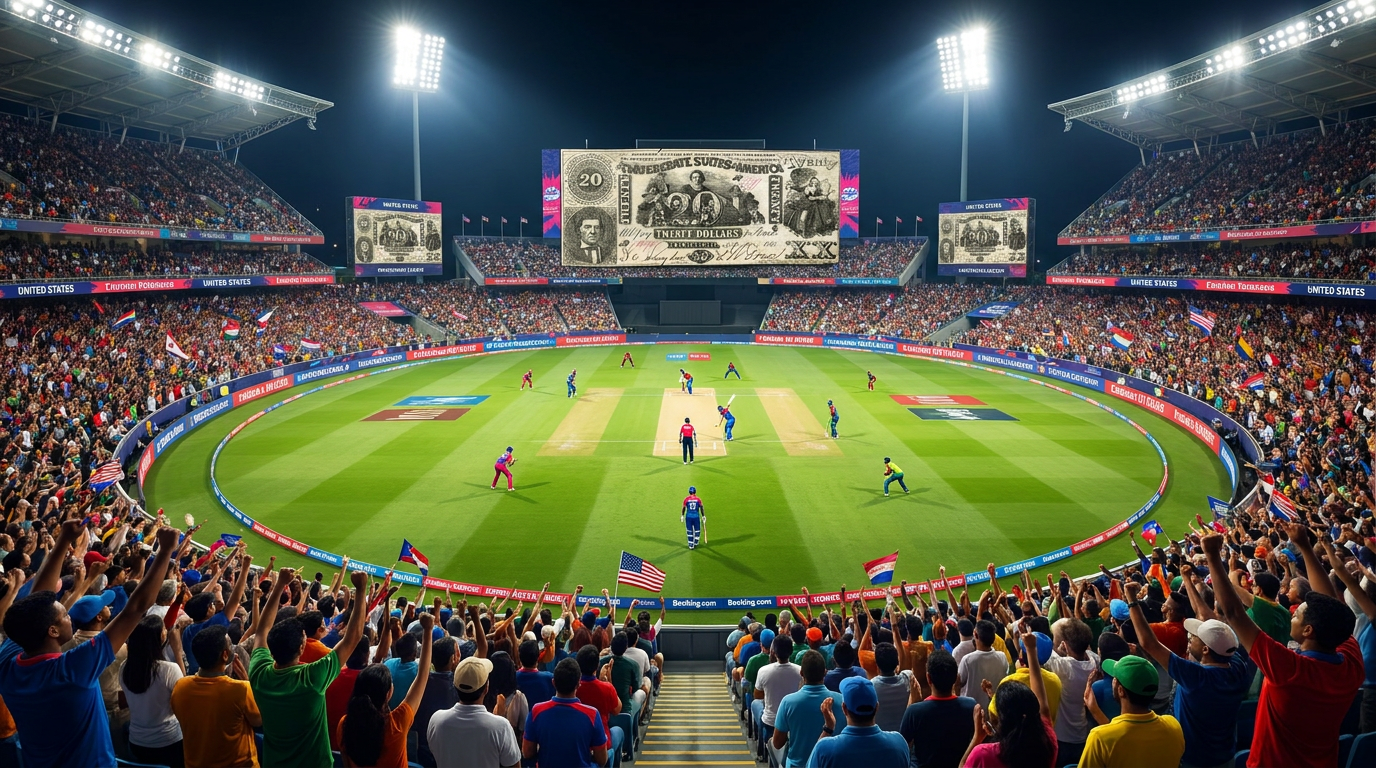
For more than a century, cricket and the Olympic Games have existed in parallel universes. The sport last appeared at the 1900 Paris Games, where a single, hastily arranged match between Great Britain and France served as its entire Olympic legacy. But as the 2028 Los Angeles Olympics approach, the world's second-most popular sport is preparing for a spectacular return to the global stage. The International Olympic Committee's decision to include cricket in the LA28 program has catalyzed a massive, coordinated effort to build a sustainable cricket ecosystem in the United States. What was once a niche pastime played primarily in immigrant communities on makeshift pitches is rapidly transforming into a multi-million-dollar professional entertainment industry, complete with franchise leagues, purpose-built stadiums, and a growing domestic fanbase.[1][3]
The Olympic tournament will feature the high-octane Twenty20 (T20) format, a condensed version of the game designed to be completed in roughly three hours. Both the men's and women's competitions will feature six teams, with a 90-player quota allocated per gender. This allows each participating nation to field a squad of up to 15 players. The decision to use the T20 format was strategic; its fast pace, frequent boundaries, and digestible run-time are tailor-made to appeal to an American audience accustomed to the rhythms of baseball and basketball. For the International Cricket Council, LA28 represents a golden opportunity to break beyond the sport's traditional Commonwealth strongholds and capture a slice of the lucrative North American sports market.[1][4]
Finding a suitable venue for an Olympic cricket tournament in Southern California presented a unique logistical challenge. The solution arrived in the form of a major infrastructure partnership. The LA28 organizing committee recently confirmed that the matches will be played at the Fairgrounds in Pomona, a sprawling 500-acre complex located roughly 30 miles east of downtown Los Angeles. To accommodate the Games, the Knight Riders Group—a major franchise owner in global cricket—announced a $21 million agreement to construct a modular, purpose-built stadium at the site. Known as the Knight Riders Cricket Ground, the facility will be expanded to a capacity of 15,000 for the Olympics and will serve as a permanent home for professional cricket in the region long after the closing ceremony.[1][6]

The Olympic spotlight is only one half of the American cricket equation. The engine driving the sport's domestic growth is Major League Cricket (MLC), the United States' first fully professional T20 franchise league. Launched in 2023, MLC was designed to prove that top-tier cricket could thrive in the US market. The results have exceeded initial expectations. As the league prepares to launch its fourth season in June 2026, it is riding a wave of unprecedented commercial success. The previous season set new records across the board, with ticket sales surging by 53 percent compared to the prior year. Perhaps most encouraging for the league's long-term viability, 84 percent of those ticket buyers were attending an MLC match for the very first time, indicating that the sport is successfully reaching beyond its traditional diaspora audience.[2][5]
This rapid expansion is fueled by serious financial muscle. American Cricket Enterprises (ACE), the strategic partner behind MLC, has already poured more than $150 million into the league's development. The investment strategy is heavily focused on solving the sport's biggest historical hurdle in the US: a lack of proper infrastructure. Unlike soccer or rugby, which can easily adapt to existing American football fields, elite cricket requires a specialized oval and a meticulously maintained pitch. ACE has committed to matching its initial investment over the next few years, with the ambitious goal of establishing ten international-standard cricket venues across the United States by 2030. This infrastructure boom is laying the physical groundwork required to host both domestic franchises and future international tournaments.[2][6]
American Cricket Enterprises (ACE), the strategic partner behind MLC, has already poured more than $150 million into the league's development.
The league's footprint is already expanding well beyond its initial hub in Grand Prairie, Texas. Recent seasons have seen professional matches staged at the iconic Oakland Coliseum in California and Broward County Stadium in Florida. The ability to draw crowds in diverse geographic markets is a crucial proof of concept for MLC's franchise model. The on-field product has also benefited from the influx of capital, attracting a roster of international superstars who previously would never have considered playing domestic cricket in America. Players like Trent Boult and Faf du Plessis have elevated the standard of play, providing a world-class spectacle that translates well to television. Global broadcast and streaming coverage for the league has now extended to more than 90 countries, reaching an estimated 54 million homes.[2][5]

While importing international talent is necessary to establish the league's credibility, the long-term success of American cricket depends on cultivating homegrown players. To that end, MLC operates a developmental pipeline known as Minor League Cricket, alongside a network of youth academies. These grassroots initiatives are designed to identify and train young American athletes, providing them with a clear pathway to professional contracts. The goal is to ensure that by the time the LA28 Olympics arrive, the United States national team is not merely a host-nation participant, but a competitive force capable of challenging established cricketing nations. Developing a robust domestic talent pool is widely viewed as the most critical, and most difficult, phase of the sport's American project.[5][6]
The cultural implications of this sporting shift are significant. For decades, cricket in the United States was sustained almost entirely by passionate communities of South Asian, Caribbean, and British expatriates. They played on uneven public parks, organizing amateur leagues that operated entirely under the radar of the broader American sporting consciousness. The arrival of MLC and the looming LA28 Olympics represent a validation of those decades of quiet dedication. The sport is finally stepping into the mainstream light, transitioning from a nostalgic connection to a home country into a vibrant, distinctly American sporting experience. The integration of local food, music, and entertainment into the match-day experience is helping to forge a new, hybrid cricket culture.[6]
Challenges certainly remain on the horizon. The global cricket calendar is notoriously crowded, and MLC must constantly compete with established leagues in England, India, and Australia for the attention of top players. Furthermore, the administrative side of the sport in the US has historically been plagued by instability and governance issues. USA Cricket, the national governing body, has faced ongoing internal turbulence, which occasionally threatens to cast a shadow over the commercial success of the franchise league. Maintaining a stable, unified front between the commercial operators and the national federation will be essential as the Olympic spotlight intensifies.[2][6]

Despite these administrative hurdles, the sheer momentum behind the sport is undeniable. The combination of Olympic prestige, Silicon Valley investment, and a massive, untapped domestic market has created a perfect storm for cricket's American expansion. The upcoming 2026 MLC season will serve as a crucial stress test for the new infrastructure and expanded schedule. If the league can maintain its upward trajectory, it will solidify its position as a permanent fixture in the crowded American sports landscape. The road to LA28 is now clearly paved, and the sport is moving at a pace that few would have predicted even five years ago.[2][5][6]
Ultimately, the success of this endeavor will be measured not just by ticket sales or broadcast rights, but by the sport's ability to capture the imagination of the next generation. When the first ball is bowled at the Fairplex in Pomona in the summer of 2028, it will mark the culmination of a century-long journey. For the international cricket community, it is a chance to showcase their beloved game on the world's biggest stage. For the United States, it is an opportunity to embrace a global phenomenon and make it their own. The 128-year wait is nearly over, and American cricket is finally ready for its moment in the sun.[1][3][6]
As the countdown to 2028 continues, the synergy between Major League Cricket and the Olympic movement will only grow stronger. The infrastructure being built today—from the modular stadium in Pomona to the youth academies in Texas—is designed to outlast the two-week Olympic window. Stakeholders are betting that the global exposure of the Games will act as a massive catalyst, introducing the rules, the stars, and the sheer excitement of T20 cricket to millions of uninitiated American viewers. If that introduction is successful, the legacy of LA28 won't just be a handful of gold medals; it will be the permanent establishment of cricket as a major American sport, fundamentally altering the global economy of the game for decades to come.[4][6]
How we got here
1900
Cricket makes its first and only Olympic appearance at the Paris Games.
July 2023
Major League Cricket launches its inaugural professional season in the US.
October 2023
The IOC officially approves the inclusion of T20 cricket for the LA28 Olympics.
March 2026
Plans are announced for a $21 million permanent cricket stadium at the Fairplex in Pomona.
June 2026
Major League Cricket begins its fourth season, expanding to new venues across the country.
Viewpoints in depth
US Sports Investors
Focuses on the untapped commercial potential and infrastructure development in the American market.
For sports investors, the United States represents the final frontier for global cricket. The strategy revolves around leveraging the massive South Asian diaspora as a foundational fanbase while gradually introducing the fast-paced T20 format to traditional American sports consumers. By pouring over $150 million into infrastructure—such as the new stadium in Pomona and upgrades in Texas and Florida—investors are building tangible assets that legitimize the sport domestically. They view the LA28 Olympics not just as a sporting event, but as a multi-million-dollar marketing campaign that will exponentially increase the value of domestic broadcast rights and franchise valuations.
Grassroots Advocates
Emphasizes the need for youth development and building a sustainable domestic pipeline.
Grassroots advocates argue that while importing international stars like Trent Boult and Faf du Plessis is great for immediate ticket sales, it does not guarantee long-term survival. This camp stresses that the true measure of success for American cricket will be its ability to produce homegrown talent capable of competing on the world stage. They point to the expansion of Minor League Cricket and local youth academies as the most vital components of the sport's growth. Without a robust pipeline of young American players, they warn, the sport risks remaining a novelty rather than becoming an integrated part of the American athletic culture.
Cricket Traditionalists
Views the T20 format and Olympic inclusion primarily as a vehicle to grow the game globally.
Traditionalists within the global cricket community see the LA28 Olympics as a necessary evolution for the sport. While some purists still favor the five-day Test format, there is a broad consensus that T20 is the only viable vehicle for Olympic inclusion and American expansion due to its shorter runtime and high-scoring nature. For this camp, the goal is to use the Olympic platform to secure government funding for cricket in associate nations worldwide, using the American experiment as a blueprint for how the sport can successfully break out of its historical Commonwealth boundaries.
What we don't know
- Whether the US national team will automatically qualify for the LA28 tournament or if they will need to pass through a regional qualifier.
- How successfully the sport will attract non-diaspora American fans once the initial novelty of the Olympics fades.
- The exact broadcast partnership details for the LA28 cricket tournament within the United States.
Key terms
- Twenty20 (T20)
- A fast-paced, shortened format of cricket where each team bats for a maximum of 20 overs, typically lasting about three hours.
- Over
- A set of six legal deliveries (pitches) bowled by a single bowler from one end of the pitch.
- Wicket
- The set of three wooden stumps at either end of the pitch, or the event of a batter getting out.
- Major League Cricket (MLC)
- The premier professional Twenty20 cricket league in the United States, launched in 2023.
Frequently asked
Will the US automatically qualify for LA28?
As the host nation, the United States is expected to receive automatic qualification for both the men's and women's tournaments, though the ICC has yet to finalize the exact qualification pathway.
Where will the Olympic matches be played?
Matches will be held at a purpose-built, modular stadium at the Fairplex in Pomona, California, roughly 30 miles east of Los Angeles.
What is the difference between T20 and Test cricket?
Test cricket is the traditional format played over five days, while T20 is a condensed, high-scoring version designed to be completed in about three hours.
Sources
Source coverage
6 outlets
3 viewpoints surfaced






[1]Olympics.comCricket Traditionalists
LA 2028 Olympics cricket venue announced
Read on Olympics.com →[2]ForbesUS Sports Investors
Major League Cricket Eyes 10 Stadiums By 2030
Read on Forbes →[3]ESPNcricinfoCricket Traditionalists
IOC accepts recommendation to include T20 cricket in 2028 Los Angeles Olympics
Read on ESPNcricinfo →[4]LA28 OfficialCricket Traditionalists
Cricket at LA28
Read on LA28 Official →[5]Cricket WorldUS Sports Investors
Major League Cricket Season 4 Dates Announced
Read on Cricket World →[6]Factlen Editorial TeamGrassroots Advocates
Synthesis by Factlen editorial team
Read on Factlen Editorial Team →
More in sports
See all 329 stories →USWNT
USWNT Grinds Out 1-0 Victory Over Brazil in Chaotic, Character-Building Friendly
6 sources
2026 Regulations
Formula 1's 2026 Revolution: How Active Aero and Sustainable Fuels Will Change Racing
9 sources
Gymnastics Longevity
The Longevity Revolution: How Older Athletes and NIL Are Reshaping Elite Gymnastics
7 sources
NFL Champions
Seattle Seahawks Unveil Super Bowl LX Championship Rings Featuring Tributes to Fans and City History
8 sources
Every angle. Every day.
Get sports stories with full source coverage and perspective breakdowns delivered to your inbox.