
How the Fediverse and Decentralized Social Media Actually Work
As platforms like Threads and Bluesky embrace open protocols in 2026, the era of the walled-garden social network is beginning to crack. Here is how decentralized social media is quietly rewiring the internet to give users control over their data and algorithms.
By Factlen Editorial Team

- Open-Web Idealists
- Argue that true digital freedom requires completely abandoning corporate-owned platforms in favor of self-hosted, decentralized protocols.
- Pragmatic Adopters
- Believe that decentralized tech only matters if it achieves massive mainstream scale through intuitive user experiences.
- Protocol Architects
- Focus on the underlying technical standards and plumbing that make cross-platform interoperability possible.
- Analytical Synthesis
- Evaluates the broader shift from closed platforms to open protocols, weighing user empowerment against technical friction.
What's not represented
- · Legacy Platform Executives
- · Everyday non-technical users
Why this matters
For the last decade, our digital lives have been locked inside proprietary platforms where algorithms dictate what we see and companies own our social graphs. The shift to decentralized protocols means you can finally own your audience, choose your own algorithm, and move between networks without losing your connections.
Key points
- Decentralized social media relies on open protocols, allowing independent servers to communicate like email providers.
- ActivityPub, a W3C standard, is the dominant protocol powering the Fediverse, utilized by platforms like Mastodon and Threads.
- Bluesky operates on a parallel architecture called the AT Protocol, which emphasizes user-selected recommendation algorithms.
- The shift empowers users with true data portability, meaning they can migrate their followers to new servers without starting over.
For the last fifteen years, participating in social media meant renting space inside a corporate walled garden. Users built vast networks of friends, followers, and professional contacts, only to realize that a single algorithm update or platform acquisition could sever those connections overnight. But in 2026, the architecture of the internet is undergoing a quiet, structural rewiring. The era of the closed platform is beginning to crack, making way for a model where users—not tech giants—own their digital identities.[7]
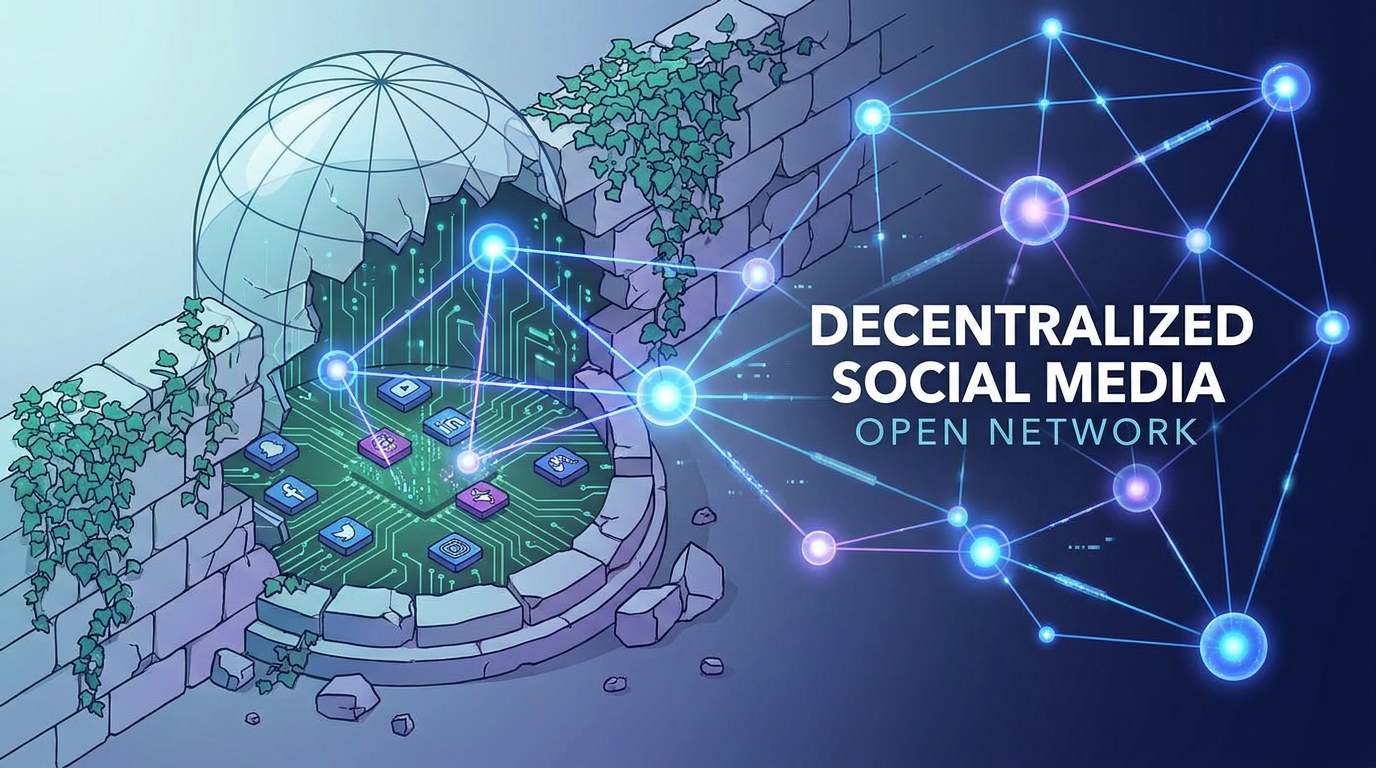
This shift is being driven by the maturation of decentralized social media, a landscape broadly referred to as the Fediverse. Rather than logging into a single central server owned by one company, users are migrating to a web of independent, interconnected servers that all speak the same underlying language. The momentum has accelerated to the point where major tech figures are publicly pivoting; Ethereum co-founder Vitalik Buterin recently declared 2026 the year he would fully recommit to decentralized platforms, arguing that centralized networks have devolved into polarized "information warzones."[2][3]
To understand how this new ecosystem functions, it helps to look at a technology we already use every single day: email. If you have a Gmail account, you can seamlessly send a message to a colleague who uses Microsoft Outlook, Apple Mail, or a custom company server. You do not need to be on the exact same platform to communicate, because all email providers use a shared, open protocol to route messages. The Fediverse applies this exact same interoperable logic to modern social media features like likes, follows, and posts.[2]
The engine powering the vast majority of the Fediverse is ActivityPub, an open, decentralized social networking protocol standardized by the World Wide Web Consortium (W3C)—the exact same international body responsible for foundational web standards like HTML and CSS. ActivityPub provides a pre-designed, universal architecture that allows entirely different applications to interoperate seamlessly. Because of this shared language, a user on a text-based microblogging site can follow a user on a photo-sharing app, and both can interact with a video hosted on a third platform, all without ever leaving their respective feeds.[5]

Under the hood, ActivityPub operates on a surprisingly simple and elegant mechanism built around three core concepts: Actors, Activities, and Objects. An "Actor" is an entity capable of taking action, such as a standard user profile, an automated bot, or even a digital publication. When that Actor does something—like publishing a new text post, liking a photo, or following another user—they generate an "Activity." The specific piece of content or profile they are interacting with is classified as the "Object." This standardized vocabulary ensures every server understands exactly what is happening.[4][5]
These interactions are routed across the internet through a standardized Inbox and Outbox system attached to every Actor. When a user publishes a new post, their home server packages that "Create" activity and pushes it to their personal Outbox. The server then acts as a digital mail carrier, delivering the activity directly to the Inboxes of everyone who follows them, regardless of which independent server those followers are hosted on. It represents a fundamental architectural shift from the traditional "pull" model of a centralized algorithmic feed to a distributed "push" model of communication.[4][5]
While ActivityPub was initially popularized in the mainstream by Mastodon—a chronological, ad-free microblogging network that surged in popularity during the turbulent platform migrations of the early 2020s—the protocol has since expanded far beyond short-form text. The W3C's Activity Streams format, which underpins the protocol's data structures, is highly flexible and capable of supporting diverse media. Today, the Fediverse includes specialized platforms like Pixelfed for Instagram-style image sharing, PeerTube for decentralized video streaming, and Lemmy for Reddit-style forum discussions, all communicating seamlessly.[2][6]
The W3C's Activity Streams format, which underpins the protocol's data structures, is highly flexible and capable of supporting diverse media.
Even long-form publishing has enthusiastically joined the federated web. Modern publishing platforms like Ghost have integrated ActivityPub directly into their core content management systems. This integration allows a standalone, independent blog to function as a fully interactive "Actor" on the Fediverse. When an author publishes a new long-form article, it is automatically federated out to subscribers across various social networks. Those readers can then like, share, and comment on the piece directly from their own microblogging feeds, with the interactions syncing back to the original blog.[4]

The most significant catalyst for the widespread adoption of decentralized social media, however, has been the entry of mainstream tech giants. Meta's Threads, which originally launched as a centralized competitor to X, has spent the last year steadily rolling out opt-in ActivityPub federation. By early 2026, Threads had actually surpassed X in daily mobile users, boasting roughly 141.5 million active mobile users. By bridging this massive, mainstream user base to the broader Fediverse, Meta has given open protocols an unprecedented level of global visibility and practical utility.[1]
Running parallel to the ActivityPub ecosystem is Bluesky, another major challenger that has taken a slightly different, yet equally impactful, approach to decentralization. Originally incubated as an internal research project within Twitter before spinning out independently, Bluesky operates on its own custom architecture called the AT Protocol. While it does not currently natively communicate with ActivityPub servers, it shares the exact same foundational philosophy: ensuring that no single corporate entity can ever completely control a user's digital identity or monopolize their underlying social graph.[1]
By 2026, Bluesky has grown to approximately 35 million registered users, carving out a highly active niche among journalists, developers, and creators. Its signature innovation is the complete decoupling of the user interface from the recommendation algorithm. On traditional platforms, the parent company dictates exactly what content surfaces in your feed to maximize engagement. On Bluesky, users can subscribe to custom algorithms built by third-party developers, allowing them to instantly swap between a chronological feed, a feed optimized for breaking news, or a feed strictly focused on a specific niche.[1]
This concept of algorithmic choice is central to the broader appeal of the decentralized web. For years, users and creators have been at the absolute mercy of opaque, constantly shifting algorithms that frequently prioritize engagement, outrage, and controversy over actual utility or truth. Decentralized platforms empower users to actively curate their own digital diets, filtering out spam and toxicity at the protocol level rather than relying on an overwhelmed, centralized corporate moderation team to police billions of daily interactions across the globe.[2][3][7]

Furthermore, decentralization offers genuine censorship resistance and true data portability, fundamentally altering the power dynamic between user and platform. If a specific server in the Fediverse is purchased by a hostile actor, drastically changes its moderation rules, or simply runs out of funding and shuts down, users are not forced to start over from scratch. Because they cryptographically own their social graph, they can seamlessly migrate their account—complete with their followers, following lists, and history—to an entirely different server, much like transferring a cell phone number to a new carrier.[6]
Despite these massive architectural breakthroughs, the decentralized web still faces significant hurdles before it can fully replace legacy systems. Onboarding remains a persistent point of friction for the average consumer. Explaining the concept of "instances" and "servers" to users accustomed to simply downloading an app and creating a username requires a steep learning curve. While multi-client aggregators like Firefly are emerging to seamlessly blend multiple protocols into a single, unified interface, the overall user experience still occasionally lags behind the highly polished, frictionless environments of legacy platforms.[2][3][7]
There are also complex technical and social challenges to navigate as the network scales. Moderation in a federated system is inherently fragmented; while individual servers can easily block malicious instances, coordinating network-wide defenses against sophisticated, coordinated spam or harassment campaigns is incredibly difficult. Additionally, the decentralized nature of the network means that poorly optimized software implementations can inadvertently trigger distributed denial-of-service (DDOS) attacks, as thousands of independent servers simultaneously attempt to fetch the exact same piece of media or link preview.[2][5]
Yet, despite these inevitable growing pains, the long-term trajectory of the internet is becoming abundantly clear. The era of the monolithic, centrally controlled social network is slowly giving way to a much more resilient, user-centric digital architecture. Whether through the massive mainstream scale of Threads, the algorithmic innovations of Bluesky, or the fiercely independent, values-driven communities of Mastodon, decentralized social media has definitively proven that a more open web is not just a theoretical ideal—it is functional, scalable, and already here.[7]
How we got here
Jan 2018
The W3C officially publishes ActivityPub as a recommended web standard.
Late 2022
Millions of users migrate to Mastodon following the acquisition and rebranding of Twitter.
July 2023
Meta launches Threads, promising future integration with the open Fediverse.
Early 2024
Bluesky opens to the public, introducing custom algorithms via the AT Protocol.
Early 2026
Threads surpasses X in daily mobile users while continuing its opt-in ActivityPub rollout.
Viewpoints in depth
Open-Web Idealists
Argue that true digital freedom requires completely abandoning corporate-owned platforms.
This camp, championed by early Web3 pioneers and privacy advocates, believes that algorithmic feeds have turned the internet into an 'information warzone.' They argue that users must own their social graphs and identities outright. For them, the ultimate goal is a landscape where no single CEO or board of directors can dictate moderation policies, alter the recommendation algorithm, or lock users out of their own audiences.
Pragmatic Adopters
Believe that decentralized tech only matters if it achieves massive mainstream scale.
This perspective focuses on user experience and frictionless onboarding. They argue that pure decentralization is too technical for the average user, and that the real victory is getting giants like Meta to adopt open protocols. By integrating ActivityPub into Threads, they believe the protocol achieves the critical mass necessary to make the Fediverse relevant to everyday consumers, even if it means compromising on absolute independence.
Protocol Architects
Focus on the underlying plumbing that makes interoperability possible.
For the developers and standards bodies building these systems, the focus is on robust, flexible architecture. They view protocols like ActivityPub and the AT Protocol as living standards that must evolve to support new media types—from long-form publishing to video streaming. Their primary concern is ensuring that the technical specifications remain secure, efficient, and capable of handling complex interactions without fragmenting the network.
What we don't know
- Whether Meta will ever implement full two-way federation for Threads, or keep it strictly opt-in.
- How decentralized networks will handle large-scale copyright enforcement and illegal content across independent servers.
- If Bluesky's AT Protocol and the W3C's ActivityPub will eventually build seamless native bridges, or remain permanently siloed.
Key terms
- ActivityPub
- An open, decentralized social networking protocol standardized by the W3C that allows different servers to share content and interactions.
- Fediverse
- A portmanteau of 'federation' and 'universe,' referring to the interconnected network of independent social media servers.
- AT Protocol
- An alternative open social networking protocol developed by Bluesky, focusing on account portability and customizable recommendation algorithms.
- Instance
- A single, independently hosted server within the Fediverse that maintains its own community rules and user accounts.
- SocialFi
- The intersection of social media and decentralized finance/Web3, emphasizing user ownership of data and social graphs.
Frequently asked
What exactly is the Fediverse?
The Fediverse is a network of independent social media servers that can communicate with each other using shared open protocols, much like how different email providers can send messages to one another.
Can Threads users talk directly to Bluesky users?
Not natively. Threads uses the ActivityPub protocol, while Bluesky uses its own AT Protocol. However, third-party bridges are actively being developed to connect the two networks.
Do I have to host my own server to join?
No. While technically inclined users can host their own servers, most people simply create an account on an existing public server, just as you would sign up for a Gmail or Yahoo email address.
Sources
Source coverage
7 outlets
4 viewpoints surfaced






[1]PostoryPragmatic Adopters
What Are the Four Microblogging Platforms in 2026?
Read on Postory →[2]ElestioOpen-Web Idealists
The Fediverse Is Growing: Why Decentralized Social Media Matters in 2026
Read on Elestio →[3]TradingViewOpen-Web Idealists
Ethereum co-founder Vitalik Buterin recommits to decentralized social media
Read on TradingView →[4]CortiPragmatic Adopters
Ghost and the Social Web: How ActivityPub Works
Read on Corti →[5]WikipediaProtocol Architects
ActivityPub
Read on Wikipedia →[6]The New StackProtocol Architects
ActivityPub: The Practicalities of Linking Up With the Fediverse
Read on The New Stack →[7]Factlen Editorial TeamAnalytical Synthesis
Synthesis by Factlen editorial team
Read on Factlen Editorial Team →

More in technology
See all 5 stories →

Every angle. Every day.
Get technology stories with full source coverage and perspective breakdowns delivered to your inbox.