
How Sound, Clones, and 'Super Corals' Are Rebuilding the Ocean's Reefs
Marine scientists are deploying a new generation of high-tech restoration techniques—from acoustic enrichment to micro-fragmentation—to rebuild coral reefs faster than they are disappearing.
By Factlen Editorial Team
- Eco-Engineering Innovators
- Believe that active, high-tech interventions are the only way to save reefs from near-term extinction.
- Marine Ecologists
- Focus on the long-term biodiversity of the ecosystem, warning against relying on single 'super coral' strains.
- Climate Policy Advocates
- Argue that while restoration is vital, it cannot serve as an excuse to delay global greenhouse gas emission reductions.
- Coastal Communities
- Prioritize the immediate restoration of reefs to protect local food security, tourism income, and storm barriers.
What's not represented
- · Commercial fishing industries relying on reef habitats
- · Tourism boards in reef-adjacent economies
Why this matters
Coral reefs support 25% of all marine life and provide food and coastal protection for over half a billion people. These new scientific breakthroughs prove that humanity has the tools to actively repair damaged ecosystems, rather than just watching them decline.
Key points
- Micro-fragmentation allows corals to grow up to 100 times faster by triggering a rapid healing response.
- Scientists are selectively breeding 'super corals' that can withstand extreme ocean temperatures.
- Underwater speakers playing healthy reef sounds successfully attract free-floating coral larvae to settle on dead reefs.
- Abu Dhabi has launched a massive 1,200-square-kilometer restoration project using 3D-printed reef modules.
- While these technologies buy crucial time, they must be paired with global emissions reductions to ensure long-term survival.
For decades, the narrative surrounding the world’s coral reefs has been one of inevitable decline. As ocean temperatures rise, these vibrant underwater cities have faced mass bleaching events that threaten to wipe out ecosystems supporting a quarter of all marine life. But beneath the surface, a quiet revolution is taking place. Marine biologists and eco-engineers have shifted from passive conservation—simply protecting areas and hoping they recover—to active, high-tech intervention. Armed with underwater speakers, specialized saws, and laboratory-bred “super corals,” scientists are proving that humanity can rebuild reefs faster than they are being lost.[6]
The urgency of this shift is underscored by the Coral Reef Breakthrough, a global initiative launched in collaboration with the UN to secure $12 billion in funding by 2030. The goal is unprecedented in scale: to actively restore and protect 125,000 square kilometers of shallow-water tropical reefs. Achieving this requires moving beyond traditional methods. Historically, coral restoration involved breaking off pieces of healthy coral and tying them to underwater frames. It worked, but it was painstakingly slow. A typical brain coral might grow only a few millimeters a year, meaning a damaged reef could take centuries to naturally rebuild its structural complexity.[3]
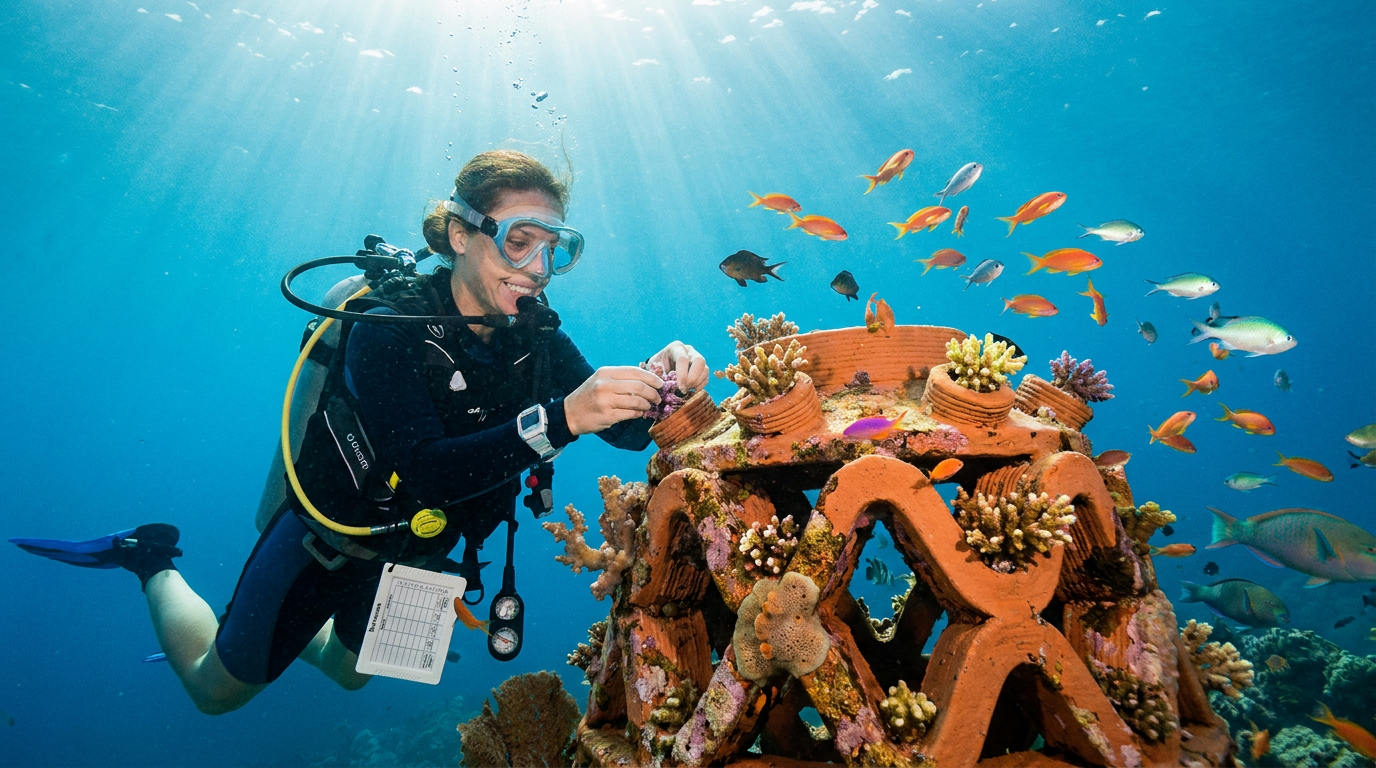
The first major breakthrough to solve this speed limit was an accidental discovery that led to a technique called micro-fragmentation. Scientists realized that when a coral is cut into tiny pieces—often smaller than a fingernail—its natural healing response kicks into overdrive. Using specialized diamond-blade saws, researchers slice living coral into micro-fragments and place them close together on a substrate. Recognizing their shared genetics, the growing fragments fuse back together rather than competing for space.[1]

The results of micro-fragmentation are staggering. Corals that would normally take 25 to 100 years to reach the size of a basketball can now achieve that same mass in just two to three years. This exponential growth rate allows conservationists to mass-produce mature, reef-building corals in land-based nurseries before transplanting them into the ocean. It effectively hits the fast-forward button on ecosystem recovery, turning a multi-generational waiting game into a project that can yield visible results within a single political term.[1][6]
But growing coral quickly is only half the battle; the new coral must also survive the warming waters that killed its predecessors. Enter "assisted evolution" and the hunt for "super corals." In places like the Gulf of Aqaba and the northern Red Sea, corals routinely survive in water temperatures reaching 36°C (96.8°F)—conditions that would instantly bleach and kill corals in the Caribbean or the Great Barrier Reef. Scientists are now mapping the genetic markers that give these specific strains their extreme heat tolerance.[2][5]
But growing coral quickly is only half the battle; the new coral must also survive the warming waters that killed its predecessors.
By identifying these resilient traits, researchers are selectively breeding heat-tolerant corals in a process often dubbed "Coral IVF." During natural mass spawning events, scientists collect coral eggs and sperm, bringing them into controlled laboratory environments to maximize fertilization. In the wild, less than 0.1% of coral larvae survive their first few months, often falling prey to predators or failing to find a suitable place to anchor. By rearing them in the lab through their most vulnerable stages, survival rates jump tenfold.[2][4]

Once these lab-reared, heat-resilient "super babies" are ready to be released, they face another challenge: knowing where to settle. Free-floating coral larvae are essentially blind, but they have an acute sense of hearing. A healthy coral reef is incredibly noisy, filled with the constant crackle of snapping shrimp and the whoops, grunts, and chirps of thousands of fish. A dead or bleached reef, however, is eerily silent. Larvae drifting on ocean currents use these acoustic cues to find a thriving neighborhood to call home.[1][6]
To trick larvae into settling on degraded reefs, scientists have pioneered "acoustic enrichment." By placing underwater speakers on dead reef frameworks and broadcasting the bustling soundscape of a healthy ecosystem, researchers create a siren song for marine life. Field studies show that playing these acoustic tracks significantly increases the settlement rates of coral larvae and rapidly attracts juvenile fish, which are crucial for eating the algae that might otherwise smother the young corals.[1]

These techniques are no longer confined to small pilot studies. In May 2025, Abu Dhabi launched the Coral Gardens initiative, the world's largest restoration project by area. Spanning 1,200 square kilometers, the $443 million project dwarfs previous global efforts. It integrates 40,000 3D-printed terracotta reef modules, which provide the perfect textured substrate for micro-fragmented, heat-adapted Gulf corals to attach and grow. Early data from the region's pilot sites showed a 95% coral survival rate and a 50% increase in local fish populations.[5]
Despite these incredible successes, marine ecologists emphasize transparent uncertainty regarding the long-term trade-offs of bio-engineering. "Super corals" that excel at surviving extreme heat often expend so much energy on thermal regulation that they grow slower than their wild counterparts. Furthermore, some heat-resistant strains have shown decreased resistance to ocean acidification, the chemical twin of global warming. As one researcher noted, it is like breeding a triathlete who excels at swimming but struggles on the run; one-trick genetic ponies cannot build a fully robust ecosystem.[4]

Furthermore, the scientific consensus remains clear: technological interventions cannot replace the fundamental need to reduce global greenhouse gas emissions. If ocean temperatures continue to rise unchecked, even the most resilient "super corals" will eventually hit their biological limits. Restoration is not a cure for climate change; it is a highly effective life-support system designed to buy the world's oceans a few more decades of time.[2][6]
Yet, buying time is exactly what the ocean needs. By combining micro-fragmentation, assisted evolution, and acoustic enrichment, humanity is proving that we do not have to be mere witnesses to ecological collapse. We now have the blueprints to act as active stewards, rebuilding the rainforests of the sea and ensuring that the half-billion people who rely on them have a secure, vibrant future.[3][6]
How we got here
Early 2010s
Micro-fragmentation is accidentally discovered, revolutionizing the speed at which coral can be grown in nurseries.
2019
Field studies confirm that acoustic enrichment successfully attracts coral larvae to degraded reefs.
2023
The Coral Reef Breakthrough is launched, aiming to secure $12 billion to restore 125,000 square kilometers of reefs.
May 2025
Abu Dhabi launches the Coral Gardens initiative, the world's largest active restoration project spanning 1,200 square kilometers.
Viewpoints in depth
Eco-Engineering Innovators
Believe that active, high-tech interventions are the only way to save reefs from near-term extinction.
This camp argues that passive conservation—simply drawing lines on a map and calling it a marine protected area—is no longer sufficient in a rapidly warming world. Innovators champion the aggressive scaling of micro-fragmentation, 3D printing, and acoustic enrichment. They point to the exponential growth rates achieved in labs and massive deployments like Abu Dhabi's Coral Gardens as proof that humanity can actively engineer its way out of localized ecological collapse, provided the funding matches the ambition.
Marine Ecologists
Focus on the long-term biodiversity of the ecosystem, warning against relying on single 'super coral' strains.
While supportive of restoration, ecologists caution against treating the ocean like a monoculture farm. They warn that selectively breeding 'super corals' for heat tolerance often comes with hidden biological costs, such as slower growth rates or increased vulnerability to ocean acidification. This camp stresses that a true reef is a complex web of thousands of species, and that restoration efforts must prioritize genetic diversity rather than just planting the toughest, fastest-growing coral variants available.
Climate Policy Advocates
Argue that while restoration is vital, it cannot serve as an excuse to delay global greenhouse gas emission reductions.
Policy advocates view coral restoration as a necessary life-support system, not a cure. They express concern that highly publicized technological fixes might create a false sense of security, giving heavy polluters an excuse to maintain the status quo. Their core argument is thermodynamic: if the oceans continue to absorb record amounts of heat and carbon dioxide, eventually even the most heavily engineered 'super corals' will exceed their biological limits and perish.
What we don't know
- Whether 'super corals' bred for heat tolerance will remain resilient against future, currently unknown marine diseases.
- How effectively lab-reared corals will reproduce naturally once they reach maturity in the wild.
- If the global funding target of $12 billion by 2030 will be met by international governments and private donors.
Key terms
- Micro-fragmentation
- A technique where corals are cut into tiny pieces to stimulate a rapid healing response, allowing them to grow up to 100 times faster than normal.
- Assisted Evolution
- The process of selectively breeding organisms, such as heat-tolerant corals, to accelerate their natural adaptation to changing environmental conditions.
- Acoustic Enrichment
- The practice of playing the recorded sounds of a healthy ecosystem to attract marine life and coral larvae to a degraded area.
- Coral IVF
- Collecting coral eggs and sperm during mass spawning events to fertilize and rear them in a safe laboratory environment, vastly increasing their survival rate.
Frequently asked
What is a 'super coral'?
A 'super coral' is a strain of coral that has naturally adapted to survive extreme ocean temperatures or acidity, often found in regions like the Red Sea. Scientists selectively breed these strains to help rebuild vulnerable reefs.
How does sound help coral reefs grow?
Free-floating coral larvae use the sounds of snapping shrimp and fish to locate healthy reefs. By playing these sounds through underwater speakers, scientists can attract larvae to settle on damaged reefs.
Can technology save the reefs without stopping climate change?
No. While these breakthroughs buy crucial time and rebuild local ecosystems, scientists agree that if global ocean temperatures continue to rise unchecked, even heat-resistant corals will eventually die.
Sources
Source coverage
6 outlets
4 viewpoints surfaced






[1]National GeographicEco-Engineering Innovators
Micro-Fragmentation and Acoustic Enrichment: New Hope for Coral Reefs
Read on National Geographic →[2]Inside Climate NewsMarine Ecologists
Rebuilding Resilient Reefs with 'Super Corals'
Read on Inside Climate News →[3]International Coral Reef InitiativeClimate Policy Advocates
The Coral Reef Breakthrough: Securing the Future of 125,000 km2 of Reefs
Read on International Coral Reef Initiative →[4]Ocean GenerationMarine Ecologists
What are Super Corals? Assisted Reproduction Explained
Read on Ocean Generation →[5]Seven Seas MediaEco-Engineering Innovators
Abu Dhabi Launches World's Largest Coral Restoration Project
Read on Seven Seas Media →[6]Factlen Editorial TeamCoastal Communities
Synthesis by Factlen editorial team
Read on Factlen Editorial Team →
Every angle. Every day.
Get environment stories with full source coverage and perspective breakdowns delivered to your inbox.