
How Solid-State Batteries Work: The Science Behind the Next EV Breakthrough
By replacing flammable liquid electrolytes with rigid ceramics or sulfides, solid-state batteries promise to double EV range, eliminate fire risks, and cut charging times to 15 minutes. Here is how the technology works, and the engineering hurdles keeping it out of driveways today.
By Factlen Editorial Team
- Automakers & Battery Developers
- Focus on the transformative commercial potential, pushing aggressive timelines to double EV range and cut charging times.
- Materials Scientists
- Emphasize the remaining atomic-level hurdles, particularly interfacial resistance and dendrite formation that cause premature failure.
- Industry Analysts
- Highlight the massive capital costs and supply chain challenges of retooling global gigafactories away from liquid lithium-ion.
What's not represented
- · Lithium mining communities
- · Current gigafactory workers facing retooling
Why this matters
Current lithium-ion batteries dictate the limits of electric vehicles—how far they can drive, how fast they charge, and how much they weigh. Solid-state technology is the key to unlocking 800-mile ranges and 15-minute charge times, which will permanently alter the economics of transportation and the power grid.
Key points
- Solid-state batteries replace flammable liquid electrolytes with rigid, non-flammable solid materials like ceramics or sulfides.
- This structural shift allows the use of a pure lithium-metal anode, which can nearly double the battery's energy density.
- The technology promises to deliver EVs with 600 to 800 miles of range and charging times as low as 15 minutes.
- Major engineering hurdles remain, including maintaining electrical contact between solid layers as the battery expands and contracts.
- Automakers like Toyota, Volkswagen, and BMW are investing billions, targeting initial commercial vehicle rollouts between 2027 and 2028.
The electric vehicle revolution has achieved remarkable momentum, but it is currently bumping against the physical limits of chemistry. Today's lithium-ion batteries—the workhorses of modern electronics and transportation—have been optimized nearly to their theoretical maximums. While they have successfully powered millions of vehicles, they still carry inherent compromises: they are heavy, they degrade over time, they charge relatively slowly, and they rely on flammable liquid components. To truly replace the internal combustion engine across all use cases, the industry needs a fundamental leap in energy storage, not just an incremental tweak.[1][4]
That leap is the solid-state battery (SSB). Often described by engineers as "lithium-ion 2.0," this technology promises to rewrite the performance benchmarks for electric vehicles and grid storage alike. By fundamentally altering the internal architecture of the battery cell, solid-state designs offer a tantalizing combination of benefits: nearly double the energy density, drastically reduced fire risks, and charging times that rival a traditional trip to the gas pump. It is widely considered the "holy grail" of battery science.[1][8]
To understand why solid-state batteries are so revolutionary, one must first look at how conventional lithium-ion cells operate. In a standard battery, energy is generated by lithium ions moving back and forth between two electrodes—the cathode (positive) and the anode (negative). These ions travel through a liquid or gel electrolyte, which acts as a highly conductive chemical highway. A porous plastic separator sits in the middle to keep the two electrodes from touching and causing a short circuit.[8]
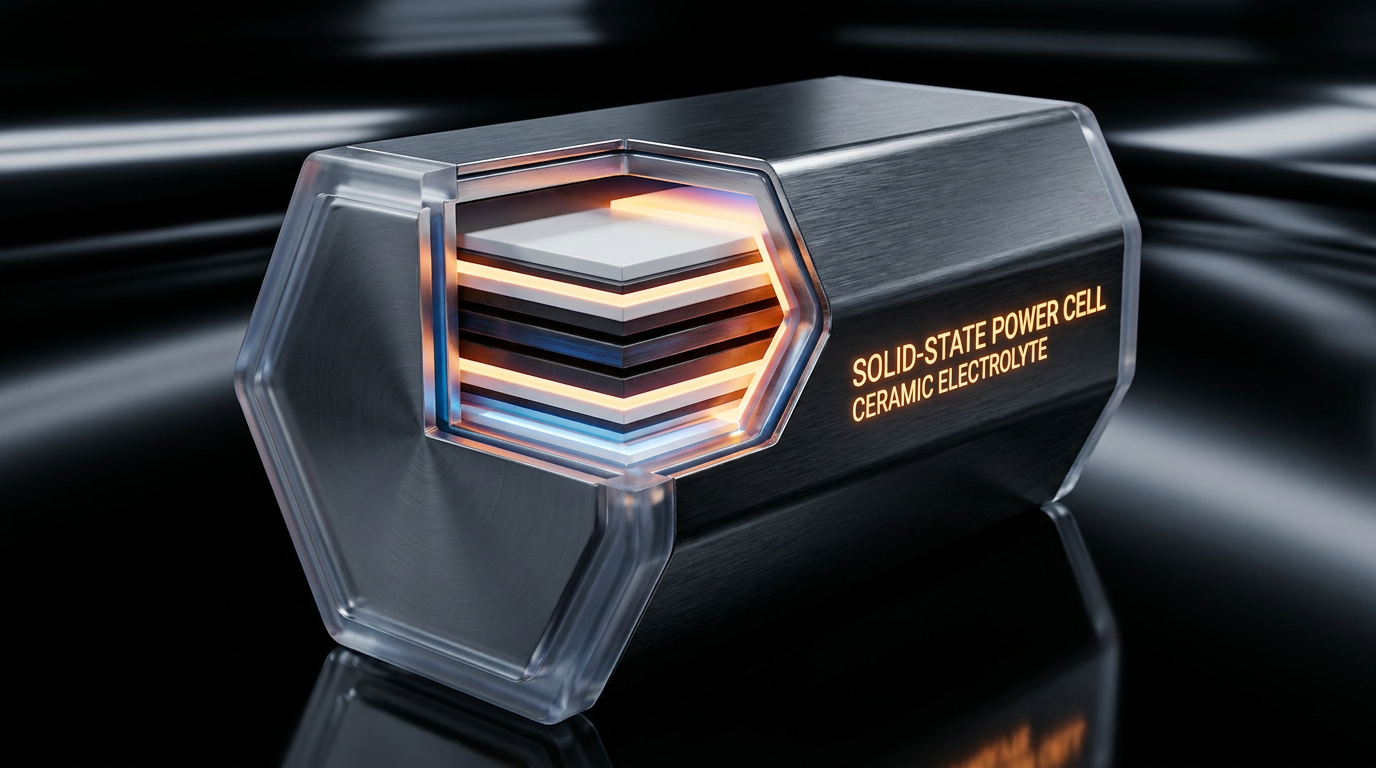
The vulnerability of this system lies in that liquid electrolyte. It is composed of highly volatile, flammable organic solvents. If the battery is punctured in a crash, or if it overheats due to rapid charging, this liquid can ignite, leading to a dangerous chain reaction known as thermal runaway. Solid-state batteries eliminate this vulnerability entirely by replacing the liquid electrolyte and the plastic separator with a single piece of solid material—typically a specialized ceramic, glass, polymer, or sulfide compound.[2][4][8]

This solid layer is non-flammable and structurally rigid, which immediately solves the safety problem. But the true genius of the solid electrolyte is what it allows engineers to do to the rest of the battery. In a traditional liquid cell, the anode is made of bulky, heavy graphite, which acts like a sponge to safely absorb and store the lithium ions. The graphite itself does not generate energy; it is merely a heavy host structure required to keep the liquid battery stable.[1][2]
Because a solid electrolyte is physically tough, it acts as an impenetrable physical barrier. This allows battery designers to completely remove the heavy graphite anode and replace it with a thin strip of pure, metallic lithium. This "lithium-metal anode" is the ultimate goal of battery chemistry. By removing the dead weight of the graphite, the battery can store vastly more energy in the exact same physical footprint.[2][3][4]
The numbers illustrate the magnitude of this shift. Today's best commercial lithium-ion packs achieve an energy density of roughly 160 to 260 watt-hours per kilogram (Wh/kg). Solid-state prototypes currently in development are consistently hitting 300 to 400 Wh/kg, with some laboratory demonstrations pushing past 500 Wh/kg. For the consumer, this translates to a simple choice: an automaker can build an EV with the same weight that drives 600 to 800 miles on a single charge, or they can build an EV with a standard 300-mile range using a battery pack that is half the size and weight.[2][6]

Today's best commercial lithium-ion packs achieve an energy density of roughly 160 to 260 watt-hours per kilogram (Wh/kg).
Beyond range and safety, solid-state architecture fundamentally alters the charging experience. Liquid electrolytes degrade quickly when subjected to the extreme heat generated by ultra-fast charging currents. Solid materials, particularly ceramics, are vastly more thermally stable. This allows solid-state cells to accept massive amounts of electricity without degrading, potentially bringing the time required for an 80% charge down to just 10 to 15 minutes. Furthermore, these solid materials maintain their conductivity in extreme cold, mitigating the severe range loss that current EVs suffer during winter months.[3][7][8]
If the benefits are so profound, the obvious question is why solid-state batteries are not already in every driveway. The answer lies in the immense difficulty of manipulating materials at the atomic level. The most significant hurdle is known as "interfacial resistance." In a liquid battery, the fluid perfectly coats the microscopic nooks and crannies of the electrodes, ensuring flawless electrical contact. In a solid-state battery, you are pressing two hard solids against each other.[2][5]
As the battery charges and discharges, the electrodes physically expand and contract—sometimes swelling by up to 20% in volume. Maintaining perfect, unbroken contact between a rigid solid electrolyte and a swelling solid electrode is an engineering nightmare. If microscopic gaps form between the layers, the flow of ions is choked off, the battery's internal resistance spikes, and the cell quickly dies. Researchers are currently experimenting with "flex-ion" soft ceramics and high-pressure pack designs to keep the layers tightly bound.[3][5]

The second major scientific challenge is the persistence of dendrites. Dendrites are microscopic, needle-like spikes of lithium metal that can grow on the anode during rapid charging. For decades, scientists believed that a hard ceramic electrolyte would act as a brick wall, physically blocking these spikes. However, recent operando studies—where researchers observe the battery in real-time under an electron microscope—have revealed that dendrites can actually exploit microscopic flaws and grain boundaries within the ceramic, eventually cracking the solid electrolyte and shorting the cell.[2][3]
Even as scientists solve these chemical puzzles, the manufacturing hurdles remain daunting. Current lithium-ion gigafactories represent hundreds of billions of dollars in sunk capital, and their assembly lines are designed to inject liquid into rolled battery pouches. Solid-state batteries require entirely different manufacturing paradigms. Sulfide-based solid electrolytes, for instance, react violently with ambient moisture to produce toxic hydrogen sulfide gas. Consequently, they must be manufactured in ultra-dry cleanrooms, which drastically increases production costs.[4][7]
Despite these immense challenges, the automotive industry is pouring billions into the technology, viewing it as an existential race. Toyota is arguably the most aggressive legacy automaker in this space, holding over a thousand patents related to solid-state tech. The company has already demonstrated working prototypes in running concept vehicles and is targeting 2027 or 2028 for the initial commercial rollout of solid-state EVs.[6][7]

Western automakers are largely partnering with specialized startups to close the gap. Volkswagen has heavily backed California-based QuantumScape, which recently began shipping its prototype cells to automotive partners for testing. BMW and Ford have invested in Solid Power, while Mercedes-Benz is collaborating with ProLogium. These startups are pioneering hybrid approaches—sometimes called semi-solid-state—which use a tiny amount of liquid or gel at the interface to solve the contact problem while still utilizing a solid separator.[6]
The transition will not happen overnight. When solid-state batteries do arrive in the late 2020s, they will almost certainly debut in high-end luxury vehicles and commercial trucking, where the premium cost can be absorbed. Standard lithium-ion technology will continue to dominate the mass market for at least another decade, steadily improving in its own right.[1][4]
Ultimately, the successful commercialization of the solid-state battery will mark the crossing of the final threshold for electric mobility. By neutralizing the lingering anxieties over range, charging time, and safety, this technology will not just improve the electric vehicle—it will render the internal combustion engine functionally obsolete across virtually all modes of surface transportation.[1][6]
How we got here
1991
Sony commercializes the first rechargeable lithium-ion battery, relying on a liquid electrolyte.
2010s
Researchers renew focus on solid-state chemistry as the EV market demands higher energy density and safety.
2020
Toyota unveils early prototype solid-state cells powering a running concept vehicle.
2024
Startups like QuantumScape begin shipping advanced prototype cells to automotive partners for real-world testing.
2027–2028
Projected timeline for the first mass-market electric vehicles equipped with solid-state batteries to hit the road.
Viewpoints in depth
Automakers & Battery Developers
Focus on the transformative commercial potential, pushing aggressive timelines to double EV range and cut charging times.
For legacy automakers and heavily funded startups, solid-state technology is viewed as the ultimate competitive moat against early EV leaders like Tesla. Companies like Toyota and QuantumScape emphasize the consumer-facing breakthroughs: the ability to drive 800 miles on a single charge and recharge in the time it takes to buy a coffee. They argue that these metrics are the only way to convince the remaining internal-combustion holdouts to switch to electric. Consequently, their public messaging focuses heavily on pilot production lines and aggressive target dates for commercialization, projecting confidence that the remaining chemical hurdles are merely engineering tasks to be optimized.
Materials Scientists
Emphasize the remaining atomic-level hurdles, particularly interfacial resistance and dendrite formation that cause premature failure.
Academic researchers and materials scientists take a more cautious view, focusing on the immense difficulty of manipulating solid chemistry at scale. They point out that while a solid-state battery works beautifully in a pristine, temperature-controlled laboratory setting, the physics change dramatically in the real world. The primary concern is interfacial resistance—the battery's tendency to tear itself apart internally as the solid electrodes swell and shrink during charging. Scientists argue that until a solid electrolyte can be made flexible enough to "breathe" with the battery without losing conductivity, mass commercialization remains a distant hope, not an imminent reality.
Manufacturing & Supply Chain Analysts
Highlight the massive capital costs and supply chain challenges of retooling global gigafactories away from liquid lithium-ion.
Industry analysts look past the chemistry and focus on the economics of scale. Over the last decade, the global auto industry has sunk hundreds of billions of dollars into gigafactories explicitly designed to manufacture liquid lithium-ion pouches and cylinders. Solid-state batteries require entirely different manufacturing techniques, including ultra-dry cleanrooms and high-pressure assembly presses. Analysts warn that even if the chemistry is perfected tomorrow, the capital expenditure required to retool the global supply chain will keep solid-state batteries prohibitively expensive for years, restricting them to luxury vehicles while standard lithium-ion continues to dominate the mass market.
What we don't know
- Whether solid-state batteries can achieve the 10-year, 150,000-mile durability required by automotive standards without severe degradation.
- Exactly how much a solid-state battery pack will cost at scale compared to mature lithium-ion technology.
- Which specific solid electrolyte material (sulfides, oxides, or polymers) will ultimately win the industry standard.
Key terms
- Electrolyte
- The medium inside a battery that allows ions to flow between the positive and negative sides to create an electrical current.
- Energy Density
- A measure of how much energy a battery can hold relative to its weight, typically expressed in watt-hours per kilogram (Wh/kg).
- Lithium-Metal Anode
- An advanced battery design that replaces heavy graphite with pure lithium metal, drastically reducing the battery's size and weight.
- Interfacial Resistance
- The electrical friction that occurs when two solid materials are pressed together, making it difficult for ions to flow smoothly across the gap.
- Dendrites
- Microscopic, needle-like spikes of lithium that can grow inside a battery during charging, potentially causing a short circuit.
Frequently asked
When will I be able to buy an EV with a solid-state battery?
Automakers like Toyota are targeting 2027 to 2028 for the first commercial rollouts. However, these will likely debut in high-end luxury vehicles first before scaling down to affordable mass-market cars in the 2030s.
Why are solid-state batteries safer?
Current batteries use a liquid electrolyte made of flammable organic solvents that can catch fire if punctured or overheated. Solid-state batteries replace this with non-flammable ceramics or polymers, eliminating the risk of thermal runaway.
Will solid-state batteries make EVs cheaper?
Eventually, yes. While initial manufacturing costs will be very high due to the need for new factory equipment, the ability to pack more energy into a smaller space means automakers can eventually use fewer raw materials to achieve the same driving range.
Sources
Source coverage
8 outlets
3 viewpoints surfaced








[1]Factlen Editorial TeamIndustry Analysts
Synthesis by Factlen editorial team
Read on Factlen Editorial Team →[2]MDPI BatteriesMaterials Scientists
Advancements and Challenges in Solid-State Battery Technology: An In-Depth Review
Read on MDPI Batteries →[3]ACS Energy LettersMaterials Scientists
Solid-State Battery Advancements, Challenges, and Industry Impacts
Read on ACS Energy Letters →[4]IDTechExIndustry Analysts
Solid-State Batteries: A Technological Leap
Read on IDTechEx →[5]MATEC Web of ConferencesMaterials Scientists
Interface Issues and Challenges in All-Solid-State Batteries
Read on MATEC Web of Conferences →[6]WardsAutoAutomakers & Battery Developers
Toyota Solid-State Battery Tech on Schedule for 2027 Production
Read on WardsAuto →[7]Green Car ReportsAutomakers & Battery Developers
Toyota solid-state battery tech on schedule, prototype fully charges in 15 minutes
Read on Green Car Reports →[8]The Battery ShowIndustry Analysts
What Are All-Solid-State Batteries? A Complete Guide
Read on The Battery Show →

More in guides
See all 52 stories →Local AI
How to Run AI Models Locally: The 2026 Guide to Digital Independence
7 sources

Exercise Science
The Science of Zone 2 Training: Why the Slowest Cardio Builds the Strongest Engine
7 sources

Battery Tech
How Solid-State Batteries Work—And Why They Are Finally Ready to Change EVs
7 sources
AI Developer Tools
Cursor vs. GitHub Copilot vs. Codeium: The 2026 AI Coding Assistant Trade-Offs
8 sources

Every angle. Every day.
Get guides stories with full source coverage and perspective breakdowns delivered to your inbox.