
How Solid-State Batteries Will Rewrite the Rules of Electric Vehicles
By replacing flammable liquid electrolytes with stable solid materials, a new generation of EV batteries promises to double driving range, cut charging times to 15 minutes, and eliminate fire risks.
By Factlen Editorial Team
- Automakers & Battery Developers
- Focus on the massive performance leaps in range, charging speed, and vehicle design flexibility.
- Manufacturing Analysts
- Emphasize the immense engineering challenges and high initial costs of scaling production from the lab to the factory floor.
- Safety & Environmental Advocates
- Highlight the elimination of fire risks and the reduction in raw materials needed to produce high-capacity batteries.
What's not represented
- · Raw Material Miners
- · Traditional Oil & Gas Industry
Why this matters
Solid-state batteries represent the largest technological leap in automotive history since the combustion engine. By solving the three biggest hurdles to EV adoption—range anxiety, slow charging, and battery degradation—this technology will fundamentally change how we drive and power our lives.
Key points
- Solid-state batteries replace flammable liquid electrolytes with stable solid materials like ceramics or glass.
- The technology can increase energy density by up to 2.5 times, potentially doubling EV driving range.
- Solid electrolytes can safely handle extreme currents, allowing for 10-to-15-minute fast charging.
- The rigid structure physically prevents dendrite growth, virtually eliminating the risk of battery fires.
- Manufacturing the cells at scale remains difficult, requiring immense precision and clean-room environments.
- Early production costs are high, meaning the technology will likely debut in luxury vehicles first.
The electric vehicle revolution has a ceiling, and it is made of liquid. For the past decade, the automotive industry has relied on conventional lithium-ion batteries to power the transition away from fossil fuels. While these power packs have improved dramatically in cost and efficiency, they are bound by the physical limits of their internal chemistry.[8]
Range anxiety, heavy vehicle weights, and charging times that stretch into the better part of an hour are all symptoms of the liquid electrolyte sloshing inside current EV cells. But a fundamental shift in battery architecture is finally moving from laboratory whiteboards to real-world highways.[8]
Solid-state batteries (SSBs) are widely considered the holy grail of energy storage. By replacing the volatile liquid components of a battery with stable, rigid materials, engineers are unlocking performance metrics that were previously thought impossible. As of mid-2026, these next-generation cells are actively being road-tested in North America, signaling that the era of the liquid battery is beginning to set.[5][8]
To understand why solid-state technology is such a massive leap forward, one must look at how current batteries operate. In a standard lithium-ion EV battery, there are two electrodes—an anode and a cathode—separated by a porous plastic film. The entire assembly is flooded with a liquid or gel electrolyte.[1][2]

When the car is driving or charging, lithium ions swim back and forth through this liquid medium. However, this liquid is highly flammable. It is also susceptible to the formation of "dendrites"—microscopic, needle-like metallic growths that can pierce the plastic separator over time, causing a short circuit and potentially triggering a catastrophic thermal runaway fire.[3]
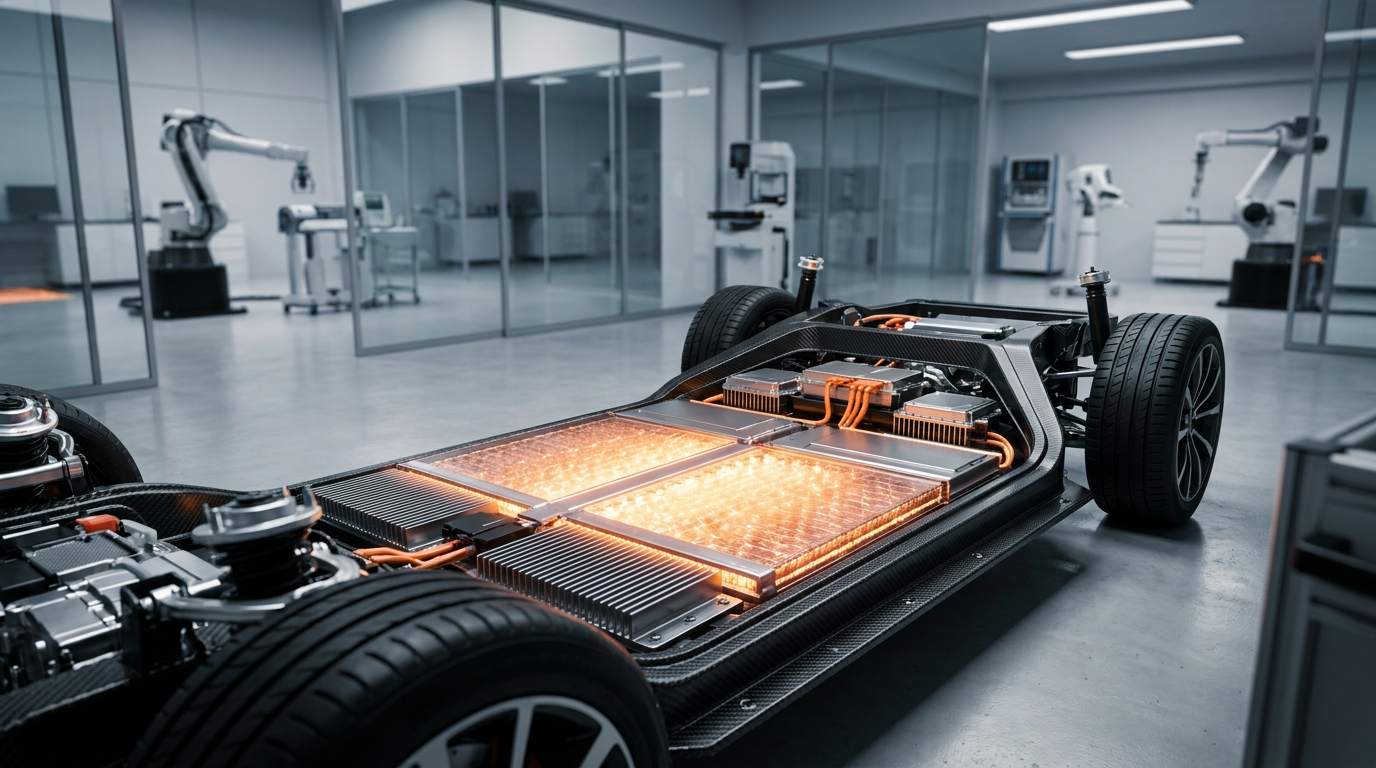
Solid-state batteries solve this by completely eliminating the liquid. Instead, they use a solid electrolyte made from advanced ceramics, glass, sulfides, or specialized polymers. This solid layer acts as a highly efficient superhighway for lithium ions, allowing them to flow freely while remaining physically rigid.[1][3]
Because the solid electrolyte is robust, it performs a dual role: it conducts the ions and acts as an impenetrable physical separator between the anode and cathode. There is no need for a bulky plastic separator film, and there is no liquid to leak, boil, or catch fire.[1][2]
This structural stability unlocks the most important upgrade in the battery's design: the anode. In liquid batteries, the anode must be made of bulky graphite to safely house the lithium ions. Because a solid electrolyte physically blocks dendrite growth, engineers can discard the heavy graphite and use a pure lithium metal anode instead.[2][3]
This structural stability unlocks the most important upgrade in the battery's design: the anode.
Removing the graphite shrinks the battery cell's thickness significantly, allowing manufacturers to pack vastly more active energy-storing material into the exact same volume. According to recent engineering studies, solid-state batteries boast an energy density 2 to 2.5 times higher than the best liquid lithium-ion technology available today.[2]
For the driver, this translates to a paradigm shift in vehicle capability. An electric vehicle that currently maxes out at 300 miles of range could suddenly travel 600 to over 745 miles on a single charge, using a battery pack of the exact same physical size and weight. Alternatively, automakers could build cheaper, ultra-lightweight commuter cars with half the battery mass that still deliver 300 miles of range.[4][5]

Charging speeds also plummet. Because solid electrolytes can tolerate extreme electrical currents and high temperatures without degrading or boiling, they can safely absorb energy at staggering rates. Prototypes have demonstrated the ability to charge from 10% to 80% capacity in just 10 to 15 minutes—approaching the convenience of a traditional gas station visit.[1][6]
These are no longer just theoretical projections. In June 2026, Stellantis and battery developer Factorial Energy officially began testing solid-state cells in Dodge Charger Daytona development vehicles on public roads. Their cells successfully demonstrated ultra-fast charging to 90% in 18 minutes while maintaining peak performance in extreme weather, from a freezing -30°C to a blistering 45°C.[5]

Beyond convenience, the environmental and safety implications are profound. The elimination of flammable liquids drastically reduces the risk of vehicle fires following a collision. Furthermore, because solid-state cells require fewer raw materials to generate the same amount of energy, their production carbon footprint is estimated to be up to 24% lower than that of traditional lithium-ion batteries.[1][7]
If the technology is so superior, the obvious question is why it isn't already in every driveway. The answer lies in the immense difficulty of manufacturing. Transitioning from hand-built laboratory prototypes to gigawatt-scale mass production requires unprecedented precision.[4][8]
The solid layers must be laminated and pressed together flawlessly. Even a microscopic gap between the solid electrolyte and the electrodes will severely throttle the battery's power output. Furthermore, many solid-state chemistries are highly sensitive to moisture, requiring manufacturing facilities to operate under incredibly strict, expensive clean-room conditions.[4]
This manufacturing complexity directly impacts the price tag. While the cost of standard lithium-ion battery packs has fallen to roughly $132 per kilowatt-hour, early commercial solid-state cells are projected to cost between $400 and $800 per kWh. As a result, the first vehicles to feature them will almost certainly be high-end luxury models and performance cars.[7]

Despite the hurdles, the global race to commercialize the technology is accelerating. Toyota, which holds over 1,000 patents in the solid-state sector, has officially targeted 2027 to 2028 for the mass production of a consumer-ready vehicle capable of traveling 1,000 kilometers on a 10-minute charge.[4][6]
Meanwhile, the Chinese automotive sector is executing an aggressive industrial sprint. Backed by massive government funding, companies like GAC Group are aiming to bring all-solid-state batteries to the mass market as early as late 2026. The transition will not happen overnight, but the bridge to a lighter, safer, and infinitely more capable electric future is finally under construction.[4][6][8]
How we got here
Late 20th Century
Early solid-state batteries are developed and successfully used in small medical devices like pacemakers.
Early 2020s
Automakers pour billions into solid-state startups, achieving major breakthroughs in energy density within laboratory settings.
Mid 2026
Companies like Stellantis and Factorial Energy begin real-world road testing of solid-state cells in development vehicles.
2027–2028
Target window for major automakers, including Toyota, to launch their first mass-produced solid-state electric vehicles.
Viewpoints in depth
Automakers & Battery Developers
Focus on the massive performance leaps in range, charging speed, and vehicle design flexibility.
For automotive engineers, solid-state chemistry is the key to unlocking the next generation of vehicle design. By doubling the energy density, automakers are no longer forced to compromise between vehicle weight and driving range. They envision a future where heavy, cumbersome battery packs are replaced by slim, lightweight modules that allow for better handling, more interior space, and aerodynamic freedom. Furthermore, the ability to charge a vehicle in 10 minutes removes the final major objection consumers have to adopting electric vehicles over gas-powered cars.
Manufacturing Analysts
Emphasize the immense engineering challenges and high initial costs of scaling production from the lab to the factory floor.
Industry analysts caution against expecting an overnight revolution, pointing out that building a perfect battery in a laboratory is vastly different from producing millions of them on an assembly line. The manufacturing tolerances for solid-state cells are microscopic; the lamination process must be flawless, and the environment must be entirely free of moisture. Because of these stringent requirements, analysts project that early solid-state batteries will cost three to five times more than current lithium-ion packs, restricting their initial use to premium luxury vehicles until economies of scale can drive prices down.
Safety & Environmental Advocates
Highlight the elimination of fire risks and the reduction in raw materials needed to produce high-capacity batteries.
Safety regulators and environmental groups view the transition to solid-state as a critical milestone for public safety and sustainability. The removal of flammable liquid electrolytes effectively neutralizes the threat of thermal runaway—the phenomenon responsible for intense, difficult-to-extinguish EV fires. Environmentally, because solid-state cells achieve higher energy outputs using less physical material, their production is less resource-intensive. Studies suggest this efficiency could lower the overall carbon footprint of battery manufacturing by nearly a quarter, making EVs even greener from the moment they roll off the assembly line.
What we don't know
- Exactly how quickly manufacturing costs will fall to match current lithium-ion prices.
- Which specific solid-state chemistry (sulfide, oxide, or polymer) will become the dominant industry standard.
- How the existing EV charging infrastructure will handle the massive power surges required for widespread 10-minute fast charging.
Key terms
- Electrolyte
- The medium inside a battery that allows electrical ions to flow between the anode and cathode during charging and discharging.
- Energy Density
- A measure of how much energy a battery can hold relative to its size or weight; higher density means more range without adding bulk.
- Dendrites
- Microscopic, needle-like metallic growths that can form inside liquid batteries over time, potentially causing short circuits and fires.
- Anode
- The negative electrode in a battery where lithium ions are stored when the battery is fully charged.
Frequently asked
What makes a solid-state battery different?
It replaces the flammable liquid or gel electrolyte found in standard lithium-ion batteries with a rigid, solid material like ceramic or glass, which conducts energy more safely and efficiently.
How fast can a solid-state battery charge?
Because the solid materials can handle extreme electrical currents without overheating, prototypes have demonstrated the ability to charge from 10% to 80% in just 10 to 15 minutes.
Are solid-state batteries safer?
Yes. By eliminating the volatile liquid electrolyte, solid-state batteries remove the primary cause of thermal runaway fires in electric vehicles.
When will I be able to buy a car with one?
While some early models may debut in China by late 2026, major automakers like Toyota are targeting 2027 to 2028 for mass-market consumer vehicles featuring the technology.
Sources
Source coverage
8 outlets
3 viewpoints surfaced








[1]JoosupSafety & Environmental Advocates
How do Solid State EV Batteries Work?
Read on Joosup →[2]Flash BatterySafety & Environmental Advocates
What are solid-state batteries and how do they work: differences with lithium batteries
Read on Flash Battery →[3]WikipediaSafety & Environmental Advocates
Solid-state battery
Read on Wikipedia →[4]EV Infrastructure NewsAutomakers & Battery Developers
Toyota solid-state Battery timeline: production plans and lifespan projections
Read on EV Infrastructure News →[5]ElectrekAutomakers & Battery Developers
Factorial, Stellantis test solid-state EV batteries in real life
Read on Electrek →[6]The Battery Show AsiaAutomakers & Battery Developers
The Roadmap to All-Solid-State: 2026–2028
Read on The Battery Show Asia →[7]Chasing CarsManufacturing Analysts
Solid state vs lithium-ion batteries: which is best?
Read on Chasing Cars →[8]Factlen Editorial TeamManufacturing Analysts
Synthesis by Factlen editorial team
Read on Factlen Editorial Team →

Every angle. Every day.
Get automotive stories with full source coverage and perspective breakdowns delivered to your inbox.