
How Quantum Computing Finally Solved Its Fatal Flaw
A series of breakthroughs in 'logical qubits' and error correction has shifted quantum computing from a theoretical physics experiment into a scalable engineering discipline.
By Factlen Editorial Team
- Superconducting Advocates
- Believe fixed 2D lattices of superconducting circuits are the most scalable path to millions of qubits.
- Trapped-Ion & Neutral Atom Pioneers
- Argue that dynamic, highly connected qubits offer vastly more efficient error correction, requiring fewer total qubits.
- Quantum Pragmatists
- Emphasize that the classical decoding bottleneck and massive cooling requirements still pose monumental engineering hurdles.
What's not represented
- · Classical supercomputing advocates who argue that AI and algorithmic improvements on traditional hardware will outpace quantum gains in the near term.
Why this matters
Without error correction, quantum computers are too fragile to solve real-world problems. Crossing the fault-tolerant threshold means the industry can finally build machines capable of simulating complex molecules, unlocking new drugs, battery chemistries, and materials.
Key points
- Multiple quantum computing teams have successfully crossed the 'fault-tolerant threshold,' proving that scaling up physical qubits can exponentially reduce error rates.
- The breakthroughs rely on 'logical qubits,' which entangle multiple fragile physical qubits into a single, highly stable virtual unit.
- Google demonstrated this using a surface code on superconducting chips, while Microsoft and Quantinuum achieved an 800-fold error reduction using trapped ions.
- QuEra and Harvard showcased highly efficient error correction using neutral atoms, pointing toward a future of vastly reduced hardware overhead.
- Despite the progress, significant engineering hurdles remain, particularly in the classical computing power required to decode quantum errors in real-time.
The Wright Brothers moment for quantum computing didn't arrive with a massive new machine, but with a quiet, mathematical victory. For decades, the field has been plagued by a fatal flaw: quantum computers are incredibly forgetful.[6]
The fundamental unit of a quantum computer, the physical qubit, is notoriously fragile. A stray photon, a tiny fluctuation in temperature, or even cosmic rays can cause "decoherence," wiping out the delicate quantum state before a calculation finishes.[5]
In traditional classical computing, error correction is straightforward. If you want to protect a bit of data, you simply copy it multiple times. If a cosmic ray flips a zero to a one, the system takes a majority vote among the copies and corrects the error.[7]
But quantum mechanics strictly forbids this. A principle known as the "no-cloning theorem" dictates that it is physically impossible to perfectly copy an unknown quantum state. If you try to measure a qubit to see what it holds, the fragile superposition collapses entirely.[7]

To bypass this law of physics, researchers developed the concept of the "logical qubit." Instead of copying the data, they entangle a large group of physical qubits together. This collective acts as a single, highly stable virtual qubit, distributing the information across the group so that if one physical component fails, the overall data survives.[2]
For years, this was a beautiful theory with a brutal practical catch. The machinery required to monitor and correct the qubits was so complex that adding more physical qubits to the system actually introduced more noise than it fixed.[6]
That dynamic has officially flipped. In a series of milestones spanning late 2024 to early 2026, multiple research teams crossed the "fault-tolerant threshold." They proved that as they scaled up the number of physical qubits, the logical error rate finally began to drop exponentially.[1][5]

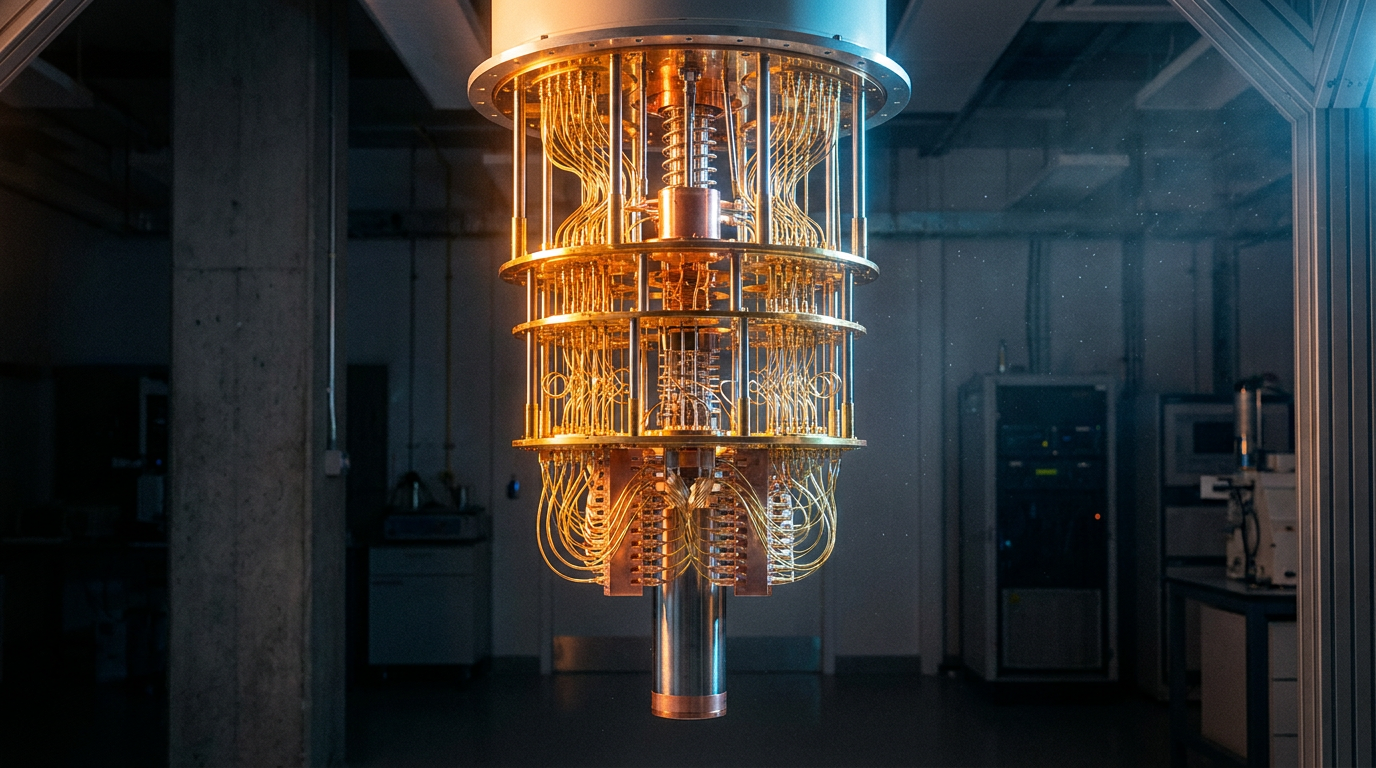
Google Quantum AI provided one of the most visible proofs with its Willow processor. Using a grid of superconducting circuits, the team demonstrated that a larger "surface code" lattice suppressed errors far more effectively than a smaller one, validating decades of theoretical math.[1]
Google Quantum AI provided one of the most visible proofs with its Willow processor.
The mechanism behind this is ingenious. In a surface code, qubits are arranged like a checkerboard. "Data qubits" hold the actual information, while alternating "measure qubits" constantly check the parity—the relationship—between their neighbors. This allows the system to detect and fix errors without ever directly looking at the protected quantum data.[7]
But superconducting chips are not the only path forward. Microsoft, partnering with hardware manufacturer Quantinuum, achieved a staggering 800-fold reduction in error rates using trapped-ion technology.[2]
By manipulating individual charged atoms with lasers, the Microsoft and Quantinuum team successfully created four highly reliable logical qubits out of just 30 physical ones. Because trapped ions can be moved around to interact with any other ion in the trap—a feature known as all-to-all connectivity—their error correction codes can be vastly more efficient than the rigid 2D grids of superconducting chips.[2][6]
A third approach, utilizing neutral atoms, has also broken through. Researchers at QuEra, Harvard, and MIT demonstrated that neutral atoms can be dynamically shuttled around during a computation.[3]

This flexibility allows for advanced error-correcting architectures that require far fewer physical qubits per logical qubit. The QuEra team's results suggest a clear path toward the "Teraquop" regime—a threshold where a quantum computer makes only one error per trillion operations.[3]
Meanwhile, IBM has accelerated its own fault-tolerant roadmap, demonstrating real-time error decoding at unprecedented speeds. They are pioneering "qLDPC" (quantum low-density parity-check) codes, which promise to drastically shrink the massive physical qubit overhead that earlier theories demanded.[4][6]
Despite these massive leaps, quantum computing remains an immense engineering challenge. The physical qubits themselves still require better baseline fidelities, and the cooling infrastructure needed to keep them near absolute zero is staggering.[5]
Furthermore, a hidden bottleneck lies in the classical computers that orchestrate the correction. To keep a logical qubit stable, a classical processor must read the error data and calculate the fix in a matter of nanoseconds. As systems scale to thousands of qubits, this real-time decoding becomes a monumental computational hurdle of its own.[6]

Yet, the crossing of the fault-tolerant threshold changes the timeline of the industry. It shifts quantum computing from a theoretical physics experiment into a scalable engineering discipline.[5]
When these systems eventually scale to thousands of stable logical qubits, they will unlock capabilities classical supercomputers could never achieve. They will be able to simulate molecular interactions perfectly, paving the way for new battery chemistries, room-temperature superconductors, and targeted pharmaceuticals.[7]
The era of noisy, error-prone quantum experiments is drawing to a close. The foundation for reliable quantum computation has finally been poured; now, the industry just has to build the house.[7]
How we got here
1997
The theoretical concept of the surface code for quantum error correction is first introduced.
2012
The term 'quantum supremacy' is coined to describe the moment a quantum computer outperforms a classical one.
2019
Google claims the first quantum advantage with its 53-qubit Sycamore processor, though error rates remain high.
Late 2024
Google's Willow chip demonstrates below-threshold error correction, proving that scaling physical qubits can reduce logical errors.
Early 2026
Multiple teams, including Microsoft, Quantinuum, and QuEra, achieve record-breaking logical error reductions across diverse hardware platforms.
Viewpoints in depth
Superconducting Advocates
Proponents of fixed 2D circuit grids.
Groups like Google and IBM argue that superconducting circuits, which are manufactured using modified silicon fabrication techniques, offer the most realistic path to scaling up to millions of qubits. While they require massive cooling infrastructure and suffer from limited connectivity, the ability to leverage existing semiconductor supply chains makes them a formidable contender for the ultimate fault-tolerant machine.
Trapped-Ion & Neutral Atom Pioneers
Proponents of dynamic, highly connected atomic qubits.
Companies like Quantinuum and QuEra believe that the rigid grids of superconducting chips are fundamentally limiting. By using lasers to manipulate individual atoms in a vacuum, these systems achieve 'all-to-all' connectivity, allowing any qubit to interact with any other. This flexibility drastically reduces the number of physical qubits needed to create a stable logical qubit, potentially fast-tracking the timeline to commercial utility.
Quantum Pragmatists
Engineers focused on the classical bottlenecks.
While celebrating the recent milestones, pragmatists warn that the quantum industry is currently underestimating the classical computing challenge. Error correction requires a traditional supercomputer to read syndrome measurements and calculate fixes in nanoseconds. As quantum processors grow to thousands of logical qubits, the data bandwidth and processing power required for this real-time decoding could become the new primary bottleneck.
What we don't know
- Whether the classical computing infrastructure required to decode quantum errors in real-time can scale to support millions of physical qubits.
- Which hardware architecture—superconducting, trapped-ion, or neutral atom—will ultimately win the race to commercial scale.
- Exactly when the first commercially transformative quantum application (like discovering a new drug or battery material) will be successfully executed.
Key terms
- Logical Qubit
- A highly stable, virtual quantum bit created by entangling multiple fragile physical qubits to protect information from errors.
- Decoherence
- The process by which a quantum system loses its fragile quantum state due to interaction with its environment, causing calculation errors.
- No-Cloning Theorem
- A fundamental rule of quantum mechanics stating that it is impossible to create an identical copy of an unknown quantum state.
- Surface Code
- A popular error-correction method that arranges qubits in a 2D grid, using neighboring qubits to constantly check for and fix errors.
- Fault Tolerance
- The ability of a computer system to continue operating reliably even when individual components fail or experience errors.
Frequently asked
Does this mean quantum computers are ready to replace normal computers?
No. Quantum computers will likely always work alongside classical computers as specialized accelerators for specific, highly complex problems like chemistry simulation.
Why can't we just copy quantum data to back it up?
The laws of quantum physics, specifically the "no-cloning theorem," prevent the exact copying of an unknown quantum state. If you try to measure it to copy it, the state collapses.
How long until these machines are commercially useful?
While timelines vary, most industry roadmaps target the late 2020s or early 2030s for the first commercially useful, fault-tolerant quantum applications.
Sources
Source coverage
7 outlets
3 viewpoints surfaced







[1]NatureSuperconducting Advocates
Quantum error correction below the surface code threshold
Read on Nature →[2]Microsoft QuantumTrapped-Ion & Neutral Atom Pioneers
Quantum error correction and logical qubits
Read on Microsoft Quantum →[3]QuEra ComputingTrapped-Ion & Neutral Atom Pioneers
Quantum Error Correction at Record Efficiency
Read on QuEra Computing →[4]IBM QuantumSuperconducting Advocates
IBM lays out clear path to fault-tolerant quantum computing
Read on IBM Quantum →[5]VentureBeatQuantum Pragmatists
5 Key Quantum Computing Breakthroughs in 2026
Read on VentureBeat →[6]WiredQuantum Pragmatists
Quantum error correction just crossed a line (here's why it matters)
Read on Wired →[7]Factlen Editorial TeamQuantum Pragmatists
Synthesis by Factlen editorial team
Read on Factlen Editorial Team →

Every angle. Every day.
Get technology stories with full source coverage and perspective breakdowns delivered to your inbox.