
How Micro-Fragmentation and Acoustic Enrichment Are Rebuilding the World's Coral Reefs
Marine biologists are deploying breakthrough technologies, from accelerated growth techniques to underwater soundscapes, to resurrect devastated coral reefs at unprecedented speeds.
By Factlen Editorial Team
- Restoration Technologists
- Argue that active, high-tech interventions are the only way to rebuild reefs at a pace that matches the current rate of ecological decline.
- Marine Researchers
- Focus on understanding the biological mechanisms of coral resilience, larval settlement, and the long-term viability of engineered ecosystems.
- Climate Realists
- Emphasize that while restoration technologies buy crucial time, they cannot outpace the fundamental threat of unchecked global carbon emissions.
What's not represented
- · Commercial fishing industry
- · Coastal developers
Why this matters
Coral reefs support a quarter of all marine life and provide coastal protection for over a billion people. These technological breakthroughs prove that devastated ecosystems can be actively rebuilt, offering a tangible lifeline for global food security and coastal economies.
Key points
- Micro-fragmentation triggers a rapid healing response, allowing massive corals to grow up to 40 times faster than normal.
- Broadcasting the sounds of a healthy reef through underwater speakers increases coral larval settlement by up to seven times.
- Scientists are using 'assisted evolution' to breed heat-tolerant super corals capable of surviving marine heatwaves.
- The Hope Reef project in Indonesia successfully increased live coral cover from 2% to 82.5% in just six years.
For decades, the narrative surrounding the world’s coral reefs has been one of managed decline. Covering less than one percent of the ocean floor but supporting a quarter of all marine life, these vibrant ecosystems have faced unprecedented devastation from climate change, ocean acidification, and pollution. Mass bleaching events have transformed kaleidoscopic underwater metropolises into skeletal wastelands. Yet, beneath the surface of this ecological crisis, a quiet revolution is taking place. Marine biologists, engineers, and conservationists are no longer just monitoring the decline; they are actively intervening. We have entered a golden age of coral restoration technology, shifting from passive observation to aggressive, high-tech ecosystem engineering.[7]
The stakes for this intervention could not be higher. Beyond their staggering biodiversity, coral reefs provide an estimated $375 billion annually in ecosystem services. They act as natural breakwaters, absorbing up to 97 percent of wave energy and protecting coastal communities from storm surges. They also serve as the primary source of protein and income for over a billion people globally. If the "rainforests of the sea" were to vanish, the cascading effects would devastate global fisheries and leave coastlines defenseless. Recognizing this, the scientific community has pivoted toward radical new methodologies designed to rebuild reefs faster and stronger than nature ever could on its own.[4][7]
Historically, coral restoration was a painstaking and often localized endeavor. Early efforts primarily involved salvaging broken fragments after ship groundings or storms and reattaching them to the substrate. While these "coral gardening" techniques were effective on a small scale, they were vastly outpaced by the sheer speed of global coral die-offs. Massive reef-building species, such as brain and boulder corals, grow at a glacial pace of just a few millimeters per year, making their restoration seem practically impossible. To save the reefs, scientists needed to find a way to hack the biological limits of coral growth and reproduction.[4][7]
The first major breakthrough came entirely by accident. At the Mote Marine Laboratory in Florida, Dr. David Vaughan was attempting to transfer a slow-growing elkhorn coral when it snagged on the tank and shattered into tiny pieces. Expecting the fragments to die, he left them in the basin. Weeks later, he discovered that the broken pieces had not only survived but had rapidly expanded their tissue to heal the wounds. Vaughan had inadvertently stumbled upon a biological loophole: when a coral is subjected to severe physical trauma, its natural healing mechanisms shift into overdrive.[4][6]
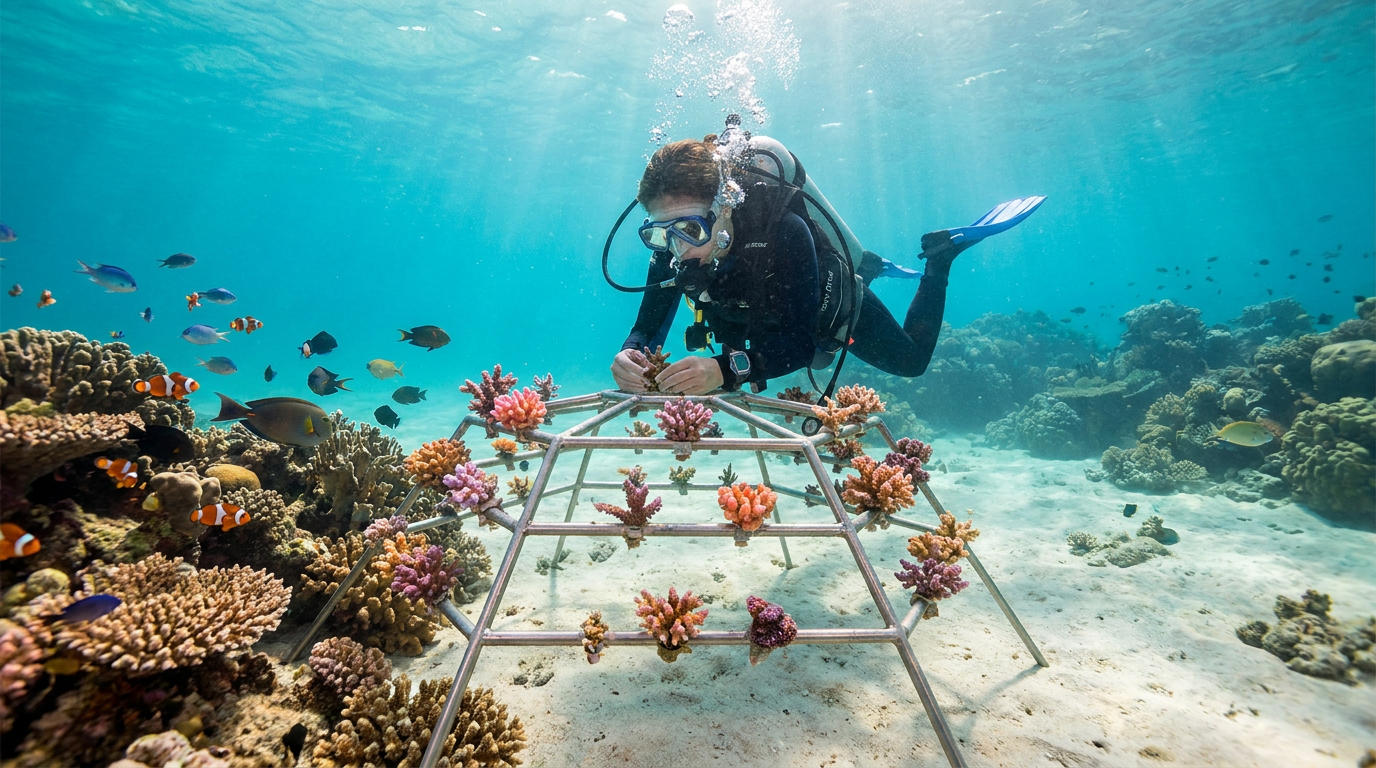
This discovery birthed the technique now known as micro-fragmentation. Using specialized diamond-blade saws, restoration practitioners deliberately cut massive coral colonies into tiny squares, often just one or two square centimeters in size. This severe fragmentation triggers an explosive growth response. Instead of directing energy toward reproduction or structural thickening, the coral pours all its biological resources into rapid tissue expansion, desperately trying to cover the exposed skeleton and heal its edges. When placed near other fragments from the same parent colony, the growing pieces eventually recognize each other and fuse back together into a single, massive organism.[4][6]

The implications of micro-fragmentation are staggering. Species that typically grow just 0.5 to 2 square centimeters annually in the wild can achieve growth rates of 10 to 25 square centimeters per year in a lab setting. This represents an acceleration of 25 to 40 times their natural growth rate. What would normally take a century to grow on a wild reef can now be cultivated in a land-based nursery in just two years. This technique has completely revolutionized the restoration of massive, reef-building corals, allowing scientists to rapidly mass-produce the foundational building blocks of a healthy ecosystem.[4][6]
But growing coral in a lab is only half the battle; getting them to thrive and reproduce in the wild requires a different kind of innovation. Corals are not simply passive rocks; during their larval stage, they are free-swimming organisms actively searching for a place to settle and grow. Scientists have long known that these larvae rely on environmental cues to choose their permanent homes. Recently, researchers discovered that one of the most powerful cues is sound. A healthy coral reef is a cacophony of biological noise—a symphony of grunts, purrs, and clicks from feeding fish, underscored by the continuous crackling of snapping shrimp.[1][3]
But growing coral in a lab is only half the battle; getting them to thrive and reproduce in the wild requires a different kind of innovation.
Degraded reefs, having lost their marine life, are eerily quiet. To a drifting coral larva, this silence signals a dead zone, prompting them to swim past in search of better real estate. Researchers at the Woods Hole Oceanographic Institution (WHOI), led by Dr. Aran Mooney and Nadège Aoki, hypothesized that they could trick larvae into settling on degraded reefs by artificially recreating the soundscape of a thriving ecosystem. They developed the Reef Acoustic Playback System (RAPS), a solar-powered underwater speaker array designed to broadcast the recorded sounds of a healthy, vibrant reef into a damaged area.[1]

The results of this "acoustic enrichment" were immediate and profound. During field tests in the Caribbean, the WHOI team found that broadcasting healthy reef sounds caused coral larvae to settle at rates up to seven times higher than in silent, control areas. The effect was most pronounced within the first 36 hours of the larvae's search for a home. By simply playing the right acoustic track, scientists can effectively summon the next generation of corals to recolonize barren rubble, kickstarting a positive feedback loop that eventually attracts the fish and invertebrates needed to sustain the ecosystem naturally.[1][3]
Even if we can grow corals quickly and coax them to settle, they still face the existential threat of boiling oceans. To address this, researchers are turning to "assisted evolution"—human interventions designed to accelerate the natural adaptation of species. At institutions like Arizona State University, scientists are subjecting corals to thermal conditioning. By exposing lab-grown corals to sublethal doses of heat stress, they trigger epigenetic changes that make the organisms more resilient to future temperature spikes. It is essentially a biological boot camp, training the corals to survive the marine heatwaves that are becoming increasingly common.[2]
Assisted evolution also targets the coral's microscopic partners. Corals rely on symbiotic algae called zooxanthellae, which live inside their tissues and provide energy through photosynthesis. When the water gets too hot, these algae become toxic, forcing the coral to expel them in a process known as bleaching. If the temperature does not drop, the bleached coral starves to death. Scientists are now selectively breeding "super corals" and pairing them with specially cultivated, heat-tolerant strains of zooxanthellae. By engineering both the host and the symbiont, researchers are creating bespoke organisms capable of withstanding the climate of the 21st century.[2]
These laboratory breakthroughs are already proving their worth in the ocean. One of the most spectacular success stories is Hope Reef, located in Indonesia’s Spermonde Archipelago. In 2019, the Mars Sustainable Solutions team arrived at a site that had been reduced to a barren wasteland by decades of destructive blast fishing. To stabilize the loose rubble, they deployed thousands of "Reef Stars"—hexagonal steel structures coated in sand and resin. These interlocking webs provided a solid foundation, onto which local restoration teams attached thousands of micro-fragmented coral pieces.[5]
The transformation of Hope Reef has been nothing short of miraculous. Between November 2019 and October 2025, meticulous monitoring revealed that live coral cover skyrocketed from a dismal 2 percent to an astonishing 82.5 percent. As the corals grew and engulfed the steel frames, the ecosystem roared back to life. Fish populations increased by 8,468 percent, and the sheer number of distinct fish species rose by nearly 300 percent. Hope Reef stands as undeniable proof that when advanced restoration techniques are paired with dedicated local management, even the most devastated marine environments can be resurrected.[5]

The challenge now is scaling these successes from isolated pilot projects to a global planetary defense. Initiatives like the Coral Research & Development Accelerator Platform (CORDAP) and the UN Ocean Decade are mobilizing hundreds of millions of dollars to transfer these technologies to the nations that need them most. Mobile laboratories are being deployed to the Maldives and the Caribbean, training local practitioners in micro-fragmentation, coral IVF, and acoustic enrichment. The global ambition is to have 30 percent of all degraded reef areas under effective, active restoration by the end of the decade.[3]
Despite the incredible promise of these technologies, marine biologists are quick to issue a sobering caveat. Micro-fragmentation, acoustic enrichment, and super corals are ultimately life-support systems; they treat the symptoms of reef decline, not the underlying disease. If global carbon emissions continue unabated and ocean temperatures rise beyond the physiological limits of even the most engineered super corals, no amount of underwater speakers or lab-grown fragments will save them. These innovations are designed to buy time, preserving the genetic diversity and structural integrity of reefs while humanity transitions away from fossil fuels.[7]
Ultimately, the story of modern coral restoration is a testament to human ingenuity and our capacity to repair the damage we have caused. We now possess the biological blueprints and the technological tools to rebuild the rainforests of the sea. From the accidental discovery of rapid healing to the deliberate broadcasting of underwater symphonies, science has provided a viable path forward. The survival of coral reefs is no longer a question of capability, but of will—a race to deploy these miracles of marine engineering before the clock runs out.[7]

How we got here
2016
Dr. David Vaughan accidentally discovers the rapid growth potential of micro-fragmentation after breaking a coral in his lab.
2019
Mars Sustainable Solutions begins the Hope Reef restoration project in Indonesia using hexagonal Reef Stars.
2023
Woods Hole researchers prove that playing healthy reef sounds increases coral larval settlement on degraded reefs.
2025
Hope Reef reports an 82.5% coral cover recovery, proving the viability of large-scale, active restoration.
2026
The UN Ocean Decade and CORDAP accelerate global funding to deploy these technologies to vulnerable coastal nations.
Viewpoints in depth
Marine Biologists & Restoration Innovators
Advocates for scaling up active, high-tech interventions to rebuild reefs.
This camp argues that passive conservation—simply protecting areas and hoping they recover—is no longer sufficient given the speed of climate change. By leveraging micro-fragmentation, acoustic enrichment, and assisted evolution, they believe humanity can actively engineer resilient ecosystems. Their focus is on securing funding to move these technologies out of the laboratory and into the ocean, transforming restoration from a boutique scientific endeavor into a massive, industrialized planetary defense system.
Climate Policy Advocates
Warns that restoration technologies are futile without aggressive carbon emission reductions.
While acknowledging the brilliance of these scientific breakthroughs, climate advocates stress that super corals and underwater speakers treat the symptoms rather than the disease. They point out that even the most heat-resilient engineered corals have physiological limits. If global temperatures continue to rise unchecked, the oceans will eventually become too hot and acidic for any calcium-carbonate-based life to survive. For this group, restoration is merely a life-support system designed to buy time while humanity transitions away from fossil fuels.
Local Coastal Communities
Focuses on the immediate economic and protective benefits of restored reef ecosystems.
For the billion people who rely on reefs for their livelihoods, the success of projects like Hope Reef is a matter of immediate survival. Local fishermen and coastal residents view restoration not just as an ecological victory, but as an economic lifeline. The return of fish populations directly translates to food security, while the structural rebuilding of the reef provides essential protection against storm surges and coastal erosion. This perspective heavily favors community-led restoration models where locals are trained to build, deploy, and maintain the reef infrastructure.
What we don't know
- Whether lab-bred 'super corals' will maintain their heat resilience across multiple generations in the wild.
- How engineered corals might interact with or outcompete native species over the long term.
- If the global funding required to scale these technologies will materialize before the next major mass bleaching event.
Key terms
- Micro-fragmentation
- A restoration technique involving cutting corals into small pieces to stimulate rapid tissue expansion and accelerated growth.
- Acoustic enrichment
- The use of underwater speakers to broadcast the sounds of a healthy ecosystem, encouraging marine life and coral larvae to recolonize an area.
- Assisted evolution
- Human intervention to accelerate the natural adaptation of species, such as breeding corals for heat tolerance.
- Zooxanthellae
- Microscopic algae that live inside coral tissue, providing the coral with energy through photosynthesis and giving it its vibrant color.
- Coral bleaching
- A stress response where corals expel their symbiotic algae due to high water temperatures, turning white and risking starvation.
Frequently asked
What is coral micro-fragmentation?
A technique where massive corals are cut into tiny pieces, triggering a healing response that makes them grow up to 40 times faster than their natural rate.
How does acoustic enrichment help reefs?
Scientists play recordings of healthy, noisy reefs through underwater speakers to attract free-swimming coral larvae, encouraging them to settle on degraded reefs.
What are 'super corals'?
Corals that have been selectively bred or thermally conditioned in laboratories to withstand higher ocean temperatures without bleaching.
Can technology alone save the coral reefs?
No. While these breakthroughs buy crucial time and restore local ecosystems, scientists warn that global carbon emissions must be reduced to stop the root cause of ocean warming.
Sources
Source coverage
7 outlets
3 viewpoints surfaced







[1]Woods Hole Oceanographic InstitutionMarine Researchers
Acoustic enrichment encourages coral to settle
Read on Woods Hole Oceanographic Institution →[2]NOAAMarine Researchers
As Ocean Waters Heat Up, A Quest to Create 'Super Corals'
Read on NOAA →[3]CORDAPMarine Researchers
Good vibrations: Increasing the capacity of acoustic enrichment applications
Read on CORDAP →[4]Coral VitaRestoration Technologists
Micro-fragmentation: Revolutionizing Massive Coral Restoration
Read on Coral Vita →[5]Mars Sustainable SolutionsRestoration Technologists
Hope Reef: A Flourishing Ecosystem
Read on Mars Sustainable Solutions →[6]Plant A Million CoralsRestoration Technologists
Our Eureka! Moment: Micro-fragmentation
Read on Plant A Million Corals →[7]Factlen Editorial TeamClimate Realists
Synthesis by Factlen editorial team
Read on Factlen Editorial Team →
More in environment
See all 16 stories →Ocean Conservation
The "Spillover Effect": How Marine Sanctuaries Are Replenishing the Global Ocean
9 sources
Bioacoustics
How AI and Bioacoustics Are Decoding the Natural World
6 sources
Wildfire Tech
How AI and Satellites Are Catching Wildfires Before They Spread
6 sources

Wildlife Crossings
How the World's Largest Wildlife Crossing Will Reconnect a Fragmented Ecosystem
8 sources

Every angle. Every day.
Get environment stories with full source coverage and perspective breakdowns delivered to your inbox.