
How the World's Largest Wildlife Crossing Will Reconnect a Fragmented Ecosystem
Opening in December 2026, the $114 million Wallis Annenberg Wildlife Crossing in California highlights a global infrastructure movement that is reducing animal-vehicle collisions by up to 97 percent.
By Factlen Editorial Team
- Ecological Conservationists
- Advocates focused on restoring genetic diversity and preventing local extinctions caused by habitat fragmentation.
- Transportation & Safety Advocates
- Government and highway agencies focused on reducing the economic and human toll of vehicle collisions.
- Urban Infrastructure Planners
- Engineers and urban planners focused on the logistical realities, costs, and structural challenges of building living bridges.
What's not represented
- · Automobile Insurance Companies
- · Local Commuters
Why this matters
Wildlife-vehicle collisions cost the U.S. economy $10 billion annually and result in hundreds of human fatalities. By engineering 'living bridges' over major highways, governments are simultaneously saving human lives, reducing insurance costs, and rescuing local ecosystems from genetic collapse.
Key points
- The Wallis Annenberg Wildlife Crossing, spanning 10 lanes of traffic in California, will be the largest in the world when it opens in December 2026.
- The structure is a 'living bridge' covered in native soil and vegetation, designed to seamlessly mimic the surrounding natural habitat.
- When combined with miles of funnel fencing, wildlife crossings can reduce large-mammal vehicle collisions by up to 97 percent.
- Beyond ecological benefits, these structures save billions of dollars by preventing crashes that currently cost the U.S. $10 billion annually.
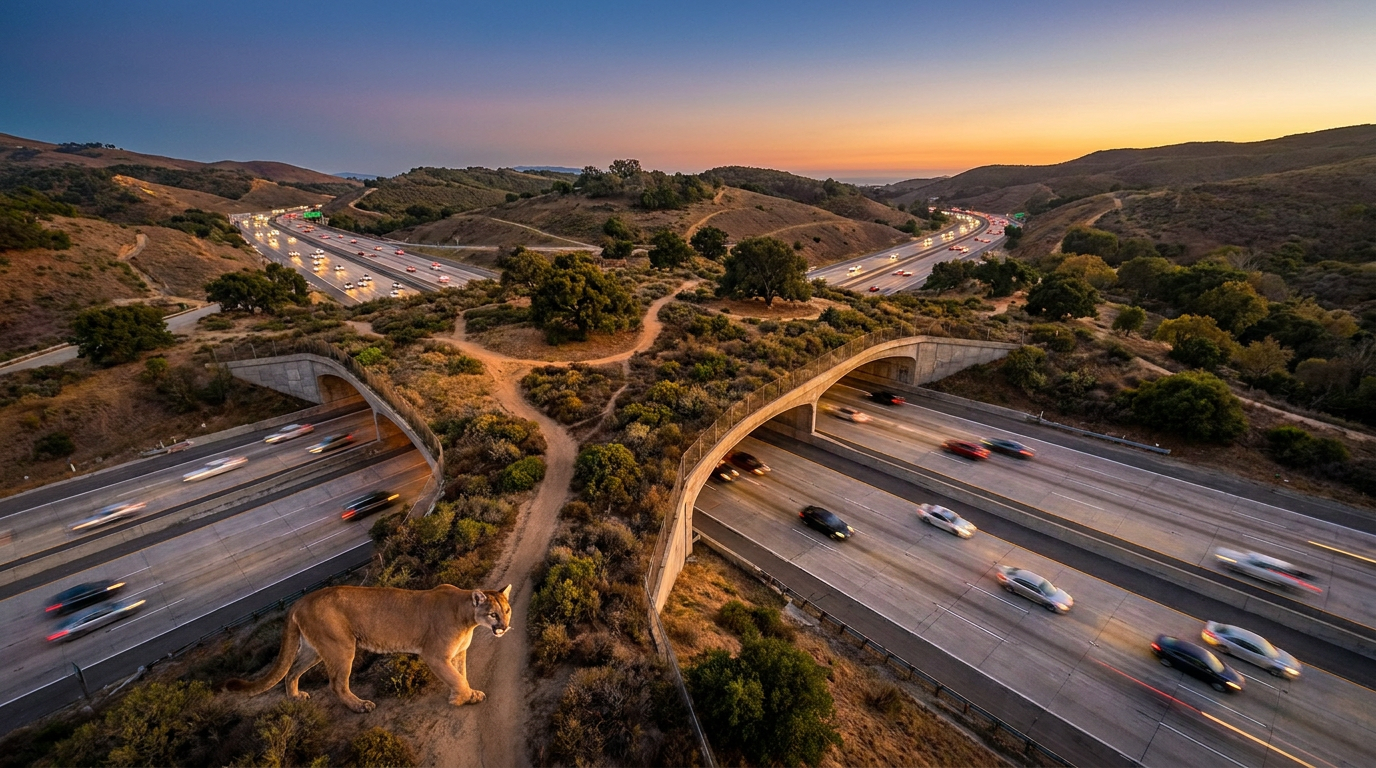
The 10-lane U.S. 101 freeway in Southern California is one of the most impenetrable barriers in the natural world. Every day, hundreds of thousands of vehicles create a roaring river of steel and asphalt that severs the Santa Monica Mountains from the Simi Hills. But in December 2026, that barrier will finally be breached. The Wallis Annenberg Wildlife Crossing, a $114 million vegetated overpass, is scheduled to officially open, marking a historic milestone in ecological engineering. Spanning 210 feet across the highway and an adjacent road, the structure is the largest of its kind on Earth. It represents a monumental shift in how civil engineers and conservationists approach the lethal intersection of human infrastructure and animal habitats, transforming a concrete divide into a living bridge.[1][5][8]
The crossing owes much of its genesis to a famous mountain lion known as P-22. In 2012, biologists were stunned to discover that the puma had somehow crossed two major Los Angeles freeways to reach Griffith Park. While his journey captivated the public, it also highlighted a quiet, fatal crisis. Highways do not just kill animals through blunt-force collisions; they slowly suffocate entire populations by cutting off access to mates, food, and territory. P-22 lived his life in genetic isolation, a stark symbol of how urban sprawl forces local species into dangerous inbreeding bottlenecks. The Annenberg project was conceived to ensure that future generations of mountain lions, bobcats, and deer could freely exchange genetic material across the region without risking their lives in traffic.[5][8]
But how do you convince a wild, skittish animal to walk over a roaring freeway? The mechanism relies on elaborate sensory deception. The Annenberg crossing is engineered to mimic the surrounding ecosystem so perfectly that animals do not realize they are on a bridge at all. The concrete superstructure is topped with one to four feet of specialized soil and planted with 50,000 native shrubs, grasses, and trees grown from over a million locally sourced seeds. Specially designed sound walls block the mechanical roar of the traffic below. Furthermore, the project incorporates strict light mitigation strategies—including lower color temperatures and pigmented concrete designed to match the local dirt—ensuring the crossing remains dark, quiet, and natural at night.[5][7]

Yet, the bridge itself is only half the equation. Wildlife crossings are virtually useless without their unsung companion: funnel fencing. Animals do not naturally seek out bridges; they attempt to cross wherever they happen to be. To solve this, engineers install eight-foot-high fences that stretch for miles along the highway in both directions. These barriers physically block animals from stepping onto the asphalt and gently guide them along the tree line until they reach the safe passage. As researchers note, it is the fencing associated with the crossings that actually stops the roadkill, turning a vast, porous danger zone into a single, highly controlled safe corridor.[3][4]
The empirical evidence supporting this infrastructure is overwhelming. Research shows that well-placed wildlife crossings, when combined with continuous fencing, can reduce large-mammal collisions by more than 80 percent, and up to 97 percent for specific ungulate species like deer and elk. In Banff National Park in Canada, a pioneering network of 44 underpasses and overpasses constructed along the Trans-Canada Highway has successfully reduced large mammal collisions by over 80 percent. Similarly, in Colorado and Nevada, extensive crossing projects have recorded tens of thousands of successful migrations by mule deer, pronghorn, and black bears, drastically improving both animal survival rates and motorist safety.[4][6]
The empirical evidence supporting this infrastructure is overwhelming.
The economic argument for these structures is proving to be just as compelling as the ecological one. In the United States alone, wildlife-vehicle collisions kill an estimated 1 to 2 million large animals annually. These crashes cause roughly 200 human fatalities and 26,000 injuries every year. Beyond the tragic human toll, these accidents cost society more than $10 billion annually in medical care, vehicle repairs, and lost productivity. A single collision with a deer costs an average of $19,000, while hitting a massive moose can incur damages and medical costs upwards of $110,000.[4]

By preventing these catastrophic collisions, a single wildlife crossing can save billions of dollars over its projected 70-year lifespan. For state transportation departments, these structures are no longer viewed merely as environmental charity or public relations exercises. They are increasingly recognized as high-return safety investments. The California Transportation Commission, for instance, allocated nearly $19 million from environmental mitigation funds to help push the Annenberg crossing to completion, viewing it as a critical component of making the state's infrastructure safer and more climate-resilient for human drivers.[4][7]
Driven by these dual benefits, the wildlife crossing movement is rapidly expanding globally. While North America is a current epicenter for mega-projects, countries around the world are integrating connectivity into their infrastructure. The Netherlands has built an extensive network of "ecoducts" that have reduced roadkill by 96 percent for certain species. India is actively constructing specialized underpasses on highways that cut through tiger and elephant reserves. Even in countries like Croatia, new highway systems are being designed from the ground up with unheralded but highly effective wildlife passages to protect native biodiversity.[2][6]

Despite the proven success rates, scaling these projects presents significant logistical and financial challenges. The Annenberg crossing's $114 million price tag highlights the steep cost of retrofitting existing, heavily developed urban corridors. Funding often requires complex public-private partnerships; the Annenberg project relied heavily on private philanthropy alongside state conservation grants. Critics have occasionally labeled such expensive projects as "bridges to nowhere," questioning the allocation of infrastructure funds. Planners must also contend with the ongoing maintenance of living structures, ensuring the vegetation survives droughts and the immense weight of wet soil does not compromise the concrete spans below.[1][8]
Nevertheless, the paradigm of highway construction has permanently shifted. The instinctual drive of animals to roam is so strong that they rarely wait for the ribbon-cutting. In Northern California, cameras recently captured mule deer successfully navigating a $20 million wildlife bridge that was still under active construction. As the Wallis Annenberg Wildlife Crossing prepares to welcome its first four-legged travelers this December, it stands as a concrete promise that human progress and wild spaces do not have to be mutually exclusive. With thoughtful engineering, we can quite literally bridge the divides we have created.[3][8]
How we got here
2012
Mountain lion P-22 is discovered in Griffith Park, highlighting the severe genetic isolation caused by Los Angeles freeways.
April 2022
Ground is broken on the Wallis Annenberg Wildlife Crossing on Earth Day.
June 2025
The first phase of the crossing, including the main vegetated superstructure over the 101 freeway, is completed.
May 2026
Cameras capture mule deer successfully using an unfinished wildlife bridge in Northern California.
December 2026
The Wallis Annenberg Wildlife Crossing is scheduled to officially open to four-legged travelers.
Viewpoints in depth
Ecological Conservationists
Advocates focused on restoring genetic diversity and preventing local extinctions caused by habitat fragmentation.
For conservation biologists, wildlife crossings are less about preventing individual animal deaths and more about saving entire populations from genetic collapse. When freeways slice through a landscape, they create artificial islands. Animals trapped on these islands are forced to interbreed, leading to genetic bottlenecks that make the population highly susceptible to disease and environmental changes. Conservationists point to the isolated mountain lions of Southern California as a prime example; without the ability to safely cross the 101 freeway to find new mates, the local puma population faced a real threat of extinction. To this camp, crossings are essential arteries that restore the natural flow of life across a continent.
Transportation & Safety Officials
Government and highway agencies focused on reducing the economic and human toll of vehicle collisions.
Transportation officials view wildlife crossings through the lens of public safety and economic efficiency. With 1 to 2 million large animals struck on U.S. roads annually, the resulting crashes cause hundreds of human fatalities and cost society upwards of $10 billion a year in medical bills, vehicle damage, and emergency response. From this perspective, spending $20 million or even $100 million on a crossing structure is a highly rational, data-driven investment. Because fencing and crossings can eliminate up to 97 percent of these collisions in known hotspots, safety officials argue that these structures pay for themselves multiple times over their lifespan by keeping drivers out of the hospital and vehicles out of the scrapyard.
Urban Infrastructure Planners
Engineers and urban planners focused on the logistical realities, costs, and structural challenges of building living bridges.
While supportive of the ecological goals, infrastructure planners are tasked with the daunting reality of retrofitting massive concrete structures over active, multi-lane highways. They must account for the immense, fluctuating weight of several feet of soil—especially when saturated by heavy rains—suspended over moving traffic. Furthermore, they face the challenge of securing complex funding. Because routine highway budgets rarely cover the full cost of these specialized structures, planners must weave together public grants, environmental mitigation funds, and private philanthropy. They must also design for long-term maintenance, ensuring that the carefully planted native vegetation survives droughts and does not compromise the bridge's structural integrity over the decades.
What we don't know
- How long it will take for the most skittish species to adapt to and trust the new Annenberg crossing.
- Whether the native vegetation on the bridge can withstand prolonged, severe California droughts without extensive artificial irrigation.
- How quickly the genetic diversity of the isolated Santa Monica mountain lion population will rebound once the corridor is open.
Key terms
- Wildlife Corridor
- A stretch of natural habitat that connects wildlife populations separated by human activities or structures.
- Funnel Fencing
- Specially designed barriers placed along highways to prevent animals from crossing the road and guide them toward a safe overpass or underpass.
- Habitat Fragmentation
- The process by which large, continuous habitats are divided into smaller, isolated patches, often by roads or urban development.
- Genetic Isolation
- A situation where a population of animals cannot mix and breed with other groups, leading to inbreeding and increased vulnerability to disease.
- Ungulates
- Hooved mammals, such as deer, elk, and moose, which are frequently involved in severe highway collisions.
Frequently asked
When does the Wallis Annenberg Wildlife Crossing open?
It is scheduled to officially open to wildlife on December 2, 2026.
How do animals know to use the bridge?
Animals are guided to the crossing by miles of 8-foot-high funnel fencing along the highway, and the bridge itself is landscaped to look, sound, and smell like their natural habitat.
Who pays for these expensive crossings?
Funding typically comes from a mix of public transportation grants, environmental mitigation funds, and private philanthropy.
Do wildlife crossings actually work?
Yes. Studies show that well-placed crossings combined with fencing can reduce wildlife-vehicle collisions by up to 97 percent.
Sources
Source coverage
8 outlets
3 viewpoints surfaced








[1]Los Angeles TimesUrban Infrastructure Planners
The world's largest wildlife crossing finally has an opening date
Read on Los Angeles Times →[2]MongabayEcological Conservationists
Global wildlife crossing projects accelerate to reconnect fragmented habitats
Read on Mongabay →[3]Smithsonian MagazineEcological Conservationists
California's First Wildlife Bridge Isn't Finished Yet, But That Hasn't Stopped Animals From Using It
Read on Smithsonian Magazine →[4]The Pew Charitable TrustsTransportation & Safety Advocates
Wildlife Crossing Structures Can Reduce Wildlife-Vehicle Crashes by More Than 90%
Read on The Pew Charitable Trusts →[5]Informed InfrastructureUrban Infrastructure Planners
World's Largest Wildlife Crossing Nears Completion In Southern California
Read on Informed Infrastructure →[6]Think Wildlife FoundationEcological Conservationists
Case studies of successful wildlife crossings
Read on Think Wildlife Foundation →[7]Office of Governor Gavin NewsomTransportation & Safety Advocates
California closes in on completing the world's largest wildlife crossing
Read on Office of Governor Gavin Newsom →[8]Travel TomorrowUrban Infrastructure Planners
World's largest wildlife crossing to open in California this year
Read on Travel Tomorrow →
More in environment
See all 16 stories →Urban Resilience
The Rise of 'Sponge Cities': How Urban Design is Defeating Mega-Floods
8 sources
Ocean Conservation
The "Spillover Effect": How Marine Sanctuaries Are Replenishing the Global Ocean
9 sources
Bioacoustics
How AI and Bioacoustics Are Decoding the Natural World
6 sources
Wildfire Tech
How AI and Satellites Are Catching Wildfires Before They Spread
6 sources
Every angle. Every day.
Get environment stories with full source coverage and perspective breakdowns delivered to your inbox.