
How Mass Timber is Turning Skyscrapers into Carbon Sinks
Engineered wood is replacing concrete and steel in high-rise construction, offering a faster, fire-resistant way to build that actively pulls carbon from the atmosphere.
By Factlen Editorial Team
- Sustainable Architects & Developers
- Focus on the environmental and aesthetic benefits of replacing concrete with renewable materials.
- Environmental Scientists
- Focus on the lifecycle emissions of timber and the strict necessity of sustainable forestry.
- Construction Pragmatists
- Focus on the economic realities, fire codes, and structural limitations of pure timber.
What's not represented
- · Traditional Steel & Concrete Manufacturers
- · Local Forestry Communities
Why this matters
The built environment is responsible for a massive portion of global carbon emissions. Shifting from concrete to mass timber offers a rare, scalable solution to build the housing and infrastructure cities need while actively pulling carbon out of the atmosphere.
Key points
- Mass timber uses engineered wood panels to replace concrete and steel in high-rise construction.
- Traditional building materials account for roughly 11% of global greenhouse gas emissions.
- Timber acts as a carbon sink, storing the CO2 that trees absorbed during their lifetime.
- Engineered wood resists fire by forming an insulating char layer that protects its structural core.
- Prefabricated timber panels can reduce construction schedules by up to 40%.
- The sustainability of mass timber relies heavily on responsible, certified forestry practices.
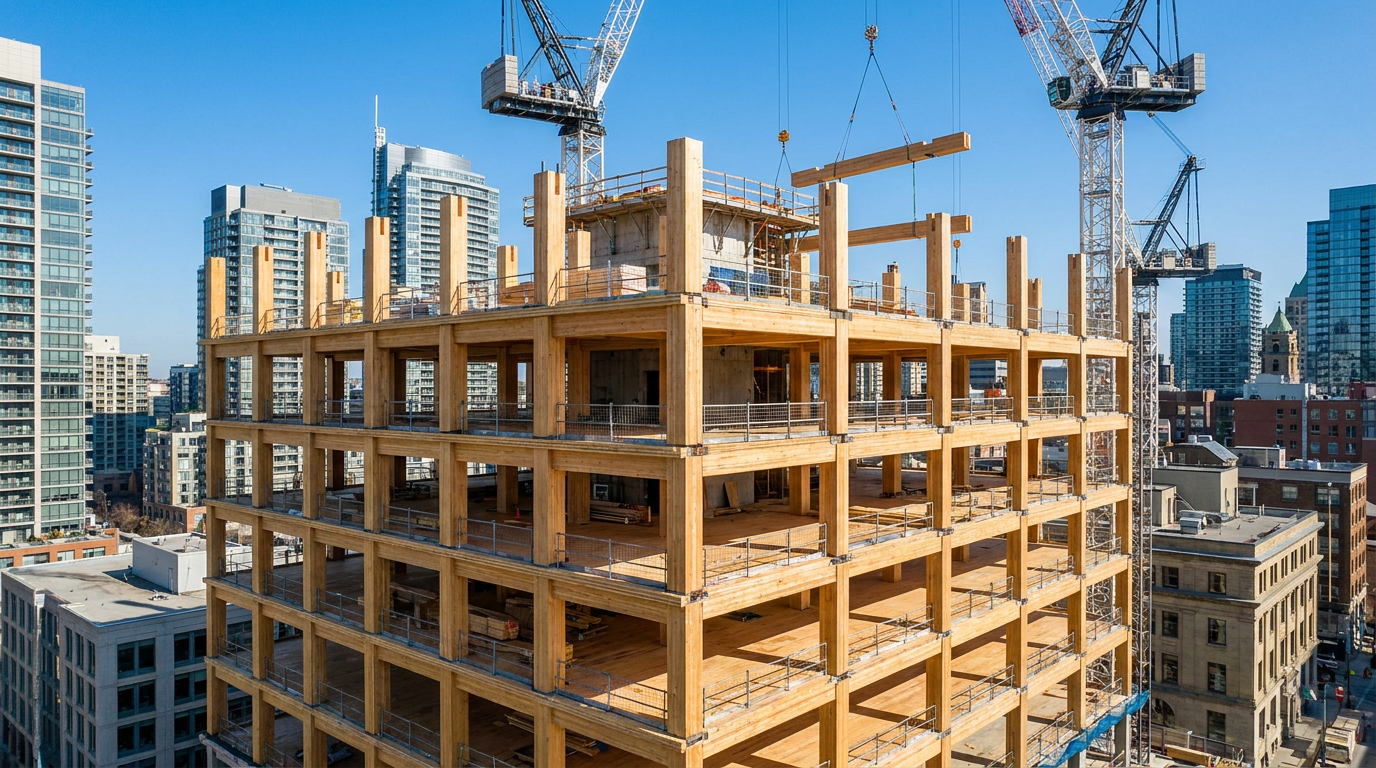
The global skyline is undergoing a fundamental shift in substance. In Milwaukee, Wisconsin, a 31-story tower called The Edison is rising to 110 meters, set to become the world's tallest mass timber building upon its completion. Halfway across the world in Sydney, the 40-story Atlassian Central is blending a steel exoskeleton with a massive internal timber structure. These "plyscrapers" represent a radical departure from the steel-and-glass monoliths that defined the 20th century.[3][4]
The primary driver behind this architectural revolution is climate change. The traditional building materials of high-rise construction—concrete and steel—are produced by extractive industries that require extreme heat. The manufacturing of these materials accounts for roughly 11% of all global greenhouse gas emissions. This "embodied carbon" means that a conventional skyscraper has already done massive environmental damage before its doors even open.[1][5]
In response, architects and developers are turning to mass timber. Unlike the traditional light-frame two-by-fours used in residential homebuilding, mass timber refers to a category of massive, engineered wood panels and beams that possess the structural integrity required to support high-rises and large commercial spaces.[4]
The most common form of this technology is Cross-Laminated Timber (CLT). To create a CLT panel, manufacturers take layers of solid wood planks and glue them together, with each layer laid perpendicularly to the one above and below it. This cross-hatching technique gives the resulting panels immense rigidity and strength in multiple directions. Another variant, glued-laminated timber (glulam), is used to create massive load-bearing columns and beams.[4][7]

The environmental mathematics of mass timber are highly compelling. As trees grow, they absorb carbon dioxide from the atmosphere through photosynthesis, using it to build their cellular structure. When a tree is sustainably harvested and engineered into a CLT panel, that carbon does not return to the atmosphere; it remains locked inside the wood for the lifetime of the building.[1][6]
This mechanism effectively turns buildings from carbon emitters into active carbon sinks. For every cubic meter of wood used in construction, approximately 0.9 tons of carbon dioxide is sequestered. By replacing concrete floors and steel beams with timber, developers can achieve a 76% to 94% lower global warming potential compared to traditional construction methods.[5][6]
Despite the environmental benefits, the immediate question most people ask about wooden skyscrapers is fire safety. It seems deeply counterintuitive to build a 30-story tower out of a material known for being combustible, especially in dense urban environments with strict life-safety codes.[5]
Despite the environmental benefits, the immediate question most people ask about wooden skyscrapers is fire safety.
However, mass timber behaves very differently from light-frame wood in a fire. When exposed to extreme heat, the outside of a massive timber beam chars. This blackened char layer acts as a natural insulator, protecting the structural integrity of the inner wood for hours. In many rigorous fire tests, mass timber has actually outperformed unprotected steel, which can rapidly warp, buckle, and collapse under high temperatures.[5][7]

Beyond environmental and safety metrics, mass timber is winning over developers on the balance sheet through sheer speed of construction. Because CLT panels and glulam beams are precision-milled in a factory using computer-aided design, they arrive on the construction site functioning like a giant, perfectly measured furniture kit.[1][5]
Instead of building complex formwork, pouring concrete, and waiting days for it to cure, small construction crews can simply crane the prefabricated timber panels into place and bolt them together. This industrialized approach to assembly can reduce construction schedules by 30% to 40%, significantly lowering labor costs and minimizing noise and disruption in the surrounding neighborhood.[5][7]
The benefits of mass timber also extend to the people living and working inside these structures. Rather than hiding the structural framework behind drywall and dropped ceilings, architects are increasingly leaving the timber exposed. This approach celebrates the natural grain and warmth of the wood as a core aesthetic feature.[4]
This practice is rooted in "biophilic design," a concept that seeks to connect building occupants more closely to nature. Studies suggest that working and living in environments dominated by natural materials can lower stress levels, regulate indoor humidity, improve acoustic performance, and enhance overall psychological well-being.[4][7]

While pure timber buildings are reaching impressive new heights, the most pragmatic path forward for ultra-tall structures is hybrid construction. Buildings like Milwaukee's Edison tower utilize a concrete elevator core to provide lateral stability against high winds, combined with timber floors and columns for the rest of the structure. This hybrid approach maximizes the strengths of both materials.[3]
The primary constraint on the mass timber revolution is the supply chain and the limits of sustainable forestry. To remain truly environmentally beneficial, the wood must be sourced from certified, sustainably managed forests where new trees are continuously planted to replace harvested ones. Scaling up mass timber to meet global construction demands without triggering deforestation requires careful ecological management.[2][6]
There are also open questions regarding the circular economy at the end of a building's life. What happens to a mass timber skyscraper in a century? If the wood is simply demolished and sent to a landfill, it will eventually decompose and release its stored carbon back into the atmosphere.[2]

To solve this, researchers are currently developing "design for disassembly" protocols. The goal is to ensure that CLT panels and glulam beams can be unbolted and reused in future buildings, extending their life as a carbon sink indefinitely. As these techniques mature, the rise of the plyscraper represents a rare alignment of ecological necessity and architectural innovation, offering cities a way to grow denser without cooking the planet.[2][7]
How we got here
2009
The first modern 9-story mass timber building is completed, proving the viability of the material for mid-rise construction.
2019
Mjøstårnet in Norway reaches 280 feet, becoming the tallest timber building in Europe and demonstrating new structural possibilities.
2022
Ascent MKE in Milwaukee is completed at 25 stories, taking the global height record for a mass timber building.
2025
Construction begins on The Edison in Milwaukee, designed to reach 31 stories and surpass Ascent MKE.
2026
Hybrid timber-and-steel mega-structures, such as Sydney's 40-story Atlassian Central, push the boundaries of high-rise engineering.
Viewpoints in depth
Sustainable Architects & Developers
Focus on the environmental and aesthetic benefits of replacing concrete with renewable materials.
This camp views mass timber as the most viable path to decarbonizing the built environment. They emphasize that because building materials account for 11% of global emissions, switching to a carbon-sequestering material like CLT is a necessity, not a trend. They also highlight the psychological benefits of biophilic design, arguing that exposed wood creates healthier, more productive spaces for occupants.
Environmental Scientists & Carbon Analysts
Focus on the lifecycle emissions of timber and the strict necessity of sustainable forestry.
While supportive of mass timber's carbon-sink potential, these experts caution that the math only works if the supply chain is rigorously managed. They argue that if mass timber scales up too quickly without strict forestry certifications, it could incentivize over-harvesting. They also stress the importance of end-of-life planning, noting that if timber buildings are eventually demolished and landfilled, the sequestered carbon will simply be released back into the atmosphere.
Construction & Engineering Pragmatists
Focus on the economic realities, fire codes, and structural limitations of pure timber.
Engineers and contractors appreciate mass timber for its prefabrication speed and lighter weight, which reduces the need for massive foundations. However, they advocate for hybrid systems—combining timber with concrete cores or steel exoskeletons—as the safest and most cost-effective way to build tall. They are primarily focused on navigating strict urban fire codes and securing insurance for these novel structures.
What we don't know
- How the global timber supply chain will handle a massive surge in demand without compromising sustainable forestry practices.
- The long-term performance of mass timber high-rises over a 100-year lifespan, as the oldest modern structures are still relatively new.
- Whether the construction industry will successfully adopt 'design for disassembly' to ensure timber panels are reused rather than landfilled at the end of a building's life.
Key terms
- Cross-Laminated Timber (CLT)
- An engineered wood product made by gluing layers of solid wood perpendicularly to one another, creating highly rigid, strong panels.
- Glulam
- Glued-laminated timber, an engineered wood product used primarily for massive, load-bearing columns and beams.
- Embodied Carbon
- The total greenhouse gas emissions generated by the manufacturing, transportation, and assembly of building materials before a building is even occupied.
- Carbon Sink
- Anything that absorbs more carbon from the atmosphere than it releases; in this case, timber locking away the CO2 a tree absorbed during its lifetime.
- Biophilic Design
- An architectural approach that seeks to connect building occupants more closely to nature by incorporating natural light, plants, and exposed natural materials like wood.
Frequently asked
Is mass timber safe in a fire?
Yes. Unlike light-frame wood, massive engineered timber chars on the outside when exposed to fire. This char layer insulates the interior wood, allowing it to maintain structural integrity for hours, often outperforming unprotected steel.
How tall can a mass timber building be built?
Currently, the tallest completed mass timber building is the 25-story Ascent MKE in Milwaukee. However, hybrid structures that combine timber with concrete cores or steel frames are pushing past 40 stories.
Does mass timber construction cause deforestation?
Not if sourced correctly. The environmental benefits rely entirely on sustainable forestry practices, where trees are harvested from carefully managed forests and immediately replanted to continue the carbon cycle.
Is mass timber cheaper than concrete and steel?
The materials themselves can be more expensive, but mass timber often saves money overall by reducing construction time by 30% to 40% and requiring smaller construction crews.
Sources
Source coverage
7 outlets
3 viewpoints surfaced






[1]EcochainEnvironmental Scientists
Mass Timber Buildings and Carbon: The Fundamentals for Business Users
Read on Ecochain →[2]MDPI Buildings JournalEnvironmental Scientists
Circular Economy in Mass Timber Construction: State-of-the-Art
Read on MDPI Buildings Journal →[3]Construction BriefingSustainable Architects & Developers
Construction starts on world's tallest mass timber building
Read on Construction Briefing →[4]Metropolis MagazineSustainable Architects & Developers
Mass timber has taken over the architecture industry
Read on Metropolis Magazine →[5]Michigan State UniversityConstruction Pragmatists
Mass Timber Realities: Solving for Cost, Constructability, and Scale
Read on Michigan State University →[6]Sustainable StoriesEnvironmental Scientists
Understanding Carbon Sequestration in Timber Construction
Read on Sustainable Stories →[7]Factlen Editorial Team
Synthesis by Factlen editorial team
Read on Factlen Editorial Team →

Every angle. Every day.
Get home stories with full source coverage and perspective breakdowns delivered to your inbox.