
How Hybrid Rubbers and Hexagonal Blades Are Rewriting Table Tennis Physics
The transition to the 40+ plastic ball has triggered an arms race in table tennis equipment, leading to the rise of hybrid rubbers and radical new racket shapes designed to claw back lost spin and speed.
By Factlen Editorial Team
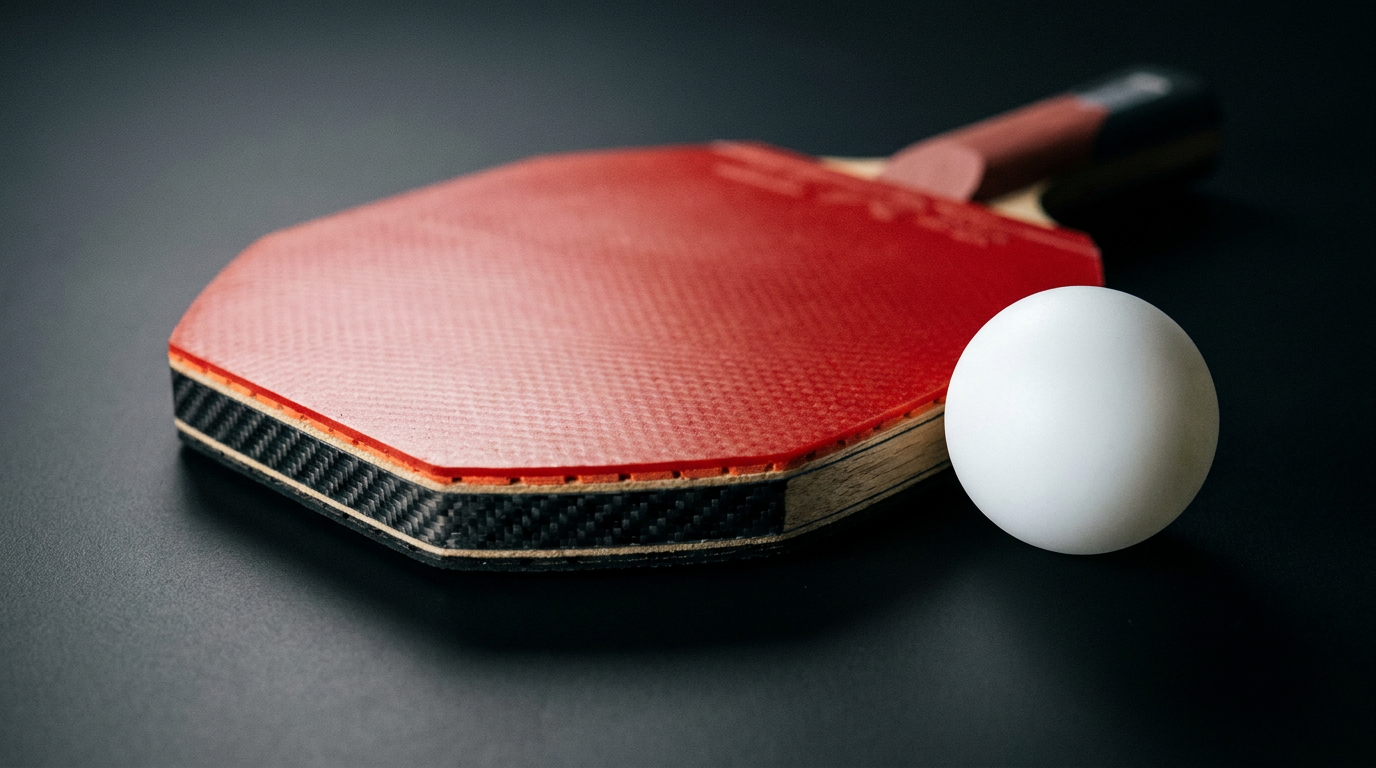
- Equipment Innovators
- Manufacturers and engineers focused on pushing the boundaries of physics with new shapes, carbon weaves, and hybrid materials to maximize speed and spin.
- Competitive Professionals
- Pragmatic elite athletes who constantly test and adopt new hybrid rubbers and carbon blades to gain a fractional edge in the high-speed modern game.
- Traditionalists & Purists
- Players and coaches who prefer the natural feel and dwell time of all-wood blades, arguing that extreme carbon technology can mask poor fundamental technique.
- Recreational Players
- Amateur enthusiasts who seek equipment that offers control and consistency, often feeling overwhelmed by the sheer volume of professional-grade gear.
What's not represented
- · Grassroots coaches teaching fundamentals
- · Sports biomechanics researchers
Why this matters
For decades, table tennis technique was dictated by the limitations of wood and rubber. Today, advanced materials science is fundamentally changing how the sport is played, allowing athletes to generate unprecedented power and spin while democratizing high-level techniques for amateur players.
Key points
- The transition to the smoother 40+ plastic ball caused a massive loss of spin in modern table tennis.
- Manufacturers created 'hybrid rubbers' to solve this, combining sticky Chinese topsheets with springy European sponges.
- Carbon-composite blades have largely replaced pure wood at the elite level to generate more power.
- Hexagonal rackets shift the center of gravity toward the tip, increasing centrifugal force during topspin loops.
- The geometric shape of new rackets expands the sweet spot and allows players to get closer to the table on short returns.
To the casual observer, a table tennis racket is just a piece of wood covered in red and black rubber. But step into any professional training hall in 2026, and you will find an arms race of materials science. The sport is currently undergoing its most radical technological shift in decades, driven by a fundamental change to the game's most basic element: the ball.[1][5]
The catalyst for this revolution began when the International Table Tennis Federation (ITTF) mandated the transition from highly flammable celluloid balls to the modern "40+ plastic ball." This new polymer sphere is slightly larger, heavier, and significantly smoother than its predecessor. For players, this meant one devastating thing: a massive loss of spin. The new ball simply did not "bite" into the rubber the way the old one did, causing heavy topspin shots to slip off the racket.[2][4][7]
Faced with this physics problem, equipment manufacturers had to rethink everything. Historically, the table tennis world was divided into two distinct equipment philosophies. The "Chinese school" relied on hard, highly tacky (sticky) rubbers to generate massive spin, though they required immense physical effort and chemical boosters to produce speed. Conversely, the "European/Japanese school" utilized highly elastic "tensor" sponges that acted like trampolines, offering blistering speed but struggling to grip the slippery new plastic ball.[1][2]
The solution that has come to dominate the sport in 2026 is the "Hybrid Rubber." By marrying a tacky, Chinese-style topsheet with a highly dynamic, springy European tensor sponge, manufacturers created a best-of-both-worlds composite. The sticky surface grabs the smooth plastic ball, preventing the dreaded "slip," while the underlying high-tension sponge catapults the ball forward with minimal effort.[1][2][4]

This hybrid approach has fundamentally altered rally dynamics. Players are no longer forced to choose between maximum rotation and maximum velocity. The grip provided by hybrid topsheets allows for aggressive counter-attacking close to the table, turning defensive blocks into offensive weapons. Even on the backhand side—traditionally reserved for smoother, faster rubbers—top professionals are now adopting hybrids to generate heavier spin off difficult serves.[2][3][4]
This hybrid approach has fundamentally altered rally dynamics.
But the rubber is only half the equation. The blades themselves—the wooden core of the racket—have undergone a parallel evolution. To compensate for the slower plastic ball, pure wood blades have largely been abandoned at the elite level in favor of carbon-composite structures. By weaving layers of carbon, Zylon, or aramid fibers between the wood veneers, engineers can drastically increase the blade's stiffness and enlarge its "sweet spot."[3][4][5]
The debate in 2026 now centers on carbon placement. "Outer carbon" blades, where the composite layer sits directly beneath the top wood veneer, offer explosive speed and a crisp, hard feel. However, a growing faction of players is shifting toward "inner carbon" architectures. By burying the carbon deeper near the core, the blade retains the softer, longer "dwell time" of natural wood on delicate touches, only engaging the stiff carbon layer during high-impact power shots.[3][6]

Perhaps the most visually striking innovation of the current era is the abandonment of the traditional round racket head. Pioneered by Swedish manufacturer Stiga with their "Cybershape" line, hexagonal rackets have moved from a viral curiosity to a proven competitive advantage. The geometric redesign is not a gimmick; it is a calculated manipulation of physics.[1][6]
By squaring off the top half of the blade, the hexagonal shape shifts the racket's center of gravity further toward the tip. This increased head-weight acts like a hammer, generating more kinetic energy and centrifugal force during a topspin swing. Furthermore, the wider upper half physically expands the optimal hitting area—the sweet spot—exactly where modern players make contact during aggressive loops.[1][3]

The geometric shape also offers a tangible advantage in the short game. The straight edges of the hexagon allow players to bring the racket significantly closer to the table surface when returning short, low serves. This fractional gain in proximity makes it easier to execute aggressive "banana flicks" over the table without catching the edge of the board.[1][5]
The professional circuit has fully embraced this new era of customized physics. Top-ranked players are constantly tweaking their setups, moving between custom hybrid carbon weaves and experimental rubber hardness levels to find the perfect trajectory. The days of a player picking up a standard wooden bat and relying solely on raw athleticism are over; modern table tennis is a synergy of biomechanics and materials engineering.[1][6]
For the recreational player, this technological boom is a double-edged sword. While the sheer volume of high-tech gear can be overwhelming, the democratization of spin and power means that amateur players can now execute shots that were physically impossible a decade ago. The equipment revolution has leveled the playing field, ensuring that the sport remains faster, spinnier, and more spectacular than ever before.[1][3][5]
How we got here
2000
The ITTF increases the ball size from 38mm to 40mm to slow down the game and make it more television-friendly.
2014
The sport begins transitioning from highly flammable celluloid balls to the new 40+ plastic polymer balls.
2021
Stiga introduces the Cybershape, a patented hexagonal racket that challenges the traditional round blade design.
2025-2026
Hybrid rubbers become the dominant equipment trend on the professional circuit to counter the slippery nature of the plastic ball.
Viewpoints in depth
Equipment Innovators
Manufacturers view the plastic ball era as an engineering challenge to be solved with advanced materials.
For equipment brands, the loss of spin caused by the 40+ plastic ball was not a crisis, but an opportunity. By leveraging advanced materials science—such as weaving high-modulus carbon with vibration-dampening synthetic fibers—engineers have been able to create blades that offer unprecedented power without sacrificing control. The development of hybrid rubbers represents a similar triumph of chemistry, blending two historically opposed manufacturing techniques to create a product perfectly tailored to modern physics.
Competitive Professionals
Elite players are pragmatic adopters who constantly test new gear to find fractional competitive advantages.
At the highest levels of the sport, loyalty to traditional equipment has been entirely superseded by the need for performance. Professional players are acutely aware of the physics of the modern game; if a hexagonal blade offers a 5% larger sweet spot, or a hybrid rubber prevents the ball from slipping during a high-tension rally, they will make the switch. This has led to an era of intense experimentation, with top athletes frequently changing their blade compositions and rubber hardness to perfectly match their individual biomechanics.
Traditionalists & Purists
Some coaches and players worry that advanced equipment masks poor technique and changes the fundamental nature of the sport.
A vocal minority within the table tennis community argues that the reliance on ultra-fast carbon blades and highly dynamic hybrid rubbers is detrimental to the sport's fundamentals. Traditionalists point out that all-wood blades force players to develop proper footwork and body rotation to generate power, whereas modern equipment allows players to hit explosive shots with minimal physical effort. There is a concern that the sport is becoming less about athletic technique and more about who has the most technologically advanced racket.
What we don't know
- Whether the ITTF will introduce new regulations to limit the speed and spin generated by hybrid rubbers.
- If other geometric racket shapes (beyond the hexagon) will emerge and prove mathematically superior.
- How long it will take for hybrid rubber technology to become cheap enough to fully replace traditional rubbers in the beginner market.
Key terms
- Hybrid Rubber
- A table tennis rubber combining a tacky, grippy Chinese-style topsheet with a springy, dynamic European-style tensor sponge.
- 40+ Plastic Ball
- The modern standard table tennis ball, which is slightly larger, heavier, and smoother than pre-2015 celluloid balls, making it harder to generate spin.
- Tensor Sponge
- A highly elastic rubber sponge developed primarily in Europe that provides a 'catapult effect,' generating high speed with less physical effort.
- Sweet Spot
- The optimal hitting area on a racket blade where energy transfer is most efficient and vibrations are minimized.
- Inner Carbon
- A blade construction where the carbon fiber layers are placed deep near the wooden core, offering the soft feel of wood on light touches but the power of carbon on hard hits.
Frequently asked
Why did table tennis switch to plastic balls?
The ITTF phased out traditional celluloid balls starting in 2014 primarily for safety and manufacturing reasons, as celluloid is highly flammable and difficult to transport.
Do hexagonal rackets actually improve play?
Yes. Physics analyses and player feedback indicate that the hexagonal shape increases the optimal hitting area (sweet spot) and shifts the balance toward the tip, which aids in generating heavy topspin.
Should beginners use hybrid rubbers?
Generally, no. Hybrid rubbers are designed for advanced players who need to counter the specific spin-loss of the plastic ball at high speeds. Beginners are usually better off with softer, more forgiving traditional rubbers to develop proper technique.
Sources
Source coverage
7 outlets
4 viewpoints surfaced






[1]Factlen Editorial TeamRecreational Players
Synthesis by Factlen editorial team
Read on Factlen Editorial Team →[2]PaddleWizEquipment Innovators
The complete guide to hybrid table tennis rubbers
Read on PaddleWiz →[3]TableTennisDailyTraditionalists & Purists
Equipment Trends: Hybrid Rubbers and Carbon Blades
Read on TableTennisDaily →[4]Shop-PingEquipment Innovators
Materials and Their Effects on the Game in 2025
Read on Shop-Ping →[5]Racket TripEquipment Innovators
Innovation in Table Tennis: Technologies and Trends Transforming the Game
Read on Racket Trip →[6]Weekly Gear DropCompetitive Professionals
Pro Equipment Shifts for 2026: Stiga LUMA and Joola Trinity
Read on Weekly Gear Drop →[7]Table Tennis EnglandRecreational Players
A whole new ball game: The evolution of table tennis equipment
Read on Table Tennis England →

More in sports
See all 6 stories →Golf Tech
How Smartphone AI and Biomechanics Democratized Golf Coaching in 2026
7 sources

Women's Football
Women's Football Shatters Viewership and Revenue Records as Global Game Enters New Era
6 sources

NWSL Expansion
NWSL Shatters Attendance and Viewership Records in Historic 2026 Season
8 sources

Combat Sports Tech
How Smart Mouthguards Are Changing the Math on Brain Trauma in Combat Sports
6 sources

Every angle. Every day.
Get sports stories with full source coverage and perspective breakdowns delivered to your inbox.