
How Humanoid Robots Finally Got Real Jobs on the Factory Floor
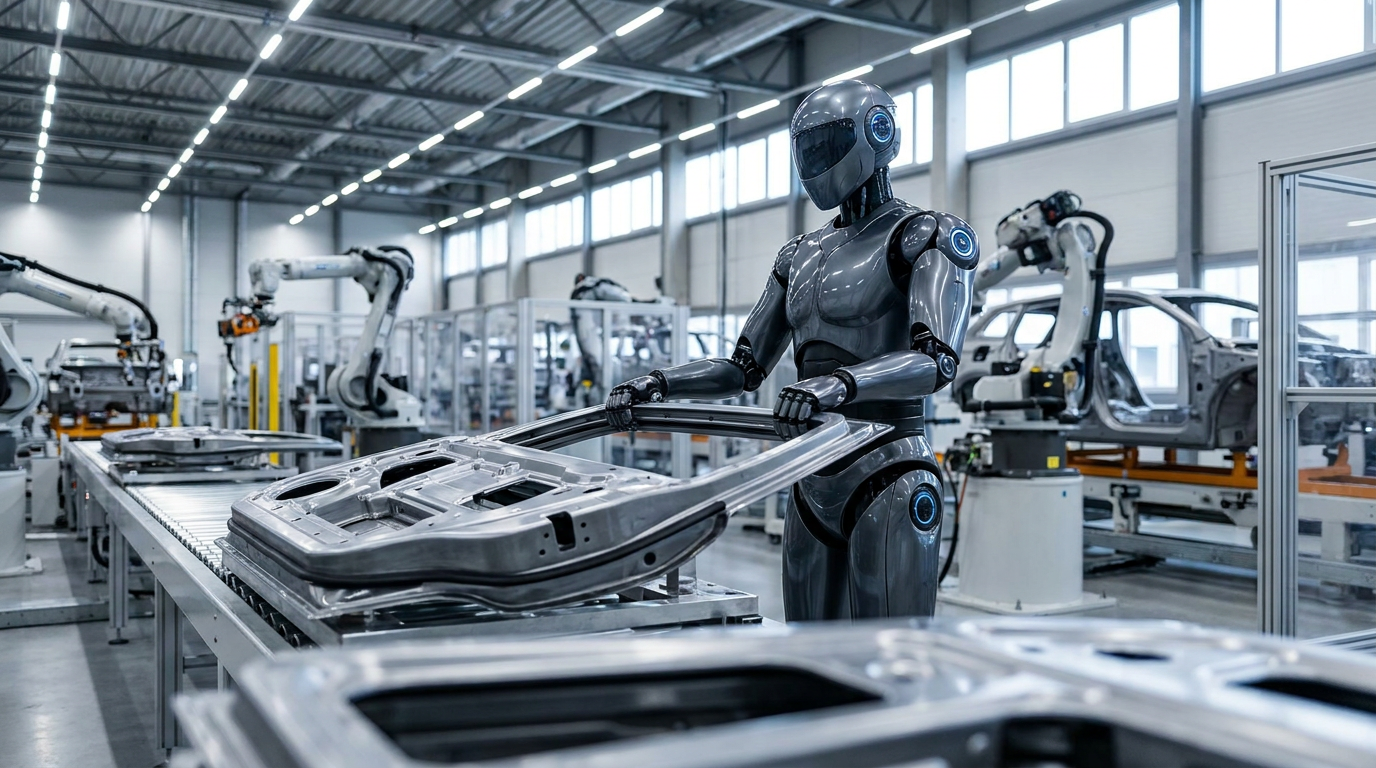
After years of viral demonstration videos, AI-powered bipedal robots have entered paid commercial service in 2026, performing repetitive logistics and assembly tasks for automakers like BMW, Mercedes-Benz, and Hyundai.
By Factlen Editorial Team
- Manufacturing Executives
- Focuses on the immediate return on investment, solving labor shortages, and integrating robots without rebuilding assembly lines.
- Robotics Developers
- Prioritizes the advancement of Physical AI, simulation training, and overcoming hardware dexterity limits.
- Labor & Safety Analysts
- Examines the safety frameworks for uncaged robots and the transition of human workers away from ergonomically dangerous tasks.
What's not represented
- · Human factory floor workers directly collaborating with the robots
- · Traditional fixed-automation manufacturers facing new competition
Why this matters
The transition of humanoid robots from research labs to active factory floors marks a fundamental shift in global manufacturing. By automating physically punishing tasks without requiring multi-million-dollar facility redesigns, this technology offers a scalable solution to severe labor shortages while keeping supply chains moving.
Key points
- Humanoid robots have transitioned from research prototypes to paid commercial deployments on factory floors in 2026.
- Automakers like BMW and Mercedes-Benz are utilizing Robot-as-a-Service models, paying roughly $25 per operating hour.
- The robots are filling a 'flexibility gap' by performing repetitive logistics tasks in spaces built for humans.
- Breakthroughs in Physical AI and Vision-Language-Action models allow the robots to understand natural language and adapt to their environments.
- While basic mobility is solved, engineers are still working to improve the tactile dexterity required for tight-tolerance assembly.
For years, the robotics industry has traded on viral spectacle: bipedal machines performing backflips, dancing to pop music, or navigating complex obstacle courses. But in 2026, the most significant milestone for humanoid robots is profoundly boring. They are moving totes, inserting sheet metal, and delivering parts on active automotive assembly lines. The era of the research prototype has quietly given way to the era of the paid commercial contract, marking a fundamental shift in how heavy industry approaches automation.[1][8]
The clearest evidence of this transition is unfolding at BMW's manufacturing plant in Spartanburg, South Carolina. Following a highly successful ten-month pilot program, BMW signed a commercial contract to deploy a fleet of forty "Figure 03" humanoid robots across its body shop and assembly lines. During the initial testing phase, the preceding Figure 02 models logged over 1,250 operational hours, successfully moving more than 90,000 parts with a placement accuracy exceeding 99 percent.[2]
The economics of this deployment represent a tipping point for manufacturing executives. Rather than purchasing the hardware outright—which cost between $30,000 and $150,000 per unit in 2025—BMW is utilizing a Robot-as-a-Service (RaaS) model. The Figure 03 units operate at a contracted rate of approximately $25 per robot-operating-hour. At that price, deploying a humanoid transforms from a speculative research expense into a CFO-defensible line item that directly competes with the cost of human overtime and turnover.[2][6]

This commercial viability is being driven by a severe demographic reckoning. Manufacturers worldwide are facing persistent labor shortages, particularly for tasks described as "dirty, dangerous, or dull." While traditional fixed automation—like robotic arms bolted inside safety cages—excels at high-speed, single-task repetition, it cannot easily adapt to the frequent product changeovers required in modern high-mix manufacturing.[1][8]
Humanoid robots are designed specifically to fill this "flexibility gap." Because factories were built around human biomechanics—featuring stairs, narrow aisles, standard tool handles, and specific workstation heights—a robot with a human form factor can drop into an existing facility without requiring a multi-million-dollar redesign of the production line. They do not replace the entire human workforce; instead, they take over the ergonomic strain of line-side kit delivery, tote handling, and repetitive component insertion.[1][4]
The hardware capable of walking and lifting has existed for years, but the software required to understand a chaotic factory environment has only recently matured. The breakthrough is a paradigm known as "Physical AI." Unlike large language models confined to digital screens, Physical AI bridges the gap between digital reasoning and physical manipulation, allowing a machine to understand physical laws, spatial relationships, and real-time environmental changes.[3]
At the core of Physical AI are Vision-Language-Action (VLA) models. These systems allow a robot to receive a natural language command—such as "pick up the red bracket and place it in the third bin"—and translate that instruction directly into motor commands. The robot uses its vision systems to identify the object, its reasoning model to plan the trajectory, and its actuators to execute the movement, all without requiring a human engineer to write custom code for that specific spatial coordinate.[3][7]
At the core of Physical AI are Vision-Language-Action (VLA) models.
Training these models in the real world would be prohibitively slow and dangerous. Instead, developers are utilizing GPU-accelerated simulation platforms, such as NVIDIA's Isaac. These digital twin environments allow AI models to practice millions of grasping and walking iterations at 1,000 times real-world speed. When the software policy is transferred to the physical robot, it already "knows" how to handle edge cases it has never physically encountered.[3]

As the software has advanced, the hardware ecosystem has rapidly consolidated. Apptronik, a Texas-based robotics firm, has deployed its 5-foot-8-inch Apollo robot in pilots with Mercedes-Benz and manufacturing giant Jabil. Capable of lifting 55 pounds, Apollo is being utilized for internal logistics, moving assembly kits across the production floor to keep human workers supplied with the exact parts they need for the next vehicle.[4][7]
Similarly, Boston Dynamics—long famous for its hydraulic research robots—has transitioned to a fully electric version of its Atlas humanoid. Backed by its parent company, Hyundai Motor Group, the electric Atlas is being positioned for heavy material handling across Hyundai's global manufacturing sites. The system integrates Google DeepMind's AI models to process 3D spatial environments, aiming for mass production and deployment at scale.[7]

In the logistics sector, Agility Robotics has moved its Digit bipedal robot into live operations with Amazon and GXO Logistics. Digit specializes in tote handling, moving plastic bins from storage racks to conveyor belts. By automating the repetitive lifting that frequently causes musculoskeletal injuries in human workers, logistics companies can maintain throughput even when facing severe staffing shortfalls.[1][6]
The consumer electric vehicle industry is also preparing its own physical AI workforce. Tesla is advancing its Optimus program, with volume production of its Gen 3 humanoid planned for its Fremont facility in late 2026. Featuring upgraded 22-degree-of-freedom hands designed for tactile precision, Optimus is intended first for internal factory use before eventually targeting a consumer price point of $20,000 to $30,000.[5]
Despite this rapid progress, significant technical hurdles remain. Basic manipulation and locomotion are largely solved, but tight-tolerance assembly—such as routing flexible cables, inserting delicate connectors, or fastening tiny screws—still exceeds the dexterity of most robotic hands. Human workers possess an innate tactile feedback loop that allows them to adjust their grip instantly if a screw threads improperly; replicating that sensitivity in a machine is an ongoing engineering challenge.[6][8]

Safety also remains a paramount concern. Traditional industrial robots operate behind steel cages because they will blindly swing through any obstacle in their programmed path. Humanoids are mobile, whole-body systems designed to work shoulder-to-shoulder with humans. They require advanced, real-time perception systems to instantly freeze or yield if a human steps into their workspace, and regulatory frameworks are still catching up to the reality of uncaged bipedal machines.[1][6]
Nevertheless, the trajectory is clear. Financial analysts project that as manufacturing scales, the unit cost of an industrial humanoid could fall below $17,000 by 2030. With multiple platforms now proving their reliability across multi-shift operations, the conversation in manufacturing boardrooms has shifted from asking if humanoids will work, to deciding which assembly station they should automate first.[5][8]
How we got here
2023
Humanoid robots are largely confined to research labs and viral demonstration videos.
Late 2024
Early pilot programs begin, with robots like Digit testing tote-moving at Amazon facilities.
2025
Breakthroughs in Vision-Language-Action (VLA) models allow robots to understand natural language commands.
Early 2026
Figure 02 completes a 10-month pilot at BMW, moving over 90,000 parts.
Mid 2026
The first wave of paid, commercial Robot-as-a-Service (RaaS) contracts are signed for factory deployments.
Viewpoints in depth
Manufacturing Executives
Viewing humanoids as a flexible solution to persistent labor shortages.
For plant managers and CFOs, the appeal of humanoid robots is strictly economic. Traditional fixed automation requires massive capital expenditure to redesign a factory floor, and it struggles with high-mix, low-volume production where tasks change frequently. Because humanoids fit into existing human-centric spaces—using the same stairs, aisles, and tools as human workers—they offer a plug-and-play solution to the 'flexibility gap.' Executives are particularly drawn to the Robot-as-a-Service (RaaS) model, which converts a daunting capital expense into a predictable hourly operating cost that directly competes with human turnover and overtime.
Robotics Developers
Focusing on the software leap from programmed paths to embodied reasoning.
Engineers view the 2026 deployment wave not as a hardware triumph, but as a software breakthrough. The physical actuators and batteries have existed for years, but the advent of Vision-Language-Action (VLA) models has fundamentally changed how robots operate. Instead of writing thousands of lines of code to dictate a specific arm trajectory, developers can now issue natural language commands. The robot's onboard AI interprets the visual scene, reasons through the physics of the task, and generates the motor commands in real time, allowing it to adapt to chaotic, unstructured environments.
Labor & Safety Analysts
Monitoring the shift toward human-robot collaboration and uncaged operations.
Workforce analysts emphasize that this first wave of humanoids is not replacing entire factory jobs, but rather automating specific, ergonomically punishing tasks like tote lifting and line-side kitting. The primary concern for this camp is safety. Industrial robots have historically operated behind steel cages because they cannot detect humans in their path. Humanoids, designed to work shoulder-to-shoulder with people, rely entirely on their AI perception systems to yield and avoid collisions. Analysts are closely watching how regulatory frameworks adapt to these uncaged, mobile systems as deployments scale.
What we don't know
- How maintenance costs and hardware degradation will scale over multi-year, continuous deployments.
- When robotic hands will achieve the fine tactile feedback necessary for complex, tight-tolerance assembly tasks.
- How regulatory safety frameworks will formally classify uncaged, mobile bipedal robots working alongside humans.
Key terms
- Physical AI
- Artificial intelligence systems that understand physical laws and can directly manipulate objects in the real world.
- Vision-Language-Action (VLA) model
- An AI architecture that translates visual inputs and natural language commands directly into physical motor movements.
- Robot-as-a-Service (RaaS)
- A business model where companies pay an hourly or monthly operational rate for a robot, rather than buying the hardware outright.
- Degrees of Freedom (DoF)
- The number of independent movements a robotic joint or limb can make, dictating its overall flexibility and dexterity.
- Digital Twin
- A highly accurate virtual simulation of a real-world environment used to train AI models safely and rapidly.
Frequently asked
Are humanoid robots replacing human factory workers?
Currently, they are filling labor shortages by taking over repetitive, physically demanding tasks like tote moving and kitting, rather than replacing entire human roles.
How much does a humanoid robot cost?
While outright purchases range from $30,000 to $150,000, many factories use a Robot-as-a-Service model, paying around $25 per operating hour.
Why build them in a human shape?
Factories are built for human biomechanics—stairs, narrow aisles, and standard tools. A humanoid form factor allows robots to navigate these existing spaces without expensive facility redesigns.
How do these robots learn new tasks?
They are trained using Vision-Language-Action models in accelerated virtual simulations, allowing them to understand natural language commands and adapt to physical environments.
Sources
Source coverage
8 outlets
3 viewpoints surfaced








[1]Automate Show InsightsManufacturing Executives
Industrial Humanoid Robots: Moving from Prototype to Pilot in 2026
Read on Automate Show Insights →[2]iFactory Manufacturing ReportManufacturing Executives
The State of Humanoid Robots on the Factory Floor in 2026
Read on iFactory Manufacturing Report →[3]Meta IntelligenceRobotics Developers
What Is Physical AI? The Leap from Digital Intelligence to the Physical World
Read on Meta Intelligence →[4]The Robot GroupLabor & Safety Analysts
Which Humanoid Robot Fits Your Factory in 2026?
Read on The Robot Group →[5]RoboZapsRobotics Developers
Quick Comparison: Best Humanoid Robots You Can Buy in 2026
Read on RoboZaps →[6]New Market PitchLabor & Safety Analysts
Humanoid robots in factories: for when?
Read on New Market Pitch →[7]EE TimesRobotics Developers
Apptronik's Apollo and the Rise of Factory Humanoids
Read on EE Times →[8]Factlen Editorial TeamLabor & Safety Analysts
Synthesis by Factlen editorial team
Read on Factlen Editorial Team →

More in technology
See all 5 stories →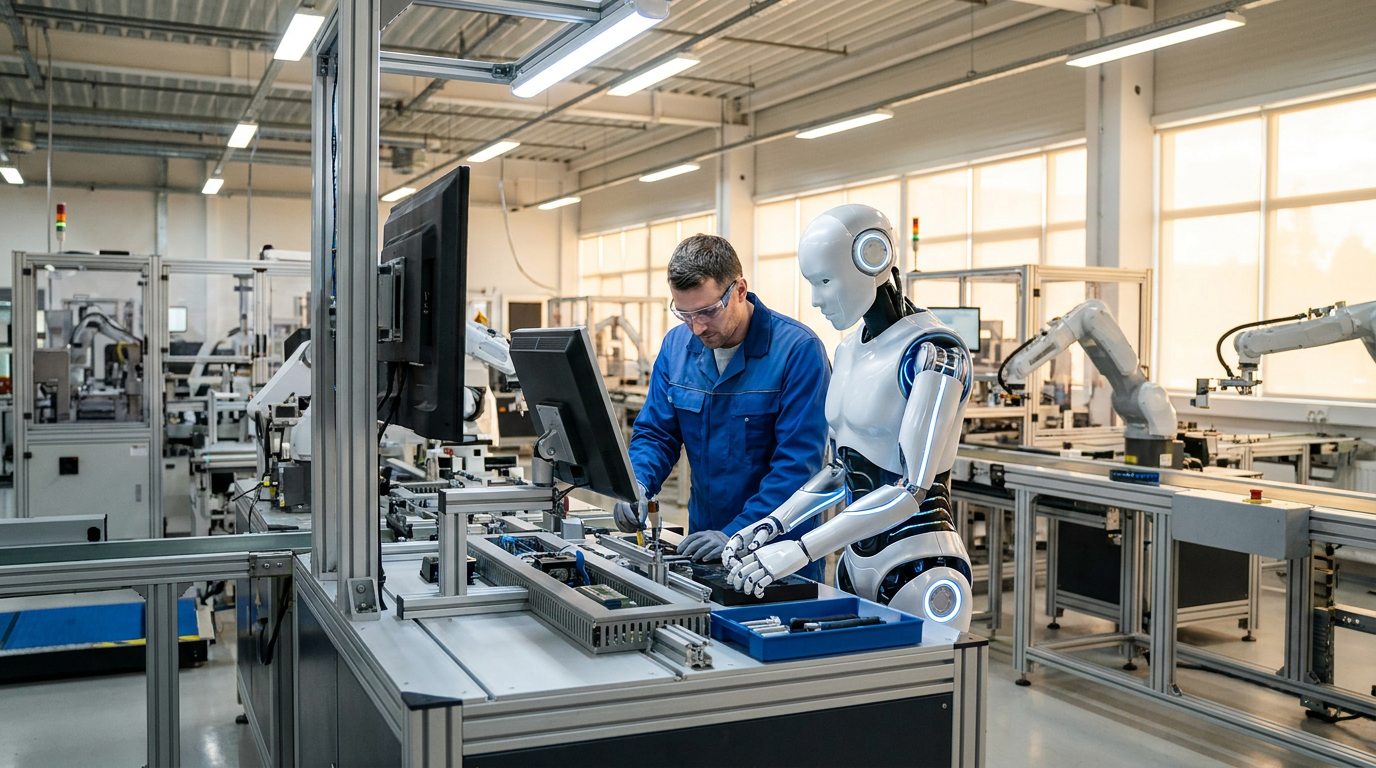


Every angle. Every day.
Get technology stories with full source coverage and perspective breakdowns delivered to your inbox.