
How Enhanced Geothermal Systems Are Unlocking Limitless Clean Energy
By borrowing drilling techniques from the oil and gas industry, Enhanced Geothermal Systems (EGS) are turning hot, dry rock into a 24/7 carbon-free power source.
By Factlen Editorial Team
- Geothermal Developers
- Argue that EGS is a deployable commercial technology that solves the fundamental permeability problem of traditional geothermal.
- Corporate Offtakers
- View EGS as a critical strategic investment to secure 24/7 carbon-free energy for massive AI data centers.
- Energy Policy Analysts
- Emphasize the need for regulatory reform, federal subsidies, and streamlined permitting to scale the technology competitively.
- Subsurface Researchers
- Focus on the fundamental science and safety protocols required to mitigate risks like induced seismicity.
What's not represented
- · Local communities near drilling sites
- · Environmental conservation groups
Why this matters
As AI data centers and mass electrification push the power grid to its limits, intermittent solar and wind are no longer enough. Enhanced Geothermal Systems offer a holy grail for the energy transition: carbon-free, always-on baseload power that can be deployed almost anywhere on Earth.
Key points
- Enhanced Geothermal Systems (EGS) create artificial underground reservoirs to extract heat from dry rock.
- The technology borrows horizontal drilling and fracturing techniques from the oil and gas industry.
- EGS provides 24/7 carbon-free baseload power, solving the intermittency problem of wind and solar.
- Tech giants are heavily funding EGS to power massive AI data centers with clean energy.
- Challenges include high upfront drilling costs, permitting on federal lands, and managing induced seismicity.
The global electrical grid is facing an unprecedented surge in demand, driven by the rapid buildout of power-hungry artificial intelligence infrastructure and the mass electrification of transportation. This surge has exposed the core vulnerability of the current clean energy transition: wind and solar power are inherently intermittent. The holy grail of energy engineering has always been a clean, baseload power source that runs twenty-four hours a day, seven days a week, regardless of the weather.[8]
Beneath our feet lies an inexhaustible thermal battery. The Earth's crust contains enough ambient heat to power human civilization for millions of years. Yet, traditional geothermal energy has remained a niche player in the global energy mix. It is geographically constrained to the 2 to 3 percent of the planet where natural hot springs, permeable rock formations, and underground aquifers happen to exist close to the surface.[8]
That geographic lottery is finally being bypassed by a breakthrough known as Enhanced Geothermal Systems (EGS). Rather than hunting for naturally occurring underground reservoirs, EGS engineers create them artificially. They target hot, dry rock (HDR) formations that exist virtually everywhere on the planet if you are willing to drill deep enough, engineering the necessary plumbing where nature provided none.[3][5]
The mechanics of EGS represent a fascinating pivot in modern energy engineering: the clean energy industry is borrowing the exact toolkit that sparked the shale oil and gas boom. By utilizing horizontal drilling and hydraulic fracturing—often referred to in this context as hydro-shearing—engineers can crack open impermeable crystalline rock deep underground to create a vast, artificial fracture network.[3][4]

Once this fracture network is established between two deep wellbores, cold water is injected down the first well. As the fluid permeates the newly created artificial reservoir, it absorbs the immense heat of the surrounding rock. The superheated fluid is then drawn up the second well to the surface, where it drives a conventional turbine to generate electricity before being cooled and recirculated in a closed loop.[1][8]
For decades, EGS was a theoretical promise plagued by technical failures. Early attempts, dating back to the 1970s at the Fenton Hill site in New Mexico, successfully fractured rock but failed to achieve the sustained fluid flow rates necessary for commercial power generation. The boreholes lost heat too rapidly, the drilling equipment degraded instantly, and the economics simply did not pencil out.[8]
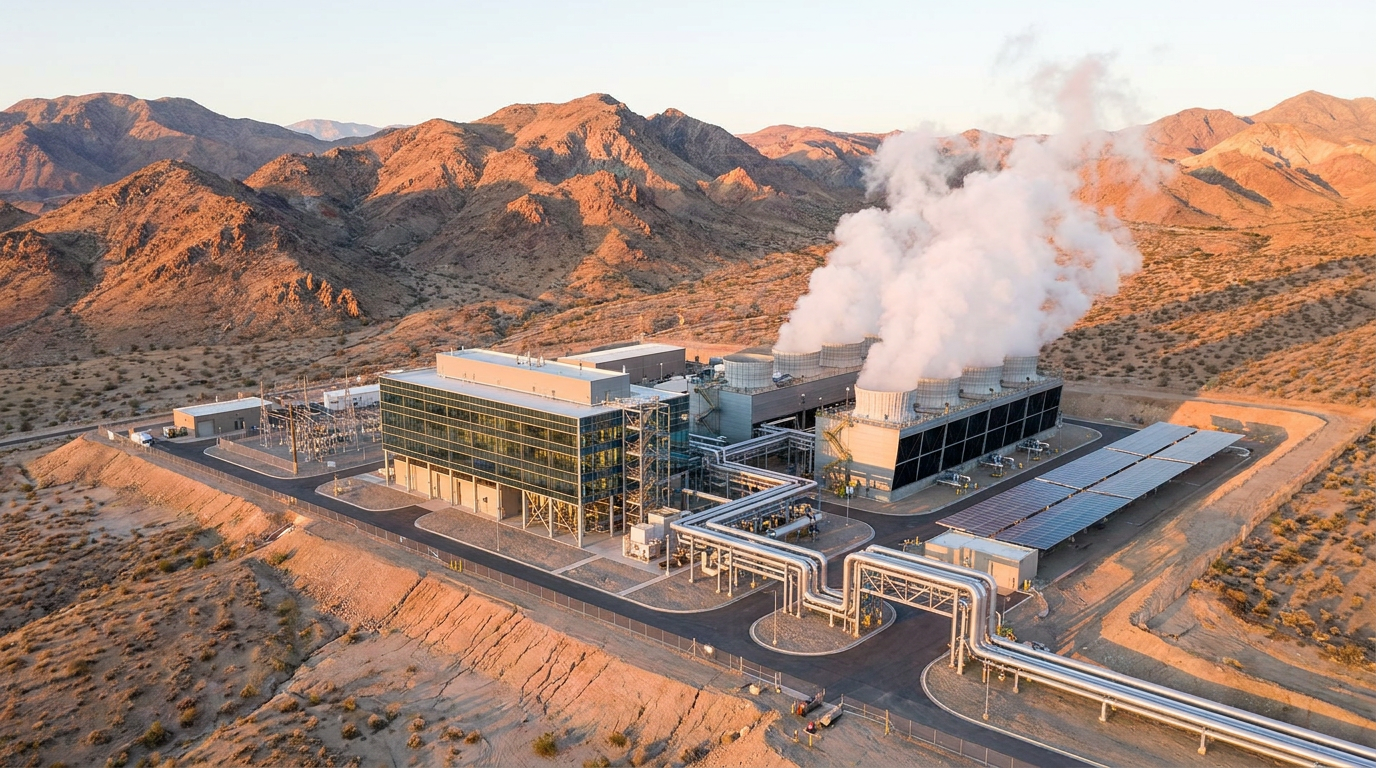
The turning point arrived with Fervo Energy's Project Red in Nevada, which recently became the longest-running EGS facility in the world. Operating as a commercial-scale testbed, Project Red validated the fundamental physics of EGS. It demonstrated that modern horizontal well architectures can deliver steady, predictable thermal output over sustained periods without the rapid thermal decline that doomed earlier projects.[1]
The turning point arrived with Fervo Energy's Project Red in Nevada, which recently became the longest-running EGS facility in the world.
The success of Project Red has triggered a massive influx of capital and commercial interest. In late 2025, Fervo Energy secured a $462 million Series E funding round backed by Google and Bill Gates' Breakthrough Energy Ventures. This capital is earmarked for Cape Station, a massive greenfield EGS development in Beaver County, Utah, signaling that the technology has officially crossed the chasm from pilot to deployment.[2]
Cape Station is not a research pilot; it is a grid-scale commercial deployment. The facility is expected to deliver 100 megawatts of carbon-free power to the grid in its first phase in 2026, with an expansion to 400 megawatts slated for 2028. The project has already secured permitting to scale up to a staggering 2 gigawatts, underscoring the massive footprint EGS could soon occupy in the American West.[2]

The U.S. Department of Energy (DOE) is actively accelerating this transition through its Utah FORGE field laboratory. At FORGE, researchers from institutions like Berkeley Lab and Sandia National Laboratories are testing cutting-edge drilling technologies. This includes polycrystalline diamond compact (PDC) drill bits that significantly improve drilling speed and durability in ultra-hard crystalline rock, driving down the single largest cost barrier for EGS.[4][7]
Patent filings confirm that the industry has crossed the rubicon from academic research to commercialization. A comprehensive analysis of intellectual property in the EGS sector reveals a massive spike in filings between 2019 and 2023. This culminated in recent patents covering commercial-scale horizontal well architectures and advanced fracture network monitoring, setting the stage for a highly competitive intellectual property landscape.[5]
While current EGS projects rely on water as the primary working fluid, the next frontier involves supercritical carbon dioxide (sCO2). Patent landscapes show a race to develop sCO2-based systems, which could mitigate the scaling and corrosion issues associated with water. Furthermore, using CO2 as a working fluid offers the tantalizing dual benefit of sequestering carbon permanently underground while generating power.[5]
Even more radical drilling technologies are on the horizon. Quaise Energy, a spinout from MIT, is developing a directed-energy drilling system derived from fusion reactor research. Instead of mechanically grinding rock, Quaise uses millimeter-wave energy to literally vaporize it. This approach could potentially reduce the cost of ultra-deep drilling by up to 90 percent, unlocking high-temperature geothermal energy anywhere on Earth.[6][8]

Despite the momentum, EGS faces genuine engineering and regulatory hurdles. The most prominent technical challenge is induced seismicity. Injecting fluid at high pressure to fracture deep rock inherently alters the subsurface stress state, which can trigger minor earthquakes if not meticulously managed. Modern projects rely on extensive fiber-optic seismic monitoring to ensure fractures propagate safely.[3][8]
Furthermore, the upfront capital expenditure for deep drilling remains astronomically high compared to traditional solar or wind installations. While the levelized cost of energy drops significantly once the plant is operational and running 24/7, EGS developers still rely heavily on clean energy mandates, federal subsidies, and premium power purchase agreements from tech giants willing to pay extra for firm power.[3]
Access to federal lands also presents a significant bottleneck. Because the most accessible high-heat rock formations in the United States are located in the West, scaling EGS will require streamlined permitting processes for drilling on public lands. This remains a complex legislative hurdle that Congress and federal agencies are only beginning to address.[3]
If these financial and regulatory challenges can be navigated, the payoff is paradigm-shifting. The DOE estimates that advanced geothermal systems could realistically supply 90 gigawatts of firm, clean electricity to the American grid by 2050. That is enough to power approximately 65 million homes, providing the elusive baseload stability required to fully decarbonize the global economy.[8]
How we got here
1970s
Los Alamos National Laboratory launches the first major EGS experiment at Fenton Hill, proving the concept but failing to achieve commercial flow rates.
2023
Fervo Energy completes a 30-day well test at Project Red in Nevada, proving the viability of horizontal drilling for EGS.
2024
Google signs the world's first corporate agreement to purchase EGS power for its data centers.
Dec 2025
Fervo Energy raises $462 million in Series E funding to scale its Cape Station project in Utah.
2026
Cape Station's first phase is scheduled to come online, delivering 100 MW of commercial EGS power to the grid.
Viewpoints in depth
Geothermal Developers' view
EGS is no longer a science experiment; it is a deployable commercial technology.
By adapting the horizontal drilling and hydraulic fracturing techniques perfected by the oil and gas industry, developers argue they have solved the fundamental permeability problem that held geothermal back for decades. They point to successful continuous operations at test sites as proof that EGS can provide the 24/7 baseload power the grid desperately needs, without the geographic constraints of traditional geothermal.
Corporate Offtakers' view
EGS is a critical strategic investment to secure 24/7 carbon-free energy.
For tech giants building massive AI data centers, intermittent solar and wind are insufficient. These companies require 'always-on' carbon-free energy to meet their climate pledges without compromising operational uptime. Consequently, they view EGS as a necessary pillar of the future grid, willing to pay a premium and inject hundreds of millions in venture capital to accelerate its commercial deployment.
Subsurface Researchers' view
Immense technical and safety challenges remain before EGS can scale globally.
While optimistic about the energy potential, geoscientists and federal researchers emphasize the engineering hurdles. Drilling miles into ultra-hard, 150°C+ crystalline rock destroys conventional equipment rapidly. Furthermore, they caution that injecting high-pressure fluids to fracture deep rock requires rigorous seismic monitoring to prevent induced earthquakes, necessitating ongoing federal support for field labs and advanced material research.
What we don't know
- Whether next-generation drilling technologies like millimeter-wave energy can successfully scale outside the laboratory.
- How quickly federal and state regulators will streamline permitting for deep drilling on public lands.
- The long-term thermal degradation rate of artificial reservoirs operating at gigawatt scales.
Key terms
- Enhanced Geothermal Systems (EGS)
- A technology that generates electricity by drilling into hot, dry rock and creating artificial fluid pathways to extract heat.
- Baseload Power
- The minimum amount of electric power needed to be supplied to the electrical grid at any given time, requiring energy sources that run 24/7.
- Hydro-shearing
- A technique used in EGS to open existing, natural fractures in deep rock by injecting fluid at high pressure.
- Supercritical CO2
- Carbon dioxide held at a temperature and pressure above its critical point, being researched as a highly efficient fluid for extracting geothermal heat.
- Induced Seismicity
- Minor earthquakes or tremors caused by human activity, such as injecting fluids deep underground.
Frequently asked
What is the difference between traditional geothermal and EGS?
Traditional geothermal relies on naturally occurring underground hot water reservoirs. EGS creates artificial reservoirs by drilling into dry, hot rock and injecting water to absorb the heat.
Does EGS use fracking?
Yes, EGS uses a modified form of hydraulic fracturing (often called hydro-shearing) to create tiny cracks in deep rock, allowing water to circulate and absorb heat.
Can EGS cause earthquakes?
Injecting high-pressure fluid into the earth can alter subsurface stress and trigger minor induced seismicity. Projects use extensive seismic monitoring to manage and mitigate this risk.
Why are tech companies investing in geothermal?
Tech companies need massive amounts of electricity for AI data centers. EGS provides 24/7 clean, baseload power, unlike wind and solar which only generate electricity when the weather permits.
Sources
Source coverage
8 outlets
4 viewpoints surfaced








[1]Fervo EnergyGeothermal Developers
A testbed for EGS technology trials
Read on Fervo Energy →[2]ESG TodayCorporate Offtakers
Google, Bill Gates' Breakthrough Energy Back $462 Million Fundraise for Geothermal Developer Fervo Energy
Read on ESG Today →[3]Information Technology and Innovation FoundationEnergy Policy Analysts
Enhanced Geothermal Systems in Action
Read on Information Technology and Innovation Foundation →[4]U.S. Department of EnergySubsurface Researchers
Utah FORGE: Advancing Enhanced Geothermal Systems
Read on U.S. Department of Energy →[5]PatSnap InsightsEnergy Policy Analysts
EGS Reaches Its Commercial Inflection Point
Read on PatSnap Insights →[6]Quaise EnergyGeothermal Developers
Millimeter Wave Drilling for Deep Geothermal
Read on Quaise Energy →[7]Berkeley LabSubsurface Researchers
Digging Deep: How Berkeley Lab Advances Subsurface Research
Read on Berkeley Lab →[8]Factlen Editorial Team
Synthesis by Factlen editorial team
Read on Factlen Editorial Team →


Every angle. Every day.
Get guides stories with full source coverage and perspective breakdowns delivered to your inbox.