
How Decentralized Social Media and the Fediverse Are Rewiring the Internet
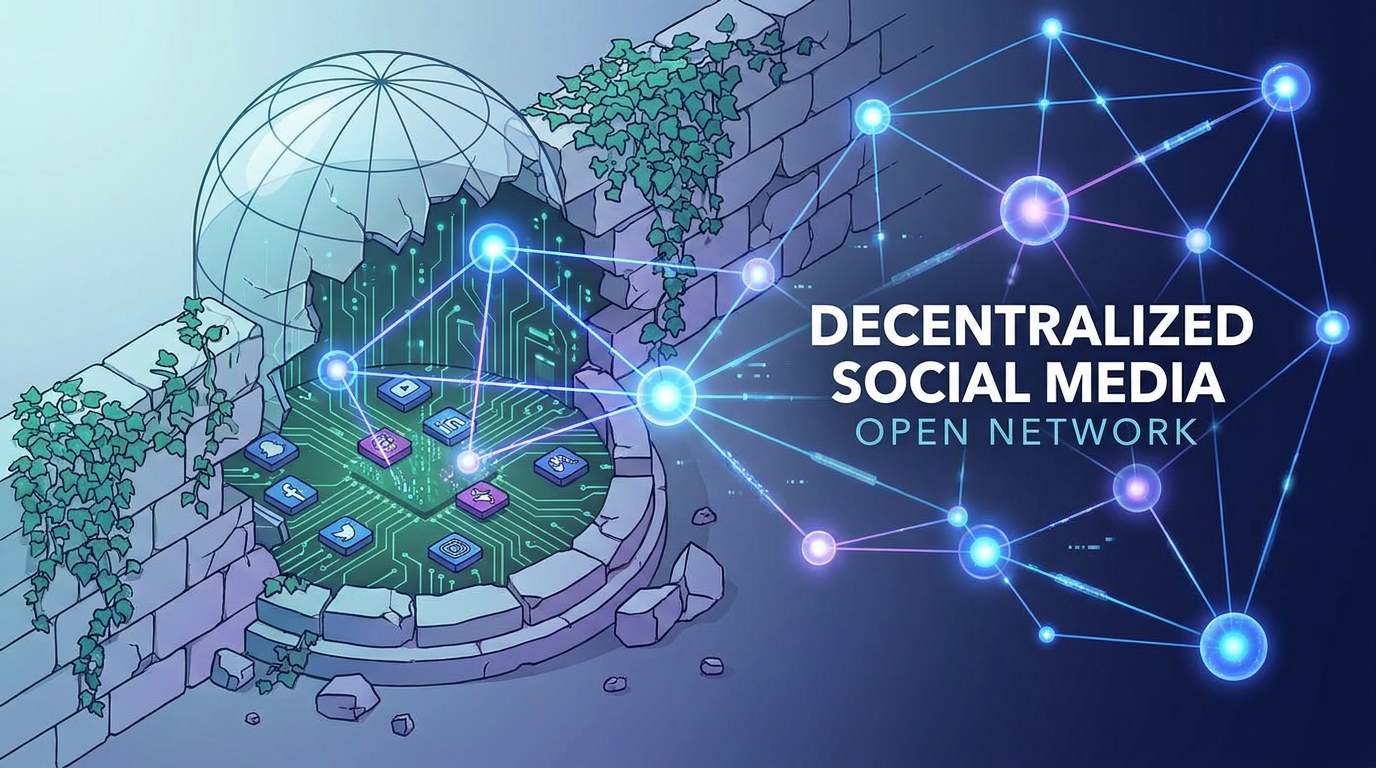
Open protocols like ActivityPub and the AT Protocol are breaking down the walled gardens of social media, giving users unprecedented control over their data, algorithms, and privacy.
By Factlen Editorial Team

- Open-Web Advocates
- Prioritize absolute privacy, community ownership, and freedom from corporate advertising.
- Protocol Developers
- Focus on building scalable, interoperable architecture that separates data from interfaces.
- Mainstream Integrators
- Aim to bring decentralized features to massive, existing user bases without sacrificing convenience.
What's not represented
- · Traditional advertisers navigating the lack of targeted ad infrastructure
- · Regulators monitoring data privacy across international server boundaries
Why this matters
For the first time in a decade, users are gaining the ability to own their digital identities and choose their own algorithms, reducing the power of centralized tech giants to dictate what we see online.
Key points
- Decentralized social media distributes control across independent servers rather than a single corporation.
- The 'Fediverse' allows users on different platforms to interact seamlessly, much like email.
- Meta's Threads has brought the ActivityPub protocol to over 400 million monthly active users.
- Bluesky's AT Protocol reached 40 million users, offering true account portability and custom algorithms.
- Open protocols provide researchers and journalists with transparent data access without exorbitant API fees.
For over a decade, the architecture of social media has been defined by the "walled garden." Platforms locked users into closed ecosystems, dictating the algorithms that sorted their feeds, the rules that governed their speech, and the advertisements that monetized their attention. If a user wanted to leave, they had to abandon the audience and connections they had spent years building. But in 2026, a fundamental architectural shift is reaching critical mass, rewiring how the internet connects.[1]
At the center of this shift is decentralized social media, a model designed to return control to users rather than corporations. Instead of a single company hosting all the data on proprietary servers, decentralized networks distribute ownership and infrastructure across independent systems. The most prominent manifestation of this is the "Fediverse"—a portmanteau of federation and universe.[1][2]
To understand how the Fediverse works, the most accurate analogy is email. A person using a Gmail account can seamlessly send a message to a friend using an Outlook account, even though they are operated by entirely different companies. The Fediverse applies this exact principle to social media profiles, timelines, and followers, allowing disparate platforms to talk to one another.[2]
This interoperability is powered by open protocols, primarily ActivityPub, which has become the W3C standard for decentralized social networking. ActivityPub acts as the universal translator between different servers, or "instances." It allows a user on a photo-sharing app to follow and interact with a user on a text-based microblogging site, breaking down the artificial barriers between apps.[2][4]

The biggest catalyst for ActivityPub's mainstream moment has been Meta's Threads. By early 2026, Threads crossed 400 million monthly active users, achieving a scale rarely seen past a platform's launch year. Crucially, Meta has steadily rolled out opt-in ActivityPub integration, allowing Threads users to syndicate their posts to the broader Fediverse and interact with independent servers.[3]
This integration represents a watershed moment. It proves that decentralized protocols can operate at a massive, commercial scale. Brands and creators who established an early presence on Threads are now finding that their reach extends beyond Meta's ecosystem, tapping into a wider network of privacy-conscious users who prefer to stay off mainstream corporate platforms.[3]
Meanwhile, Mastodon, the pioneer of the modern Fediverse, has stabilized as the definitive privacy-first alternative. Operating entirely without venture capital or advertising, Mastodon boasts between 10 and 15 million registered accounts across thousands of independent servers. Its nonprofit governance model ensures that the platform remains community-first, insulated from the shifting priorities of billionaire owners or corporate boards.[4]
Meanwhile, Mastodon, the pioneer of the modern Fediverse, has stabilized as the definitive privacy-first alternative.
Parallel to the ActivityPub ecosystem is the AT Protocol, the engine powering Bluesky. Bluesky crossed 40 million users in early 2026, driven by an architecture that explicitly separates the "speech" layer from the "reach" layer. On the AT Protocol, the base layer acts as a common space for speech, while indexing services and custom algorithms sit on top to determine how that speech is distributed.[5][6]

The defining feature of the AT Protocol is true account portability. Users own their data through cryptographically signed repositories. If a user dislikes the moderation policies or performance of their current server, they can migrate their entire account—including their handle, posts, and followers—to a new provider without needing the original server's permission.[5]
Furthermore, Bluesky has pioneered "composable moderation." Instead of a single trust-and-safety team enforcing universal rules, users can subscribe to custom moderation filters and algorithmic feeds. One user might choose a chronological feed with strict family-friendly filters, while another opts for a chronological feed of academic research with minimal content blocking. The power of choice is pushed to the edges of the network.[5]
The protocol is also evolving to handle more complex social interactions. In the spring of 2026, the Bluesky protocol team announced a major focus on "Permissioned Data." This initiative aims to bring truly private state and secure direct messaging to the open protocol, addressing one of the longest-standing limitations of decentralized networks: the difficulty of handling non-public data securely.[5]
The implications of this open-data architecture extend far beyond everyday users. Academic researchers, journalists, and developers have flocked to decentralized platforms. When legacy platforms locked down their APIs and began charging exorbitant enterprise fees, the research community lost vital visibility into how information spreads online.[6]

Because the AT Protocol treats public data as genuinely public, researchers can query the network without navigating restrictive developer tiers or paying thousands of dollars a month. This openness is fostering a new wave of transparency tools, sentiment analysis models, and academic studies on digital community dynamics.[6]
However, the decentralized web still faces significant hurdles, chief among them being financial sustainability. Running servers, moderating content, and managing storage growth requires capital. While Mastodon relies heavily on community donations and managed hosting services to keep its instances afloat, larger networks are exploring new economic models.[2][4]
Bluesky, for instance, is rolling out premium subscriptions to support its infrastructure, aiming to create a sustainable business model that doesn't rely on invasive targeted advertising. The goal is to allow creators and developers to build profitable businesses on top of the protocol without compromising user privacy.[5]
Despite these growing pains, the trajectory of social media in 2026 is unmistakable. The era of being locked into a single corporate feed is ending. By redistributing power away from centralized authorities and toward users, decentralized protocols are building a healthier, more resilient, and fundamentally open internet.[1][2]
How we got here
Late 2022
Twitter's ownership change triggers the first massive wave of user migration to Mastodon.
July 2023
Meta launches Threads, promising future integration with the open ActivityPub protocol.
Early 2024
Bluesky opens its network to the public, moving out of its invite-only beta phase.
Mid 2024
Threads begins rolling out opt-in ActivityPub federation for its users.
Early 2026
Threads crosses 400 million users, while Bluesky surpasses 40 million, cementing the decentralized shift.
Viewpoints in depth
Open-Web Advocates
Prioritize absolute privacy, community ownership, and freedom from corporate advertising.
This camp, heavily represented by the Mastodon community, views decentralization as a moral imperative to escape surveillance capitalism. They argue that social media should be treated as a public utility rather than a profit center. For these advocates, the lack of algorithmic feeds and advertising is not a missing feature, but the primary draw. They emphasize the importance of community-run servers where local moderators set the rules, ensuring that no single billionaire or board of directors can dictate global speech policies.
Protocol Developers
Focus on building scalable, interoperable architecture that separates data from interfaces.
Engineers and architects behind systems like the AT Protocol believe the solution to social media's woes is structural. They argue that users should own their social graph (their followers and connections) in a portable format, much like owning a domain name. By separating the underlying data from the user interface, they envision an ecosystem where hundreds of different apps can read the same network, forcing companies to compete on user experience and custom algorithms rather than relying on data lock-in.
Mainstream Integrators
Aim to bring decentralized features to massive, existing user bases without sacrificing convenience.
Represented by platforms like Meta's Threads, this perspective argues that the average user will not adopt decentralized tech if it requires managing server instances or cryptographic keys. They believe the path forward is to build highly polished, centralized apps that quietly support open protocols under the hood. By offering opt-in federation, they aim to bridge the gap between the convenience of traditional social media and the interoperability of the open web.
What we don't know
- How smaller, community-run servers will financially sustain themselves as storage and moderation costs scale.
- Whether the ActivityPub and AT Protocol ecosystems will eventually bridge, or remain parallel decentralized networks.
- How effectively decentralized networks will handle coordinated spam and abuse without a centralized trust-and-safety team.
Key terms
- Fediverse
- A network of interconnected, independent social media servers that can communicate with each other using shared protocols.
- ActivityPub
- The open, W3C-standardized protocol that powers Mastodon and Threads, allowing different platforms to federate.
- AT Protocol
- The open-source framework built by Bluesky that emphasizes account portability and composable moderation.
- Instance
- An independent server within a decentralized network, often managed by a specific community with its own moderation rules.
- Account Portability
- The ability for a user to move their profile, data, and followers from one server to another without losing their audience.
Frequently asked
Do I have to pay to use decentralized social media?
No. Most platforms, including Mastodon, Bluesky, and Threads, are free to use. Some independent servers accept community donations to cover hosting costs.
Can I move my followers if I change platforms?
Yes, on networks built for portability. The AT Protocol (Bluesky) allows you to migrate your entire account and followers to a new server seamlessly.
Are Threads and Mastodon connected?
Yes. Threads uses the ActivityPub protocol, meaning users can opt-in to have their posts visible to users on Mastodon and other federated platforms.
Who moderates content on the Fediverse?
Moderation is handled at the server level. Each instance sets its own rules, and users can choose to join communities that align with their preferred content guidelines.
Sources
Source coverage
6 outlets
3 viewpoints surfaced






[1]Factlen Editorial Team
Synthesis by Factlen editorial team
Read on Factlen Editorial Team →[2]ElestioOpen-Web Advocates
The Fediverse Is Growing: Why Decentralized Social Media Matters in 2026
Read on Elestio →[3]PostEverywhereMainstream Integrators
8 Threads Trends as It Hits 400M Users (2026)
Read on PostEverywhere →[4]FediviewOpen-Web Advocates
The Fediverse in Numbers: Latest Stats on Mastodon and Decentralized Social Media (2026)
Read on Fediview →[5]Bluesky Protocol TeamProtocol Developers
AT Protocol Roadmap (Spring 2026)
Read on Bluesky Protocol Team →[6]ApifyProtocol Developers
How to Use the Bluesky Scraper: AT Protocol Data for Social Media Analysis
Read on Apify →

More in technology
See all 5 stories →

Every angle. Every day.
Get technology stories with full source coverage and perspective breakdowns delivered to your inbox.